


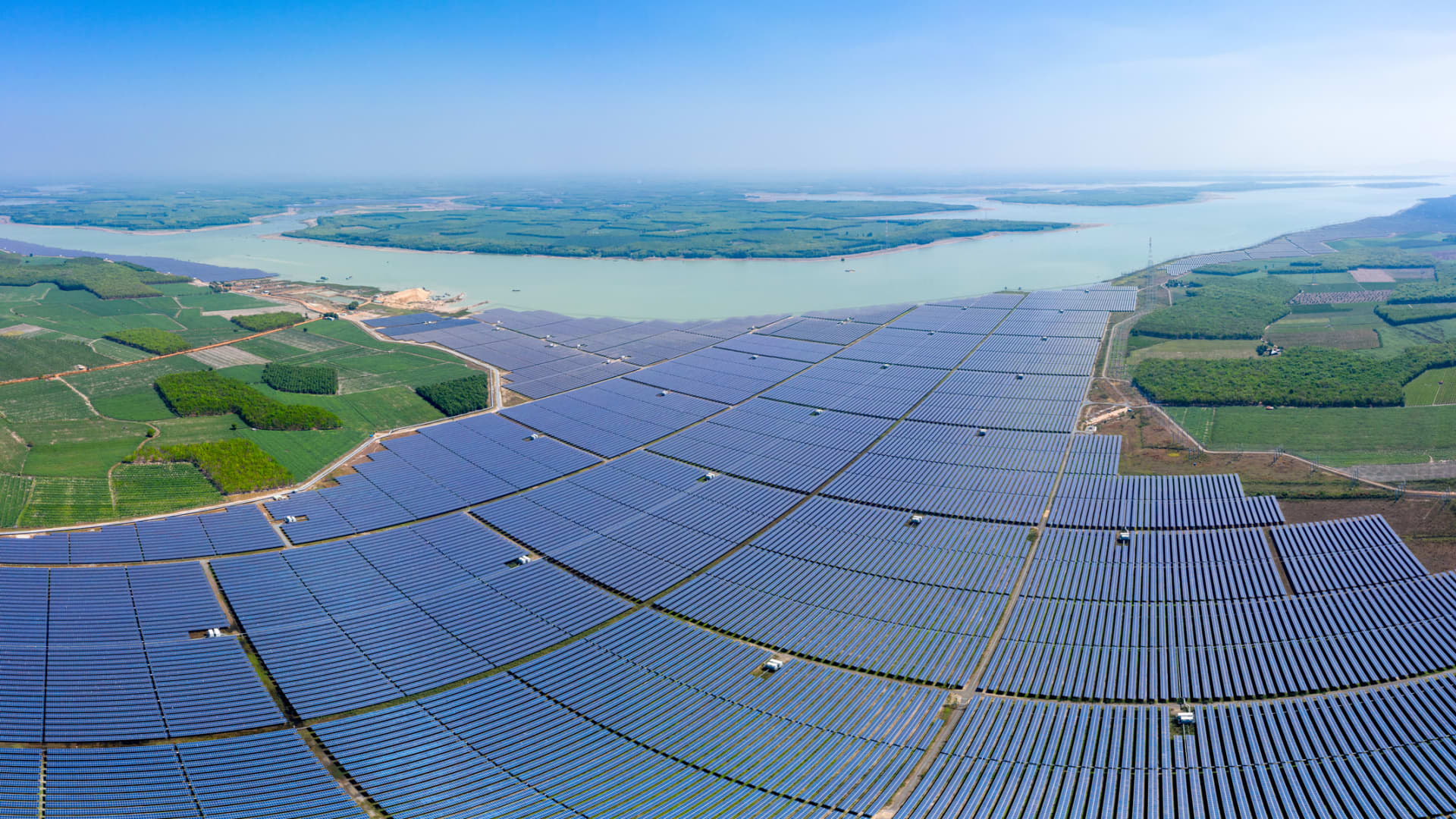
A solar power plant in Tay Ninh province, Vietnam. The Central Bank of Singapore is supporting bioenergy and solar power projects in Southeast Asia through its Green Investment Partnership.
Tan Dao Dui | Moment | Getty Images
The Asian Development Bank’s $70 billion plan to support new energy and digital infrastructure in the region will be the biggest boost to Southeast Asia.
The program includes the Pan-Asia Grid Initiative to connect national and sub-regional power systems and the Asia-Pacific Digital Highway to bridge the region’s infrastructure gap, according to ADB, which has set a 2035 deadline for funding projects.
“Energy and digital access will define the region’s future,” ADB President Masato Kanda said in a statement on Sunday.
This connectivity will create the systems needed for the Asia-Pacific region to grow, compete and connect, Kanda said. “By connecting power grids and digital networks across borders, we can reduce costs, expand opportunities, and provide reliable power and digital access to hundreds of millions of people.”
Although the funding is aimed at the entire Asia-Pacific region, experts say Southeast Asia is expected to be the main beneficiary of ADB’s connectivity drive.
Greg Statton, vice president and chief technology officer for Asia Pacific and Japan at AI-powered data security company Cohesity, said the bank typically leans toward developing member countries based on growth needs, project readiness and mission, beyond market size.
Statton noted that unlike Southeast Asia, China has introduced its own financial institutions and policies and has largely moved away from ADB lending. Although India continues to receive large amounts of funding from ADB, it has strong access to capital markets, operates many domestically funded projects, and Japan itself is a major funder of ADB.
“Large economies such as China, India and Japan already have more established domestic capital markets, deeper infrastructure financing channels and greater financial capacity to finance large-scale projects domestically,” said Chasen Nevett, managing partner of principal investments at GMA Capital Partners, adding that Southeast Asia remains structurally underdeveloped in both energy interconnection and digital infrastructure.
“This combination creates a more efficient deployment environment for capital, where every dollar can unlock broader private sector participation and accelerate regional integration,” Nevett said.
power play
Indonesia, Vietnam and the Philippines are expected to be the biggest beneficiaries within Southeast Asia.
These countries are expected to receive a larger share of the $70 billion in funding based on ADB’s historical lending patterns and current priorities, including their population size, infrastructure needs, and active project pipelines, Statton said.
Malaysia and Thailand could also benefit given that they are regional hubs for energy and data infrastructure, but the relative marginal impact of capital may be somewhat lower due to their more developed base in Southeast Asia, Nevett said.
Malaysia has the largest data center project pipeline in Southeast Asia, accounting for about 60% of all proposed projects in the region, and is expected to lead Southeast Asia’s data center load demand by 2035, along with Thailand, according to Wood Mackenzie.
Scott Dunn, head of Asia strategy and growth at infrastructure consultancy AECOM, said ADB funding also provides an opportunity to build interoperable transmission systems that can flow clean electricity across borders, improving reliability and reducing costs.
Markets such as Laos, Thailand, Vietnam, and Cambodia have abundant hydropower and rapidly expanding solar and wind power, but lack cross-border capacity to transport clean power to the areas of greatest demand, Dang said, adding that ADB’s plan is “effectively designed for these conditions.”
By 2035, ADB aims to integrate nearly 20 gigawatts of renewable energy across borders and connect 22,000 circuit kilometers of transmission lines.
Make CNBC your preferred source on Google and never miss a moment from the most trusted names in business news.
Source link
