


While the US has been largely successful in imposing its security doctrine on vassal states in Latin America, it cannot replace the trade or investment it seeks to destroy.
As the US tries to reassert its dominance over the Western Hemisphere, one of its core objectives is to reduce China’s economic footprint in the region. The Western Hemisphere section of the Trump administration’s 2025 National Security Strategy may not mention China by name, but it doesn’t need to. Everyone knows who the authors are referring to in the section’s first paragraph:
“We will deny non-Hemispheric competitors the ability to position forces or other threatening capabilities, or to own or control strategically vital assets, in our Hemisphere.”
The final paragraph of the section states the objective in even starker terms:
“We should make every effort to push out foreign companies that build infrastructure in the region.”
No country has invested more in infrastructure in Latin America over the past two decades than China. According to the Wall Street Journal, the Asian giant has poured over $300 billion into infrastructure projects of all shapes and sizes, from hydraulic dams and power plants to railroad lines, electricity grids, football stadiums and the recently opened deep sea port in Chancay, Peru.
The US’s goal of pushing out Chinese companies from Latin America has so far met with mixed success. Washington has ramped up pressure on Chinese-linked projects and assets throughout the region — most notably targeting Venezuela’s oil sector, Panama’s port and canal control, and trade infrastructure tied to China’s Belt and Road Initiative (BRI).
When Panama’s government formally withdrew from China’s Belt and Road initiative and the US was able to take full control of Venezuela’s oil sector , it seemed that the US’s revamped plans for regional hegemony would meet limited resistance. However, China has shown in recent months that it is not willing to relinquish its position in Latin America without at least putting up a fight.
The recent reelection of Luiz Inacio Lula da Silva as president of Brazil represented a major setback for US plans. Japan Times even suggested, perhaps a little prematurely, that Lula’s victory had “killed the Donroe Doctine”. Lula’s victory was certainly a source of relief for Beijing, given Flavio Bolsonaro’s promises to bring Brazil closer to the US as well as perhaps even reconsider Brazil’s membership of the BRICS alliance.
The US’ Donroe Doctrine suffered another setback at the tail end of last week, when Santiago Peña resigned as president of Paraguay after being implicated in the collapse of Ueno Bank, one of the country’s largest lenders. Peña, who came to power in 2023, was one of the US’s staunchest allies in South America, having pledged full support to President Trump’s Shield of the Americas initiative.
Peña’s fall from grace has also tarnished Paraguay’s reputation as a beacon of neoliberal economic policies that has inspired governments across the region. Argentine President Javier Milei described Paraguay as an “example of what needs to be done in economic matters” for the whole of South America.
Now, it is Milei’s turn to worry about the potential contagion effects of Ueno’s collapse on Argentina’s fragile banking sector. The question is: what happens if the country needs another bailout? This being Argentina, such a risk cannot be ruled out, especially as global financial conditions deteriorate. Will the Trump administration try to rush through an emergency bailout before the Democrats take over both houses of Congress?
This highlights an interesting point raised by the Japan Times piece on the limits of US power, even in its own “backyard”. While the US has been largely successful in imposing its security doctrine on vassal states in the region since Trump’s return to power — according to the New York Times, the Pentagon is even pushing for a permanent US troop presence in Venezuela — the weakest link of the US’ revamped Monroe Doctrine is in the economic domain:
For all the bonhomie among right-wingers, the north and south of the hemisphere have drifted apart economically. The rhetoric about inter-American security masks the broader reality: Since 2000, China, not the U.S., has become Latin America’s preferred export market. China now buys roughly 28% of Latin America’s exports, far surpassing the U.S.’ 16% share, which has shrunk substantially.
This fact was reinforced by the announcement last week that Peru and China had commemorated the 55th anniversary of the establishment of diplomatic relations between the two countries with the entry into force of the Protocol for the Optimization of the Free Trade Agreement (FTA) signed in 2010. Put into simple language, China and Peru are upgrading their already very strong trade relations. From Spain’s news agency EFE (machine translated):
In the academic meeting dedicated to examining the progress and challenges of the bilateral relationship, the Deputy Minister of Foreign Affairs, Eric Anderson, recalled that Peru was one of the first Latin American countries to establish diplomatic relations with the People’s Republic of China, on November 2, 1971.
Anderson reaffirmed the willingness to continue strengthening bilateral ties on the basis of the one-China principle, mutual respect and trust.
Peru and China have maintained a Comprehensive Strategic Partnership since 2013, and China is currently the country’s main trading partner.
Within the framework of the Joint Action Plan 2024-2029, the bilateral agenda includes the strengthening of trade and investment, as well as cooperation in science, technology, education and culture, the Peruvian Foreign Ministry said.
Since becoming president in late July, Keiko Fujimori, daughter of the former dictator, Alberto Fujimori, has tried to strike a balance between US security demands against Peru’s deep economic dependence on China, its largest trade partner. As Bloomberg reported shortly after her election, Fujimori is rejecting an “automatic alignment with any power” and defending a “strategically balanced” position between China and the US.
In other words, Peru “is going to be pragmatic,” said Luis Miguel Castilla, former Peruvian ambassador to Washington and former economy minister. “That’s been part of our foreign policy for a long time.”
As the Bloomberg article noted, the fact that a leader with such strong personal ties to the US — Keiko Fujimori received her university education in the US (a BA in business administration from Boston University and an MBA from Columbia) and was also quick to join Trump’s Shield of the Americas initiative — would take such a balanced position reflects the limits of Trump’s attempt to displace China from Latin America.
This is particularly true for the countries south of Colombia, where Beijing’s economic influence is greatest. As we have noted in previous posts, Peru is already Latin America’s most Chinese country
China is Peru’s largest trading partner on both the exports and imports side. A whopping 38% of Peru’s exports go to China, compared with just 13% to the US. In the first four months of this year, the total value of Peru’s exports to China grew by 43% while those to the US grew by 27%.
Unlike most countries in the region, Peru has a large trade surplus with China, compared to a large trade deficit with the US. It is also the second largest destination for Chinese investment in Latin America, behind only Brazil as well as one of just five countries in the region to have signed free trade agreements (FTAs) with China, along with Chile, Costa Rica, Ecuador and Nicaragua. Now, that FTA has been upgraded.
Interestingly, Peru’s relations with China have continued to strengthen even as an endless succession of governments has passed through the Palacio Nacional. It was former president (and the world’s most unpopular democratic leader), Dina Boluarte, who virtually inaugurated the $1.3 billion phase-one Port of Chancay alongside Chinese President Xi Jinping during the 2024 APEC summit in Lima, Peru.
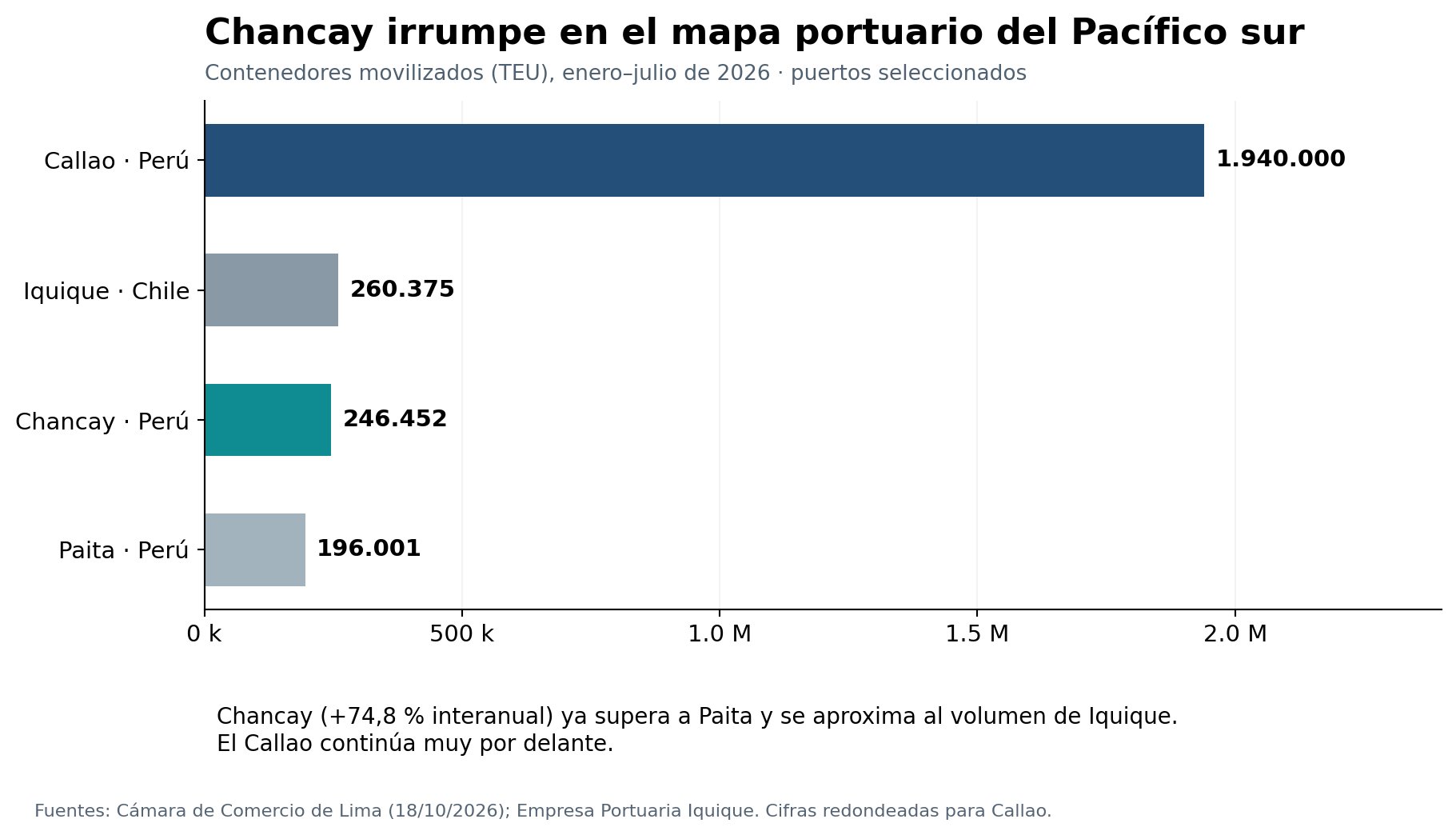
Since that inauguration, Chancay has gradually expanded its operations. According to Descifrando la Guerra, Chancay handled 246,452 containers (TEUs) between January 1 and June 30 2026, 75% more than during the same period of 2025. This growth has allowed it to surpass the Peruvian port of Paita and approach the volume of Iquique, one of the main ports in northern Chile. However, Callao continues to dominate Peru’s container traffic.
The Chancay port, coupled with the proposed interoceanic rail corridor connecting Brazil’s Atlantic seaboard with Peru’s Pacific coastline, is one of China’s most ambitious projects in the Americas. It is also arguably the one most hated by US officials, since the two projects have the potential to reconfigure supply routes in the Americas. The US’ main response has been to pledge funding for defence and logistics enhancements around Callao.
In February, the State Department’s Bureau of Western Hemisphere Affairs voiced concerns about “reports indicating that Peru may be unable to oversee Chancay, one of its most important ports, [which is] under the jurisdiction of predatory Chinese owners.”
The U.S. ambassador to Peru, Bernie Navarro, a close associate of US Secretary of State Marco Rubio and one of his principal fundraisers, joined the scrum on X by pontificating on the vital importance of national sovereignty (oh, the irony):
“Everything has a price, and… long run cheap is expensive. There is no higher price than losing sovereignty.”
The hope in Washington is that Peru’s constitutional tribunal will intervene in proceedings by ruling that the Peruvian state should oversee operations at Chancay, the country’s only port that is designed to handle ultra-large container vessels, and not the Chinese state-owned company COSCO. There’s a lot riding on that decision, notes Americas Quarterly:
Given the geopolitical risks of appearing to surrender regulatory control to a foreign entity, a ruling restoring state oversight remains the most likely outcome. If so, Peru would gain a statutory mechanism to inspect facilities and cargo, enforce customs, or impose dual-use bans. This could satisfy some U.S. concerns without outright taking over the ports, while still triggering regulatory friction and additional legal challenges with COSCO.
If the Constitutional Tribunal rules against state oversight, Peru will effectively cement COSCO’s operational autonomy over the Pacific port, severely straining relations with Washington and heightening fears that Peru has lost sovereign control over critical national infrastructure.
The Reversibility of Chancay
As Panama’s takeover of the Balboa and Cristobal ports shows, these decisions carry significant consequences, especially when dealing with an assertive superpower like China.* Thus, replicating the Panama blueprint in Chancay, undoing a multibillion-dollar investment, this time one directly undertaken by a Chinese state-owned company, would carry far higher economic, diplomatic, and strategic costs for Peru than revoking the port concessions did for Panama…
China’s leverage over Peru — which some would even call strategic dependence — means applying the Panama playbook would face much heavier economic friction and is thus unlikely. China has consolidated its regional logistics network in Chancay and intends to keep it that way.
If, as Urban C Lehner notes in a February article published in Asia Times, Peru was forced to choose between China, which is so critical to its economy, and the US, which would it choose? And how would the US respond?
If Peru chose China, would we send in the Marines?
The NSS section proposes readjusting America’s global military presence to “address urgent threats in our Hemisphere.” It is silent on whether ports like Chancay represent an urgent threat.
What they’re wondering in Beijing is how much of the Donroe Doctrine is just rhetoric. Denying China the use of a port it has built or forcing a Latin American country to evict Chinese companies would likely require a riskier military move than taking out Maduro…
Officials in Beijing are undoubtedly trying to calculate just how far the US might go in ridding the Western Hemisphere of Chinese influence – and what they can do about it.
Beijing can probably rest assured that it is so embedded in Latin America trade, commodity markets, infrastructure and financial relationships that its presence cannot simply be pushed offshore by US threats and bluster. There is no better illustration of this fact than Javier Milei’s ongoing insistence that Argentina’s growing trade partnership with China has no bearing on Argentina’s relationship with the US.
“Why are we not going to be able to trade if the United States itself trades with China and in fact it is one of our most important trading partners?”, Milei said at a forum organised in Madrid by Nueva Economía Fórum. Even Milei, one of the US’ most fawning vassals who on the campaign trail referred to the Chinese government as “assassins”, is pragmatic enough to realise that Argentina needs China’s credit and custom more than ever.
As the geopolitical analyst Angelo Guiliano notes in the tweet below, ideology does not print dollars. Even governments closely aligned to the US in Latin America, like Milei’s Argentina and Fujimori’s Peru, are acutely aware that the US has neither the intention nor the means of replacing the Chinese trade and investment it seeks to destroy in the region:
* When Panama’s Supreme Court, under intense US pressure, ruled unconstitutional the concessions held by Hong Kong-based CK Hutchison Holdings to operate two ports at the entrances of the Panama Canal, Beijing responded by increasing its detentions of Panama-flagged vessels in Chinese ports. China’s COSCO Shipping suspended its operations at Panama’s Balboa port while CK Hutchison initiated arbitration proceedings against Panama.
As the AQ piece notes, through these actions “China was not only punishing Panama; it was also engaging in geopolitical signaling, not directed at the U.S., but at countries like Peru, whose importance to Beijing’s position in Latin America has increased significantly.”
