


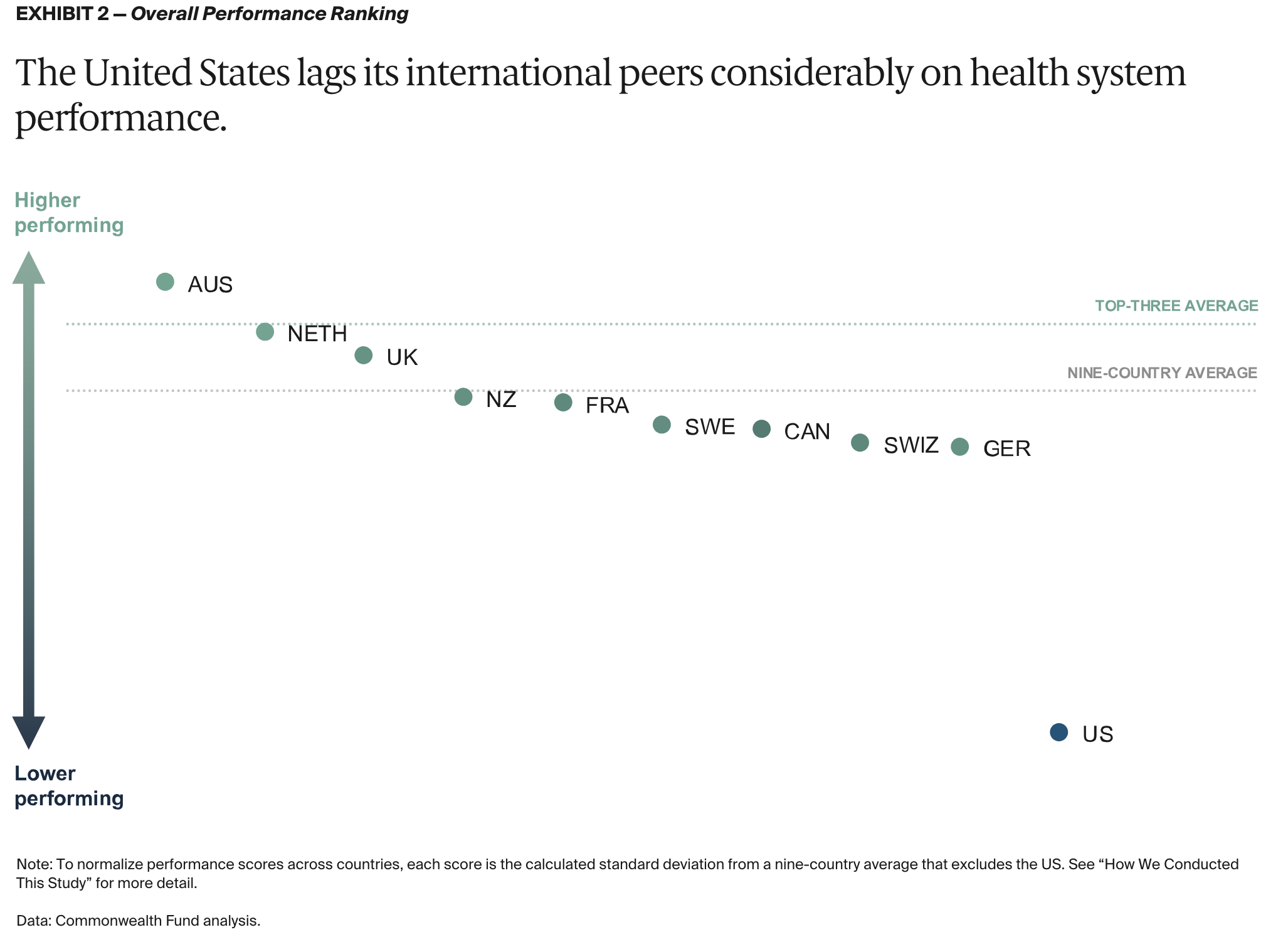
Yves here. We’re taking the unusual step of featuring two syndicated posts in one here because they help illuminate a large and growing problem. The US has been falling behind on a relative basis on important measures of population-level health, from height to life expectancy to food security. Diet, exercise, enough control over one’s life so as to have only manageable stress, clean water and air, and adequate housing are all important to health. However, so to is health care (as opposed to “access to health care”). International comparisons of the performance of the US health system repeatedly highlight its outsized cost levels versus its poor performance on many key measures. This Commonwealth Fund chart based on 2024 data says it all:
The US does score well in many comparisons on preventive care, even though that in practice includes overtesing and overtreatment.
But the response to continued health care system rentierism is not to beat it back but to accommodate it, by jacking up insurance costs on employee health plans while also cutting coverage and by restricting public funding, starting with the poor. The Orwellianly-labeled Big Beautiful Bill mandated Medicaid cuts. From What Medicaid Cuts Mean for Older Adults and People With Disabilities:
With the passage of HR 1, Congress is cutting around $1 trillion from Medicaid over the course of the next 10 years. The cuts will affect Medicaid at every level, restricting eligibility and enrollment, driving up the cost of covered services for beneficiaries and states, and damaging the health care system nationwide.
These cuts harm the people who rely on the program, including millions of older adults and people with disabilities who are dually eligible for Medicare and Medicaid, as well as people nearing Medicare eligibility who have coverage through expansion Medicaid.
The cuts take three forms: direct cuts to eligibility, red tape that hampers access to care or coverage, and loss of benefits due to state cutbacks.
While the following posts give a sense of some of the immediate effects, these cuts intensify an ongoing public health crisis. Americans broadly have few to no sick days. Even highly paid workers face pressure to keep soldiering on less they be seen as not a team player, worse a malingerer, and lose out to hard-charging competitors. So further cut to health care “access” among the poor and low income, who are often essential workers or in public-jobs means more sickness, including un- or late-treated infectious diseases. For instance, IM Doc has been warning for some time of drug-resistant tuberculosis among patients he sees, such as restaurant employees and sex workers.
So this level of callousness is not just cruel. It ultimately endangers even the privileged who still seem intent on preserving their advantaged position, irrespective of the cost.
First to New York City hospitals getting ready to assume the brace position as a result of Medicaid cuts. Second is a sighting from KFF Health News on the lengths some uninsured will go to obtain care.
First from The City Reporter, in NYC Public Hospital Leaders Warn of ‘Crisis’ from Federal Medicaid Restriction.
By Trenton Daniel, a reporter covering public health in New York for Healthbeat. Originally published at Healthbeat
Leaders from New York City’s public hospital system anticipate a crisis of coverage as federal healthcare policies force hundreds of thousands residents to lose their Medicaid plans.
Drs. Ted Long and Jonathan Jiménez of NYC Health + Hospitals offered a preview this week at a City Council oversight hearing of the turbulence the NYC Care program could see as Medicaid work requirements take effect Jan. 1. Overseen by NYC Health + Hospitals, the nation’s largest public healthcare system, NYC Care is a healthcare program for low-income New Yorkers and will assume the role of last resort for residents who lose their Medicaid or insurance coverage.
“This will be a crisis,” Long, senior vice president and chief medical officer for clinical services and population health at Health + Hospitals, said at Wednesday’s hearing. “We’re going to move heaven and earth to do as much preparation as we can.”
New York City public hospital leaders say they are increasing staffing for NYC Care, ramping up outreach, and connecting with influencers to prepare for an influx of patients because of federal health policy changes. Health + Hospitals officials declined to say more about the influencers, including if they are being compensated.
Former Mayor Bill de Blasio launched NYC Care in the Bronx in 2019, and it later expanded to all five boroughs. It guarantees low-cost and no-cost services to New Yorkers who do not qualify or cannot afford health insurance based on federal guidelines, which includes undocumented immigrants who are excluded from Medicaid and other public programs. The aim of NYC Care is to connect uninsured New Yorkers to a primary care physician before their health worsens and they end up in the emergency department.
NYC Care members pay on a sliding scale, and there are no premiums, deductibles, or co-pays. More than 90% of enrollees receive an appointment with a primary care provider at one of the Health + Hospitals locations within two weeks of enrollment, Long said.
After primary care, speciality services include cardiology, rheumatology, orthopedics, podiatry, mental health and substance abuse services.
NYC Care enrollment peaked at more than 143,000 in 2024, but enrollment numbers have since dropped. As of Oct. 23, enrollment stood at 125,766, Long said Wednesday.
Long and others at NYC Care attribute the overall drop to aging participants switching to Medicaid. The latest Mayor’s Management Report said Health + Hospitals had heard anecdotally that local immigrants are becoming increasingly reluctant to share their personal information with government agencies.
The city’s public hospital system has already seen disruption brought on by federal policy changes. On July 1, 450,000 New Yorkers lost coverage through the Essential Plan after the state narrowed insurance eligibility for some of its low-income members. The Essential Plan offers a low-cost insurance plan to New Yorkers who earn too much to qualify for Medicaid but may struggle to afford private plans sold through the state health insurance marketplace.
As of Aug. 30, 41% of the members who lost Essential Plan coverage on July 1 had not enrolled in another plan through the state marketplace, according to the state Health Department, potentially leaving some without insurance. A Health Department spokesperson said Wednesday those numbers haven’t changed.
On Wednesday, Queens Council Member Selvena Brooks-Powers asked if NYC Care had seen an increase in the number of enrollees because of the elimination of the Essential Plan tier that covered New Yorkers making up to 250% of the federal poverty line.
“Thousands of them — on the level of thousands went into NYC Care,” Long said. “This gave us a lot of clues about what doing a good job is and how we can, you know, get ready for the Medicaid transition.”
Officials declined to provide a specific number.
Long said the program could take in as many as 20,000 new patients. Its annual budget is $100 million.
To learn more about the program, New Yorkers are urged to call 1-646-NYC-Care (646-692-2273).
Now to KFF Health News, in A Few Miles From the US Capitol, Dozens Slept in Their Cars, Waiting for Free Care. Note how many needed dental exams and treatment.
By Phil Galewitz. Originally published at KFF Health News
Friday night lights took on a whole new meaning at a high school here in this suburb of Washington, D.C.
Instead of fans packing stadium bleachers to watch football, on this recent October weekend the gymnasium, hallways, and parking areas were jammed with people desperately seeking healthcare at a free pop-up clinic.
The 2026 election season has been punctuated by affordability issues, with polls showing high healthcare costs are a top concern among likely voters. The staggering toll of people struggling to get care was on full display here just eight miles northeast of the U.S. Capitol — in an area where census data shows the median household income tops $108,000 and about 94% have health insurance.
Dozens of people slept in their cars overnight outside Takoma Academy to secure spots for free health, dental, or vision care, according to clinic coordinators and interviews with patients.
Though clinic doors were scheduled to open at 6 a.m. Oct. 17, the first patients drove up shortly before midnight. By 4 a.m., three hours before sunrise, about 80 cars had arrived. Patients were given numbers representing their place in line when they entered the parking lot, and they had to be on site when they were notified by text message that it was their turn.
Kenys Bautista arrived at the school before midnight after driving 20 minutes from her home in Wheaton, Maryland. She wanted to be sure she got the medical and dental checkups that she had put off for three years because she didn’t have insurance or the money to cover the costs.
“It’s really sad that a lot of people like me had to sleep in their car just to see a doctor or dentist because we do not have health insurance,” Bautista said. She works as a payroll specialist for a small company but does not get any health benefits.
Bautista was one of 467 patients at the weekend clinic. Most received dental and/or medical care. Ninety-nine got vision exams, and many left with new eyeglasses, according to clinic organizers.
While most patients at the clinic were uninsured, 1 in 4 had health coverage, such as through Medicare or their employer. But many said just having coverage was not enough, because it left them with unaffordable out-of-pocket costs .
“I never thought I would need a clinic like this, but it’s gotten so expensive in the world,” Alma Walton said. She has Medicare, but routine dental care is not a standard benefit.
Walton, who lives in Camp Springs, Maryland, was 59th in line for care. She arrived around 1:30 a.m. “I wanted to make sure I could get in,” she said. She went to the clinic in hopes of getting a filling fixed after it cracked over the summer. She had postponed seeing a dentist.
Around 11 a.m., Walton was in one of the 30 dental treatment tents set up in the large gymnasium, having her filling replaced.
“You got here just in time,” John Renzi, a dentist volunteering at the clinic, told her just before he began drilling. “Any longer and this tooth would have been a goner.”
Dentist John Renzi replaces a cracked filling for Alma Walton. (Eric Harkleroad/KFF Health News)
The clinic was organized by Remote Area Medical, a Tennessee-based nonprofit that says it has provided free healthcare to more than a million patients over its 40-year history. The clinics initially targeted rural areas, such as in Appalachia, traditionally home to some of the poorest and least insured communities in the country.
In recent years, the organization has branched out into urban and suburban areas — such as around the nation’s capital, Baltimore, and Philadelphia — where having insurance is more common. The clinics rely on doctors and dentists donating their time.
At the Takoma Park event, more than 300 dental, medical, and vision professionals volunteered along with members of the U.S. Public Health Service.
According to a survey by Remote Area Medical, nearly 40% of patients here said they had not seen a dental provider — other than one provided at a RAM clinic — in at least two years.
And nearly two-thirds said they did not have a usual place for seeking care other than a hospital emergency room.
Dana Bensinger, a nurse specialist working at the medical care clinic, said many patients had high blood pressure or diabetes. They were given prescriptions for a 90-day supply of pills and told to connect with community health centers or free clinics where they can get free or low-cost primary care.
“We have seen a lot of folks who lose insurance or are not able to keep it, and so they can’t get their prescriptions renewed,” he said.
Many patients at the clinic showed up to get a tooth extraction — and with it, relief from dental pain.
“We call it point-and-pull dentistry,” said Tom Ritter, a retired dentist who was triaging dental patients. “You point to the tooth you want out, and we take it out.”
A clinic volunteer shows a jar of patients’ extracted teeth. “We call it point-and-pull dentistry,” Ritter says. “You point to the tooth you want out, and we take it out.” (Eric Harkleroad/KFF Health News)
The dilemma, he said, is patients often need multiple teeth extracted and the volunteer dentists have only limited time for each patient. “We have to spread the love around because we have a busy schedule.”
Michel Boudreaux, an associate professor at the University of Maryland Department of Health Policy and Management, said the RAM clinic, about 5 miles from his campus, highlighted the growing difficulty people with and without health insurance face.
“Even in this suburban county there are a lot of uninsured people struggling with affordability and insured people struggling with high deductibles and copays,” he said.
Boudreaux called it “disheartening” that people felt they had to sleep in their cars overnight for care.
Having a government job with benefits was once seen as way of immunizing one’s family from rising health costs.
Cheromie Johnson, who works for the District of Columbia, said that recent dental work left her with a $12,000 bill.
She came to the clinic with her 6-year-old son, Cairo, to get eye exams. She was hoping they would each get a new pair of eyeglasses.
“This is very important, especially for him in school, and I drive, so we both need to see clearly,” Johnson said. She estimated the free vision care would save them more than $1,000.
Cheromie Johnson’s 6-year-old son, Cairo, receives an eye exam at the clinic. (Eric Harkleroad/KFF Health News)
When asked what this busy free clinic said about the state of U.S. healthcare, she said: “It’s poor, and it needs to be revamped. But we all know that.”
John Osborn, dental director for RAM, was taking a break on a balcony that overlooked the gymnasium, now peppered with treatment tents and mobile equipment that had transformed the space into something from the TV show M*A*S*Hfrom decades ago. He was not surprised to see people showing up on a Saturday morning for care. Over the past 35 years, he’s seen similar scenes at RAM’s clinics across the country.
He only wished that some members of Congress would have come by to bear witness.
“It would have been nice for them to see what people have to do to get healthcare,” he said.
This entry was posted in Free markets and their discontents, Guest Post, Health care, Income disparity, Politics, Ridiculously obvious scams, Social policy, The destruction of the middle class on November 3, 2026 by Yves Smith.
Post navigation
← Boiling Point: The Road to War and Ukraine’s Uncertain Future
Mexico, the Final Frontier of the Global War on Cash →
