


In case you haven’t noticed, things aren’t going great in the European Union, and Poland added a whole lot of fuel to the fire over the weekend.
While the crisis may have its roots in post-1989 domestic political divisions (hopefully some of our Polish politicos can chime in in comments), I will focus here on the wider factors and repercussions, namely how this is a battle between the EU and Polish sovereignists, how Ukraine exacerbates the crisis, what comes next, and what it could portend for the rest of the bloc and the war with Russia.
First, let’s briefly review the basics.
What Happened?
On Friday, a group of judges backed by the pro-EU government of Prime Minister Donald Tusk attempted to take control of Poland’s Constitutional Tribunal away from its chief justice, who is aligned with the EU-skeptic opposition and President Karol Nawrocki.
The government-backed judges declared that the chief justice was suspended from his duties.
Police surrounded the court and prevented the chief justice from entering the building despite his supporters cutting a hole through the fence with a power tool.
President Nawrocki, who was enroute to Senegal for a state visit, turned around midflight and returned to Warsaw.
There are reports that there was an attempt to prevent Nawrocki’s plane from landing, but that the order was not followed:
Nawrocki miał nie dostać zgody na lądowanie w Warszawie. Wojsko nie posłuchało
#włączprawdę #TVRepublika
https://t.co/piDk4vz5oT
— Telewizja Republika 🇵🇱 #włączprawdę (@RepublikaTV) October 31, 2026
He forced his way into the courthouse and in a statement issued around 5 a.m., accused the government of “forcibly seizing a constitutional institution”, demanded that police leave the court grounds and summoned emergency consultations with parliamentary parties for Saturday, citing a “threat to Poland’s internal security.”
Police remain deployed outside the tribunal, there’s no easy way out of the crisis, Tusk has ruled out compromise, and there are reportedly preparations in place to escalate.
Roots of the Crisis
The little reporting that can be found in the Western media includes the claim that Tusk is simply trying to reverse controversial moves by the former government to fill the court with judges aligned with the nationalist party. That is not accurate, as the standoff dates back further than that when in 2015 Tusk’s Civic Platform tried to appoint two judges whose positions weren’t to become vacant until the new government took office.
The PiS responded by trying to not only invalidate those two appointments but others as well. And here’s Notes from Poland bringing us up to speed on what’s happened since:
The dramatic events follow a years-long crisis around the TK. Since the current government – a coalition ranging from left to centre right led by Prime Minister Donald Tusk – came to power in 2023, it has refused to recognise the court’s legitimacy.
That is because three of its judges were unlawfully appointed under the former national-conservative Law and Justice (PiS) government, which was widely seen to have brought the court under political control.
As a result, Tusk’s government has ignored the TK’s rulings and, until this year, refused to even nominate new judges to fill vacancies that arose on the court’s 15-person bench.
That changed in March, when the ruling coalition began filling the backlog of empty seats. So far this year, parliament has chosen eight new judges, meaning that its nominees in theory now have a majority on the court.
However, under Polish law, although new TK judges are chosen by parliament, they must swear an oath “before the president”. Nawrocki, who is aligned with PiS, has refused to swear in five of those eight new judges, citing concerns over how they were chosen or their qualifications.
Those five judges arranged their own swearing-in ceremonies in parliament and submitted their oaths to the president’s office. However, Święczkowski, who before being appointed as a TK judge had served in the former PiS government, refused to accept those five judges on the court.
In doing so, he ignored an order by the European Court of Human Rights that the judges be allowed to take up their positions. Święczkowski argued that the ECHR had no authority to issue such a ruling.
3,2,1. Blame Russia
🇵🇱 Radek Applebaum has finally commented on Poland’s Constitutional Court crisis, with talking points that sound like they came straight from his wife’s desk.
His take: if pro-Russian media praise you, you should “think twice.” And the real scandal is a photo of PiS leader Jarosław Kaczyński standing next to Grzegorz Braun, a man Sikorski says should be “on the complete margins of Polish politics.”
He’s not wrong that it’s strange. Kaczyński and Braun can’t stand each other, and for years they were barely on speaking terms. Then Tusk’s government sent riot police to the Constitutional Court and locked out its president, and suddenly PiS, Confederation and Braun are all standing outside the same gate.
It takes real talent to unite the entire Polish right against you in one night, then blame it on Russia.
— DD Geopolitics (@DD_Geopolitics) November 1, 2026
The Rule of Law and Life or Death Political Struggles
Polish PM Tusk, who was President of the European Council from 2014 to 2019, had this to say:
That “rule of law” mantra should sound familiar; the EU has been using it for years so that the courts are, in effect, a bloc-wide shadow government. Since the dawn of Project Ukraine they’ve been operating with an even heavier hand, even annulling an election in Romania because a candidate in favor of talks with Russia won.
With the courts throughout EU states playing a major role in Brussels exerting control over the bloc and the erosion of sovereignty, it’s natural that they become the sites of major political struggle — as we see playing out in Poland.
The European Commission has the power to cite “rule of law” deficiencies in member states, which can put in jeopardy EU cohesion and recovery funds earmarked for the state in violation. In theory, the warning is supposed to be about democratic standards, corruption, the independence of the judicial system and the safety of journalists. In reality, the threat to cut off some EU funds is used as a form of financial blackmail to keep bloc countries from straying from neoliberal orthodoxy and NATO priorities. We can see evidence of the politicization of “rule of law” in the cases of Hungary and Poland. The Commission used billions in withheld funds to bribe former Hungarian Prime Minister Viktor Orbán into relenting on money he was holding up for Project Ukraine, and in Poland it has been selectively applied against the PiS, which is less EU-friendly and goes against the grain on Ukraine—even if that’s only for domestic political reasons.
Poland’s rule of law problems with Brussels magically disappeared once loyal EU/NATO soldier Donald Tusk was elected prime minister last year — despite nearly identical issues with the media, for example, as under his predecessor.
Ultimately Brussels wants courts that are in line with its idea of democracy and a “Juristocratic” Europe rather than an expression of the “national will.” In the case of Poland, there are also reports that it wants Poland’s gold, which could be playing a role in the courts fight.
The EU has long used lawfare, economic sabotage, and threats to bend national elections in its direction. And even if the outcome didn’t go the way Brussels wanted, it usually had enough “tools” as von der Leyen calls them to force the new government to fall in line.
NEW – EU Commission President on the upcoming elections in Italy, where a right-wing victory is expected:
“We will see. If things go in a ‘difficult direction’ – I have spoken about Hungary and Poland – we have tools.” https://t.co/PxtvpXyCua
— Disclose.tv (@disclosetv) September 23, 2022
What we’re seeing now is an escalation of this trend. In just a few short years we’ve gone from “tools” to pressure elected representatives to “tools” to simply cancel election results because of TikTok videos (in the case of Romania), to the armed takeover of the courts in Poland.
Despite Tusk’s rule-of-law defense, his actions have achieved the opposite:
Here’s Marcin Matczak, a Polish constitutional law scholar on the Twitter:
At the EU level, the wielding the “rule of law” cudgel has also achieved the opposite:
🚨 PROTESTS HIT 12 NATO COUNTRIES IN 3 WEEKS. HERE’S WHAT HAPPENED TO EACH:
🇩🇪 Germany — looting and rioting spread to Frankfurt last night for the FIRST time. Petrol bombs at police, a GUN STORE looted. Organisers say 120,000 marched against cuts, military spending and conscription
🇫🇷 France — 320,000 marched yesterday, the 3rd straight weekend. 70,000 police out, tear gas in Lyon and Toulouse. THOUSANDS of shops damaged or looted in recent weeks
🇮🇹 Italy — tens of thousands out in Friday’s general strike against living costs and MILITARY SPENDING. Clashes near the Colosseum
🇵🇱 Poland — top court chief SUSPENDED for a month. Riot police at the court in Warsaw, several hundred protesters, clashes. President Nawrocki turned his plane back: “forcible takeover”
🇬🇧 UK — every department told to cut 1% of capital budgets to fill a £4.7 billion DEFENCE hole, after 1% cuts earlier this year. Gen Z protested in London on Oct 25 over rent, tuition and jobs
🇪🇸 Spain — Barcelona riots on Oct 24: 132 arrested, 83 of them MINORS. 30+ fires, 14 stores vandalised or looted
🇦🇱 Albania — Molotovs at police in Tirana yesterday, protesters demand PM Rama RESIGN. At least 295 injured, 186 of them police
🇬🇷 Greece — seafarers struck at Piraeus on Friday, as dockworkers at 113 ports in 22 countries struck against ARMS shipments: “We will not work for their wars”
🇵🇹 Portugal — police baton-charged a Lisbon housing protest camp today. House prices MORE THAN DOUBLED since 2017
🇧🇪 Belgium — nearly 200 ARRESTS after protests in Brussels and Liege over education reforms and budget cuts
🇳🇱 Netherlands — riot police in The Hague yesterday, at least 10 arrested, shops BOARDED UP
🇨🇿 Czechia — several thousand in Prague against a plan to replace public media licence fees
Outside NATO:
🇷🇸 Serbia — Vucic conceded defeat on Oct 25 to a student-led movement
🇨🇭 Switzerland — national strike called for Nov 20: “Fight for our future, not their wars!”
🇦🇹 Austria — Vienna university demo against cuts of around 10% in real terms
🇮🇪 Ireland — Cork student housing protests
12 countries, different sparks: a top court, housing, a prime minister. Not every protest is about NATO.
But the NATO target is 5% of GDP by 2035.
Britain is already cutting every department for defence, with more cuts hinted.
Germany and Italy marched against military spending.
They signed up for the weapons. Their people got the bill.
Follow me for more.
— Taegun Lee (@TGLetter) November 1, 2026
EU vs Polish Sovereignists
At the risk of oversimplification, Poland, like many countries in the EU, has ever-widening divisions between the liberal professional managerial class that support the EU and the more socially conservative, working class who favor national sovereignty.
In Poland, Tusk’s Civic Platform is the lead pro-EU party while the PiS is opposed to surrendering sovereignty to Brussels.
The PiS fired a shot across the bow a few days before Tusk’s attempted takeover. Here’s Notes from Poland:
Jarosław Kaczyński, the leader of Poland’s largest opposition party, has sparked controversy by appearing to suggest that Poland and some other allied European Union member states could launch the process of leaving the EU if they fail in efforts to reform it.
Repeating his longstanding criticism of Brussels, Kaczyński warned that there had been a “consistent drive to transform the EU into a centralised state” with too much power over national governments. He also called the European Parliament in its current form a “parody”.
But soon, said Kaczyński, “a window of opportunity” for reform may appear because “completely different governments could emerge” in Poland, France and Spain, all of which will hold elections within the year.
PiS has previously enjoyed close relations with Marine Le Pen’s far-right National Rally (RN) party in France and the nationalist Vox party of Santiago Abascal in Spain.
Kaczyński suggested that Poland, if led by PiS, could work with other like-minded EU governments to push for reform of the bloc by influencing public opinion, identifying breaches of EU treaties, creating a blocking minority in the European Council, and trying to change the EU’s treaties.
However, the PiS leader then warned that, “if [those] approaches fail to yield results, the states that want change could conclude a new treaty with the elements we are seeking, but with a delayed entry into force”.
Kaczyński then noted that the EU treaties “include provisions specifying the terms under which a state may withdraw from the EU. This all begins with negotiations. And simply begin these negotiations”.
“It is a tough approach, a risky one, but the situation is so dire that it is worth employing such a method if all others fail to yield results,” he added.
Only 48 hours later, Tusk sanctioned the armed takeover of the country’s Constitutional Tribunal. Shocking no one, the EU Commission is now coming out in support of the move. From Euronews:
“It is for the Polish authorities to ensure that the Constitutional Tribunal can function in accordance with the Polish constitution and in respect of the relevant case law of the Court of Justice of the European Union,” a Commission spokesperson told Euronews on Saturday.
“The appointment of eight new members of the Constitutional Tribunal lies within the constitutional power of the Sejm, Poland’s parliament,” the spokesperson added.
Why Not Let the People Decide?
Parliamentary elections aren’t due until next year, but it’s unlikely they’ll be held sooner. That’s because polling currently shows that a PiS-led coalition would likely return to power.
A big reason the sovereignists are likely to regain power if a vote is held is the war going on next door.
Project Ukraine Aids Destabilization of Poland
There are roughly 2 million Ukrainians in Poland — about 1 million of whom arrived after Project Ukraine went full meat grinder in 2022. Frustration is mounting about the strains on public services, and the PiS is capitalizing.
Nawrocki’s presidential campaign message last year was “Poland first! Poles first!” and him and his party have been hammering the issue ever since.
Although Poland has no love lost for Russia, public opinion has been moving steadily against Ukraine and Ukrainians in Poland for some time.
Yet geopolitically there are only minor degrees of difference.
While Tusk worships at the altar of the Project Ukraine holy war, Nawrocki speaks in colder Cold War terms. Here he is recently:
“Poland’s interest is that Ukraine and Ukrainian soldiers cope as well as possible with the post-Soviet Russian Federation and keep it as far from Poland as possible. That is obvious; that is the Polish state’s strategy,” Nawrocki said. “Let them kill the Soviets who attacked them—it does not hurt us Poles at all. In this they can always count on our help, because where a Muscovite is beaten, Poland helps, even if it does not take part directly in this war.”
…The support came fenced. “It is also Poland’s strategic interest that Bandera flags do not fly in Warsaw or anywhere in Poland,” Nawrocki said, promising to help “but always saying: Poland first, Poles first”—not, he added, “thoughtlessly sending fleet after fleet without analysis, on phone calls and smiles.”
Both sides are also fully onboard with NATO, although there are minor differences.
Splitting Hairs on Defense
While both major factions in Polish politics are for the until-the-last-Ukrainian policy and building up the country’s military against the “Russian threat” there are differences over financing and sourcing.
Tusk’s government backs defense investment through European-level borrowing and the theoretical purchase of European weapons systems. The PiS is more for Polish purchase of American weapons outside of any EU procurement program.
At the end of the day, as the US-NATO increasingly dominates the EU as a whole, one could be forgiven for asking: what’s the difference?
The Americans seem to be asking the same thing about the rule of law row. Here’s the Trump-appointed Ambassador to Poland—a Zionist, Project Ukraine supporter— Tom Rose::
The events unfolding tonight at Poland’s Constitutional Tribunal are very serious indeed. We appear to be witnessing an unprecedented confrontation over the government’s use of state power and the independence and authority of a constitutional institution.
Both sides offer sharply different accounts of what happened and why. Whatever the facts ultimately establish, thousands gathering outside the Tribunal make an already dangerous situation more combustible. The last thing Poland needs is a confrontation that spirals into something far worse.
America is on Poland’s side. It is not our place to judge or interfere in its internal affairs. Our concern is for the stability, security, and democratic future of a country we are proud to call our friend and ally.
I hope everyone involved—government officials, law enforcement, and demonstrators alike, to take a deep breath, and don’t take any action that could provoke violence or further escalation.
Americans and @POTUS care deeply about this country, its democracy, and its future. But Poland’s strength ultimately must come from within—from its people, its institutions, and their shared commitment to the rule of law.
Poland has come too far and accomplished too much to let political differences, no matter how strongly felt, put any of that at risk.
— Ambassador Tom Rose (@USAmbPoland) October 30, 2026
At the G20 meeting in Atlanta where a group photo was scrapped due to some Europeans—including Polish foreign minister and Anne Applebaum husband Radoslaw Sikorski—objecting to the inclusion of Russian Foreign Secretary Sergei Lavrov, Secretary of State Marco Rubio was praising Poland as the chaos unfolded in Warsaw:
“I’d also like to take a moment to note the inclusion of Poland as a full participant in this G20. President Trump believes their economic success and growing global influence is exactly what the G20 needs to tackle the major economic challenges we all face, and we’re very excited to have them with us here today and this week.”
Yet much of Poland’s growth has been the result of EU funding and the relocation of industrial production from Western Europe to Poland to take advantage of lower wages. At the same time, Poland is dealing with serious debt issues:
On 18 September, Moody’s downgraded Poland’s credit rating from A2 to A3 and changed the outlook from negative to stable. It was the agency’s first downgrade of Poland in more than two decades. The reason was not weak economic growth.
Poland is still growing at a solid pace. The problem is the state of public finances. The budget deficit remains the biggest concern. Moody’s expects the general government deficit to stay close to 7% of GDP in both 2026 and 2027.
At the same time, it forecasts GDP growth of 3.7% in 2026 and 3.2% in 2027. In other words, Poland is running a very large deficit even in relatively good economic conditions. Moody’s expects general government debt to rise from 59.7% of GDP in 2025 to 68.9% in 2027.
One gets the suspicion that what American officials like Rubio love most about Warsaw’s “economic success” is its willingness to break the bank to pay for US military hardware. Poland is spending an absurd 4.8 percent of GDP on defense this year.
In September, the US signed a $4 billion Foreign Military Financing loan agreement with Poland. Warsaw said it is geared toward “supporting the technical modernization” of its armed forces and bolstering “transatlantic cooperation,” i.e., Poland is getting a loan from the US to buy US military hardware.
Poland is seeking new joint ventures and purchases from American defense contractors that could be financed by European loans, according to Konrad Gołota, Poland’s deputy state assets minister.
There are plenty of American think tank reports on the importance of Poland to “European Security”, its partnership with the US and how it should serve as a model for European countries, but let’s go with this recent one from the Heritage Foundation due to its prominent role in the Trump White House. The summary:
Poland has the highest defense spending as a percentage of GDP and the third-largest military in terms of personnel within NATO. Polish military modernization is extremely impressive, and Poland stands as a model for other NATO members. If every European NATO member took its defense as seriously as Poland does, there would be little threat from Russian aggression in Europe. Poland now has the potential to act as a major force in regional security and as a net provider of security to other NATO allies. The U.S. and Poland should highlight Polish defense leadership in Europe, redouble cooperation on energy and arms, seize strategic opportunities through trade and investment, and stress the importance of Poland’s role in Baltic security.
Ka-ching!
Warpath Effect?
It’s a longheld dream of Cold War hawks that Poland will be next into the meatgrinder.
Polish Foreign Minister Sikorski (who’s really more of a Davos man than Polish) told a Russian prankster earlier this year that Tusk doesn’t want to send troops to Ukraine, but that could change if the front collapses. Well, seeing as the front is collapsing, has it changed? And could the Tusk government’s attempted coup have anything to do with that calculation?
Prime Minister Donald Tusk recently waved off any concerns over borrowing to buy US military hardware or the likelihood that social spending will eventually need to be cut.
“We won’t defend the Polish border with a small deficit,” he said. “We will defend it with a modern, large army”.
So if the worst case scenario is Poland next into the meat grinder, the best case scenario is starting to look like a country with a bunch of American military hardware but broke and unable to deal with the coming crises:
The probability of a wave of migration of desperate Ukrainians into surrounding countries like Poland and Hungary is growing. It would hit at the same time as an energy crisis. European leaders are on autopilot – they are also low IQ droolers installed by a foreign power.
— Philip Pilkington (@philippilk) September 5, 2026
Poland looks less like a country prepared for war and more like one on the verge of civil war as Tusk has opened Pandora’s Box by resorting to force, and it is reportedly creating divisions in the police:
🇵🇱 Poland’s police chief responds to his own officers: “Everything was legal”
After the “Policyjna Solidarność” union warned of collapsing morale and legal doubts over the operation at the Constitutional Court, Police Commander-in-Chief Gen. Marek Boroń has sent a letter to all officers.
He opens it by quoting the police oath, “to faithfully serve the Nation,” the same oath opposition MPs had been reminding officers of all weekend.
His main points:
➡️The police presence at the court on Friday and Saturday was “necessary” to protect people inside and the crowds outside.
➡️All police actions were “fully in line with the law.” “Our role is not to assess the functioning of the Tribunal.”
➡️”I have never allowed, and will not allow, any of you to be exposed to unlawful liability” for doing their job.
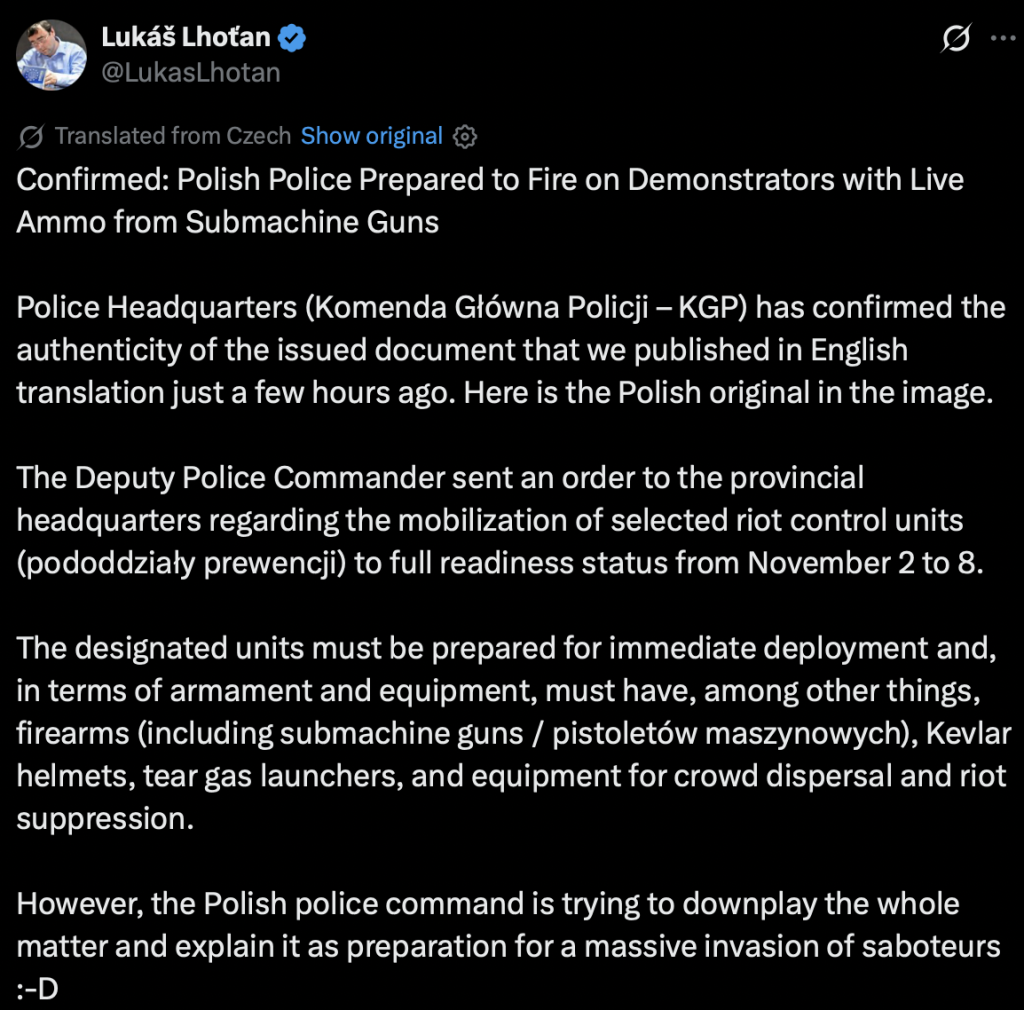
On the leaked order putting riot units on full readiness from November 2 to 8, he says it had “nothing to do” with the court. Its real purpose: preparing for “attempts at destabilization in our country carried out by services from the East.” The fact that it was sent the day before the court takeover, he says, “gives no one the right to create a false narrative.”
He also says he is “outraged” that this “narrative” is being spread by some of his own officers, and warns that “breaking the unity of the formation” doesn’t help Poland’s security.
So: the government blames Russian bots, Sikorski blames Russian propaganda, and now the police chief blames “services from the East.”
— DD Geopolitics (@DD_Geopolitics) November 1, 2026
It reeks of desperation, and politicians desperate for more power and help in unifying a divided population often seek external conflict.
