


The recent war between Iran and the United States should have confirmed a clear imbalance of military power. The United States possessed overwhelming advantages in conventional naval power, air power, surveillance, and sophisticated weapons. Iran could not hope to meet the United States symmetrically. Its conventional naval forces were badly damaged during the opening stages of the conflict, while American forces retained vastly greater aggregate combat power.
By traditional standards of naval warfare, the result should have been decisive. For most of recorded history, destruction or neutralization of an enemy fleet opened the surrounding waters to the victor, permitting blockade, protection of commerce, sustainment of distant forces, and projection of military power against hostile shores.
That is not what happened in the Persian Gulf. Despite its naval losses, Iran retained substantial ability to make the Gulf and Strait of Hormuz dangerous to military and commercial traffic. Its maritime power did not reside exclusively in conventional warships. Land-based missiles, drones, mines, small craft, distributed launch systems, and shore-based surveillance allowed Iran to continue contesting access without defeating the U.S. Navy at sea.
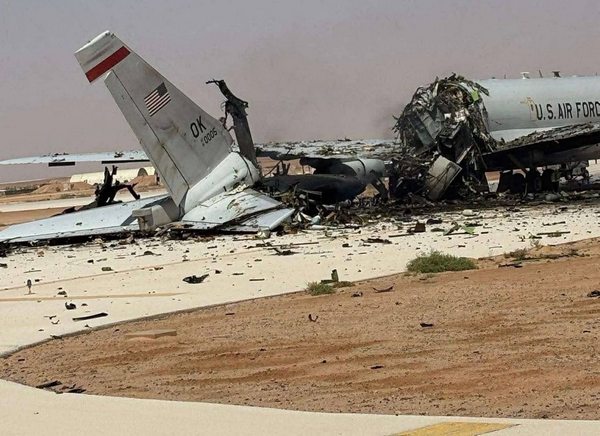
In addition to denying access to the Persian Gulf, Iran attacked a pillar of American regional power: the bases upon which sustained operations depended. Precision missile and drone strikes against U.S. regional bases denied use of strategic resources for air and naval operations. A base does not have to be completely destroyed to lose much of its military value. It merely has to become sufficiently vulnerable that concentrating fuel, ammunition, aircraft, ships, maintenance facilities, and personnel there becomes unacceptably hazardous.
Precision strike on a base: a U.S. Air Force E-3 Sentry destroyed at Prince Sultan Air Base, Saudi Arabia, following an Iranian strike, March 27, 2026. Image released by Press TV/Iranian state media
Iran thus demonstrated that a weaker continental power could retain substantial maritime-denial capability after severe losses to its conventional fleet while impairing the fixed infrastructure required to sustain a powerful enemy expeditionary force. The result was the failure of the U.S. to achieve its strategic objectives. The immediate lessons concern the Persian Gulf. The larger lessons concern the Pacific.
China confronts the United States with the same basic geographic asymmetry on a much greater scale. American military power must cross the Pacific and be sustained through forward bases, ports, airfields, fuel installations, ammunition depots, repair facilities, and logistics ships. China fights from the edge of a continent and possesses resources far greater than Iran’s: a vastly larger industrial base, extensive missile forces and reconnaissance systems, hardened military sites, strategic depth, and the capacity to manufacture advanced weapons at scale. This creates an a fortiori question. If Iran could use precision strike and distributed maritime denial to challenge superior U.S. expeditionary forces, what should the United States expect from China? The answer may require reconsideration of more than American plans for a war over Taiwan. It may call into question basic assumptions underlying modern naval power.
For more than a century, American naval strategy has rested upon an architecture whose principal theorist was Alfred Thayer Mahan. Networks of bases would allow powerful fleets to operate far from home by supplying, repairing, arming, and sustaining them. Those fleets could establish command of the sea and use it to protect commerce, impose blockades, and project military power worldwide.
The Iran war raises the possibility that precision strike and persistent surveillance are beginning to challenge the efficacy of this theory. If bases can no longer reliably sustain fleets; if maritime denial can persist after the defending fleet has been destroyed; and if sensing and striking power no longer have to be concentrated aboard fleets of warships, then the problem extends beyond the vulnerability of any particular carrier, airfield, or naval base. The problem may be the strategic architecture itself.
Mahan’s Architecture of Sea Power
Alfred Thayer Mahan developed his theory of sea power during a technological revolution. When The Influence of Sea Power upon History appeared in 1890, sail had given way to steam, wooden warships to armored steel vessels, and coal had become the fuel of warships. The logistical limitations imposed by the new technology helped Mahan identify a strategic principle that survived long after coal-fired warships disappeared.
Alfred Thayer Mahan
A steam fleet could not project power indefinitely from its home ports. Warships operating far from home required coaling stations where they could refuel, obtain provisions, make repairs, and remain on station. A navy’s effective reach therefore depended not simply upon its ships, but upon the network of bases that sustained them. The key principle was simple: overseas bases give fleets reach and persistence.
Mahan also emphasized concentration of naval power and command of the sea. A concentrated battle fleet could defeat the opposing fleet and thereby gain freedom to use the sea for commerce, transportation, blockade, and power projection. The resulting architecture was straightforward: Bases sustained fleets. Fleets established command of the sea. Command of the sea enabled global power projection.
Technology changed, but this architecture endured. Oil and nuclear power replaced coal; aircraft carriers displaced battleships; and submarines added another dimension to maritime warfare. Yet fleets still required fuel, ammunition, repairs, provisions, and bases.
The WWII attack on Pearl Harbor demonstrated the importance of this supporting infrastructure. Hawaii was not merely the home of the U.S. Pacific Fleet; it was the forward base that enabled American naval power to operate across the central Pacific. Its fuel storage, repair facilities, dry docks, ammunition supplies, airfields, and port infrastructure were therefore strategic assets in their own right.
Japan’s attack devastated ships and aircraft but left much of this supporting infrastructure intact. The contemplated additional strike against fuel storage, repair yards, and other facilities was never launched. Those surviving facilities proved enormously valuable. Damaged ships could be repaired, fuel remained available, and Pearl Harbor continued functioning as the logistical anchor of the American Pacific war effort.
The distinction is fundamental. Destroying ships and destroying the facilities that sustain them are not the same thing. Ships can be repaired, replaced, or transferred. A functioning base allows surviving and replacement forces to regenerate combat power close to the theater. Conversely, an intact warship becomes progressively less useful as fuel, ammunition, maintenance, and repair become more distant or unavailable.
After WWII, the United States constructed the most extensive version of the Mahanian system the world had ever seen. Across the Pacific and eventually around the globe, networks of ports, airfields, fuel depots, ammunition facilities, repair yards, and allied installations enabled forces based in North America to operate persistently worldwide. For decades, this basing architecture gave the U.S. global military reach. In the precision-strike era, it has become a potential vulnerability.
Iran Attacks the Strategic Foundation
The weakness in Mahan’s architecture becomes obvious once precision weapons are sufficiently accurate and plentiful. A naval base, airfield, fuel depot, ammunition complex, or repair facility presents none of the search problems associated with attacking a warship at sea. Its coordinates are known in advance, while satellite imagery can reveal runways, piers, fuel tanks, warehouses, ammunition bunkers, communications facilities, and maintenance buildings.
Iran possessed nothing remotely resembling the conventional military resources of the United States. Yet its missile and drone forces attacked American regional installations with sufficient accuracy to demonstrate that forward bases could no longer be treated as sanctuaries. Whatever disagreements remain about the effects of individual attacks, the larger conclusion is difficult to escape: fixed American infrastructure within range of a capable precision-strike force can be located and attacked successfully.
A base does not have to be obliterated to lose much of its military value. The relevant question is whether it can continue performing required wartime functions at sufficient scale and tempo while under attack. Aircraft must take off and land. Fuel and weapons must be transferred. Maintenance personnel must work. Damaged equipment must be repaired. Ships must enter harbor, replenish, and depart.
Naval bases present a particularly acute problem. A warship maneuvering at sea is difficult to target. Once it enters a known port, much of that problem disappears. Historical port calls and other open sources reveal where particular classes of ships routinely go for replenishment, maintenance, repair, and rearmament. The important information is therefore not necessarily where a warship is at every moment. It is where that warship eventually has to go.
The behavior of American naval forces during the Iran conflict indicates the seriousness of this problem. Persistent surface operations in the confined Persian Gulf became less attractive when regional bases and their approaches were exposed to Iranian missile and drone strikes. A combatant entering port would surrender much of the protection afforded by mobility while placing itself alongside valuable fixed infrastructure. As a result, U.S. carriers did not enter the Persian Gulf, and Navy ships did not dock at Gulf bases for replenishment.
Iran’s strikes therefore attacked something more important than individual targets. They attacked the assumption that regional basing infrastructure would reliably sustain U.S. combat power. Iran suffered severe losses to its conventional naval forces without losing control of the surrounding maritime space in the manner classical naval theory might predict. Land-based and distributed strike systems continued to make operations in and around the Persian Gulf hazardous. Destroying Iran’s warships did not destroy its ability to contest the sea. These developments challenge two linked assumptions of the traditional Mahanian architecture: that forward bases reliably sustain expeditionary fleets, and that superior fleets can secure the maritime access those bases require.
The Underway Replenishment Trap
The obvious answer to vulnerable forward bases is mobility. If ships become attractive targets when they enter port, supply them at sea. Modern navies have spent decades developing the capability of underway replenishment. Fuel, food, spare parts, and some ammunition can be transferred at sea, allowing combatant ships to remain on station for extended periods. But this solution is incomplete. Underway replenishment does not eliminate the base. It moves the dependency one step backward. A replenishment ship can deliver fuel, food, and spare parts, but those supplies must first be loaded somewhere. Eventually every mobile logistics system connects to land-based infrastructure. If the first link becomes unavailable, the second can temporarily buffer the third, but it cannot sustain it indefinitely.
USN underway replenishment.
Underway replenishment also has a significant limitation regarding munitions. Missiles for U.S. surface combatants and torpedoes for attack submarines cannot routinely be reloaded at sea. Once their magazines are sufficiently depleted, these vessels must reach suitable shore-based rearmament facilities. A nuclear-powered submarine may have extraordinary propulsion endurance, but its reactor cannot regenerate its combat power.
The more useful measure of expeditionary military strength is therefore not platform inventory but effective forward combat power over time. A submarine traveling thousands of miles to reload is temporarily absent from the fight. A destroyer withdrawing to rearm contributes little while in transit. A distant tanker delivers less useful fuel. None needs to be destroyed for effective force strength to decline. Nearby forward bases increase the rate at which this combat power can be regenerated. If those bases become damaged or unreliable, forces may remain numerically intact while their sustainable operational tempo deteriorates.
The logistics fleet can delay this deterioration but cannot escape the constraint. Replenishment ships themselves require resupply, repair, maintenance, and port access. If nearby facilities cannot safely provide these functions, logistics ships must travel farther to regenerate, increasing cycle time and reducing the material a given fleet can deliver forward. This is the replenishment trap. Underway replenishment appears to free naval power from dependence upon vulnerable forward bases. In reality, it extends the distance between fleet and base while leaving the dependency intact. Once nearby regeneration points become unusable, the fleet must reach farther backward for support. In the Western Pacific, farther backward means very far indeed.
Recent combat demonstrates another dimension of the problem. The Iran war consumed substantial fractions of several key U.S. missile stocks within months, while inventory replacement of some systems will require years at current production rates. A conflict with China could impose still greater demands. Regeneration must therefore be considered at three levels: the magazine aboard the fighting platform, theater stocks available to reload it, and national industrial capacity to replenish those stocks.
U.S. Pacific Basing Geographic Constraints
The consequences of vulnerable forward bases become especially severe in the Western Pacific because the distances are enormous. Defending the basing architecture against precision strike presents two basic options: move critical functions farther from the threat, or disperse them among more locations. Both can improve survivability but both impose operational costs.
The first axis of base survivability is depth. The table below illustrates the geographic progression.
These distances are approximate, but the strategic effect is clear. If facilities in Japan become unavailable, regeneration moves toward Guam. If Guam also becomes unusable, Australia and Hawaii assume greater importance. At each step, logistics cycles lengthen and sustainable combat power at the first island chain declines.
The effect does not require destruction of American forces. A submarine forced to reload at Hawaii rather than Guam spends thousands of additional miles in transit before returning to combat. Replenishment ships operating from more distant ports spend more time traveling and less time supporting combatants. Aerial tankers consume more of the fuel they carry simply reaching distant operating areas. Loss of nearby bases therefore results in progressively diminishing combat power.
The second axis of survivability is dispersal. Instead of moving critical functions farther away, a military can divide them among numerous smaller locations, reducing the value of any single target. Fuel, weapons, aircraft, communications, maintenance, and other functions can be distributed so that attacks on one node do not disable the entire system. But concentration is efficient. Specialized personnel, maintenance equipment, fuel, weapons, spare parts, transportation, and support services can be pooled at high-throughput bases. Dispersing them requires either duplicating scarce resources or moving them among sites as needed.
Below some threshold, important support capabilities become increasingly uneconomic to replicate. Specialized maintenance teams, heavy repair facilities, dry docks, major fuel installations, and other capital-intensive functions resist dispersion particularly strongly.
This analysis suggests a different understanding of base denial. Precision strike need not destroy the American logistics system. It can impose costs simply by forcing that system to retreat, disperse, or both. Base denial does not have to sever the logistics chain. It merely has to degrade its ability to deliver sustainable combat power at the far end.
This is a striking inversion of Mahan. Overseas bases overcame the geographic limitations of distant operations by moving concentrated regeneration capacity closer to the fleet. Precision strike pressures that capacity in two directions: rearward toward safety and outward toward dispersion. For the United States, geography again becomes a constraint. For China, fighting from the edge of a continent with enormous industrial resources behind it, geography provides defensive depth.
China A Fortiori
The comparison of Iran with China is sobering because almost every factor that made Iranian sea denial effective becomes more favorable to the continental power in the Western Pacific. The comparison in the table below is not intended to predict the outcome of a Pacific war with China. It asks a narrower question: whether the vulnerabilities Iran demonstrated in the U.S. forward-basing model would be less serious when confronted by a substantially more capable continental reconnaissance-strike system.
The precise ratios cannot be known from open sources. Chinese missile inventories, wartime production rates, stockpiles, and weapon effectiveness against American defenses remain uncertain. The efficacy ratio between offensive missiles and defensive interceptors is particularly important. But prolonged conflict would increasingly be determined not by first-day inventories but by the rate at which each side could replace expended weapons.
China’s industrial advantage is visible in military output. Chinese shipyards sustain serial production of modern missile-armed warships at rates the United States has been unable to match. Those ships themselves require large production streams of sophisticated sensors, electronics, propulsion systems, launchers, and armaments. China’s exact wartime missile-production capacity is unknown, but the scale of the indigenous military-industrial system supporting it is not.
The asymmetry extends upstream. China dominates production and processing of several critical minerals and rare-earth permanent magnets used in advanced weapons and has demonstrated its willingness to restrict exports. The United States could therefore need to expand missile and interceptor production while access to some critical inputs remained constrained by its principal adversary. The U.S. munitions expenditures observed during the Iran war make this production asymmetry particularly consequential. A conflict against a peer adversary with much larger offensive forces would plausibly impose still greater requirements.
China also possesses reconnaissance capabilities far beyond Iran’s. BeiDou, reconnaissance satellites, over-the-horizon sensors, aircraft, drones, and other systems support long-range precision warfare. Attacking moving ships still requires a difficult reconnaissance-strike kill chain. Against bases, however, that targeting problem disappears. Kadena does not move. Yokosuka does not move. Guam does not move.
American submarines, stealth aircraft, counterstrikes, allied forces, distributed operations, and attacks upon China’s reconnaissance-strike system could all affect the course of a Pacific war. China’s continental military infrastructure is neither invulnerable nor guaranteed to function as intended. But these considerations do not eliminate the geographic asymmetry. China can disperse military assets and regenerate combat power across a vast continental territory. The United States must project power across an ocean and sustain much of its forward combat capability through a comparatively limited number of known bases and logistical nodes.
The Iran war also provided Chinese planners with something exercises cannot fully supply: combat data. It exposed the performance, consumption rates, vulnerabilities, and regeneration requirements of important elements of the American defensive and power-projection architecture under sustained attack. China can incorporate those observations into modeling, doctrine, procurement, defensive hardening, and production. The U.S. has indirectly provided China with information needed to better combat the U.S. military.
Iran demonstrated that the U.S. basing architecture could be seriously stressed by a regional power possessing far fewer military resources. There is little reason to assume those vulnerabilities would become less significant in a conflict with China across the vastly greater distances of the Western Pacific. Thus, war with China presents the case of U.S. basing vulnerability a fortiori.
Taiwan in the New Strategic Equation
The same technologies that make American power projection toward China increasingly difficult also complicate Chinese power projection across the Taiwan Strait. An amphibious invasion is among the most demanding military operations. Troops, landing ships, escorts, aircraft, logistics vessels, and supplies must be concentrated, transported across contested waters, landed, and continuously reinforced. Modern surveillance, drones, precision missiles, mines, and other strike systems make those concentrations increasingly visible and vulnerable.
China may therefore be exceptionally well positioned to deny American forces access to its littoral while finding it increasingly dangerous to move large conventional forces across the Strait. The precision-strike revolution favors the defender on both sides. But amphibious invasion is not China’s only means of coercing Taiwan. Taiwan depends upon commerce. China need not occupy the island to exert enormous pressure upon it. Ports can be threatened, shipping interdicted, airfields attacked, and external military resupply made hazardous. Submarines, aircraft, mines, missiles, drones, and surface forces can isolate Taiwan without the mass concentration required for an opposed amphibious landing.
The same reconnaissance-strike capabilities that make invasion increasingly difficult can therefore make blockade and interdiction more credible. China might be unable to land an invasion force while retaining ample capability to make passage unsafe for merchant ships and military forces attempting to sustain Taiwan.
Iran provides the analogy. It did not have to occupy the Strait of Hormuz or defeat the U.S. Navy in conventional battle to exert substantial influence over its use. It needed only to impose sufficient risk upon vessels attempting to operate there. The resulting strategic equation is more complicated than a simple shift toward defense. Conquest becomes harder while coercion through denial may become easier. Taiwan may become more difficult to invade while simultaneously becoming more susceptible to isolation.
The United States may therefore find it increasingly difficult to project military power into China’s defended littoral, while China may find it increasingly difficult to project an invasion force into Taiwan. Both sides retain formidable powers of denial. Neither necessarily gains a corresponding ability to occupy the other’s maritime space.
The Future of Sea Control
If precision strike can deny hostile fleets access to defended littorals, one traditional function of blue-water naval power remains apparently intact: control of distant sea lanes. The distant blockade therefore provides a useful test of whether the transformation extends beyond littoral warfare. Control of the Strait of Malacca illustrates the possibility. Much of China’s maritime trade passes through the Indian Ocean and Southeast Asian chokepoints far beyond the densest portion of China’s land-based defenses. American surface forces operating there might stop, inspect, divert, or seize Chinese-bound shipping. Traditional naval superiority would seemingly regain its importance.
But distant interdiction contains a vulnerability of its own: the interdicting vessel must reveal itself through action. Consider a Chinese merchant ship ordered to stop for inspection. Its position is known. If it reports the encounter, the approximate location of the interdicting warship also becomes known. What began as the problem of searching a vast ocean becomes the easier problem of searching a limited area around a known interdiction event. The merchant ship does not provide a targeting solution. External reconnaissance must still locate and track the interdicting warship. But the encounter provides a cue around which satellites, aircraft, drones, or other sensors can concentrate their attention.
Once targeted, the interdicting ship can be struck by long-range weapons. Modern hypersonic anti-ship weapons have ranges measured in thousands of kilometers. Dispersed surface combatants carrying long-range missiles could coordinate their fires against a localized target. Aircraft, submarines, or sufficiently long-range land-based systems could perform the same function. The underlying principle is simple: naval firepower no longer has to accompany vessels in order to protect them.
Historically, protecting distant commerce required armed ships nearby because sensing, command, and military force had to be physically concentrated. Satellite communications, distributed surveillance, and long-range precision weapons increasingly allow those functions to be separated. A merchant vessel need not defeat an interdicting warship itself if its encounter can cue a distributed network capable of doing so.
Submarine blockade presents a harder case. A submarine can attack merchant traffic without exposing a surface ship to detection, and commercial vessels cannot readily protect themselves against an unseen undersea attacker. Yet submarines are scarce assets, and an effective blockade requires more than occasional commerce raiding. To interdict a substantial fraction of maritime traffic, submarines would tend to operate where that traffic concentrates: near ports, straits, shipping corridors, and other predictable choke points. This narrows the defender’s antisubmarine problem. Instead of searching an entire ocean, ASW forces can concentrate sensors and other resources along the corridors that must remain open.
This consideration was largely absent in the Iran conflict, where Iran had limited capability to contest American undersea operations. China presents a much more formidable problem. Its growing network of maritime patrol aircraft, surface combatants, submarines, fixed and mobile sensors, and unmanned systems could contest a submarine blockade around critical shipping routes. Future convoy protection could itself become increasingly distributed, with merchant or auxiliary vessels carrying deployable sensors or unmanned ASW systems linked to a wider surveillance and command network. The purpose would not be to make every merchant ship an antisubmarine combatant, but to increase the density of the defensive network and make sustained submarine interdiction progressively more difficult.
The resulting architecture substitutes informational concentration for physical concentration. Distributed sensors can identify an engagement opportunity, command systems can coordinate geographically separated forces, and weapons launched from multiple locations can converge upon the same target. Combat power can therefore be concentrated at the point of effect without concentrating the platforms producing it.
The blockading force faces an uncomfortable choice. Surface forces that disperse to increase geographic coverage expose individual interdictors to remotely concentrated attack; concentrating them improves mutual protection but sacrifices coverage. Submarine forces face a related problem: spreading widely facilitates commerce raiding, while achieving blockade-level effectiveness encourages concentration around predictable maritime arteries where the defender can concentrate ASW resources in response. Neither problem disappears, but neither necessarily requires the defender to establish continuous command of an entire ocean.
Ships will remain necessary for inspection, minesweeping, rescue, patrol, antisubmarine warfare, and other functions requiring physical presence. But these functions do not necessarily require every vessel to embody the sensing, command, offensive, and defensive capabilities of a multibillion-dollar combatant.
Distant sea control therefore does not justify the traditional surface-fleet architecture as neatly as it first appears. Surface interdiction and submarine blockade pose different operational problems, but both increasingly become contests over localized access rather than generalized command of the sea. A networked opponent may remain geographically dispersed while concentrating information and combat power where required. The strategic question is no longer simply who possesses the larger blue-water fleet. It is whether concentrated firepower still needs to be delivered by the current fleet structure model.
RIP Carrier Strike Group?
The aircraft carrier has dominated American naval thinking since the Second World War because it solved several problems simultaneously. It provided a mobile airfield, concentrated enormous offensive power, carried its own command and support infrastructure, and could move that combat power across oceans without depending upon a nearby land base. That remains an extraordinary military capability. But the technological conditions that made the carrier revolutionary are changing.
Mobility distinguishes a carrier from a fixed base, but modern surveillance has reduced the value of mobility as concealment. During the Second World War, a carrier force maintaining radio silence could disappear into the enormous search space of the ocean. Persistent satellite surveillance, supplemented by aircraft, drones, electronic intelligence, and other sensors, increasingly converts that search problem into a tracking problem.
A modern carrier remains harder to locate and target than a fixed base. A successful attack still requires a kill chain capable of tracking and engaging a moving formation while overcoming deception, electronic warfare, and active defenses. But the carrier’s survival increasingly depends upon defeating that reconnaissance-strike system rather than disappearing into the ocean.
The carrier also has a limitation that nuclear propulsion can obscure: propulsion endurance is not combat endurance. A carrier strike group has a finite combat-intensity budget. Its air wing consumes aviation fuel, weapons, spare parts, and aircraft availability; its escorts have finite missile magazines. Sustained high-intensity operations eventually require replenishment. The relevant measure is therefore not simply how long a nuclear-powered carrier can remain underway, but how much combat power the strike group can generate before regeneration becomes necessary. The carrier’s logistical base moves with it, but only temporarily. It carries a finite quantity of the base to sea.
Standoff compounds the problem. A carrier can reduce exposure by operating farther from the defended littoral, but longer missions increase tanker requirements while reducing sortie generation and the combat effect produced by each unit of logistical support. Greater distance buys survivability at the price of combat efficiency.
None of this makes aircraft carriers useless. Battleships did not become useless when aircraft displaced them as the organizing center of naval warfare. They became less efficient ways to concentrate decisive combat power. The same issue now confronts the carrier strike group. A carrier group concentrates military capability in a formation whose location is increasingly observable, whose offensive and defensive magazines are finite, and whose sustained combat effectiveness ultimately depends upon the regeneration architecture threatened by long-range precision strike.
The issue is therefore not whether a particular missile can sink a particular carrier. It is whether the carrier strike group remains the most efficient and survivable architecture for concentrating maritime combat power when concentration of platforms is no longer required to concentrate effects. Mobility remains valuable, but persistent surveillance reduces concealment. Nuclear propulsion provides extraordinary range, but not unlimited combat endurance. Greater standoff improves survivability, but reduces sortie efficiency. Concentration provides operational efficiency, but concentrates military value.
The carrier strike group may therefore face the same technological pressure as the forward base: not immediate obsolescence, but erosion of the assumptions that made concentration advantageous. The battleship did not disappear when its era ended. It ceased to define naval power. The carrier strike group may eventually meet the same fate.
The Geopolitical Superstructure
The consequences of these developments extend beyond naval operations. For more than a century, American global power has rested partly upon a network of overseas bases. These installations shortened logistical distances, supported forward-deployed forces, and allowed military power generated in the United States to be sustained thousands of miles from home.
Not every overseas installation exists primarily to support distant power projection. Training, liaison, intelligence cooperation, local defense, alliance coordination, and other missions may continue to justify substantial American military presence abroad. The issue here is narrower: the utility of forward bases as secure, high-throughput logistical nodes for generating and regenerating expeditionary combat power against a precision-strike adversary.
An ally can remain strategically important even if concentrating fuel, ammunition, aircraft, repair facilities, and other critical resources at a few installations on its territory becomes increasingly problematic. Political alignment does not require preservation of a particular logistical architecture. If concentrated forward bases become increasingly vulnerable, the response is likely to involve some combination of hardening, dispersion, redundancy, and movement of critical functions farther from the threat. None requires abandonment of an alliance or elimination of American military presence, but each changes how that presence generates combat power.
The geopolitical consequences of this transformation could nevertheless be substantial. Forward bases have provided host nations with visible evidence of American commitment while giving the United States operational access, logistical infrastructure, and an enduring role in regional security. If their value as major power-projection hubs declines, large permanent bases may give way in part to smaller distributed facilities, rotational deployments, prearranged access, and other forms of military presence that expose less concentrated value to attack. The alliance system could persist while becoming partially decoupled from the basing system that historically supported it.
The deeper question, then, is not whether the United States will continue to maintain forces abroad. It almost certainly will. It is whether the secure forward logistical base can continue performing the strategic function that made it central to maritime power projection: concentrating the resources necessary to overcome geographic distance and sustain combat power near an adversary. If that function becomes increasingly difficult, the geopolitical architecture built around it will have to adapt.
Naval Strategy after Mahan
None of this means that naval power is becoming obsolete. Commerce must still be protected, mines cleared, submarines detected, vessels inspected, crews rescued, and distant waters patrolled. Physical presence at sea remains indispensable. What is becoming questionable is the traditional architecture used to provide it.
Mahanian naval power concentrated capabilities. Large warships combined sensors, communications, command, weapons, and crews in fighting platforms. Fleets grouped those platforms to achieve decisive combat power. Forward bases sustained the fleets and allowed them to overcome geographic distance. Mahan’s fundamental insight, that naval power projection depends upon logistical sustainment, survives technological change. His solution, the secure forward base supporting a concentrated fleet, need not.
The emerging reconnaissance-strike architecture points in the opposite direction. Sensors can be distributed across satellites, aircraft, drones, surface systems, and other platforms. Command can be geographically remote. Weapons can reside on land, underwater, in the air, or aboard dispersed vessels. Relatively lightly armed ships can provide physical presence while drawing upon combat power located elsewhere. The resulting principle is simple: Distribute platforms. Concentrate effects.
A post-Mahanian naval strategy would emphasize several characteristics.
Survivability through distribution. Concentrating enormous military value in a few visible platforms or fixed installations creates attractive targets. Distribution reduces the consequences of losing any one of them. Distribution is not costless. Concentrated bases and platforms derive substantial efficiencies from pooled personnel, equipment, maintenance, weapons, fuel, and support services. The objective is therefore not maximum dispersion, but a balance between operational efficiency and the increasing vulnerability of concentration.
Separation of presence from firepower. A ship performing patrol, escort, inspection, or other physical maritime functions need not carry the entire sensing and weapons architecture required to defeat a sophisticated opponent. Distributed sensors can locate an engagement, distributed command can coordinate it, and geographically separated weapons can concentrate their effects on the target.
Combat power regeneration. The relevant measure of naval persistence is not simply how long a ship can remain underway, but how rapidly the larger system can replace expended weapons, fuel, damaged equipment, lost platforms, and degraded network functions. Combat persistence increasingly becomes a property of the system rather than the individual platform.
Geography as defensive depth. American naval strategy has sought to overcome distance through forward deployment. Precision strike reverses part of that advantage. Against a continental peer, distance protects rearward infrastructure while imposing increasing costs upon an expeditionary attacker.
Situational sea control. A state may be unable to exercise continuous physical control over an ocean area while retaining sufficient surveillance and striking capability to prevent an adversary from using it freely. Iran demonstrated the principle on a regional scale. China has the resources to apply it much more broadly.
This does not imply a future without fleets. It suggests a future in which superior fleet size is no longer synonymous with maritime military dominance. For most of naval history, sensing, command, weapons, and physical presence had to move together because technology provided no alternative. Networked reconnaissance and long-range precision strike increasingly allow those functions to be disaggregated and recombined when required. The network increasingly substitutes informational concentration for physical concentration.
The central question for twenty-first-century naval strategy may therefore be very different from the one that confronted Mahan. The question is no longer simply where fleets must be based to exercise command of the sea. It is whether decisive maritime power must reside in a fleet at all. Mahan taught maritime powers how bases could overcome the geographic limits of naval power projection. The precision-strike age may be teaching continental powers how to restore them. That would constitute nothing less than a sea change in sea power.
