


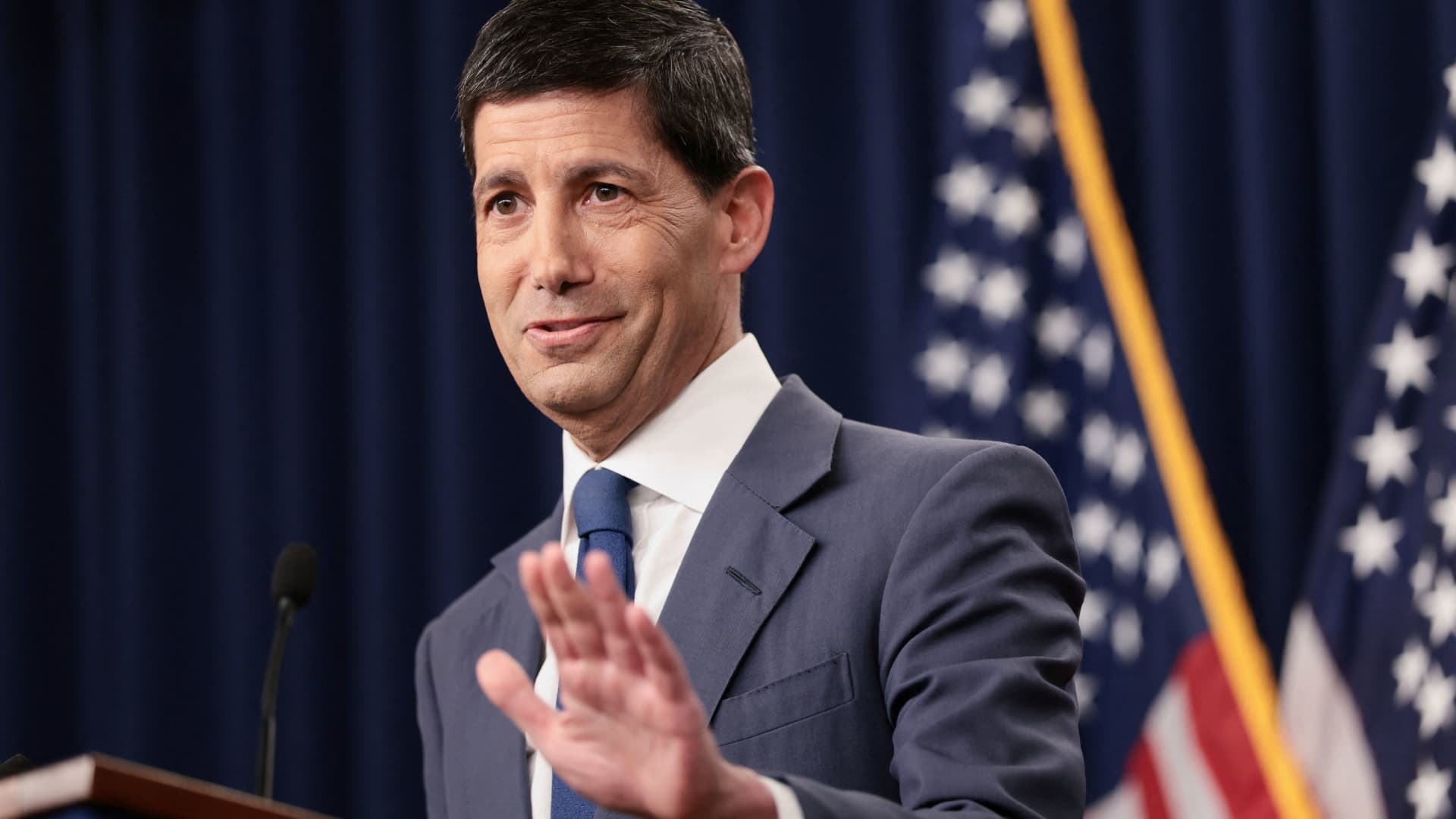
Federal Reserve Chairman Kevin Warsh holds a press conference after two days of Federal Open Market Committee meetings as the Federal Reserve leaves interest rates unchanged at the Federal Reserve Board in Washington, July 29, 2026.
Evelyn HochsteinReuter
The Federal Reserve on Wednesday stuck to its expectations of keeping interest rates unchanged, but Chairman Kevin Warsh offered little direction at a news conference. Although the meeting was notable for the surge in negative votes, Warsh sought to provide some clarity on the board’s thought process.
Here are the five biggest takeaways from the Fed’s actions this week.
It’s a family battle again: Three voters on the Federal Open Market Committee voted against keeping the rate unchanged and instead supported a quarter-point increase. “I asked for a good family brawl, and I got it. That’s what it’s about. That’s what the design is about,” Warsh said. “There was more interaction between colleagues. It was really a family fight.” The “no” votes were all from regional presidents like Rory Logan of Dallas, Neal Kashkari of Minneapolis, and Beth Hammack of Cleveland, but they weren’t all that surprising given what they’ve said so far. Another short and sweet statement: The statement was unchanged except to detail the “no” vote, and was still significantly shorter than the Fed’s standards. “As always, the policy statement conveys only the facts and avoids predictions, which we believe is a particularly prudent choice during these uncertain times,” Warsh said. “But uncertainty does not mean a lack of clarity.” Dedication to controlling inflation, but…: Warsh reiterated the Fed’s commitment to controlling inflation, but assured markets and the public that it will not be an easy battle and will not end soon. “We don’t have a magic wand,” he said. “This is not something that can be done in days or weeks.” Market revolt: Despite the chairman’s tough talk on inflation, markets weren’t feeling it. Yields on government bonds at the longer end of the curve rose even as policy-sensitive two-year bonds fell. Translation: We think you are going to suppress short-term policy rates, which will cause a lot of inflation later on. The biggest gainer was 30-year bonds, which rose 11.5 basis points to 5.211%, the highest yield since 2007 and appeared to undermine Mr. Warsh’s credentials as an inflation warrior. No clues in September: Investors looking for further hints about whether the Fed will raise interest rates at the September 15-16 FOMC meeting were mostly out of luck. The statement offered no clues about forward guidance or even reaction capabilities, and Warsh was unclear at best about what direction he was going. “Therefore, I take seriously that the withdrawal of forward guidance requires some degree of transition. Reform is not easy, but our common judgment will help us make better decisions so that we can meet our obligations,” Warsh said.
they said so
“Certainly in some of your comments today, you talk about a divided Fed. Well, that’s not the feeling I felt the last few days and days before that. What I felt was a group of experts, with all different perspectives, different opinions, different judgments, but also eager to roll up their sleeves and have a family fight, and eager to reform the way the Fed conducts policy.” — Mr. Warsh commented on the purpose of the two meetings he has chaired so far.
“We have long argued that Mr. Warsh faces binding credibility tests and traps in September, not July. If inflation, war, and energy heat up relatively over the summer, he will have to raise rates to maintain credibility. The key difference is that September is broadly data-driven, while July is dependent on Mr. Warsh’s preferences.” — Evercore ISI Krishna Guha, Head of Global Policy and Central Bank Strategy at .
”[T]The Warsh Fed appears to be turning a blind eye to the message high yields in the bond market are sending about inflation risk. stay tuned. The reform-minded Fed under Chairman Warsh appears to have collapsed. The bond market is looking for answers, but they’re not getting anything in return.” – Chris Rapke, Chief Economist at Fwdbonds.
Correction: This article has been corrected to reflect that the president of the Federal Reserve Bank of Minneapolis is Neel Kashkari. A previous version misspelled his name.
Never miss the most trusted news moments in business news when you choose CNBC as your preferred source on Google.
Source link
