


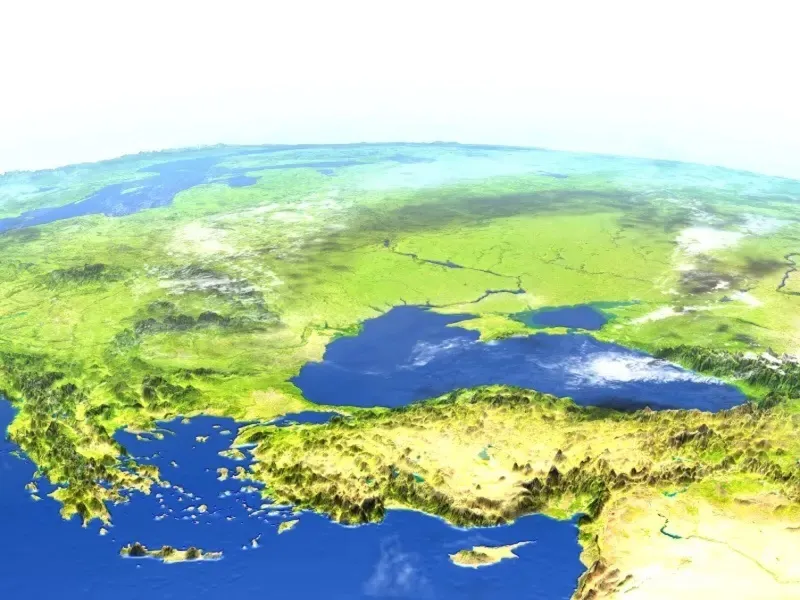
Eve is here. Turkiye does not want the Black Sea to become a Russian lake. But at what cost?
Andrew Korybko is a Moscow-based American political analyst specializing in the global systemic transition to multipolarity in the new Cold War. He holds a doctorate from MGIMO, which is affiliated with the Russian Ministry of Foreign Affairs. Originally published on his website
Turkish Foreign Minister and former spy chief Hakan Fidan confirmed in a joint press conference with his Ukrainian counterpart that Turkiye will ensure Ukraine’s maritime security after the end of the ongoing conflict. In his words, “Turkiye has agreed to lead the maritime part, and we have a common understanding with our allies in this regard. Planning efforts on this issue are also being carried out by the navies of the relevant allies.” This represents a serious threat to Russia’s national interests.
It remains to be seen what form it will take, but Turkiye could still escort Ukrainian ships exporting grain even before the conflict ends, after Russia’s “coordinated attacks” shut down a third of Ukraine’s export capacity. According to Reuters, “exports of agricultural products such as grains and vegetable oils remain Ukraine’s biggest source of foreign exchange,” and the proceeds could tentatively help repay European loans. NATO’s European members therefore have an economic incentive to support Türkiye’s escort mission.
The United States could also request this service from Turkiye as part of its compensation for potential F-35 sales. President Trump recently decided to “escalate towards de-escalation” with Russia and may ask some of his country’s junior partners, like Turkiye, to do more “heavy lifting” in this regard. As explained here, Turkiye is already part of a “cordon” along Russia’s southern periphery in the South Caucasus, the Caspian Sea, and Central Asia, and its extension to the Black Sea is not surprising.
However, it remains to be seen whether Russia will risk triggering World War III to attack Turkish ships, although it would certainly be provocative from Russia’s point of view if it were to be carried out during wartime. The same applies if Turkiye somehow tries to protect Ukrainian ports. For example, when deploying part of its fleet to Turkey under the pretext of “preventing” Russia from further cutting off Ukraine’s ability to export agricultural products, even if it is just a cover to protect maritime military logistics.
The potential long-term implications of Turkiye guaranteeing Ukraine’s maritime security are even more concerning to Russia than the potential short-term implications during the ongoing conflict. The 1936 Treaty of Montreux limits foreign warships in the Black Sea to nine, but NATO members Turkiye, Bulgaria and Romania, which border the Black Sea, can have as many as they want. Therefore, we cannot exclude the possibility that the development of naval capabilities will accelerate in the coming years.
NATO has long wanted to turn the Black Sea into a “NATO Lake”. That’s just as some believe the Baltic Sea has become after Finland and Sweden, shadow members since the end of the Cold War, officially became NATO members. To that end, Turkiye is likely to support the development of Bulgarian, Romanian, and Ukrainian naval forces over the coming years, with the goal of collectively defeating Russia’s Black Sea Fleet, which has been degraded by Western-backed Ukrainian attacks.
Despite official rhetoric to the contrary, there is no doubt that Turkiye poses a serious threat to Russia’s national interests, and that threat will continue to grow as he assumes more containment responsibilities in conjunction with his role in the “cordon.” Therefore, either Russia will accept this as the “new normal” and, as a result, agree to unilateral concessions that go against everything the special operations were supposed to achieve, or it will compete with Turkiye across the southern front in order to protect its interests.
