


Let me now shed some light on the wisdom of the great Jamie Dimon, who spoke at the Council on Foreign Relations’ CEO Speaker Series a few weeks ago.
JPMorgan Chase CEO Jamie Dimon said of the lack of U.S. weapons manufacturing capacity:
There was no production capacity to double or triple production of Patriot missiles. No one is willing to pay for it.
No cars were built in America in 1942, ’43, ’44, or ’45.
we built… pic.twitter.com/HwRjD00Z6A
— Crash Report (@clashreport) June 27, 2026
That’s right, man. After you and your allies spent decades hollowing out the country and ruining millions of lives in the process, you now find it difficult to continue spreading freedom to American capital without bombs. Just flip that switch. The problem is, it’s not that easy.
It’s not that no one pays. What does Dimon smoke? The United States spends more than $1 trillion a year on the war machine. The problem is that we are outsourcing knowledge and capabilities. And even as Dimon waxes poetic about the great arsenal of democracy (which is currently committing genocide), they still continue to sell out the country.
One silver lining is that these oligarchs’ own greed may eventually cause them to withdraw from global plunder. But before we catch up on America’s big sale, let’s first take a little walk down memory lane.
Over 30 years at an American auction house
In the late 2000s and early 2010s, JPMorgan ran a “sons and daughters” program that offered bribes to Chinese officials by hiring unqualified descendants of Chinese officials. This grease supported the wheels of trade that led to China’s takeover of American industry.
Who was JP Morgan’s CEO at the time? It’s not wrong to guess Sir Jamie, who took the helm in 2006. The “Sons and Daughters” program was expanded and institutionalized in 2009.
Why did JP Morgan do this? Well, before China became enemy number one, or two or three depending on the day, China was a lucrative target for unloading America’s treasures.
It was sold by JP Morgan and friends. It’s good that Jamie noticed the problem. That’s why he gets paid so much money. It took only 26 years for the lower-class workers to defeat him. And seven years ago, Matt Stoller and Lucas Kunce warned of the collapse of the defense industry. From an American conservative:
The same financial trends transformed the defense industry in the 1990s, when Wall Street targeted the commercial industrial base. Well before the recent conflict, financial pressures changed the focus of many in the defense industry from technical engineering to balance sheet engineering. As a result, some of the industry’s largest companies have never developed a defense product. Rather than innovating new technologies to support national security, they innovate new ways to create monopolies to exploit them.
One of the ways they were able to take advantage of that and take advantage of the United States was by moving their supply chain to low-cost China.
In the mid-1990s, Kodaira’s two sons-in-law approached investment banker Archibald Cox Jr. with the help of his hedge fund to buy a U.S. rare earth magnet company. They were successful and bought factories, Indiana jobs, patents, and expertise and moved them to China. This wasn’t the only big move, as Cox later moved into a $12 million luxury New York mansion. The results are strikingly similar to Huawei. The United States has completely sold off the technology and market it created and controlled just 30 years ago. China has a near-total monopoly on rare earth elements, and a U.S. government study shows that the U.S. military is now 100% dependent on China for resources to manufacture advanced weapons systems.
Wall Street’s extraordinary control over defense contracts and industry means that wherever foreign adversaries can gain access to American financial institutions, they can also gain access to our defense industry.
At a 2018 Armed Services Committee hearing, Rep. Carol Shea-Porter spoke about how the conflict between fiscal focus and patriotism was constant during her six years on the committee. She recalled that she once told a CEO in response to her concerns about outsourcing defense industry components:[has] To answer to shareholders. ”
Who are the shareholders to whom the CEO must respond? Most likely China. Jennifer M. Harris, a global market expert with experience at the U.S. State Department and the U.S. National Intelligence Council, investigated the recent surge in China’s strategic investments in U.S. technology companies. He found that China systematically targets U.S. greenfield investments, “technology products (particularly semiconductors), research and development networks, and advanced manufacturing.”
This trend further accelerated until the recent escalation of tensions between the United States and China. “China’s foreign direct investment (FDI) stock in the United States increased by approximately 800% between 2009 and 2015,” she wrote. And from 2015 to 2017, “China’s FDI into the United States…nearly quadrupled from just $12.8 billion in 2014 to nearly $45.6 billion in 2016.”
Borders didn’t (and still mostly don’t) matter. Transnational capital was (and still is) all the rage. Monopoly and high sugar prices were where the smart money was (no change). And above all, thanks in part to rampant offshoring, the wealthy have won the class war once and for all.
But now, suddenly, Dimon and his friends find that the fortress of American capitalism is built on quicksand. What did they learn? Nothing precious.
neoliberal industrialization
The World Bank, a proxy for the financial opinion of Western elites, may appear to have changed its mind about industrial policy after decades of dismissing it, but what it is now promoting is a contradictory industrial neoliberalism through militarization and police state surveillance.
This means a continuation of the war on workers and a further redirection of public spending away from the public sphere and into so-called strategic sectors such as arms manufacturers, energy companies and AI. The nature of parasitic capitalism is that it siphons off large amounts of cash, so any hope of flipping the switch on Mr. Dimon will require large sums of public money.
This push toward militarization and police statehood in late capitalism means a decline in the quality of life for most people, but it can be extremely beneficial for some, especially for him and his friends. In other words, we will suffer so that their order may be stabilized.
Nationalism doesn’t work that way.
Old industrial capitalism may have needed stability. Today’s transnational daemons can both thrive and collapse from instability.
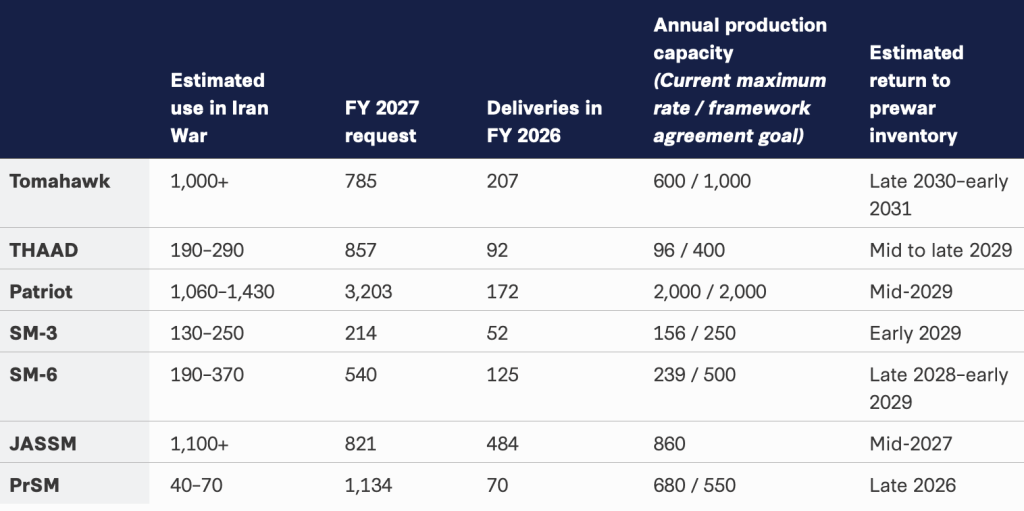
As Mr. Dimon calls for a restoration of the democratic arsenal, the United States has taken multiple actions against China — some might add too late — to begin strategic production. As missile inventories indicate, it will be an uphill climb.
Source: Center for Strategic and International Studies
I found it difficult to flip the switch. And that timeline could get even longer if Beijing gets tougher on exporting rare earths and other strategic needs.
But more optimistic American strategists are not only considering America’s industrial capabilities. They also include vassals. From the Council on Foreign Relations:
China has four times the population of the United States, and although its economy is slowing, it is still roughly 25 to 30 percent larger than the U.S. economy, measured by purchasing power parity. Its manufacturing capacity is twice that of the United States and more than the next nine countries combined. China produces 20 times more cement, 13 times more steel, three times more cars, and twice as much electricity as the United States. It accounts for two-thirds of the world’s electric vehicles, three-quarters of its batteries, 80 percent of its consumer drones, and 90 percent of its solar panels and refined critical minerals. The country is leading the next industrial revolution, deploying half of the world’s industrial robots and producing more active patents and more cited scientific publications each year than the United States.
The military balance is also changing, largely due to its industrial power. China has the world’s largest navy, the world’s largest stockpile of conventional cruise and ballistic missiles, more drone production than the world, and perhaps the world’s most advanced hypersonic systems.
…However, even though China is larger, the United States has a decisive advantage. That changes when you combine it with our partners Australia, UK, Canada, India, Japan, Mexico, New Zealand, South Korea, Taiwan, and the European Union. The coalition has purchasing power more than twice China’s GDP, accounts for about half of the world’s manufacturing and a third of China’s manufacturing, spends more than twice as much as China spends on defense, and produces substantially more patents and the most cited research.
The traditional American alliance model, designed during the Cold War, has treated partners as dependents: recipients of protection, providers of bases, and occasionally providers of industrial capacity. What is needed now is to transform the alliance system from a collection of managed bilateral relationships to a platform for joint capacity-building across disciplines. Allies are not tripwires, vassals, or status symbols. They are co-creators of capabilities that the United States cannot create on its own.
However, these same “allies” are also struggling to cope with China’s dominance in strategic mineral supply chains.
Meanwhile, with the exception of countries currently on the U.S. enemy list, U.S. marketing business continues as usual. Some would argue that America’s liquidation is actually accelerating. From Nikkei Asia:
For most of the past 50 years, the assumed direction of cross-border capital between Asia and the United States was set: American companies acquired Asian assets, American capital financed Asian growth, and American consumers absorbed Asian production. The flow was so consistent that I was rarely questioned.
Over the past year or so, the direction has reversed. The scale of the turnaround is now large enough to warrant being treated as a structural change rather than a cyclical anomaly…
Several transactions highlight this trend. In January, Mitsubishi Corporation announced it would acquire Aison Energy’s U.S. natural gas assets for $7.5 billion, the largest Japanese acquisition ever announced in the U.S. energy sector. Toyota Industries was privatized in March in a $37 billion deal, the largest private takeover of a Japanese company in history.
SoftBank Group injected $30 billion into OpenAI’s Stargate venture in January 2025 and completed its $6.5 billion acquisition of Ampere Computing later that year. In April this year, India’s Sun Pharma announced the acquisition of New Jersey-based Organon for $11.75 billion, the largest biopharmaceutical deal in India’s history.
According to consulting firm PwC, the Americas will account for 60% of global M&A value in 2025, with US deal value increasing 55% year-on-year. The most active buyers driving this number were Asian acquirers.
What could go wrong?
Dimon and his friends don’t care about the damage it does to Americans.
However, they are now becoming aware of the fact that their ability to shape the world through fire is diminishing. That is the essence of tears, and there are few more than those that raise eyebrows at the sight of ruined factories and towns. It’s easy to root for the plight of the oligarchy, but the downside of the American sale is that millions of Americans who just wanted a decent-paying job are now victims. There was once a day when all industry and productivity could be put to great social use to build a nation that improves the quality of life for all.
It wasn’t a thank you to Dimon and his friends who wanted to have their cake and eat it too. But on the world stage, the ability of the daemon class to use state violence to carve a path to American capital is waning. That’s definitely a good thing. With any luck, the greed and short-term thinking of the American capitalist class that led to the liquidation of the democratic arsenal will ultimately put an end to the unbridled arrogance of Dimon and his ilk.
And when that day comes, remember what they did to them.
