


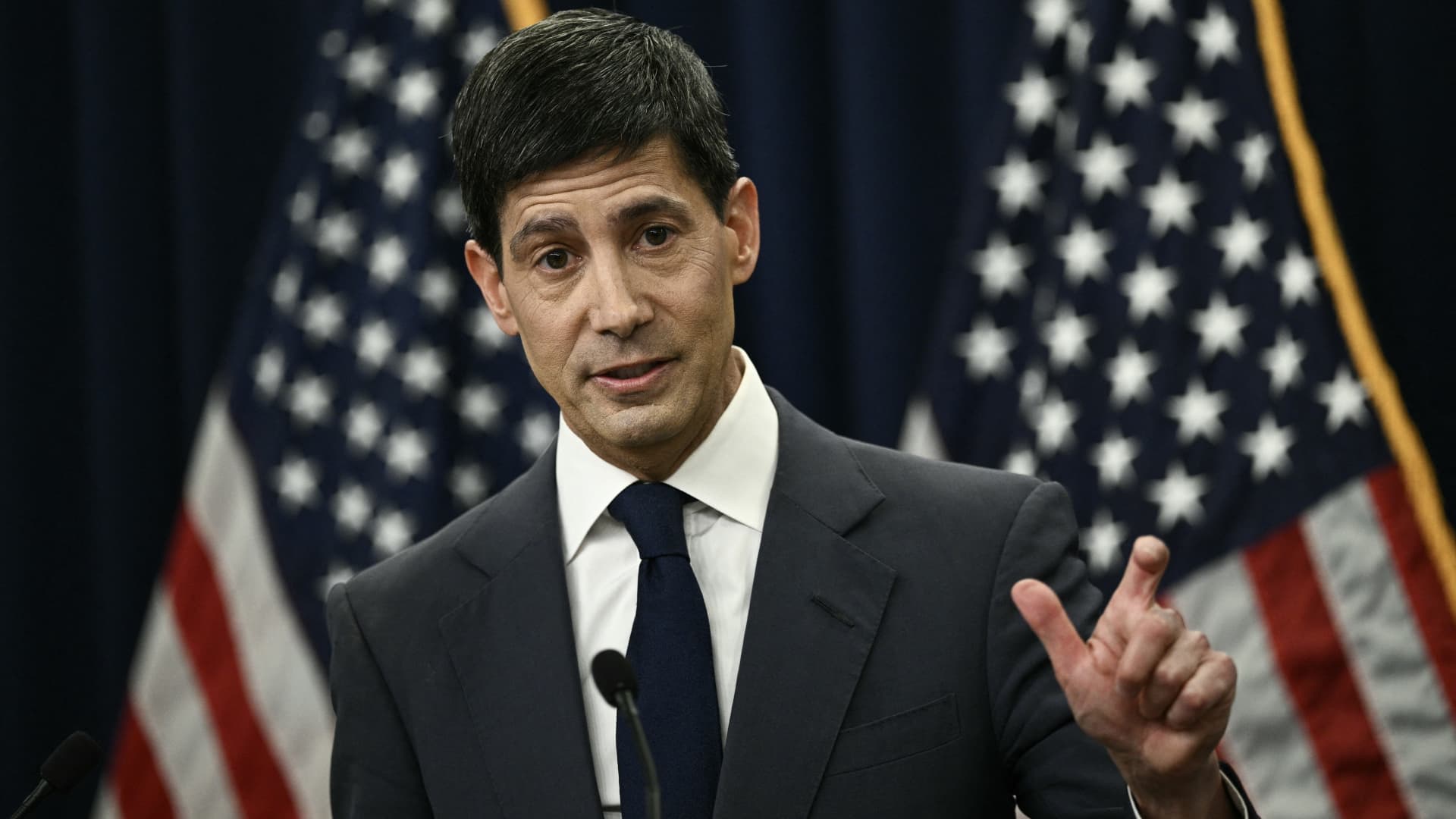
U.S. Federal Reserve Chairman Kevin Warsh speaks at a press conference in Washington, DC, June 17, 2026.
Brendan Smialowski AFP | Getty Images
Federal Reserve Chairman Kevin Warsh on Tuesday vowed to “get monetary policy right” and defeat the inflation that has plagued the central bank for the past five years.
In remarks to another Congressional committee this week, Mr. Warsh reiterated recent harsh comments about inflation, while also emphasizing the strength of the U.S. economy and the benefits to be gained from business investment, particularly in artificial intelligence.
“Today, we stand at a crossroads in history, and it’s up to all of us to rise to this moment,” Warsh said in a speech before the House Financial Services Committee on Tuesday and the Senate Banking Committee on Wednesday.
He added: “The Fed’s primary goal is to get monetary policy right, or as close to it as possible. That is our clear and abiding goal, and that is our guiding star.” “And if we get policy right, and we will, the inflation surge of the past five years will be a thing of the past.”
The remarks came just two months into Warsh’s term. The Fed chairman is required to appear before Congress twice a year to report on monetary policy and then take questions from lawmakers.
Mr. Warsh takes over a Fed whose inflation rate has exceeded the mandated 2% since 2021. During his confirmation hearing earlier this year, the chairman called inflation a “choice,” and during his first press conference he reiterated the importance of lowering the cost of living.
Like his predecessor, Jerome Powell, Warsh said that persistently high inflation levels are “unfairly burdening American households and businesses,” and that they face higher costs across the board, with recent increases driven in large part by soaring energy prices.
“While monthly price fluctuations are inevitable, especially in a volatile world, the basis for long-term inflation is largely determined by monetary policy,” he said. “Members of this committee do not tolerate persistently high inflation and share a firm determination to restore price stability.”
Looking at the broader picture, Warsh said the economy is “expanding at a solid pace and is showing resilience in the face of recent trends.”
He singled out business investment, which he called “the most striking feature” of the current situation.
“The pace that appears to be accelerating largely reflects the huge demand for data center construction and the AI-related equipment and software that will be installed there,” he said.
“We don’t know how much the economy will benefit from the development of AI,” he added. “However, it seems inevitable that what is currently called ‘AI investing’ will soon be simply called ‘investing’.”
Mr. Warsh has previously said he expects the AI productivity boom to be disinflationary, a premise that some economists and Fed policymakers dispute.
Elsewhere, Mr. Warsh further elaborated on the five task forces he created to conduct a comprehensive review of the Fed’s operations. Panel discussions will explore topics such as communications, technology, balance sheets, economic data used by the Fed, and views on inflation.
He said the groups are together part of a “new chapter for the Federal Reserve,” an extension of the “regime change” Warsh promised in an interview with CNBC last year. But while Warsh previously blamed the Fed’s “incumbents” for systemic problems, he has taken a more conciliatory stance since taking office.
“It’s an honor to return to the Federal Reserve and once again work with so many talented and dedicated people I call colleagues,” he said.
Make CNBC your preferred source on Google and never miss a moment from the most trusted names in business news.
Source link
