


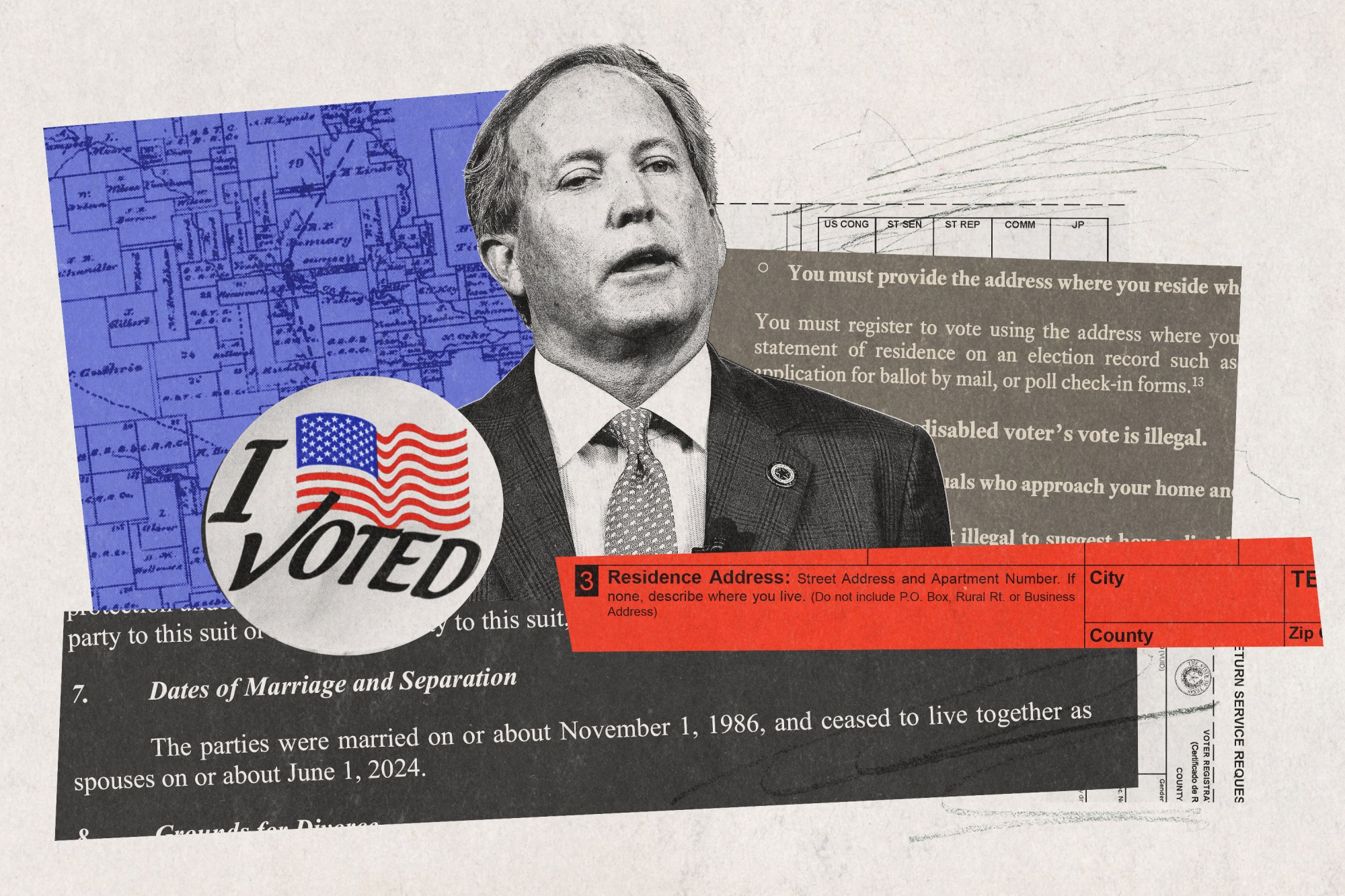
Two weeks before this year’s primary election, Texas Attorney General Ken Paxton announced the creation of a tip line for people to report suspected voter fraud.
“Free and fair elections are the cornerstone of a thriving republic, and with the authority vested in my office by the Legislature, I will stop at nothing to expose and stop illegal voting activity,” Paxton said in a February news release announcing the tip line.
The announcement was related to guidance from his office on Texas election law, including a requirement to be a U.S. citizen, a ban on collecting mail-in ballots on behalf of others, and a warning that “it is unlawful to misrepresent a residence on election records or to establish a residence for the purpose of influencing the outcome of an election.”
“You must register to vote using your residential address,” the attorney general’s guidance states.
Records obtained by ProPublica and the Texas Tribune show that despite his warnings, Paxton appears to have used a non-resident address while voting in six elections over the past two years, including the May runoff in which he was the Republican Senate candidate.
State Sen. Angela Paxton said in her 2025 divorce filing that Paxton, who accused her of extramarital affairs, moved out of her Collin County home a year ago. However, Paxton continues to list his home address in the northern Dallas suburbs on his voter registration. Angela Paxton declined to be interviewed. A source close to the Paxtons said Attorney General never returned to their home after leaving.
It is unclear where Mr. Paxton has lived for the past two years, but ProPublica and the Tribune have reported that he has been living in a home in neighboring Denton County since February.
Three election lawyers told news outlets that Paxton may have violated the same Texas law that his office warned in a news release.
ProPublica and the Tribune contacted Mr. Paxton’s campaign on June 3, 15, and 25 to ask why he continues to register to vote in Collin County, even though he no longer appears to live there, and about his ties to property in Denton County. The reporter also left a voicemail on his personal cell phone on June 25th. The news organization sent an email to government offices and campaign staff on Monday with a detailed list of questions, including one requesting Paxton’s response to his election attorney’s opinion that he may have violated the law.
Paxton and his office did not respond by email Monday. Campaign spokeswoman Madison Searcy did not respond to media questions. Instead, she issued a statement saying the attorney general is “a national leader on election integrity with a long track record of defending Texas elections.” “Tabloid articles full of baseless lies that try to tear him down by implying otherwise is not real reporting,” Searcy said.
The campaign did not respond to two requests for clarification on what it believed were inaccuracies.
Voting in an election if you are ineligible is a second-degree felony under Texas law, punishable by up to 20 years in prison and a fine of up to $10,000. But election lawyers say individual voter residency claims are difficult to prove, so prosecutors rarely challenge them and file lawsuits.
State courts have repeatedly ruled that there is no one way to determine where someone lives, and that judges must consider multiple factors, including where voters sleep and keep their personal belongings. Prosecuting such cases also requires proof that the voter “knowingly” or “deliberately” broke the law.
Even if it is clear that you no longer live at the address where you are registered to vote, state law allows you to remain registered if you intend to return home for a temporary absence. This clause is commonly used by college students and military personnel.
“I think as long as you really want to go back, you’ll be fine,” said Beth Stevens, an elections attorney who has worked with the Harris County Clerk’s Office and the Texas Civil Rights Project. “When you start doing things that make you think, ‘Oh, I’ve completely moved on. I’m just wink-winking that I’m going to come back,’ that’s when you get into questionable territory.”
David Becker, a former voting rights attorney at the Justice Department, said Paxton’s controversial and public separation from his wife could make it difficult to argue that he intended to return to the home he owns or where she continues to live.
“You’re going to have questions about a residence that someone isn’t living in, isn’t spending the night in, and has no intention of continuing to occupy. That would probably raise red flags in any state,” Becker said.
Becker, now director of the Center for Election Innovation and Research, a Washington, D.C.-based nonprofit that works to build public trust in elections, added that the situation is especially troubling because Paxton’s job is to enforce election laws.
“Certainly, Texas’ top law enforcement officer, who has advocated for election integrity and made it a priority of his job, should be charged with knowing Texas resident laws regarding voting,” Becker said.
Paxton has advocated for stricter enforcement of the state’s election fraud laws, including lawsuits against voters whose residence records his office allegedly falsified. In 2018, the Attorney General’s Voter Fraud Unit arrested nine people for allegedly using a non-residential address to vote in the Edinburg City election in the state’s Rio Grande Valley. The county prosecutor who represented Mr. Paxton later dismissed the charges, citing a lack of conviction against the mayoral candidate for encouraging voters to register with false addresses. Candidate Richard Molina has maintained his innocence and said prosecutors were politically motivated.
Clark Barsall was not an attorney in those cases, but he represented another resident whom Paxton had charged with voting illegally. Birdsall was stunned that the attorney general appeared to vote at an address where he did not live.
“It’s especially egregious when someone like Ken Paxton appears not to be following the law,” he said.
State privacy laws allow some politicians and law enforcement officials to keep voter registration information from public view. Paxton doesn’t. So does his opponent in the Senate race, Democratic state Rep. James Talarico. Talarico’s campaign said he lives in a north Austin home he bought in 2022 and has it registered. ProPublica and the Tribune could not independently confirm this.
Paxton’s campaign did not raise any issues with Talarico’s voter registration. But Mr. Searcy said in a statement to ProPublica and the Tribune that “Mr. Talarico has actively campaigned against voter safety measures” and opposes voter identification requirements. She pointed to a 2021 Fox News interview in which state representatives said they opposed voter identification rules that would require Texans to provide part of their driver’s license number or Social Security number when voting by mail. Talarico said hundreds of thousands of Texans who don’t drive don’t have a driver’s license. During the interview, he did not directly answer questions about his Social Security number.
Talarico’s camp did not respond to requests for comment.
Paxton’s housing status since his separation from his wife has not been made public, but information obtained by ProPublica and the Tribune gives some indication of where Paxton has been living since February.
In mid-February, a trust company purchased a 5,000-square-foot home listed in a gated community in Denton County for $2.4 million, according to the appraisal district and the seller’s real estate agent. The trust did not disclose its ownership to Denton County officials. A spokesperson for the Travis County Appraisal District said the trust is not required by law.
Paxton shared a separate blind trust with his wife Angela, which he used to purchase real estate and other assets. For years, the address listed on that blind trust was an office building in Collin County. However, that address was changed to a home in Denton County a week after the property was purchased.
Angela Paxton said through a spokeswoman that she has no connection to the Denton County home or the trust that purchased it. Family friend Chip Roper, a trustee of the Paxtons’ trust, did not respond to questions about the change of address.
In June, a reporter knocked on his door in Denton County. No one answered. When the reporter put Paxton’s letter in the mailbox, he saw an envelope addressed to Warren Paxton, the attorney general’s name.
Later that week, Paxton appeared on a podcast with Texas Lieutenant Governor Dan Patrick. A video of the podcast showed Paxton sitting in front of a fireplace and mantle that looked almost exactly like the one depicted in the online real estate listing. A resident also told reporters that they found Paxton in the gated community.
In a June podcast appearance, Texas Attorney General Ken Paxton sat in front of a gray fireplace that appeared to match a real estate listing for a Denton County home. Retrieved and edited to protect privacy by ProPublica and The Texas Tribune
Separately, the Daily Mail reported in May that Paxton had moved into a Denton County home with Tracy Duhon, and the outlet said Duhon and Paxton’s extramarital affair led to his wife filing for divorce. The Daily Mail also published a video of Paxton and Duhon that it said was taken at an Icelandic airport in late June. The video quickly drew the attention of Talarico, who portrayed Paxton as distancing himself from the Texans. Duhon did not respond to questions about her relationship with the Denton County property or the Daily Mail report.
Paxton is not registered to vote in Denton County, according to voter rolls. Instead, he has voted twice in Collin County since February, once in the Republican primary in March and once in the runoff election in May. Because each county in Texas elects its own local officials, state law requires voters to register where they live.
Echo Yanka, a law professor at the University of Michigan who specializes in election law, said Paxton’s voter registration status should remind the attorney general that studies consistently show that intentionally illegal voting is rare.
“I think people who are going through this will learn a little bit of humility that a lot of things that appear on the surface, such as technical legal violations, can usually be explained by completely normal things,” Yanka said. “In fact, only a complete cynic who ignores all evidence can claim that these events were the result of egregious criminal intent.”
Joshua Blank, director of research at the Texas Politics Project at the University of Texas at Austin, said Paxton cannot claim ignorance of the law because he is enforcing the law. In fact, as attorney general, Paxton should avoid even the appearance of not following the law, Blank said.
“We expect these laws to be understandable to the general public,” Blank said. “When our elected officials, who are tasked with passing and enforcing these laws, have a problem with engaging in the voting process themselves, that creates serious problems.”
