


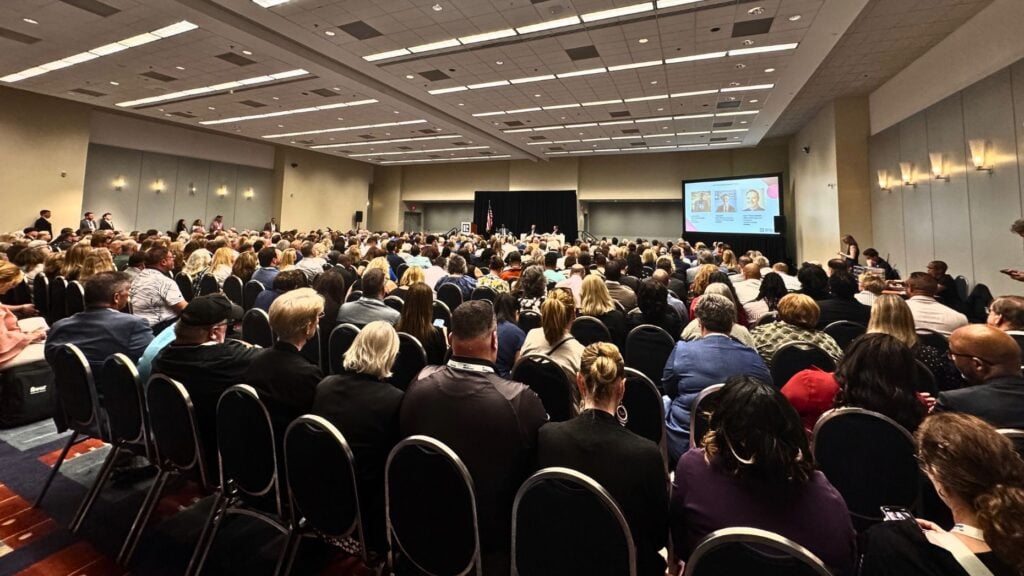
By the time White House Science and Technology Policy Director Michael Crasios began speaking, there was standing room only. But he had a clear message for real estate agents and brokers: Start using AI now.
Kratsios’ comments were made at the Regulatory Issues Forum, “AI Innovation, Real Estate, and Regulation: A Candid Discussion on AI Regulation at the National Association of Realtors’ 2026 Legislative Conference in Washington, D.C.” The forum, held on Monday, highlighted how important AI and regulation are for real estate agents.
Kratsios, Trump’s chief of staff for science and technology, told a crowd at the Walter E. Washington Convention Center that AI tools are already available that can automate back-office operations, streamline communications with clients and sharpen market knowledge, and agents who delay adoption risk falling behind in what he called a “K-shaped economy” that divides companies into two camps.
“There has never been a better time in history to be a small business owner than today,” Kratsios told the crowd. “In the history of the world, there has never been a more powerful tool for small businesses to use and leverage to their benefit.”
Kratsios spoke during a fireside chat moderated by Kaitlyn Vannoy, NAR’s director of legal advocacy. The chat preceded a panel discussion on AI regulation moderated by Sipho Simela, founder and CEO of Matrix Rental Solutions, and featuring Adam Thierer, resident senior fellow on the R Street Institute’s technology and innovation team, and Travis Hall, director of state engagement at the Center for Democracy and Technology.
K-shaped economy
Kratsios cited data from financial technology company Ramp as evidence of the widening gap between AI adopters and bystanders. He said that because Ramp processes corporate card transactions, it can track which companies are spending on AI tools and what happens to their revenue as a result.
“These companies are actually seeing a dramatic increase in revenue,” Kratsios said of companies that have adopted AI. “And companies that aren’t buying AI or trying to implement AI are basically stagnant in their growth.”
He said RAMP economists are increasingly concerned about this trend, which they describe as a K-shaped economy, where some companies grow at above-average rates while others plateau.
Kratsios urged agents not to wait for perfect conditions before deploying AI, explaining that the learning curve is more manageable than it was a year ago.
“I think that’s very likely,” he said. “The ROI of spending part of your week absorbing some of these and using them for basic tasks is like a snowball effect where you start to see something working in one place and can think about testing it in another place.”
1,800 laws, no clear framework
Kratsios’ optimism gave way to a more cautious tone as the conversation turned to a panel discussion on the regulatory landscape. In their discussion, Mr. Tiller and Mr. Hall painted a picture of a fragmented and rapidly changing policy environment that poses real compliance risks for agents and brokers.
Tierer, who has been tracking technology policy for 35 years, told the audience that the scale of AI legislative activity alone is staggering.
“According to one leading AI tracking service, there are currently 1,800 legislative actions in place in the United States,” Tierer said. “That’s a huge number.”
He said the surge represents a major reversal from the 1990s, when a bipartisan federal approach to internet policy helped birth the digital economy. Currently, he says, Congress is largely out of touch with technology policy, leaving states to fill the void in contradictory and sometimes contradictory ways.
“It’s crazy,” Thieller said of the patchwork approach. “The market in 2026 will not function well and will not be orderly.”
Who is responsible when AI fails?
Hall, who runs an organization focused on civil rights and technology, focused on a more pressing concern for real estate agents: it’s still not clear who will be held responsible if AI tools have a negative impact on real estate transactions.
“The problem with artificial intelligence is that it obfuscates how decisions are made,” Hall said. “It blurs responsibility. Who is ultimately responsible when things go wrong?”
He pointed out that agencies already have legal responsibilities for fair housing compliance, accurate disclosure, and customer due diligence, and that their duties do not stop just because AI tools are involved in the process.
“You’re on the front lines, and now you’re being told that. To be fair, I think you could be more efficient with these tools, but there’s a layer of testing and accountability for these tools that’s missing,” Hall told the audience.
Drones, data, and what’s next
During the fireside chat, Kratsios also previewed regulatory changes that will directly impact real estate professionals. It’s a new federal rule governing behind-the-scenes drone operations that allows agents to send drones to map properties without being physically present.
“This is currently illegal without an FAA exception,” Kratsios said, adding that a final rule is expected to be released soon.
Regarding data ownership, Kratsios said the administration’s position is that creators should control how their content is used to train AI models.
“If you’re a creator, if you create something, you need to manage that asset,” he said. “If you want someone to give you consent to use it, you should let them use it. If you don’t want to give consent, you shouldn’t use it.”
Thiers concluded his panel comments with a warning about the next big pressure point for the industry: litigation.
“The floodgates of litigation are now open,” he said, warning that trial lawyers are keeping an eye on the uncertain liability situation surrounding AI. He said that without federal safe harbor provisions, even minor AI-related mistakes could expose intermediaries and agents to legal action.
The hall closed by imploring the audience not to wait for regulatory clarity before establishing internal AI policies and warning that the alternative is worse.
“If you haven’t already established an AI policy for your company, you already have one,” Hall said, paraphrasing a McKinsey study. “You just don’t know about it.”
Email Jesse Healy
