


[Today’s Iran war update again launched before complete because overly dynamic situation. We aspire to have the post done by 8:00 AM EDT, at worst 8:30 AM EDT. Please return around then or refresh the page for the completed version.
Also be sure to scroll into the body for the financial markets/real economy sightings. These are important for fundamental reasons as well as putting pressure on Trump]
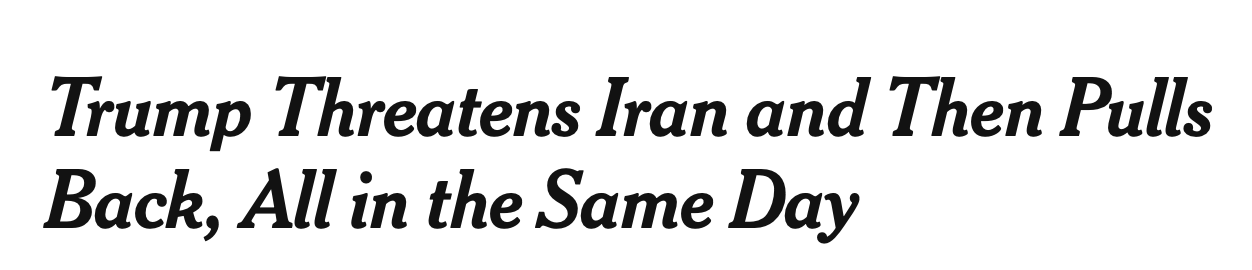
We signaled yesterday that, due to Trump conditioning, we were skeptical that Trump would deliver on his latest threat of an imminent, very big very bad attack on Iran, despite military-connected types saying they expected action based on continued movement of military assets into the theater and noises from contacts.
As the New York Times put it:
The Trump statement:
Now it is possible that this new flip flop is a feint to keep the growing investor freakout at bay, and that Trump will attack over the Memorial Day weekend, which we had seen as the probable timing. But as Jim Carville said,
I used to think that if there was reincarnation, I wanted to come back as the President or the Pope or as a .400 baseball hitter. But now I would want to come back as the bond market. You can intimidate everybody.
As we’ll cover in more detail later in this post, yields rose meaningfully across the world as too-complacent finance types are finally coming to grips with the idea that the Strait of Hormuz is very unlikely to return to old normal traffic levels any time soon and that that is very bad, potentially catastrophically bad.2
Trump did give what we see as fundamentally misguided hopes of negotiations yet another lease on life via an itty bitty concessions to Iran. Note a story on Tasnim News, even picked up by Bloomberg, that the US was again going to lift sanctions on Iran oil, was false.3
In his tweet, he stated he had acceded to requests from Qatar, Saudi Arabia, and the UAE to hold off and continue with negotiations. We pointed out very early on that one way for this war to end sooner rather than later was for key Gulf states to come to terms with Iran, which would cripple US and Israeli operations.
We have no idea yet how firm these objections were, and they may not have been at the same intensity level. Recall that after Saudi Arabia, Kuwait, and others said they would not allow their airspaces to support Project Freedumb, Trump scuttled that operation. But several tweets on Twitter claimed that the Saudis were otherwise permitting the US to use their airspace.
Keep in mind that we do not know how firm the stance of these states is and whether they are unified. Larry Wilkerson said last weekend that the Saudis had lodged a protest over the use of their airspace and facilities, but he did not regard that as sufficient.4 Wilkerson opined that the the Saudis would need to tell the US that it was prepared to send in armed personnel to oust the Americans if needed.
Even though Trump’s relationship with truth is strained, he is constrained in how far he can go in fabricating by the fact that the White House is packed with Zionists. With that in mind, consider how Trump explicitly said he “informed” Israel of his decision to honor the Gulf states’ petition:
Starting at 1:13, from a machine transcript:
Reporter: Can you speak a little bit about your post on Truth Social on Iran and what was the decision that why you didn’t attack Iran?
Trump: Well, other countries have come to me and they’ve said we were getting ready to do a very major attack tomorrow. And I put it [snorts] off for a little while. Hopefully maybe forever, but possibly for a little while.
Of course, we’ve had very big discussions with Iran.
And we’ll see what they amount to. I was asked by Saudi Arabia, Qatar, UAE, and some others if we could put it off for two or three days, a short period of time because they think that they are getting very close to making a deal. And if we can do that where there’s no nuclear weapon going into the hands of Iran, I think. And and they’re satisfied, uh we will be probably satisfied also.
Uh we’ve uh informed Israel. We’ve informed other people in the Middle East that have been involved with us.
Now even if this positioning is entirely Trump spin, the fact is that the Gulf states, are seeing the mounting costs and potential for Iran sending them back to the stone ages with its promised ferocious retaliation in the event of another meaningful US/Israel attack. Out of self-preservation, they need the conflict to cool down to at most terrorism against Iran and traffic in the Strait of Hormuz at much higher levels. This obvious conflict with Israel is now becoming acute.
And if the UAE, which recently attached itself at the hip to Israel, is now retreating from more aggression, US and Israel operations in the theater would be hamstrung. I am not an expert but I would venture it would be more difficult to mount another round of full bore attacks, and at a minimum would require developing new plans.
However, even if enough Gulf states really are putting down their feet hard as far as stopping escalation is concerned, that is a long way away from ending the conflict. Israel could still try to go alone and drag the US in deeper. Even with a Gulf states revolt, I doubt Trump would drop the hammer on Israel by cutting off targeting support.6
And there is always the option of a false flag.
With Mario Nawfal, Trita Parsi picks though the Trump messaging right before and after his latest TACO. As I have warned readers repeatedly, it’s necessary to filter out Parsi carrying on about “negotiations” where former diplomat has objected to the use of that term, saying the messaging at a distance underway can at most be called talks.5
From a lightly-cleaned up machine transcript. At the top from Parsi:
I think a lot of people have seen of course the post in which he says that the UAE, Saudi, and Emirates asked him not to attack and as a result he’s pulling back, etc. And obviously that’s very important.
We should, you know, analyze that, but it’s also very important to take a look at the the tweet or the post that he had an hour or so before in which he at first it looks as if he was calling for Iran’s complete capitulation and their navies at the bottom of the sea, etc. etc.
Which again, if that is really what his message was would be devastating. It would mean that he is really going for war. It would be a tweet that would, you know, disrupt whatever negotiations were taking place.
But when you read the full tweet and it’s like one long sentence that is an entire paragraph, you realize actually that’s not what he’s doing. He’s saying that even if all of that was achieved, the mainstream media, New York Times would never say that he won.
Instead, they would say that Iran won. And I think that is reflective of the fact that he’s frustrated that he’s not going to be able to get the type of the win that he wants. But he’s also trying to say to everyone, I am going to get that win, but don’t trust the media when they say that Iran won because they will say that Iran won regardless of what the reality is.
That’s the kind of a tweet you’re going to say put forward when you’re about to actually back off from a very significant milestone that you had put forward for the negotiations. And in order to protect yourself from saying that, you know, this is a failure, he’s now discrediting the voices preemptively of those who are going to come out and criticize him and say that this is a failure because he didn’t achieve X Y Z that you had said that you would do.
Larry Johnson is not buying hopium and simply sees Trump in yet another rinse and repeat cycle. From The President Who Cries War, then Peace, Then War:
The lad who inspired Aesop to write, “The Boy Who Cried Wolf” (also known as “The Shepherd Boy and the Wolf”), has grown up and is now President of the United States. Since February 28, 2026, Donald Trump has released 11 statements suggesting the war with Iran was over or that a negotiated deal is close, only it turns out to be a hoax.
What emerges across nearly three months is a remarkably consistent cycle: Trump declares victory or proximity to a deal → Iran denies it or the facts on the ground contradict it → Trump escalates rhetoric → a new round of claimed breakthroughs begins. Analysts noted the contradictions reflected Trump seeking what one described as a “quick and easy” triumph while Tehran was determined to delay US demands and extract its own concessions first — a fundamental mismatch in negotiating timelines that produced the whipsaw of declarations. The declarations themselves have become a diplomatic liability, with Iran repeatedly using them as evidence that the US negotiating position is incoherent….
The only thing Trump is accomplishing with this constant reversal of his position on attacking Iran is giving friends and family who are clued in to Trump’s “peace” announcements the chance to make big money by shorting stocks and oil. Otherwise, he is undermining trust and confidence in his presidency. Aesop’s fable about the Boy Who Cried Wolf teaches the moral that repeated lying erodes trust, so that when a real crisis occurs, people won’t believe the liar.
Aside from being a very profitable exercise for Trump and his cronies, the Trump gaslighting has succeeded in another way: some major media outlets are not giving the conflict above-the-fold coverage.1 But the flip side is investors are not reacting as positively as they did before to Trump antics that ought to be market soothing. For instance, a fresh update from Aljazeera’s live feed:
Oil prices fall as Trump holds off on scheduled attack on Iran
Oil prices have fallen, with global benchmark Brent crude dropping 1.5 percent, after Trump said he had paused a planned military strike on Iran to allow for negotiations to end the war.
Brent futures LCOc1 for July were down $1.73, or 1.5 percent, at $110.37 a barrel as of 08:25 GMT, while US West Texas Intermediate crude CLc1 for June delivery, which has expired, slipped 63 cents, or 0.60 percent, to $108.03.
The more active July contract CLc2 fell 82 cents, or 0.8 percent, to $103.56.
Some kinetic front sightings:
⚡️BREAKING
A regional source says the United States expects the Bab el-Mandeb Strait to be Closed
The Pentagon has significantly stepped up its surveillance over Yemen, and one of its MQ-9 drones was Shot Down less than 24 hours ago
The closure of this Strait would deprive… pic.twitter.com/5HfeQLQY7D
— Iran Observer (@IranObserver0) May 18, 2026
فعالشدن پدافند قشم علیه ریزپرندهها
خبرنگار تسنیم به نقل از منابع مطلع: پس از مشاهده ریز پرندهها در آسمان جزیره قشم، پدافند در جهت نابودی اهداف متخاصم فعال شده است
— خبرگزاری تسنیم – خبر فوری (@Tasnimbrk) May 18, 2026
خبرگزاری تسنیم – خبر فور\
Translated from Persian:
Qeshm’s Air Defense Activated Against Micro-Drones
Tasnim News Agency reporter, citing informed sources: Following the sighting of micro-drones in the skies over Qeshm Island, air defense systems have been activated to destroy the hostile targets.
On the economic front, the alarms about collateral damage from the continuing close-to-closure of the Strait of Hormuz are getting louder and identifying more types of collateral damage. Today’s must watch from Jeff Currie is short but pointed:
Last night, I went outside my normal media fare to listen to a few squawkbox type segments on the state of the bond market. They confirmed the alarms Currie has been making from early on in the Strait of Hormuz crisis, that the finance types are dangerously out of touch with the importance and ultimate primacy of commodities and supply chains. The pundits and bond pros nattered on about inflation with no joke virtually no mention of energy prices and none of the Strait of Hormuz. When asked what would come next, all talked about Fed action only. Below is an example of generally useful commentary that nevertheless is hopelessly anchored in the view finance is the driver of inflation and not the real economy:
It was as if I had entered a movie set where experts with market feeds on their screens were talking to TV producers, and in the outer window a huge head of Godzilla appears, with his teeth bared.
Similarly, this Aljazeera segment demonstrates how out of touch US elite beliefs are on the downside risks. In Trump halts planned Iran attack after Gulf leaders intervene amid diplomatic efforts the short discussion with the White House correspondent demonstrates how they will continue to sacrifice the general public. He describes that Republican Congresscritters worry that voters will punish them at the polls despite lower energy prices at election time, as if that was likely.
By contrast, the Financial Times turns the urgency dial up a notch in Financial Times Tipping point looms for global energy crisis:
Nearly 80 countries have now introduced emergency measures to protect their economies as the world approaches a new, more dangerous phase in the energy crisis driven by the Iran war.
Governments are stepping up their responses ahead of a looming tipping point, when traders warn that oil prices could jump again sharply unless more fuel trapped in the Gulf can be exported through the blockaded Strait of Hormuz.
Paul Diggle, chief economist at fund manager Aberdeen, said his team was now examining a scenario where Brent crude rockets to $180 a barrel, causing surging inflation and recessions in a host of European and Asian countries…
Demand for air conditioning and holiday travel at the start of the northern hemisphere’s summer will put further strain on supplies of crude oil, gasoline, diesel and jet fuel, when global stocks are already falling at the fastest rate on record…
The International Energy Agency estimates that the number of countries that have already been forced into emergency measures has reached 76, up from 55 at the end of March.
Economists and traders warn the next phase of the crisis could bring another sharp jump in energy prices, broader fuel rationing, industrial shutdowns and a significant slowdown in global growth.
If the Middle East conflict “does not end in the coming weeks and we don’t have the reopening of the Hormuz strait, I’m afraid a world recession could be on the table”, the EU’s transport commissioner Apostolos Tzitzikostas told an FT conference in Athens on Thursday.
Since the outbreak of the conflict, the world has been existing beyond its energy means.
The IEA estimates that between March and June global oil consumption will run roughly 6mn barrels a day above production. Some analysts believe the shortfall could be closer to 8mn-9mn barrels a day…
More than 2mn barrels a day of emergency crude from strategic reserves are flowing into the system, but many of those releases are scheduled to end by July.
Global reserves have fallen by nearly 380mn barrels since the war began, the IEA said, excluding the inaccessible stocks trapped inside the Gulf.
….Most oil reserves, over 3bn barrels, are held by oil companies, traders and refineries, but the majority of this “inventory” is part of the system. Pipelines require minimum volumes to maintain pressure, refineries need continuous supplies and storage tanks cannot be fully drained without risking damage.
Markets would seize up well before inventories hit zero, said analysts…
JPMorgan estimates inventories among OECD countries could approach “operational stress levels” by early June….
Across large parts of the developing world, shortages are already apparent…
“An ‘escalation’ scenario — where oil prices surge through $150 a barrel — would mean physical shortages, supply chain disruption, and recessionary outcomes,” they said in a note this week.
Even local media are warning oil prices could rise to $140 to $180 a barrel levels:
Bloomberg described to panic buying by businesses in Global Inventory Race Intensifies in Shadow of the Iran War
The global rush to stockpile manufactured goods on fears of an energy-supply crunch will again overshadow business surveys in the coming week gauging the impact of a third month of war in the Middle East.
Among the purchasing manager indexes for May measuring industrial activity in key economies, all of those for which Bloomberg polls analysts are projected to show continued expansion, in many cases bolstered by front-loaded stockbuilding.
The question overshadowing the spate of numbers due from Australia to the US on Thursday will be the extent to which such a picture points to resilience, or is simply evidence of manufacturers running on fumes before the energy shock fully hits.
The indexes will also reveal how that cost impact is affecting major economies, while possibly hinting at the sort of supply logjams that production volatility caused during the pandemic.
And on one of our favorite topic, jet fuel shortages, CNBC takes note:
No one is spared! See Reuters in Rising diesel costs from Iran war strain US school budgets (hat tip Ann)
And a very fine account of the significance of a Department of Justice saddling up to poke around at a BlackRock credit fund that looks green at the gills. DoJ = criminal, since this is normally the SEC’s beat and one assumes the SEC must have made a criminal referral. Admittedly, even if there are charges (recall this is just at the investigation stage), they could wind up being merely civil, particularly if BlackRock is cooperative.
But as Jeff Snider describes long form, this probe legitimates valuation worries about private credit funds generally:
In comic relief of sorts, The Cradle picks up a Financial Times story (hat tip Kevin W) Trump’s $40bn Hormuz insurance scheme fails to cover a single ship: Report. Recall we had predicted its failure from the get-go:
Two months after US President Donald Trump announced a $40-billion scheme to provide insurance for vessels to pass through the Strait of Hormuz, not a single dollar of coverage has been provided, the Financial Times (FT) reported on 18 May…
“But the up to $40bn program has not yet been used at all, two people familiar with its operations said, even as insurance rates have been stuck at multiples of their prewar levels,” FT wrote.
According to insurance brokers speaking with the British newspaper, Trump’s scheme failed because it could not meet all the requirements for ships transiting the strait and depended on the US Navy providing ongoing military escorts, which it was unable to do.
This post is already long, so apologies for leaving an important item to the very end. Sky News has done on-the-ground reporting from Minab on the US war crime perpetrated there. I hope you have time to watch their documentary and circulate it widely.
Done for now. See you tomorrow!
____
1 See the BBC landing page at around 5:00 AM EDT:
And the Wall Street Journal landing page at the same time:
The Bloomberg US landing page does give the latest Trump TACO prominent play:
2 Commodities maven Jeff Currie pointed out that even with Ansar Allah’s attacks on Red Sea shipping had dropped down greatly about two years ago (and the latest strikes were on Israel-bound vessels), traffic on that route was at 75% of former levels.
3 There were reports of denials by anonymous US officials, but this is dispositive:
The US Treasury Secretary says he’s calling ‘the world’ to join the US in imposing sanctions on Iran.
Scott Bessent was speaking as G7 finance ministers arrived in Paris for a two day meeting amid global economic turmoil. pic.twitter.com/M0ht5nDMps
— Al Jazeera Breaking News (@AJENews) May 18, 2026
4 When Spain’s President Sanchez said he would not allow the US to use Spanish airbases in the Iran war, that the US could simply fly in and use them. See at 0:30:
So Wilkerson’s point is well taken.
5 Confirmation comes from Aljazeera, which has multiple entries today on how impossibly far apart the two sides are. An example from Aljazeera’s live blog:
Iran, US remain at loggerheads over key issues
There remains a significant difference in the positions of the negotiating parties.
In his latest address to the parliament’s National Security Commission, Iran’s Deputy Foreign Minister Kazem Gharibabadi said Iran is not going to give up on its right to enrich uranium.
This is a sticking point, as the Americans have said in their proposals that the Iranians must stop enriching uranium for the next two decades.
Iran has rejected this, saying this period is too long.
Iran says the Americans must guarantee an end to the war on all fronts, including Lebanon, before it will discuss its nuclear programme.
The Americans have refused to agree to this, saying it depends on the course of negotiations.
Iran has also asked the US to end its blockade of the Strait of Hormuz. The US has said Iran must first reopen the Strait of Hormuz before it will do so.
Iran is also insisting on receiving reparations for war damage, which the Americans have firmly rejected.
Iran has asked that US forces withdraw from the region, particularly from the GCC countries, and that all the sanctions related to the nuclear file, human rights violations, “terrorism” sponsorship and so on be lifted, which the Americans have also not agreed to do.
5 Confirming Ambrose Bierce in his Devil’s Dictionary:
Alliance: In international politics, the union of two thieves who have their hands so deeply inserted in each other’s pockets that they cannot separately plunder a third.
