


[This Iran war post fired before finished. Please come back at 8:00 AM EDT or refresh the page then for a final version]
Haven’t we seen this movie before? Trump again blusters at Iran:
Trump’s brinkmanship poses a grave threat to int. peace and security. His blustering is an attempt to appear scary—a stark mismatch with the reality on the ground, where he is struggling with self-inflicted failures that he tries to mask as victories. His policy has reached a… pic.twitter.com/2NSq7xSUkD
— Iran in Japan/ 駐日イラン大使館 (@IraninJapan) May 18, 2026
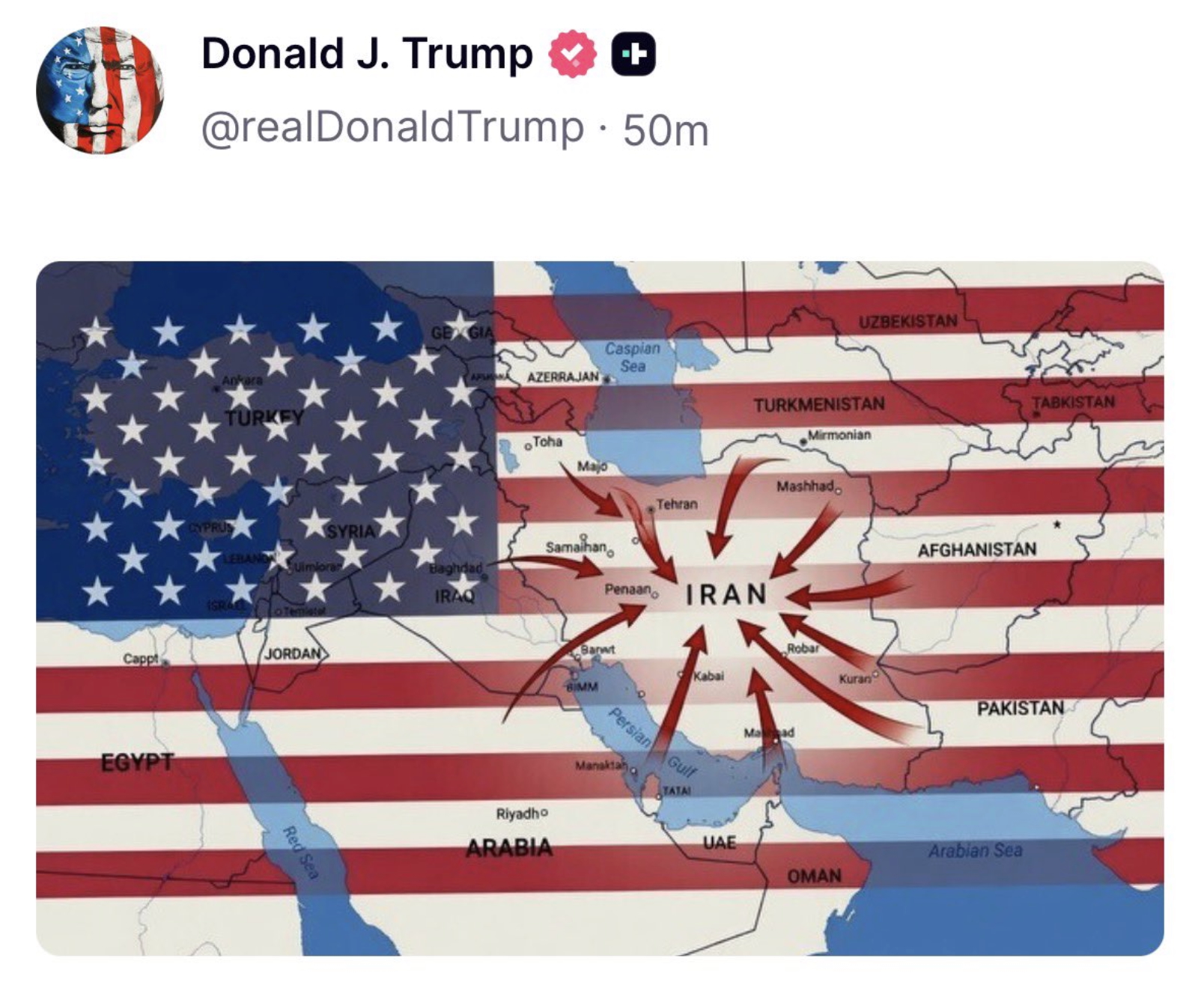
And this tweet went live about 12 hours ago, which looks as if Trump has embraced the Israeli goal of balkanization:
The US and Israel continue to send signals that they are about to Do Something. First from Axios, Team Trump’s preferred messaging outlet, in Trump warns Iran “clock is ticking” until U.S. launches harder strikes:
President Trump told Axios in a phone call that “the clock is ticking” for Iran and warned that if the Iranian regime doesn’t come with a better offer for a deal “they are going to get hit much harder.”
Why it matters: U.S. officials say Trump wants a deal to end the war, but Iran’s rejection of many of his demands and refusal to make meaningful concessions on its nuclear program has put the military option back on the table.
Trump is expected to convene his top national security team in the Situation Room on Tuesday to discuss military options, two U.S. officials said.
Trump spoke Sunday with Israeli Prime Minister Benjamin Netanyahu about the situation in Iran.
Behind the scenes: Trump met Saturday with members of his national security team at his Virginia golf club to discuss Iran, a source with knowledge said.
Attendees included Vice President JD Vance, White House envoy Steve Witkoff, Secretary of State Marco Rubio and CIA Director John Ratcliffe.
State of play: Pakistan’s interior minister visited Tehran on Saturday and Sunday for talks with senior Iranian leaders about the deal for ending the war. Pakistan is the official mediator between the U.S. and Iran.
Qatari Prime Minister Mohammed bin Abdulrahman Al Thani, who is also mediating, spoke Sunday with his Pakistani counterpart and with the Iranian foreign minister.
Trump told Axios he still thinks Iran wants a deal and said he is waiting for an updated Iranian proposal, one he said he hopes will be better than the last offer given several days ago.
Trump declined to give a specific deadline for the negotiations with Iran.
What he is saying: “We want to make a deal. They are not where we want them to be. They will have to get there or they will be hit badly, and they don’t want that,” Trump said.
🇺🇸 BREAKING: President Donald Trump is escalating his warnings toward Iran as reports swirl about possible next-step military planning
According to multiple reports, U.S. and Israeli officials are discussing additional contingency options if negotiations collapse completely.… pic.twitter.com/IHEcjdvhe6
— And We Know©🇺🇸 (@andweknow) May 18, 2026
BREAKING: Trump and Netanyahu just spoke for 30 minutes by phone. Netanyahu immediately entered a limited-security cabinet meeting after the call, per Ynet. White House reporters have also been called to an “unknown event” on the South Lawn.
— The Hormuz Letter (@HormuzLetter) May 17, 2026
Massive United States Air Force airlift to multiple bases in the Middle East.
Get Ready!
— Douglas Macgregor (@DougAMacgregor) May 17, 2026
Trita Parsi on Aljazeera says he believes the US seems primed to restart the war, that it believes another whacking will chasten Iran and give the US advantage in negotiations:
It is frustrating to see an otherwise informative analyst like Parsi continue to present negotiations as the endgame. There will be no negotiated settlement.
First, a “deal” is unacceptable to Israel. Look at how Ukraine, which has far less power than Israel does in the US, continues to thwart the settlement of that conflict. Second, there is a Marianas-trench size gap between the position of the two side, with Iran hardening its stance as it sees the war going its way, even if at a cost. Third, the US would have to make concessions to cinch an agreement, and the text would crystalize its loss.
Daniel Davis also weighted in. Click through for his detail:
How much longer will intelligent ppl in the United States continue to listen to claims like this – repeated so many times since February – when there is literally zero military capacity to make good on that threat?
Here’s the biggest problem with such empty threats: Iran is well… pic.twitter.com/wPjBtEnW0t
— Daniel Davis Deep Dive (@DanielLDavis1) May 17, 2026
Iran issued a counter-threat to the US which has gone largely un-reported:
The segment above covers the drone attack on a nuclear facility in the UAE. The drone came from the West, as in the direction of Saudi Arabia, which makes it harder to depict Iran as responsible. The UAE has yet to assign blame and Iran has not taken credit. More detail from the Financial Times in UAE says drone strike caused fire at nuclear plant:
The United Arab Emirates said a drone strike caused a fire at the perimeter of its Barakah nuclear power plant, but that there were no injuries and radiation levels remained safe.
The emirate’s state news agency said on Sunday that authorities were “handling a fire that broke out in an electric generator outside the inner perimeter” of the Barakah power plant “caused by a drone strike”.
The UAE did not apportion blame for the attack and there was no claim of responsibility…
The drone that struck the electrical generator at Barakah was one of three that entered the country from the western border, according to the UAE Ministry of Defence. The other two were intercepted, the ministry said….
The Barakah plant, located near the UAE coast and its border with Saudi Arabia, began operations in 2021 as the Arab world’s first commercial nuclear power station…
The plant is key to the UAE’s energy needs, but is also central in its diversification efforts as it seeks to reduce the nation’s carbon footprint by providing clean energy to industries, businesses, homes and government facilities.
NO1 reports that Iran blamed the Saudis. This is not crazy given a report from a spooky and generally accurate contact telling us in early May that a drone strike on a UAE oil port was carried out by the Saudis after the UAE pulling out of OPEC. The UAE blamed Iran in order to pretend that they’ve broken the ceasefire.
From NO1:
Three drones entered from the western border; two intercepted, one struck the external generator. First documented perimeter penetration of an operational Gulf nuclear site. No injuries or radiation release. Iran denies involvement, IRGC blamed Saudi Arabia. Saudi Arabia intercepted 3 drones from Iraqi airspace the same day. UAE calls it an “unprovoked terrorist act”.
Former Army Ranger and House candidate Greg Stoker, in an important talk with host Danny Haiphong and Elina Xenophontos, explains why loss of data centers in the Middle East or the US would be a major blow to the US military:
Now, we’re seeing another critical vulnerability. And so, over the past couple weeks, I’ve been focusing more on the domestic side, what this means militarily for the United States. And when I when I mention that, I’m talking specifically about the AWS, the Amazon Web Services cloud data centers, which have a dual function of civilian use and military functionality.
They got hit enough in Qatar that Larry Fink went in front of the Milkin Institute summit and said, “Hey, this is a real drone warfare from lone actorsis a significant domestic terrorist threat, enough where a $3,000 drone could put out of commission a $5 billion data center. And so when we’re we can’t just talk about ships and drones and munitions anymore because this AI cloudware architecture is basically the new platform for how the Pentagon is trying to wage military operations across the globe.
And they’re not just centered in the United States, they’re in the Gulf, they’re in Europe and stuff. And like because it’s cloud-based, all of these things are integrated together. And so if you lose one, it kind of affects a lot of others as well. So there’s this massive vulnerability not just within like conventional um third generation warfare, aircraft carriers, large naval command ships, but also this tech infrastructure that is completely unsecurable. It’s so insecurable that here in the congressional district where I’m running, which has Fort Hood, third largest military base in the continental United States, is building a civilian-run commercial data center. Of course, there’s no such thing as a commercial data center anymore. All of them are dual use and have military functions because all these tech companies have defense contracts. Even if they’re not doing a lot of in defense, you know, they get subsidies and like R&D tax breaks and stuff like that. But they’re building these data centers on four different military installations now across the country.
Robert Pape’s latest Substack, The Next Global Economic Shock From the Iran War Is About to Begin, focuses on the near-certainty of a long war with Iran. Since most of it is paywalled, I will recap rather than hoist.
There are two area where I differ with Pape. One is that he posits a long war out of the belief that the US and Israel will keep taking “mow the lawn” type whacks at Iran, to weaken the government.1 Iran is very well aware of this risk and is determined not to let that happen. It intends to inflict such a decisive defeat on the US and Israel that they will not mess with Iran for many many years.
Mind you, I am not sure how Iran achieves that ex the elimination of Israel as a Zionist state, since the US and Israel could be forced to abandon active war operations but persist in terrorism. Early on, we said this conflict would be a test to destruction.
However, I do not see a long war, as in measured in years, as possible. It will still be “long” as in longer than the US planned for, which means longer than it can sustain, and more important, longer that the US and world economy can endure. The US cannot continue to fight a hot war in the face of a global economic collapse, which is the trajectory we are on now with traffic in the Strait of Hormuz still at very low levels. To yet again cite economist Herbert Stein, ““If something cannot go on forever, it will stop.”
Second, Pape looks only at the energy part of the equation and misses that the world has entered a supply polycrisis, of imminent risk of actual shortages not just of oil and gas, but sulphur, fertilizer, helium, plastics, lubricants. Given pervasive just-in-time inventory practices in most industries, the world is exposed to tight coupling resulting in compounding of the damage.
We saw tight coupling at work in the 2008 crisis. It occurs when shocks propagate across a system faster than anyone can act to halt its progress. Consider one example: what happens as lubricants shortages, which we are seeing now in US motor oil, become more widespread? What about hydraulic fluids, which are necessary for automotive transmissions, brakes, but also for aircraft controls, industrial lifts, rams, excavators, and agricultural equipment etc. They have to be changed frequently in many applications.
We warned early on that lubricants shortages could result in food distribution problems as a result of a big fall in forklift capacity (many mothballed due to lack of lubricants). Most famines result not from a lack of sufficient output but distribution failures.
In other words, Pape’s warnings are not sufficiently dire. But he is still way ahead of consensus reality.
Pape’s new post describes how investors and pundits and planners are still assuming the war will be over soon. He presents economic forecasts where none contemplate the war continuing to fall 2026. He discusses where looming energy shortages are set to hit hardest in the US, stressing what is in effect a tight coupling point, that there are no ready remedies to the loss of 15% of oil, gas, and petrochemical inputs. The result for energy (and some of the other critical types of supplies listed above) will be rationing, determining which sectors will be preserved and which sacrificed. 2 He also warns that the US is not as insulated at it fancies; shortages abroad will propagate back to the US via our reliance on foreign-produced goods.
Pape has a section, “The United States: The Diesel Time Bomb.” He contends oil’s position as a globally traded commodity means the US is a price-taker, so US drivers will be subject to international price pressures. He points out that diesel is more crucial to US activity than gas. Consumers can get by and cut back car use, while diesel price hikes and shortages hit farms, ports, retailers (truck deliveries) and railroads.
As Pape puts it: “Oil moves cars. Diesel moves economies. And in prolonged energy crises, diesel gets priority everywhere at once.”
Jeff Snider returns to one of his regular and more visibly accurate themes: that consumer demand and the state of jobs in the US was not so hot even in 2025,. Despite inflationary pressures from the Hormuz supply shock, the bigger danger is a shortage-driven plunge in demand. He describes how generally hawkish European central bankers are recognizing that scenario.
The Financial Times covers the scramble to use land routes to provision the Middle East. You can infer what the reporter were loath to say, that these measure are band-aids over a gunshot wound. From its lead story, Financial Times, lead story Gulf freight rates jump as shipping companies turn to trucks to move cargo:
Shipments bound for the Middle East at the start of the Iran war remain stranded in ports as far away as India and Mozambique, with businesses facing thousands of dollars in extra costs despite efforts by major shipping lines to find alternative routes.
Freight rates on the Shanghai to Gulf and Red Sea route hit record highs this week, surpassing even the peaks reached during the Covid-19 pandemic.
The cost to ship a standard 20ft container (TEU) on that route increased from $980 before the outbreak of the war to $4,131 in the week to May 15, according to data provider Clarksons Research.
The highest cost during the pandemic was $3,960 per TEU in 2021.
Much of the increase has been driven by fuel costs and the rush to find trucking capacity to transport cargo by road…
Trade flows into the Gulf region had fallen by between 60 and 80 per cent, he [ Hapag-Lloyd chief executive Rolf Habben Jansen] added. One shipping industry lawyer said ports were being forced to prioritise essential goods such as food and medical supplies….
Christian Wendel, president of fertiliser trader Hexagon Group, said that for fertiliser, the scale of the rerouting posed major logistical challenges because export cargoes typically range from 30,000 to 50,000 tonnes, while the trucks carry about 30 tonnes each.
“Logistically it’s a nightmare,” he said.
But lorries can replace only a fraction of the capacity provided by the large container and cargo ships that previously served the Gulf through the Strait of Hormuz, which has in effect been closed to shipping since the start of the war on February 28.
And what happens to the low-level workers, often migrants, that kept these countries afloat as their incomes erode and they face much higher living costs and scarcity
Steve Keen gives a good, layperson-friendly overview of how markets and the general public are under-reacting to the accelerating economic crisis. His discussion is similar to what we said early on3
To finish on a lighter note:
“Habibi, come to Dubai!” 🏝✨
Just make sure to visit before the petrodollars run out and AI investors flee from the missiles. This plastic paradise is hanging by a thread. 👀 pic.twitter.com/TiqAMNq8Hi
— GANDOCRAFT (@gandocraft) May 17, 2026
Done for today! See you tomorrow!
____
1 This is not a distortion of Pape’s views:
From a mildly-cleaned up machine transcript:
The hard part about this Mario is there’s no stable equilibrium here, the path. So when I lay this out on my graphics here. I have the stage one is stage two and then the branch to stage three and stage four, which are these two options. Then I have a dotted line in between.
And when I give talks about this and I’m explaining this now, there is an it’s an unstable equilibrium between these. And the reason is because both of those pathways have significant costs for the United States, the world etc. So you are not seeing a stable movement or a stable equilibrium.
The hope was negotiations would be the stable thing. Now what you’re on are a branch, a fork in the road. These are both bad choices as you’re seeing. So you would expect bouncing back and forth. So that may mean a few weeks of bombing here and then back to saying, “Oh, okay. Now we’ve tried a few weeks of bombing again. Can we get them back to the negotiating table?” Uh and I’m telling you that this is going to go on for months.
Pape has not been listening to Iran. Iran has made clear that any meaningful attacks on Iran will lead to a massively disproportionate retaliation which will devastate Middle East energy production. This will not go on for months. It will go only one round unless the US makes a showy but substantively weak attack or Iran makes a pre-emptive attack, say on US vessels, which temporarily puts the US on the back foot. But the latter would result in Trump being under major pressure to then make a big blow.
Mind you, Pape also made some critically important points that deserve wider play:
This is not a real estate deal, and it’s not a business deal at all. What this is you’re dealing with issues of sovereignty and major power, great power and these are zero sum in nature.
There’s not a way that Iran can become an emerging fourth center of world power and not okay these are not like a compromise. There’s no compromise there. You can Iran cannot both have nuclear weapons and not have nuclear weapons. Iran cannot both control the Strait of Hormuz and not control the Strait of Hormuz . America cannot both have its forces in the Middle East in the UAE and not have its forces in the Middle East in the UAE. So these are these issues which don’t lend themselves to this solemn judgment where you’re going to cut the thing in the middle and so forth. What you are seeing is when you you’re you’re dealing with these first order great power issues. You end up with much more zero sum politics where one side wants everything the other side doesn’t want to budge.
Both sides are now not budging. And the truth is this is how you get to war.
And a short time later:
One of the things that you’re also seeing is Iran is deliberately going out of its way to humiliate President Trump and humiliate the United States. So, this is a, a few weeks ago people kept saying, well, Iran’s going to offer some sort of fig leaf that President Trump can declare victory and get out. This is the complete opposite of that. They are humiliating President Trump at every possible stage.
You know how people are bringing gifts to the Oval Office and kind of saying let’s nominate President Trump for a Nobel Peace Prize. This is the complete opposite of that approach.
Nw well number one, why might they be doing that? It’s because in international politics reputation for power is a big part of power. And this has been true for hundreds of years.
This is not unique to any modern uh system. So Iran is not just interested in materially weakening the United States, which I believe is a number one goal of Iran now to materially weaken the United States as we go forward. But they want to do even more than that. They want to weaken President Trump’s reputation for power.
Because if you do those two things together, you’re going to get more gains. Your reputation for power will go up as I’m now I’m not just surviving.
I’m flourishing materially. Now I’m even embarrassing the number one power in the world. Everybody sees that, Mario. Trump may be able to spin this a bit in on True Social for some people. But uh everybody has seen this. This is why Chancellor Merz, this was after we were on before, he’s adding to this humiliation by simply saying Trump and the United States are humiliated.
2 Thailand seems more on the ball than the US here. The government, even though it is not talking it up, seems acutely aware of the risk of plastics shortages. Very early in the war, it proposed to Iran to trade a cargo of food for plastic pellets (Iran did not respond). The medical industry uses a ton of plastics. I asked one of my doctors here about plastics supplies (among other things, I get blood tests periodically). He actually checked and reported back that medical services would be given top priority in the event of shortages.
3 From a mid-March post:
For instance, traders and investors should see the potential for making big bucks by being ahead-of-the-curve on the trajectory of events and placing wagers accordingly. So this report from reader kriptid before the market opening yesterday, which illustrates the depth of learned passivity, or what is more formally called normalcy bias:
A sense of goings on inside Wall Street…
For the most part, everyone is MSM-captured at mid- and senior-level management. There is some noticeable confusion from those types about why we haven’t just ended this already. Last week, a senior guy was recounting a golf course meeting with a highly placed general, recently retired, who assured him that US tech was “at least 30 years ahead of what they’ve got.” That gives you a sense of it.
Inside my shop, we have been getting daily missives from our energy trading desk about the war. The tone has shifted markedly from “this should be over soon” and “don’t see how Iran can sustain against the combined might of US/Israel” towards the realm of “the sustained closure of the Strait of Hormuz could wreak havoc” and “we think Trump will soon seek an off ramp.”
Myself, I’ve been telling everyone in my little corner of the office that the LNG situation is precarious given (1) the number of tankers bottled up in the gulf is a large proportion of the global fleet (2) LNG has lower stockpiles and less marine infrastructure to support it than oil and (3) the gas field shared between Iran and Qatar is the most easily accessed escalatory lever, and as this drags on, someone will be tempted to use it.
I did not expect it to happen this quickly. I expect this will sharpen the focus a lot of minds in the energy markets today.
After the initial spike in gas and oil prices, both retreated a bit. I wish I had screenshot it, but during the day, I saw a Bloomberg banner headline which said something very close to “Markets Chipper Up After Soothing Words from Trump and Netanyahu.”
Mind you, that recovery occurred despite evidence of reality starting to break through, as shown in the Financial Times in ‘Armageddon scenario’ for gas markets as Qatar hit by missiles (hat tip reader Acadia):
Before the attack, traders assumed that the flow of LNG from Ras Laffan would resume once the Middle East conflict eased and the Strait of Hormuz was safe for tankers to pass through. Gas prices, having risen last week, had stabilised far below the levels seen during Russia’s 2022 invasion of Ukraine.
But that assumption has now been shattered.
One trader said that gas prices in Europe would be pushed higher “through 2027” and that Europe would find it harder to refill its gas storage tanks this summer as Asian buyers snapped up LNG from the US to make up for the lost supply.
Asia was already facing shortages and rationing due to the loss of supply from the Gulf.
Europe, which has become more reliant on LNG since Russia slashed pipeline exports during its war with Ukraine, is now expected to be pitched into direct competition against countries such as Japan and South Korea for limited cargoes.
Laurent Segalen, a clean energy investment banker, said: “It is apocalypse now. The coming months for gas importers are going to be a bloodbath.”
Now how can that be? Decades of momentum trading being far more lucrative than fundamental analysis, exacerbated by faith in the Greenspan-Bernanke-Yellen-Powell put, plus indoctrination that if you hold financial assets long enough, they will work out in the end, seems to have produced cognitive stupor, an inability to recognize the black swan that just landed on your desk.
But it goes even deeper. In the early 1980s, in a short print article I have never been able to locate again, management guru Peter Drucker noticed that the symbol economy, as in profiting from finance and other non-material products, was assuming primacy over the real economy. He could sense this would produce bad outcomes in the long run but could not articulate why.
Now the world is run almost entirely by professional-managerial class symbol manipulators, who like Ursula von der Leyen, think if they can make things work on paper or in a PowerPoint and get approving nods at meetings, their schemes are viable. Admittedly, current divisions over what to do about Iran shows that at least some EU leaders have sobered up, per a new Politico story, EU leaders find themselves incapable of action despite wars so close to home.
