


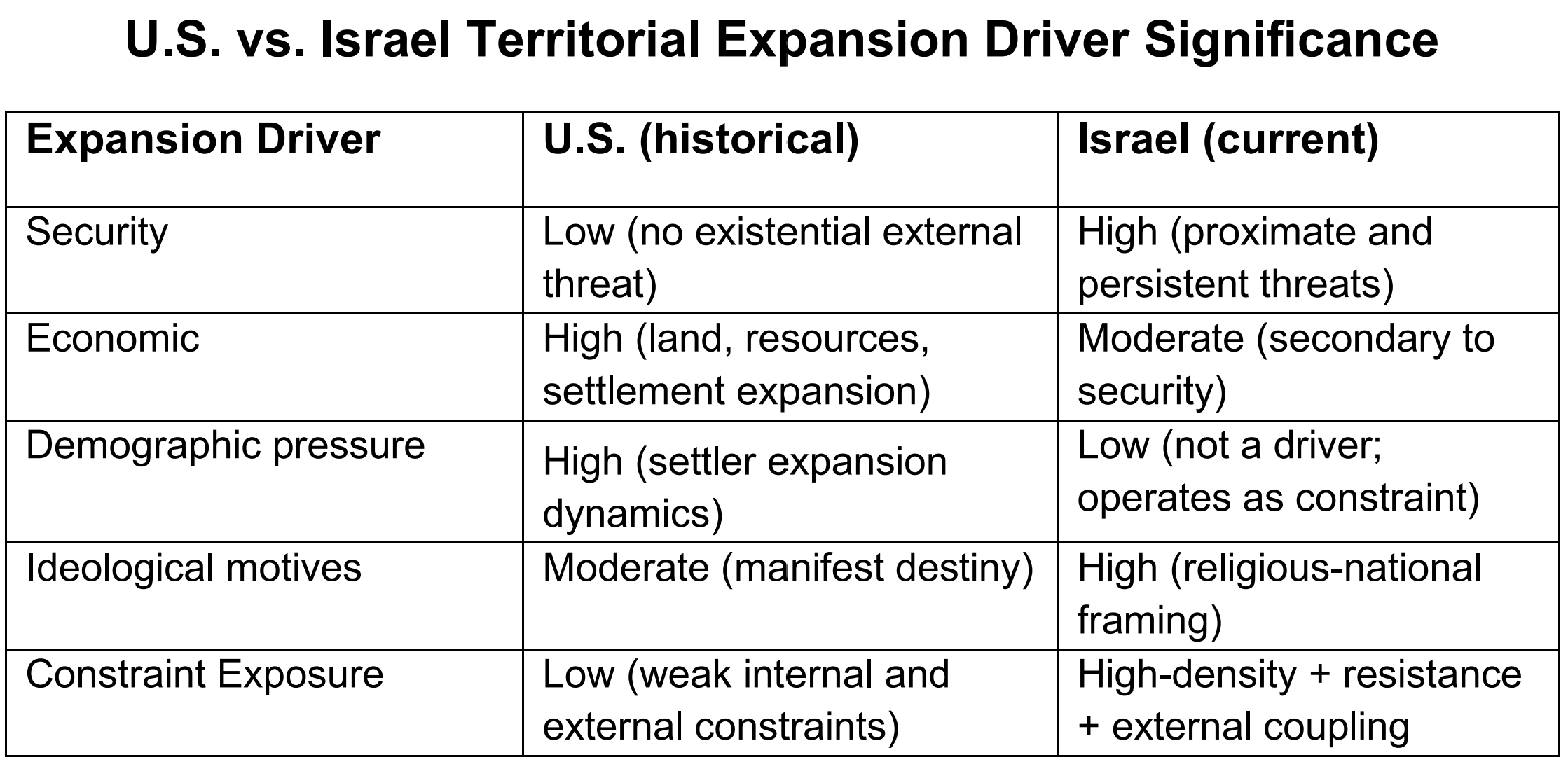
Like many nations throughout history, Israel has sought to expand its territorial control. By acquiring additional territory, states aim to reduce security vulnerabilities, increase access to resources, and extend regional influence. Yet territorial expansion is not determined solely by military capability or political will. It succeeds or fails based on whether newly acquired territory can be rendered stable, governable, and economically integrated over time. In some historical contexts, expansion has produced durable outcomes. In others, it has generated persistent instability and strategic overextension. The critical distinction lies not in the motives driving expansion, but in the constraints shaping its execution.
This article examines the forces driving Israeli territorial expansion and the constraints that limit its effectiveness. It does so through a comparative framework: the relatively permissive conditions that enabled U.S. territorial expansion versus the highly constrained environment in which Israel operates today. The central question is not whether expansion is possible, but whether it can produce stable outcomes under modern conditions.
Territorial Expansion Drivers
Territorial expansion is driven by a system of interacting forces: security imperatives, economic incentives, demographic pressures, and ideological narratives. These forces rarely operate in isolation. When they reinforce one another, they generate sustained political momentum for expansion—even when the long-term outcomes are uncertain or adverse.
Security concerns are often primary. States seek to improve defensibility by acquiring terrain that offers strategic advantage, such as high ground, buffer zones, or control of key approaches. Economic incentives may include access to natural resources, agricultural land, trade routes, or infrastructure corridors. Demographic pressures can arise from population growth, settlement movements, or efforts to consolidate populations linked by identity or affiliation. Ideological drivers—ranging from historical claims to religious or nationalist narratives—can further intensify expansionist objectives by framing them as necessary or inevitable.
Israeli minister Ben Smotrich has OFFICIALLY announced the start of the “Greater Israel” project.
He includes Syria, Lebanon, and Palestine. pic.twitter.com/Y00DUQV7QL
— Ethan Levins 🇺🇸 (@EthanLevins2) April 9, 2026
These drivers explain why expansion efforts persist over time. They do not, however, determine whether expansion will succeed. Outcomes are shaped by the constraints under which expansion occurs. Historical U.S. expansion and contemporary Israeli expansion share several motivating forces, particularly in the domains of security and territorial control. The decisive difference lies in the structure and magnitude of the constraints each faced.
Territorial Expansion Constraints
Territorial expansion succeeds or fails not on the basis of intent or initial military advantage, but on the characteristics of the environment into which expansion occurs. The same expansionary drivers can produce durable outcomes under permissive conditions or persistent instability under constrained ones.
U.S. expansion in North America unfolded within a relatively permissive environment. Geographic space was expansive, indigenous populations were fragmented and unevenly distributed, and external intervention was limited. Population inflows followed territorial acquisition, enabling settlement to stabilize gains over time. Economic integration was achievable, and the time horizon for consolidation was extended. Expansion, in this context, was cumulative: each increment of territory could be absorbed, governed, and integrated with diminishing marginal cost.
Israel operates under fundamentally different conditions. Geographic space is compressed, adjacent populations are large and entrenched, and resistance is persistent and adaptive. External actors are continuously engaged, both directly and through proxy relationships. Legal frameworks impose ongoing constraints on population management and military operations, while real-time global information flows amplify the political consequences of tactical actions. Expansion in this environment does not reduce problems; it compounds them.
The contrast is not one of degree, but of structure. U.S. expansion occurred within conditions that enabled stabilization. Israeli expansion occurs within conditions that engender instability. The following comparison outlines the key differences in these constraint environments.
Armed Resistance
Expansion into territories with hostile populations generates persistent armed resistance that cannot be eliminated through decisive engagement alone. Unlike conventional military forces, these resistance systems are embedded within the local population, capable of dispersal, concealment, and regeneration over time. Tactical defeats do not translate into strategic resolution; they are absorbed and resistance forces are reconstituted.
This distinguishes modern constrained environments from many historical expansion contexts. During U.S. westward expansion, indigenous resistance, though at times formidable, was generally fragmented and limited in its ability to sustain coordinated, long-duration opposition across large areas. Over time, resistance capacity diminished relative to expanding state control.
In contrast, resistance faced by Israel operates as a durable system rather than a finite adversary. Armed groups are organizationally adaptive, supported by external networks, and able to reconstitute leadership and operational capability after losses. Urban terrain and dense population environments further enhance survivability and concealment, increasing the cost and duration of military operations.
Under these conditions, expansion does not eliminate opposition; it reproduces it. Each newly controlled area introduces additional population exposure, new points of friction, and expanded operational requirements. The result is a persistent security burden in which military effort must be continuously reapplied without producing stability.
Hezbollah fighters – armed and dangerous
Geographic Depth
Territorial expansion is strongly conditioned by the availability of geographic depth—the extent to which space can absorb operational risk and facilitate consolidation. In permissive environments, expansion creates buffer zones that reduce exposure and allow security pressures to be displaced outward from core population centers.
U.S. expansion benefited from this dynamic. Large, sparsely populated territories provided room for maneuver, error tolerance, and gradual stabilization. Setbacks could be absorbed without immediate strategic consequence, and newly acquired land could function as a buffer rather than a point of continuous friction.
Israel operates in a geographically compressed environment where such depth is largely absent. Adjacent territories are small, densely populated, and immediately contiguous with existing population centers. There is no intermediate space into which instability can be displaced. As a result, expansion occurs in direct contact with hostile or resistant populations, eliminating the buffering effect that geographic depth would otherwise provide.
This compression produces two reinforcing effects. First, it reduces error tolerance: operational setbacks have immediate strategic consequences because there is no spatial margin for recovery. Second, it increases exposure: each increment of territory acquired expands the interface between Israeli forces and hostile populations. Expansion, in this context, does not create distance from threats; it intensifies proximity to them.
External Intervention
Territorial expansion is constrained not only by internal conditions within contested areas, but by exposure to external actors capable of influencing outcomes. In permissive environments, expansion can proceed with limited interference from neighboring states or distant powers. Where such interference is minimal, territorial gains can be consolidated without sustained external disruption. U.S. expansion occurred under relatively low risk of external intervention. Neighboring powers were either weak, distant, or unable to project sustained force into contested regions. This allowed territorial acquisition and consolidation to proceed largely on internal terms.
Israel operates under conditions of continuous external exposure. It is situated within a region where multiple state and non-state actors have both the capability and the incentive to influence expansion outcomes. This influence may take direct forms—such as military engagement or deterrent posturing—or indirect forms, including financial support, arms transfers, intelligence sharing, and diplomatic coordination with local actors.
In addition to regional dynamics, Israel’s actions are embedded within a broader system of great power involvement. Major external powers maintain political, economic, and security interests in the region, shaping the strategic environment in which expansion occurs. Support relationships, alliance structures, and diplomatic pressures introduce constraints that limit operational autonomy and affect the sustainability of prolonged territorial control.
The result is a multi-layered constraint in which expansion cannot be treated as a closed system. Local operations are continuously influenced by external inputs, and outcomes are subject to negotiation, pressure, and intervention beyond the immediate theater of conflict. Under these conditions, territorial expansion becomes contingent not only on internal control, but on the reactions and tolerances of a wider set of actors.
Target Population Density
The population density of targeted territories fundamentally alters the character of territorial expansion. In low-density environments, control of land can often be achieved without immediate and continuous engagement with large civilian populations. In high-density environments, expansion becomes inseparable from the management of concentrated populations.
U.S. expansion frequently occurred into regions where populations were sparse or unevenly distributed, allowing territorial control to precede large-scale population integration. This reduced the immediate administrative and security burden associated with newly acquired land and enabled gradual consolidation over time.
Israel operates in a markedly different demographic environment. The territories most directly implicated in expansion are characterized by high population density, urban concentration, and limited physical separation between civilian and combatant spaces. Under these conditions, territorial control cannot be isolated from population control. Military operations are conducted in close proximity to civilian life, and governance responsibilities arise immediately upon acquisition.
This density produces a cost-amplification effect across multiple dimensions. Security operations require continuous monitoring and policing of large populations, increasing personnel and intelligence demands. Urban terrain complicates military action, raising the risks associated with movement, targeting, and force protection. Civilian presence constrains the use of force and increases the operational and political consequences of collateral damage.
As a result, expansion in high-density environments does not scale efficiently. Each additional unit of territory acquired brings with it a proportional or greater increase in administrative, military, and political burden. Rather than enabling consolidation, population density transforms expansion into an increasingly resource-intensive and visibility-constrained process.
Legal Framework
Territorial expansion in the contemporary international system is conducted under continuous legal scrutiny. Unlike historical expansion processes that operated with limited external constraint, modern operations are evaluated against established frameworks of international humanitarian law, including the Geneva Conventions, and are subject to review by formal legal institutions.
U.S. expansion largely unfolded outside a binding international legal regime capable of imposing real-time constraints. While political and moral considerations existed, they did not translate into sustained external legal exposure affecting operational decisions or long-term consolidation.
Israel operates within an international legal environment in which actions are subject to ongoing evaluation by established institutional bodies and legal processes. Proceedings in venues such as the International Court of Justice and the International Criminal Court, along with broader legal assessments by states and organizations, generate persistent scrutiny of both military operations and population management practices. The International Criminal Court Prosecutor has sought arrest warrants for Israeli officials related to alleged crimes arising from operations in Gaza.
The constraining effect does not depend on final rulings. Legal exposure produces immediate consequences: it shapes diplomatic relationships, conditions the behavior of partner states, and introduces risk into military, economic, and logistical support channels. Governments and institutions must account for liability, reputational impact, and compliance obligations when engaging with ongoing operations. As a result, legal oversight functions as a continuous operational constraint. It narrows the range of acceptable actions, increases the cost of sustained operations, and links tactical decisions to broader diplomatic and material consequences.
Real-Time Global Information
Modern conflict unfolds within a continuous, high-resolution information environment in which local actions are rapidly captured, distributed, and interpreted at global scale. Territorial expansion is therefore not only an operational process, but an immediately visible and contested narrative event.
During U.S. territorial expansion, the political consequences of military action were mediated by time delays, limited reporting capacity, and state-controlled channels of information. This allowed governments to shape narratives after the fact and to buffer tactical actions from immediate public reaction. That buffering capacity has largely disappeared. Civilian populations, journalists, and independent observers generate a constant stream of visual and textual information. Mobile devices and networked communication platforms enable rapid dissemination, often within minutes of an event. As a result, tactical military actions are transformed into globally visible signals before formal explanation or strategic framing can occur.
This produces a significant constraint on Israel’s expansion. Operational decisions must account not only for their direct military effects, but for how they will be perceived, interpreted, and amplified across global audiences. Visual evidence of civilian harm carries disproportionate weight, shaping public opinion, influencing diplomatic behavior, and reinforcing legal scrutiny.
The effect is both immediate and cumulative. Individual events generate rapid responses, while repeated exposure contributes to a broader narrative trajectory that can alter the strategic environment over time. Under these conditions, expansion cannot be separated from its real-time representation. Tactical actions and strategic consequences become tightly coupled, narrowing the range of operational choices.
🇮🇱🇱🇧⚡️- The IDF confirms the authenticity of the circulating picture depicting an Israeli soldier smashing the head of a Jesus Christ statue in southern Lebanon, saying “appropriate measures will be taken against those involved.”
Full statement:
Following the completion of an… https://t.co/SJZOTiglNv
— Rerum Novarum // Intel, Breaking News, and Alerts (@officialrnintel) April 19, 2026
Time Horizon
The time horizon under which expansion is pursued significantly shapes both strategy and outcomes. In permissive environments, expansion can unfold gradually, allowing consolidation processes to develop alongside territorial acquisition. Time functions as an expansion enabling factor, reducing risks and stabilizing gains.
U.S. expansion largely benefited from extended time horizons. Territorial acquisition was followed by periods of consolidation in which population inflows, infrastructure development, and administrative control could mature. This temporal flexibility allowed setbacks to be absorbed and adjusted to without undermining the broader expansion process.
In constrained environments, the perceived time horizon is often compressed. Decision-makers may operate under the assumption that conditions are deteriorating—whether due to shifting regional dynamics, changing external support, or internal political pressures. Under these conditions, expansion is pursued not because the environment is favorable, but because it is expected to become less favorable over time.
This compression produces a risk-acceleration effect. Shortened time horizons increase the perceived urgency of action and encourage reliance on high-impact, high-risk operations intended to achieve rapid results. At the same time, the constraints outlined above limit the ability of such operations to produce stable outcomes by increasing the negative consequences of risky operations.
The result is a structural mismatch between urgency and feasibility. Expansion is pursued under increasing time pressure, while the conditions required for successful consolidation remain resistant to acceleration. Rather than resolving instability, compressed time horizons tend to intensify it.
Stabilization Risk
Territorial expansion is strategically meaningful only if acquired territory can be converted into durable control. This requires the establishment of stable governance, sustained security, and functional economic integration. Without these, territorial gains do not accumulate, but instead persist as unresolved obligations.
In permissive environments, stabilization tends to follow acquisition. Population flows into newly controlled areas, economic activity develops, and security requirements decline over time. Expansion produces a self-reinforcing cycle in which each additional increment of territory becomes easier to govern and integrate. This pattern was characteristic of U.S. historic expansion.
In constrained environments, this process is reversed. The conditions necessary for stabilization are undermined by constraining conditions. Persistent resistance prevents the reduction of security requirements. Geographic compression and high population density increase the cost and complexity of governance. External intervention and legal constraints limit the range of available actions, while real-time information flows amplify the consequences of operational decisions. Compressed time horizons further reduce the feasibility of gradual consolidation.
Israel’s recent experience reflects this pattern. In Gaza, repeated military operations have degraded adversary capabilities without producing durable governance or long-term security stabilization. In southern Lebanon, Israeli incursions have historically achieved tactical objectives but have not eliminated the underlying conditions that sustain armed resistance. In the West Bank, ongoing security control has required continuous operational presence without resolving the political and administrative challenges of long-term integration. Across these cases, territorial control has not transitioned into stable consolidation.
Under these conditions, territorial acquisition does not transition into stable control. Instead, it generates a compounding burden. Security requirements remain elevated or increase over time. Economic development remains fragile and contingent. Governance structures operate under continuous strain. Each additional unit of territory expands these obligations without resolving the underlying sources of instability.
Escalatory Risk
Expansion-driven conflict in constrained environments can generate escalatory risk, but this outcome is conditional rather than automatic. The likelihood that local conflict expands into broader regional or systemic confrontation depends on the structure of the surrounding environment—particularly the number of capable external actors, the degree of their engagement, and the extent to which local events trigger wider responses.
Escalation risk was low during U.S. territorial expansion because outside powers were distant and neighboring states were relatively weak. In Israel’s case, geographic proximity places multiple state and non-state actors within immediate range of conflict dynamics. Persistent armed resistance ensures ongoing engagement, while external actors retain both the capability and incentive to influence outcomes. Real-time information flows accelerate the transmission of events into political and diplomatic domains, and legal and normative pressures increase the stakes associated with operational decisions.
Thus, Israel’s territorial expansion carries significant escalatory potential. The presence of critical energy infrastructure and major trade routes means that localized conflicts can have broader systemic consequences. Israel’s larger neighbors will continue to arm themselves with progressively more powerful weaponry. Energy disruption can affect global markets and draw in superpowers. Each episode of conflict risks cascading beyond its immediate context. Expansion therefore operates within a system where local actions can produce global effects. Israel’s possession of nuclear weapons raises the stakes of escalation in any conflict that spreads through the region. The recent war with Iran demonstrates the magnitude of this escalatory danger.
Conclusion
Israel’s drive for territorial expansion is likely to continue, but its capacity to stabilize acquired territory is significantly constrained. The interaction of restive occupied populations, limited feasibility of settlement development, and involvement of outside powers will likely prevent expansion from producing durable outcomes. The probable result will be a pattern of incremental, attempted territorial annexation and recurring armed conflict. Each expansionary episode will carry the risk of broader conflict escalation without resolving the underlying problem of Israel’s mismatched goals and capabilities.
This pattern is not unique to Israel. It reflects a general condition of modern conflict in highly constrained environments. Where expansion cannot be translated into stable control, conflict becomes a recurring condition rather than a transitional phase. Under these conditions, the pursuit of territorial enlargement increases instability without providing a reliable path to its resolution.
Absent a diplomatic resolution that stabilizes and secures regional borders, an expansionary Israel faces a future of episodic armed conflict with destructive consequences and attendant escalatory risks. This is the dangerous challenge faced not only by Israel, but by all nations with economic and political interests in the Mideast. Relentless pursuit of a greater Israel will bring greater danger to Israel and to the world.
