


Five days after an Immigration and Customs Enforcement officer shot and killed activist Renee Good, tensions were high in the Minneapolis neighborhood where she was killed.
As federal immigration agents surrounded and questioned a man who had stopped his car, people emerged from their homes onto snowy sidewalks and streets. They shouted obscenities, told staff to leave and filmed what was happening on their cellphones.
Staff from FRONTLINE and ProPublica were also filming.
The man questioned, a U.S. citizen named Christian Molina, told ProPublica reporter AC Thompson that federal agents chased him and rammed his car.
Co-published with
What happened next can be seen in footage from FRONTLINE and ProPublica’s new documentary, “Caught in the Crackdown.”
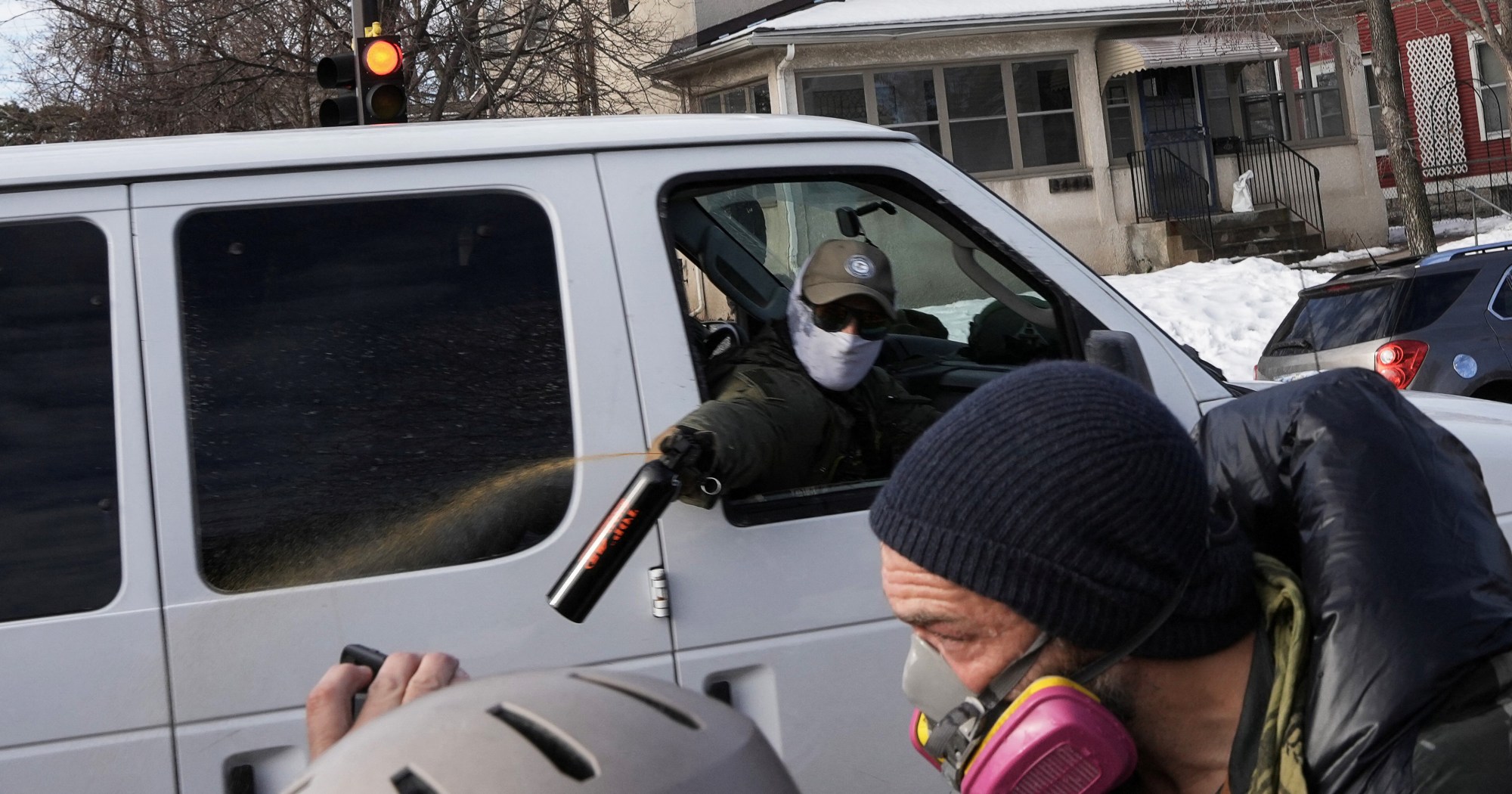
Someone threw a snowball at the investigators, and one of them responded by throwing tear gas canisters into the crowd.
“They’re using tear gas in my neighborhood,” the demonstrators shouted. “People live here.”
Agents pepper-sprayed protesters and news photographers at close range amid a toxic fog. Another agent fired a pepper ball into the crowd, hitting Thompson three times. One bullet hit him above his right eye. Federal use-of-force guidelines generally instruct agents not to aim these weapons at people’s heads or faces.
As the agents drove away, one of them fired pepper spray out the window of the car, hitting other members of the film crew, including Frontline director Gabriel Shonder and cinematographer Tim Gulza, who were sprayed in the face.
Watch as agents use tear gas and other weapons against crowds in Minneapolis
Footage of the confrontation was captured for FRONTLINE and ProPublica’s new documentary, “Caught in the Crackdown.”
In the Minneapolis neighborhood where Renee Good was killed, residents were protesting the actions of federal immigration agents. Someone threw a snowball at the agent. Then came what one former Justice Department official later called “excessive use of force after excessive use of force.” Frontline and ProPublica
The January 12 crash is one of many chaotic clashes chronicled in Caught in the Crackdown. The joint investigation, which will premiere on April 14, will examine how federal officers responded to protesters and bystanders during the Trump administration’s immigration sweeps in major U.S. cities from Los Angeles to Chicago to Minneapolis, including using tactics that experts said violated police officers’ own rules.
As the documentary explores, President Donald Trump’s administration said immigration enforcement protects Americans by targeting criminals and illegal immigrants. Through on-the-ground reporting and interviews with officials, experts, insiders, and witnesses, Caught in the Crackdown traces how federal forces arrested hundreds of Americans observing protests and attacks, routinely painted them as domestic terrorists and extremists, and repeatedly deployed weapons such as tear gas and pepper balls.
The man leading the enforcement effort showed no remorse for the investigators’ methods.
“We’re here to fulfill our Title VIII mission,” Greg Bovino, then Border Patrol commander, told a local television station, referring to immigration enforcement. “Despite the tremendous violence against rioters, agitators, and federal agents, it’s not going to stop. We’re not going to stop.”
But when Thompson shared the Jan. 12 footage with former law enforcement officials, they expressed concern.
“It’s clear that there is a continuation of excessive use of force after use of excessive force,” said Christy Lopez, who has spent years investigating law enforcement misconduct for the Justice Department’s Civil Rights Division. “It is unacceptable under any circumstances to pepper spray people as they leave the scene.”
“This is pretty egregious,” said Chris Magnus, the head of Customs and Border Protection who previously supervised Bovino. Magnus, who has served as police chief in multiple cities, pointed to the principle of proportionality in the use of force in law enforcement, saying, “In many situations, there’s a good chance that people will get under your skin.” “You don’t like it, but the experts don’t respond to it.”
As the documentary reports, ProPublica and Frontline found that the case collapsed because the charges against many protesters were contradicted by video evidence and witness testimony.
Bovino was ultimately forced from his position after federal agents shot and killed a second protester, Alex Preti, in Minneapolis. The Trump administration said it “recognizes that certain improvements can and should be made” regarding immigration operations. Mr. Bovino has since retired, but many of the questions raised on the streets of Los Angeles, Chicago and Minneapolis under his watch remain unanswered.
“Even if Gregory Bovino is gone, will his footprint remain on every federal agency that continues to be on the streets?” Sergio Olmos, a journalist who reported on Bovino for the nonprofit media outlets CalMatters and Evident Media, says in the documentary. “Will anything really change? He was the person who was the tip of the spear for this new type of immigration enforcement across the country.”
