


Eve, here. One of the costs of being a nerd is that you pursue one field so fervently that other fields are ignored. I wish I had more time to become more knowledgeable in all areas, especially history, criticism, and poetry. I’ve never read Walter Benjamin, but reading Das’s article below has me adding him to my long list of authors I’d like to read someday.
Satyajit Das is a former banker and author of numerous technical works and several popular titles on derivatives. “Traders, Guns & Money: Knowns and Unknowns in the Dazzling World of Derivatives” (2006 and 2010), “Extreme Money: The Masters of the Universe and the Cult of Risk” (2011), and “A Banquet of Consequence – Reloaded” (2016 and 2021). His latest book is about ecotourism – Wild Quests: Journeys into Ecotourism and the Future for Animals (2024). Published in association with New Indian Express Online Webscroll.
Walter Benjamin’s reputation grew greatly over time. He is associated with the Frankfurt School and literary contemporaries such as Theodor Adorno, Hannah Arnendt, and Bertolt Brecht, and his work has had a major influence on critical theory.
Peter Gordon’s excellent compact literary biography Walter Benjamin – The Pearl Diver (2026) Yale University Press is the latest attempt to explain Benjamin. This follows other books such as Esther Leslie’s Walter Benjamin: Overwhelming Conformism (2000) Pluto and Walter Benjamin (2014) Reaktion. In Wolfram Eilenberger’s The Age of the Magician – The Great Decade of Philosophy, 1919-1929, 2022, Penguin tried to place him alongside Martin Heidegger, Ernst Cassirer and Ludwig Wittgenstein, but the proud and impatient Germans might not have liked it.
Benjamin was a mass of contradictions. Although he was an academic, he was denied habilitation, the highest doctoral degree required to teach as a full professor in many European countries, and was likely restricted from holding university posts. He was Jewish, but it was unclear whether he embraced the religion. For Benjamin, capitalism was a religion based on human experience. He favored dialectical materialism but was always skeptical of communism. Unwilling to join the party, by his own account he was a “left-wing outsider” and the possibility of joining was “unthinkable” because politics only allowed choices for the lesser of evils. Although he sought to understand ordinary life, he was an elitist who avoided the “secret tyranny of vocational training.”
Benjamin, a German by birth, was very attached to France, at least to Paris. Polite and well-mannered, but always close to poverty, he was not afraid to accept money from friends and organizations, and rarely fulfilled his obligations to them. He was an indifferent orator. Gordon described one of his speeches in these words: “He delivered a very literal speech with great enthusiasm into a corner above the ceiling, without looking at the audience, and stared at it the whole time.” His radio broadcasts, however, were reportedly clear and at times gripping. His personal shortcomings include gambling, infidelity, and unstable mood. I’ve been ignoring my friends for reasons I don’t understand.
His available output is certainly limited in translation, which, combined with his hesitations, results in an almost blank screen for projecting particular views. Benjamin offered the interesting insight that he himself enjoyed the words of La Rochefoucauld: “His laziness sustained his glory for many years in the darkness of a false and hidden life.”
Benjamin’s works ranged from philosophical tracts, short stories, plays, essays, and literary criticism.
His most famous works available in English are Illuminations: Essays and Reflections (a collection of his major works) and The Storyteller (a collection of short stories). He is perhaps best known for his seminal The Arcades Project, where many of his positions still remain. Conceived in 1927 and written over 13 years, it remained unfinished at the time of his death in 1940.
Benjamin described the Arcade Plan as a monumental ruin and the stage for all his ideas and struggles.
For him, the 19th-century Parisian arcades, lined with glass-roofed stores, represented something profound. He was obsessed with the very modern concept of the commodification of objects and experiences, believing it to be a defining feature of modernity. The Arcades project sought to critique this phenomenon.
The book is actually notes organized around specific themes: fashion, boredom, the city of dreams, photography, the catacombs, advertising, prostitution, Baudelaire, and the theory of progress. Benjamin digs beneath the surface to uncover the hidden meanings of the physical world he explores. It’s not an easy read. His imagination was formidable, but his elaborate writing style was often incomprehensible. Still, the montage of images and jumbled thoughts and quotes is hypnotic. Exterior and interior frequently merge, time becomes fragmented, and fleeting moments take on almost magical significance.
Benjamin was a literary man at heart, convinced that literary criticism had become obsolete and that it was his mission to breathe new life into it in order to uncover the truth in works. Nowhere is this more evident than in his trenchant essay on Franz Kafka. After reading a brilliant essay on Benjamin’s work, the Viennese critic and satirist Karl Kraus was perplexed.[Benjamin] It seems like you know quite a lot about me that I didn’t know before and that I still don’t clearly realize. And I can only express the hope that others will understand it better than me. ”
Like Ludwig Wittgenstein, Benazimin believed that language plays a central role in how the world acquires meaning. After all, his reputation rests on the subtitle of Gordon’s book. Hannah Arnendt says, “The most characteristic thing about him was a small notebook that he always carried with him, in which he energetically wrote down what his daily life and reading brought him in terms of “pearls.”” Benjamin’s satisfaction was finding little treasures while reading books in libraries and cafes.
Intelligent, restless, skeptical of simple systems of thought, and necessarily multicultural, he was the typical flâneur who wandered from place to place and text, absorbing everything around him. His best works are those of a passionate observer, combining the characteristics of a critic and a poet. In his best works, Benjamin displays great skill in depiction.
Two essays, both from his posthumously published Theses on the Philosophy of History, are outstanding. In The Turks, Benjamin describes the brilliant chess-playing machine devised by Baron Wolfgang von Kemplen as “an automaton so constructed that it could play a winning game of chess by responding to every move of its opponent with an opposing move.” The device featured a doll wearing Turkish costume and holding a hookah in its mouth, sitting in front of a chess board. A system of mirrors creates the illusion that the table is transparent from all sides. A little hunchback, who was actually a master chess player, sat inside and guided the doll’s hands with a string. Benjamin used factual stories to expose the deceptions of history. This machine was less a miracle of technology and science than an elaborate hoax powered by other forces. It remains a powerful metaphor for humanity’s obsession with god-like technology.
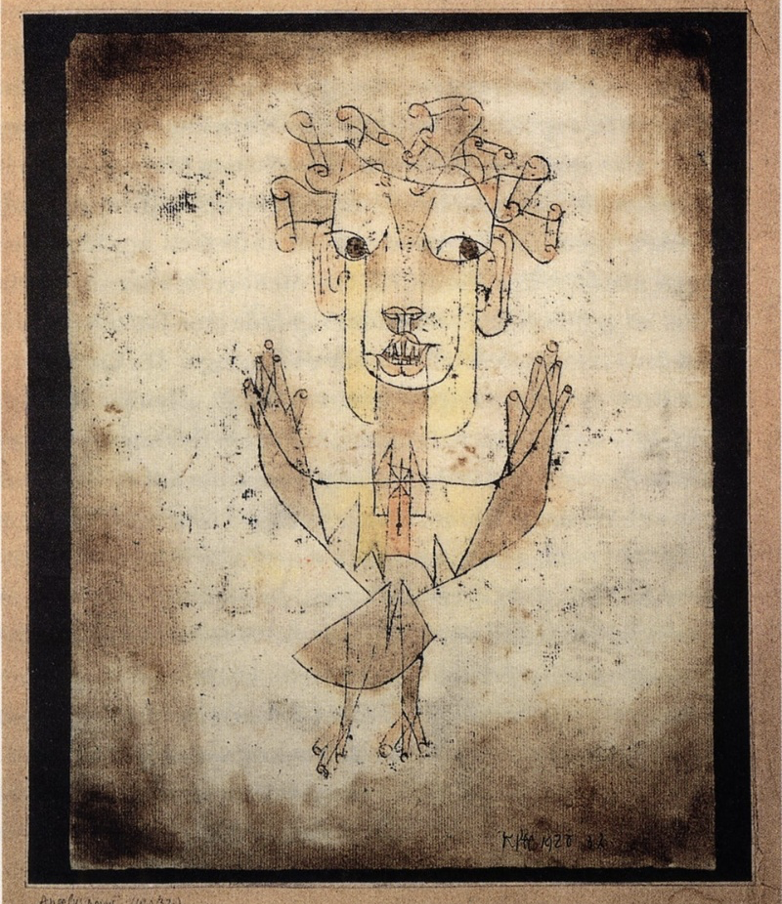
The second piece was inspired by Paul Klee’s painting ‘Angelus Novus’. The painting, which Benjamin bought for 1,000 marks around 1920 or 1921, depicts a strange human-like figure with wings and claws. It appears to be floating, staring at something invisible beyond the painting. It would remain with Benjamin for most of his life.
Source: Wikipedia
The image has stuck. As time passed, the figure transformed into an angel of history. This image, he writes, allows us to “understand humanity’s ability to prove itself through destruction.” This is the central part of Benjamin’s Treatise IX. “Klee’s painting Angeles Novus depicts an angel who seems to be moving away from what he is staring at. His eyes are staring, his mouth is open, his wings are outstretched. This is how the angel of history is depicted. His face is turned towards the past, as we recognize the sequence of events. When he realizes, he sees a single catastrophe that keeps piling up the wreckage and throws it before him. The angel stays there, hoping to awaken the dead and repair what has been destroyed. But a mysterious, gloomy, hopeless storm is brewing. There is no more powerful critique of humanity.
Benjamin’s death is part of mythology. Fleeing German persecution, he obtained documents destined for the United States requiring him to cross from France to Spain on his way to Lisbon to make his way to New York. Unfortunately, the Spaniards closed the border on the day he was about to cross. Despondent and fearful of being captured by the Nazis, he committed suicide by taking a lethal dose of morphine tablets. Ironically, the borders will then be reopened.
His tombstone near town is inscribed with a quote from the Theses of the Philosophy of History. “There is no document of civilization that is at the same time a document of barbarism.” On his final journey, Benjamin carried a heavy black briefcase on his back. He told the guide that it contained a new manuscript and that it “must be preserved” because “it is more important than me.” It hasn’t been found yet.
Walter Benjamin remains an enigmatic and somewhat eccentric figure in literary history. In one of his early novels, he predicts his fate as a poor man distributing leaflets, humiliated by a public uninterested in his literature. A big fan and translator of Baudelaire’s The Flowers of Mull, he was drawn to the French poet’s line, “I become a writer because I sell my ideas.”
In 1939, as both his life and the world he lived in were coming to an end, Walter Benjamin told a friend that his ambition was to “one more time sit on the terrace of a cafe and twiddle my thumbs.” Benjamin’s life and work are best expressed in one of his haunts, Café des Westens, a popular spot on Berlin’s Kurfstendamm. With typical irony, the locals give it the nickname “Café Großenfan” (Cafe of Grand Fantasy).
© Satyajit Das 2026 All Rights Reserved
