


[This Iran war post is launching again before complete. I aspire to have it done by 8:00 AM EDT. Feel free to comment straight away, but do refresh your browsers and re-skim at 8:00 AM]
As the Iran war continues, it still appears that the best prospect for the Trump Administration to get past their severe denial and make genuine efforts to back out of the epic disaster they have created is a market rout. As we have demonstrated and others are staring to voice, the closure of the Strait of Hormuz, if it persists for even as much as a week longer, will inflict durable damage on the global economy, reaching far beyond the impact the world can see now, of higher oil and LNG prices whose effects alone will ripple though the costs of goods generally. The downside of a closure of a mere additional month, even assuming no damage to energy production facilities in the Gulf, given the time it will take to get shuttered operations back to full steam, is a serious global recession. Two months from today would translate into a multi-fronted real economy crisis and high odds of a global depression, along with food shortages.
So I remain stunned at the level of investor complacency and the willingness of too many to take handwaves from the Administration, bluster about how much we are hurting Iran and how the war is nearly won, and insubstantial promises of somehow forcing the opening of the Strait of Hormuz as a testimony to elite greed and incompetence. The head of every major financial firm and US multinational should be in Trump’s and Congresscritters’ faces demanding a monster change of course.
But between deeply internalized faith in Western superiority and the successful numbing effect of decades of ever-better propaganda, they cannot see what is obvious: Iran has the means and will to destroy the world economy. I had invoked the novel Dune early in this war, “He who can destroy a thing, controls a thing.” And as we have shown, by throttling the Strait of Hormuz, it has not merely strangled energy and fertilizer supplies, as serious as those are. We’ve pointed to the knock-on effect on other critical supplies, using sulphuric acid, which is essential in many manufacturing processes, as another example. And as we’ll soon show, the bottleneck in the Strait of Hormuz is also wreaking havoc with shipping generaly.
Let me offer a forecast. I am not saying this is what will happen, but right now, it seems a probable path. Trump and his team are increasingly messaging that somehow they will pry the Strait of Hormuz open. When that idea was first voiced, we showcased Daniel Davis in one of his Deep Dive presentations on what an impossibly bad idea that was, that it would simply open up naval ships for easy destruction by Iran. Nevertheless, talking this barmy scheme up to credulous investors and the public, that somehow the spice will be flowing again soon, is now the Administration’s best path for somewhat containing energy price rises and the immediate damage they do
We’ll show in a video below from shipping maven Sal Mercogliano that a plan seems to be advancing to get forces in place to implement a limited Strait of Hormuz opening, at only 10% of pre-war transit levels, starting at the end of the month (Mercogliano deems even that level of relief to be grossly inadequate). Let us not forget a point I believe Douglas Macgregor and perhaps others have made: our navy, in terms of level and diversity of vessels, is a shadow of what it was in the 1980s, during what were called the tanker wars.
The Administration does have to Do Something in its own mind, rather than admit now to a Suez Crisis level self-inflicted loss of primacy. Forcing open the Strait of Hormuz fits our fantasies of dominance and military power. And if enough officials talk about this, erm, plan, the Administration may talk itself into it.
So if we have not had a market freakout sooner, the likely trigger for one is sending US ships to the Strait of Hormuz and suffering a crushing defeat. It would then become undeniable that Iran has the whip hand.
An alternative scenario is a soft military coup, that the Navy refuses to take the Trump order to pursue what would be close to a large-scale suicide mission.
Keep in mind that as the situation on the West looks more and more desperate, the new Iranian Supreme Leader has made his first public statement, and among other things, has vowed to expand the scope of the conflict.
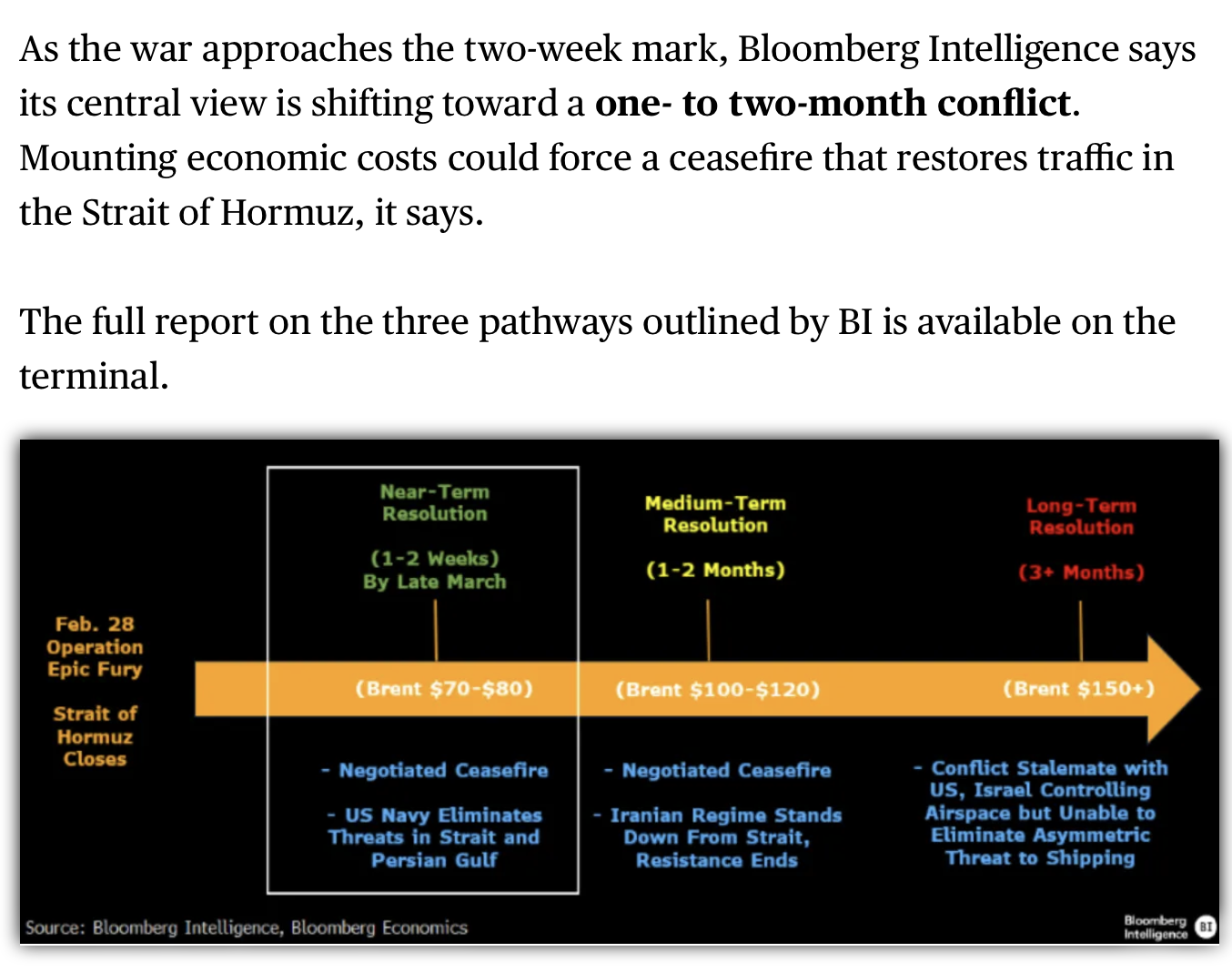
This item from the Bloomberg live feed 30 minutes ago provides yet more confirmation of the severity of the denial. How can anyone who has a grip on the balance of forces and Iran’s incentives think that hostilities will end in as soon as two months, ex the inconceivable-to-this-crowd spectacle (admittedly not likely but possible) of a US military collapse?
Contrast what amounts to a derangedly sunny view with this section from an important piece by Kevork Almassian:
Because Washington didn’t only miscalculate Iran’s will, it miscalculated geography, logistics, and blowback. It miscalculated the fact that the U.S. empire in the Middle East is not a fortress; it is a web of exposed arteries: bases scattered across Gulf monarchies, troops housed in predictable locations, air defenses that are expensive and finite, radars and communications nodes that can be degraded, and a regional order that can be shaken with one choke point.
You can see the arrogance in the assumptions. For years, Iran warned that if its survival is threatened—if the U.S. and Israel push the conflict into an existential zone—Hormuz becomes part of the battlefield. Washington heard that and filed it under “Iranian theatrics,” because the American political class is addicted to the idea that their enemies always bluff, while they alone possess the right to act.
But Iran was not bluffing. Iran was describing the rules of an environment where deterrence is the only language that keeps you alive.
And as Daniel Davis stressed, it was our explicit threat against the very existence of the Iranian nation that legitimated the use of closing the Strait of Hormuz.
This Sal Mercogliano update is a must-watch.
Notice first that Mercogliano makes clear that he is distressed. He describes the dire consequences of a continued closure of the Strait of Hormuz, not just to oil and LNG transit, but the operation of global shipping. Yet he is grasping at straws. He believes the US is able to open the Strait of Hormuz but has badly misallocated military resources. He mentions that we have the ability to do so, using helicopters and small vessels. I am sure these military assets would make for easy targets from the many caves in the cliffs overlooking the Strait of Hormuz. He is also beside himself over the prospect that no action will be taken to pry open the Strait before (presumably at the earliest) the end of March, and that the target of escorting only 10% of pre-war transit levels is so low.
And Iran is hitting ships at a faster pace. However, this may be due to more efforts to move them than by design.
Sixteen ships struck in the Strait of Hormuz.
One narrow passage carrying a fifth of the world’s oil.
For decades the US tried to stop any state from weaponizing this chokepoint. Now Iran is showing exactly how fragile that strategy really was.
The Trump administration kicked… pic.twitter.com/ZWuktz6u9y
— Richard (@ricwe123) March 13, 2026
Other important new video. Janta Ka has a double-header, one starting with the, erm, loss of a refueler plane over Iraq, which CENTCOM insists was not attacked but the Iraqi militia says otherwise. Now it is remotely possible, with the warning that former Army Ranger Greg Stoker gave about our poor military maintenance and logistics, because outsourcing, that it really did fall from the sky. But it is hardly unreasonable to question the official story, particularly in light of Daniel Davis saying in one of his past 24 hour videos that inside sources tell him that the damage and cost to personnel are far worse than has been acknowledged.
Janta Ka also covered the remarks of the new Supreme Leader, the most important of which Aljaeera flagged in its live feed yesterday morning US time. Its lead headline then:
Iran war live: US bases will be attacked unless closed, says Khamenei
And
Supreme leader vows Iran will secure compensation through assets or destruction
In a written statement read out on state TV, Iran’s supreme leader has said the country “will obtain compensation from the enemy”.
“If it refuses, we will take from its assets to the extent we deem appropriate, and if that is not possible, we will destroy its assets to the same extent,” he said in the statement.
And the second Janta Ka presentation includes telling clips of prominent Republicans making pointed statements that show they can see the war is going pear-shaped, as well as a brief recap of a Netanyahu presentation via Zoom. The Times of Israel report is In first press conference since war began, Netanyahu says Israel ‘crushing’ Iran and Hezbollah, mocks IRGC ‘puppet’ Mojtaba Khamenei, who ‘cannot show his face in public’.1
Some additional kinetic war items. The current banner headline at Bloomberg:
From the body of its story:
The North Atlantic Treaty Organization intercepted an Iranian missile that entered Turkish airspace on Friday, Turkey’s Defense Ministry said in a statement.
“A ballistic munition launched from Iran and entering Turkish airspace was neutralized by NATO air and missile defense assets deployed in the Eastern Mediterranean,” the ministry said, without disclosing the location of the incident.
An initial reaction:
Iran fired a missile at US Incirlik Airbase in Turkey (NATO) as a flex to show it can.
5,000 US troops. 50 B61 nuclear gravity bombs in a vault.
Incirlik is critical to Israeli genocides in Palestine, bombings and occupations of Lebanon and Syria, attacks on Iran.
Game… https://t.co/K5ZZCEihB1
— Kathleen Tyson (@Kathleen_Tyson_) March 13, 2026
Aljazeera’s live feed highlights Israel’s continuing attacks on Iran:
Israel’s military announced start of new “extensive wave” of strikes on Iran’s capital Tehran as Israel issued forced evacuation orders amid new attacks on Lebanon’s capital Beirut.
Two people have been killed in Oman after the downing of a drone in Sohar province, Oman’s state news agency is reporting.
Even though this is from close to a full day ago, very little actual reporting can come out of Israel, so these France 24 updates are valuable. This one confirms that Iran has lived up to its promise of intensifying its campaign against Israel:
Far and away the most important tidbit from my quick notes is #4, that Israel officials are staring to signal that the war might go on for a year:
1. Casualties so far have low because civilians have been hunkering down in shelters
2. Strikes are up in last 24 hours
3. People have been told to go back to work, that they must use sick days if they are absent, but many can’t can’t due to kids, both due to many staying closed or being seen as too hazardous due to lack of shelters
4. Officials now signaling it may take a year to defeat Iran
5. Bibi might have a press conference (he did as we indicated above)
Due to the length of this post, we must mention this important, in-depth Larry Johnson piece in passing and urge you to read it at your leisure: Should Iran Build a Nuke… Game Theory Says Yes.
The Israel attack on Lebanon and Hezbollah’s forceful response are not getting the attention they warrant. Due to how multi-fronted this conflict is proving to be, forgive me for providing only short items. From the BBC live feed at 1:00 PM EDT yesterday:
Death toll in Lebanon rises to 687, health ministry says
The death toll in Lebanon has risen to 687 since 2 March, the Ministry of Public Health says.
That figure is up from 634 yesterday and includes 98 children and 62 women.
Officials say 1,774 people have been injured in the same period, including 304 children and 328 women.
From Vanessa Beeley in Operation civil war in Lebanon – the Zionist puppets within the government are attempting to turn Army against Resistance for Israel:
A serious political and institutional confrontation appears to be unfolding within the state structure of Lebanon, following reports that the head of the army, Commander of the Lebanese Armed Forces, Rudolph Haykal, has refused to allow the military to be drawn into an internal confrontation.
According to circulating statements below attributed to Haykal, the army will not participate in any move that could ignite internal conflict or fracture Lebanese society. The position is widely interpreted as a rejection of pressure from the current political leadership to confront Hezbollah domestically.
This stance triggered alarm among factions within the current governing coalition. Political sources claim that external actors, particularly the United States, had already begun discussing three potential replacements for Haykal should he refuse to comply with demands to escalate internally.
If these reports are accurate, Lebanon may be entering a rare and extremely dangerous constitutional moment, where the chain of command between the political leadership and the military leadership becomes contested.
And thanks to information-sleuthing by Social Rhino and junkelly, from Iraqi Resistance warns al-Sharaa: Attack on Lebanon means war in AlMayadeen:
The Islamic Resistance Coordination Committee in Iraq warned Syria’s transitional leader Ahmad al-Sharaa against any hostile action toward Lebanon.
In a statement, the Committee cautioned al-Sharaa that any attack against Lebanon coordinated with the US-Zionist enemy, under any pretext, would be considered a declaration of war on the Axis of Resistance…
“The Islamic Resistance in Iraq, which made US occupation forces suffer and left the bodies of ISIS fighters for the wolves of the valleys, is capable of crushing your movement if you become involved in attempts to target the resistance environment or Hezbollah…
“If you dare to violate the sovereignty of Lebanon and its patient, resisting people, we will turn your land into an open battlefield of fire,” the statement added.
We have given economic updates a comparatively short shrift and hope to turn to them more fully in the next day or so. A foretaste from a late-in-day Bloomberg story yesterday, Stocks Fall on War, Credit Worries as Oil Surges: Markets Wrap:
A renewed oil surge stoked fears the war in Iran will further crimp energy supplies and fuel inflation, spurring a slide in stocks, which were also hit by signs of distress in the $1.8 trillion private-credit market.
Brent held near $100 on shipment disruptions, with Iran’s supreme leader, Ayatollah Mojtaba Khamenei, signaling no intention of ending the Strait of Hormuz closure. The S&P 500 lost 1%. Banks sank as redemption requests from private-credit funds forced Morgan Stanley and Cliffwater LLC to cap withdrawals. Deutsche Bank AG flagged a $30 billion exposure to the sector….
Goldman Sachs Group Inc. warned that oil prices could exceed the 2008 peak if flows via Hormuz remain depressed through March. Brent rallied to a high of $147.50 that year. The Iran war is causing unprecedented turmoil in oil markets, hitting 7.5% of global supply and an even bigger swath of exports, the International Energy Agency said.
$147.50 in July 2008, per the CPI calculator, translates into a smidge over $219.00 in current dollars. We (and mony others) have not been able to monitor what is going on in the private credit market at all well because it is opaque by design. But that level of opacity can trigger even faster investor freakout when they finally realize that they have cause for concern, since they will not get enough information to calm their nerves (charitably assuming that thing are less dire than they appear).
In addition, analysts are now cutting their expectations of rate cuts due to the rising odds of higher inflation. This is a negative both for stock prices as well as interest rates and credit terms. On top of that, local communities are likely to rebel even harder against data center buildouts that put even more pressure on what were seen as unduly high electricity prices. These together may create the perfect storm of AI, generally seen as wildly overvalued, yet whose 2025 capex was attributed with generating as much as half of US GDP growht that year.
On the economic war front, reader Ann provided this sighting in comments. Note that Iran International is a diaspora publication in London, so this story amounts to an admission against interest From Iran International in Iran keeps oil flowing to China as Hormuz pressure forces reserve release :
Iran is still loading about 1.5 million barrels of crude a day in March while China is receiving about 1.25 million barrels daily, Kpler data show, even as days of Iranian pressure around the Strait of Hormuz and rising prices force consuming nations to tap emergency reserves.
The figures suggest Tehran’s oil lifeline has not been cut despite a widening maritime crisis that has already disrupted shipping and shaken energy markets since the war began on February 28.
Instead, the conflict is evolving into a prolonged contest over energy flows: Iran continues exporting oil – largely to China – while simultaneously applying military pressure on one of the world’s most important oil chokepoints.
Courtesy reader Ben Panga:
Trump’s Latest Truth Social:
We are totally destroying the terrorist regime of Iran, militarily, economically, and otherwise, yet, if you read the Failing New York Times, you would incorrectly think that we are not winning. Iran’s Navy is gone, their Air Force is no longer, missiles, drones and everything else are being decimated, and their leaders have been wiped from the face of the earth. We have unparalleled firepower, unlimited ammunition, and plenty of time – Watch what happens to these deranged scumbags today. They’ve been killing innocent people all over the world for 47 years, and now I, as the 47th President of the United States of America, am killing them. What a great honor it is to do so! Thank you for your attention to this matter. President DONALD J. TRUMP
BP: He’s getting worse. Beyond the self-deluded hogwash, a bloodlust seems to be growing. It’s noticeabley more extreme.
Finally, this video is from yesterday, but this too important to miss. Daniel Davis at points channels Walter Cronkite.
We left material on the cutting room floor but feel we need to stop here. See you tomorrow!
___
1 Our reader raspberry jam watched it so you don’t have to. From comments yesterday:
I am taking immense psychic damage for the commentariat by watching the video with captions translated to English. I’m about three quarters of the way through but a few things stand out:
– a lot of references to acting on their own/making their own way to become a regional power; I think this “regional power without always having the backing of the US” position is going to be more prominent going forward
– a lot of emphasis on how Iran has been changed permanently
– he is extremely skilled at answering only a little bit of the question and then twisting the rest of the response back to his primary points
I think this is the first time I’ve watched him do a lot of speaking in Hebrew and I have to admit he has a very specific and engaging style that, if one were unpracticed in reading intent vs projection, would come across as confident leadership. However I am practiced and to me he looks very worried and stressed (even with he Zoom appearance filter on).
okay having watched the entire speech now I think the most interesting part is the last reporter’s questions and not so much what Netanyahu says but how he reacts. This won’t come across in the transcript, it’s worth watching. It starts here, you can switch the captions to auto translate to English.
The first question is about a petition underway to have Ben Gvir removed. Here you see Netanyahu briefly drop the polished mask and then rein it back in; between the bullshit he says that he doesn’t think now is the time for this (because Israel is facing an existential crisis).
The second question is about the Witkoff visit and what he thinks about the possibility that Witkoff is coming to set a deadline or end date for the war. Here Netanyahu does something interesting, you briefly see body language that indicates he is genuinely nervous and/or worried. And he says something like “I hope I will always be happy to see Witkoff” but then stresses that the US does not issue dictates, the relationship is more of a partnership.
I get the impression the reporters are used to dealing with the slippery, bullshit responses and initially I was surprised by how many of the questions dealt with Trump’s comments on the pardon (one funny point was when a reporter asked if Netanyahu had told Trump that Herzog was a disgrace, putting the words in his mouth). But by the last question it made sense; I think everyone there is just as much aware of the role the trial is playing in the war and the news of the last day about a pardon not being recommended plus his reaction to the question about Ben Gvir makes me wonder if he is really nearing the last of his nine lives (so to speak) and if Witkoff does indeed tell him to end the war what he will do next to stay out of jail. Stop saying nukes, I think another Lebanon war is more likely!
