


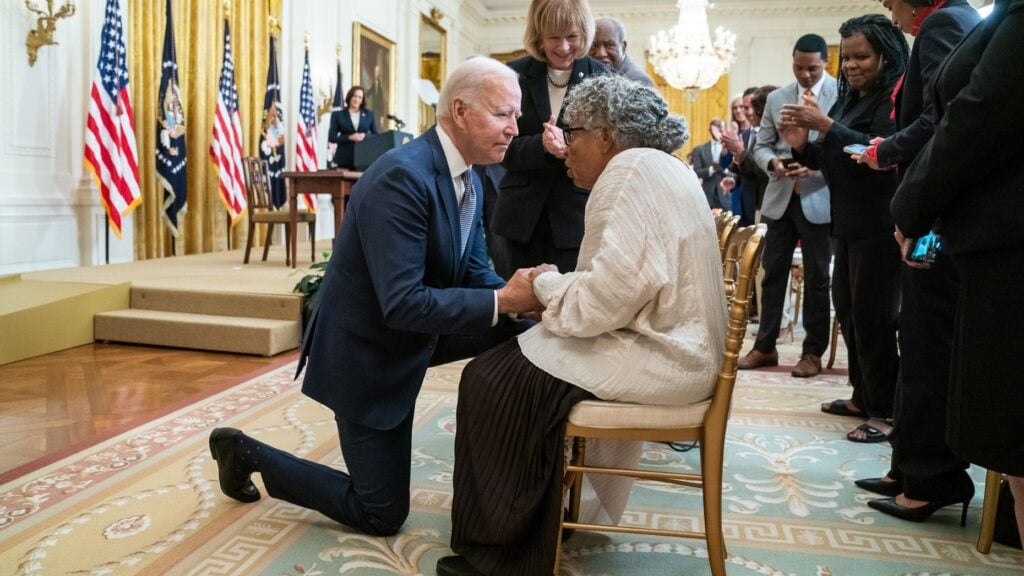
Meet Dr. Opal Lee, the “grandmother of Juneteenth,” who has been fighting for freedom and homeownership for decades. Dr. Lee Davenport shares 31 quotes to inspire your clients this June.
As real estate professionals, we would dare to say that we would all agree that home is where everything begins and ends for everyone. Do real estate professionals, especially in the United States, have a natural tendency to think that real estate is the center of everything? Yes! Could we be wrong? Probably not.
Participate in the INMAN Intel Index Survey
Similarly, Juneteenth, a federal holiday in the United States, begins and ends at home, unbeknownst to some.
“Property must be secured or there can be no freedom.” — John Adams, Founding Father of the United States, 2nd President of the United States
mother of juneteenth
Juneteenth, also known as Freedom Day, was codified by the federal government in the United States in 2021, thanks in large part to the relentless work led by then-94-year-old Dr. Opal Lee (HC) for decades.
“Opal Lee” by Userfromtheusa5000 is licensed under CC BY-SA 4.0. To view a copy of this license, please visit https://creativecommons.org/licenses/by-sa/4.0/?ref=openverse.
Dr. Lee (HC), known as the “Grandmother of Juneteenth,” did more than just lobby Congress. Her advocacy work literally culminated in a walking testament to the connection between liberation and equal access and opportunity in the United States.
In 2016, at age 89, she embarked on a 1,400-mile journey from Fort Worth, Texas, to Washington, D.C., walking 2.5 miles each day. It symbolizes the two-and-a-half years between the Emancipation Proclamation and June 19, 1865, when Union forces finally enforced freedom at Galveston.
Her journey positioned Juneteenth not simply as a commemoration of the past, but as an ongoing journey to provide equal access and opportunity to all Americans today.
Broken promise
Nowhere is that unequal access and opportunity more evident than in American homes, starting with Juneteenth’s original broken promise and reverberating into the 20th century. General Sherman’s Special Field Order No. 15, which proposed “forty acres and one mule” for newly freed families, was overturned by President Andrew Jackson in the fall of 1865.
This began a century in which black Americans were legally excluded from the single greatest source of generational wealth: land and homeownership. The often unchecked and inequitable housing legalized this century has stripped billions of capital from Black communities and the entire U.S. economy (which affected us all) (as reported by Citigroup).
Below are some of the despicable, but often legal, actions that take place based on characteristics that are merely superficial and unimportant to homeownership (race, gender, etc.).
Inducing blockbusting Exclusion from professional associations (including the Realtors Association, which has since apologized) Valuation bias (with low or no compensation) Forced evictions (e.g., prominent properties) Denial of promised benefits (GI Bill, Fannie Mae, etc.) Threats of violence (e.g. Sundowntown) Subprime lending Lending bias Redlining Restrictive covenants Predatory contract sales
fair housing
Of course, by the time the Fair Housing Act of 1968 (and subsequent amendments) was passed to end the legality of these practices (which still occur today, but now carry legal penalties), the gap between rich and poor was already deeply entrenched.
But against all odds, Black Americans continue to bounce back. Remarkably, Dr. Lee’s life embodies these intersections. In a hallmark of anti-black hate crimes of the 20th century, in 1939, when she was 12 years old, a white mob, enraged by Dr. Lee’s parents’ purchase of property in a white neighborhood, burned down Dr. Lee’s family’s Fort Worth home on Juneteenth.
So, as we celebrate National Homeownership Month and Juneteenth, the best proclamation I can offer is not my words (which I have shared often, as here), but rather Dr. Lee’s poignant musings.
When Home Isn’t Home: Opal Lee’s Traumatic Experience with Inequitable Housing
Here’s what the living, almost 100-year-old venerable Dr. Opal Lee had to say about Juneteenth and the effects of owning and not having a welcoming home (also known as fair housing). These are of great interest to us today.
“Our parents worked hard…and bought this house on Annie Street.” — CNN article (about the family home before the attack) “The nicest place.” [we] It was in Fort Worth. ” — BWTimes “My parents bought the house and my mom fixed it up very nicely. But on June 19th, 500 people who didn’t want us in the neighborhood came together and tore the place up and burned the furniture.” — Oprah Daily Interview “And there were police officers, but they didn’t do anything… Our parents sent us to a friend a few blocks away. (Then) they left under cover of darkness.” — CNN Article Recalling the night of the attack more than 80 years ago, he said, “When my parents kicked us out of the house, we were scared to death. It was traumatizing to come back and see the mess.” — BWTimes “Those people threw the furniture away. They did some despicable things.” — CNN Article “This surprises me because we would have been good neighbors. “They didn’t see it that way.” — ABC7 NY article “The fact that it happened on June 19 made me want people to understand that Juneteenth is more than just a festival.” — Freedom Center: “It’s not a celebration. It’s about truth. It’s about honoring those who were enslaved and recognizing the resilience needed to continue living. It’s about teaching the whole picture of this country, not just the convenient parts.” — Oprah Daily Book Excerpt (A Committee of One) “If you can teach people to hate, you can teach them to love. But know this: you can’t erase history. So let’s learn from it and make sure it never happens again.” — Freedom Center “I felt like there was something else to do. And I had the idea that if I walked from Fort Worth to Washington, D.C., and asked the president to make Juneteenth a national holiday, someone would notice. Transcript “People think this is a Texas thing or a Black thing, but it’s not. It’s about freedom for everyone.” — Greenhill School Interview Transcript “We just have to make people realize that no one is free and not yet free until everyone is free.” — Freedom Center
“Committee of One”: How Opal Lee’s journey reached a nation
Lee continued to speak and advocate across the country on important topics surrounding these issues for Black Americans.
“Growing up in East Texas, we celebrated Juneteenth every year, and we thought the rest of the country did too.” — Oprah Daily Book Excerpt (A Committee of One) “Two and a half years after the Emancipation Proclamation was signed, this issue announced that all enslaved people were free and stood in what former slaves and their orders called ‘absolute equality.’ Phew! Can you imagine?” — Excerpt from the Oprah Daily Book (A Committee of One) “They gained so much that day: the ability to name themselves and keep their children from being taken away from them, the ability to wear clothes that fit them, the ability to own property.” — Excerpt from the Oprah Daily Book (A Committee of One) “That question became a burden I couldn’t shake. I knew Juneteenth needed to be more than a local or regional event.” — Oprah Daily Book Excerpt (A Committee of One) One) “I walked 2.5 miles in many cities across the country. The freedom of enslaved people in Texas was delayed by one mile a year.” ―Excerpt from the Oprah Daily Book (A Committee of One) “When people saw an old woman walking 2.5 miles in the heat and cold through a city she had never been before, they asked questions. And those questions led to conversations. Those conversations led to understanding, and that understanding led to change.” — Excerpt from the Oprah Daily Book (A Committee of One) “I met kids who said they had never heard of Juneteenth before, and now they will never forget it.” “I met elders who shed tears of gratitude to see our history finally getting the light it deserves.” — Oprah Daily Book Excerpt (A Committee of One) “There were people of all backgrounds — black, white, Latino, Asian — saying, ‘I didn’t know this before, but now I want to know.’” — Oprah Daily Book Excerpt (A Committee of One) “That’s why it’s important to do the following.” “I’ve been called the Grandmother of Juneteenth, and I’m proud of that name, but I’ve walked for justice and truth.” — Oprah Daily Book Excerpt (A Committee of One)
June 1st is finally a federal holiday.
When the holiday was finally recognized by the federal government, Ms. Lee shared many of her feelings, thoughts, and words of wisdom.
“Let’s celebrate freedom from June 19th to July 4th, because we weren’t all free in 1776.” — Oprah Daily Interview “Juneteenth must stand tall beside the Fourth. Not as a replacement, but as a reckoning, as a completion of the story of freedom.” — Oprah Daily Book Excerpt (A Committee of One) “People always ask me if I’m scared that Juneteenth will be like that. I can’t say it will be removed as a federal holiday in light of the change of administration, so I hope the new administration can’t dissolve it…If that happens, I’m sure I’ll get new tennis shoes.” Book Excerpt (Committee of 1)
finally got home
In June 2024, through a collaborative partnership between Trinity Habitat for Humanity, HistoryMaker Homes, and Texas Capital, Dr. Lee was gifted a home on the land where her family was attacked on June 1, 1939, nearly 85 years to that day, she told CNN.
“I wanted to do the sacred dance. I’m a happy camper, girl, you won’t believe how happy I am!” – CNN “He was going to give it to me! They brought me the drawings and Habitat was going to build a house for me on the property. I tell you, how about it come full circle?” – CNN
Listen, may I add Dr. Opal Lee, Presidential Medal of Freedom recipient, Nobel Peace Prize nominee, and a living Barbie doll. May your historic path and life’s journey continue to inspire ours. Happy Juneteenth!
Dr. Lee Davenport is an MBA professor and executive business coach. Follow her on YouTube and Instagram or visit her website.
