


Even as one chokepoint brings down the global economy, and another (the Bab-el-Mandeb Strait) threatens to double the effort, quieter legal and financial fights over global port operations continue to escalate.
Let’s start at another major chokepoint where Chinese shipping giant Cosco, which owns one of the world’s largest fleets of tankers, is suspending operations at the two busiest Panama Canal ports. Panama “retook control” of the Pacific Ocean port of Balboa and the Atlantic Ocean port of Cristobal after a court annulled a contract that had allowed a subsidiary of Hong Kong-based CK Hutchison Holdings to operate both since 1997. Last year, 38 percent of the containers that passed through the Panama Canal went through these two ports.
According to some, it’s no big deal. Here’s Intellinews:
…the immediate operational impact appears limited: the Danish shipping group Maersk already handles roughly 75% to 80% of container traffic at the facility, according to data cited by La Prensa. In that sense, COSCO’s move carries as much strategic signal as it does logistical weight. The company has also begun rerouting some transhipment activity through the Colombian port of Buenaventura.
But there’s more to it than that.
The Hutchison subsidiary is now seeking at least $2 billion in damages through arbitration proceedings against Panama under the rules of the International Chamber of Commerce. The company argues that the government’s actions amount to an unlawful seizure that violates contractual commitments and international investment protections.
Panama turned around and awarded temporary 18-month operating contracts to subsidiaries of Maersk, for Balboa, and to Mediterranean Shipping Company (MSC), for Cristóbal.
There is evidence that Beijing is also playing hardball with both Panama and Maersk and MSC—and it’s hard to see how China doesn’t come out on top of those fights:
🚨Panama Just Grabbed Chinese Ports – Now Beijing’s Turning Off the Money Tap 🇨🇳🇺🇸🇵🇦
Panama’s port grab is blowing up in their face and it’s a perfect snapshot of how U.S. pressure turns allies into collateral damage in the China trade war.
Quick Recap: Panama’s Supreme Court… pic.twitter.com/fzj6QiO9Y6
— James Wood 武杰士 (@commiepommie) March 13, 2026
In typical Washington fashion, the Panama takeover appears intended to make sure the US avoids blame and others take the hit. The US Trade Representative tried last year to slap fees on ships built in China—or operated or owned by Chinese entities—as part of an effort to revive US shipbuilding and blunt China’s rising shipping power. Washington backed off that plan when Beijing hit back with its own fees plan, as well as other economic retaliation.
If the upcoming meeting between Chinese President Xi Jinping and Trump happens (Trump is now threatening to delay it if Beijing doesn’t help open Hormuz), the Chinese side will likely have plenty to say about the latest schemes to hurt China shipping interests.
Meanwhile, Panama’s move against Hutchison was clearly pushed by the US, which under Trump has pushed the narrative that China “controls” the Panama Canal. And the way in which Panama “retook control” took a page right out of the US playbook:
BREAKING NEWS: THE PANAMA AUTHORITIES stormed the Hong Kong-run port terminals in its country and ordered staff to leave immediately, workers revealed yesterday.
The strong-armed takeover of the pair of terminals follows threats from US President Donald Trump that his country’s… pic.twitter.com/cbDvMySK77
— Nury Vittachi (@NuryVittachi) February 24, 2026
The plot to expel Hutchison from the ports comes as a Western takeover of the Hong Kong-based logistics giant remains stalled. Almost exactly one year ago, a deal was announced that would have seen most of Hutchison’s international ports (43 with 199 berths across 23 countries, excluding mainland China) go to a consortium led by BlackRock and MSC.
Reuters is now reporting that MSC and BlackRock have reopened and are accelerating negotiations with Hutchison to complete the acquisition of its international ports—this time without the two that Panama just “retook” (handing one to MSC under the new 18-month operating contract).
What a strange time to be doubling down on those efforts:
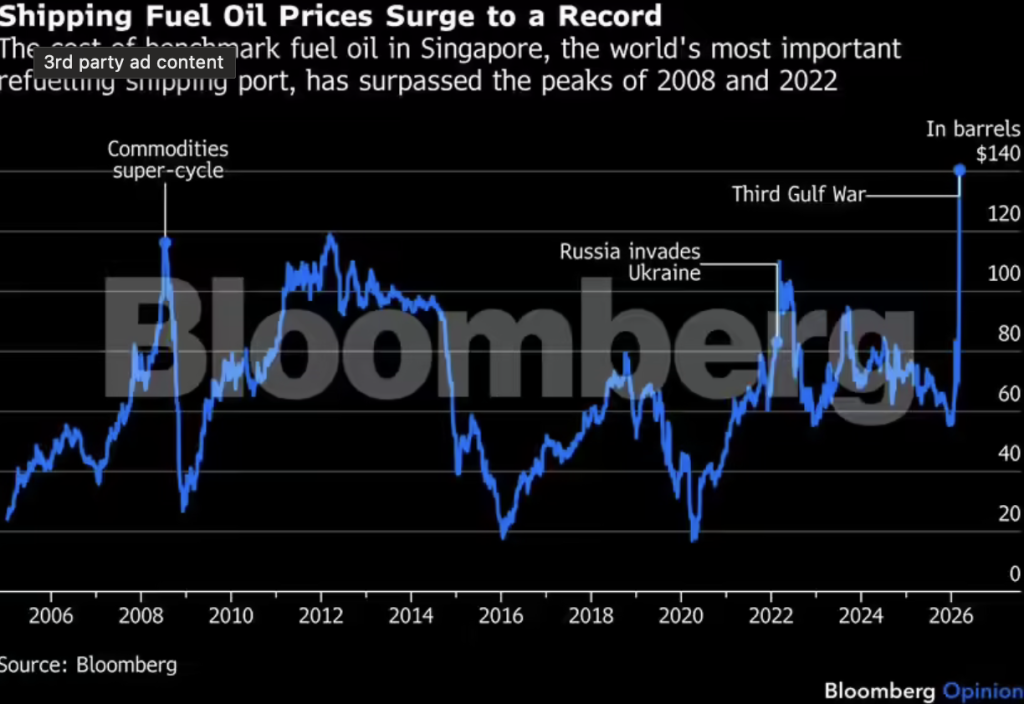
Not only are some of the ports in a Persian Gulf that will be changed forever, but port operations across the world are facing some of their strongest headwinds ever due to the closure of the Strait of Hormuz. As Javier Blas writes in Bloomberg:
Overshadowed by the other stuff coming higher up from the distillation process — diesel, jet fuel and, above all, gasoline — fuel oil plays a huge role in the modern world, powering the workhorses of globalization: container ships.
The problem isn’t just that it’s getting crazy expensive; the real worry is that some key ports may run dry, forcing all kinds of ships, from container vessels to bulk carriers, to halt. The shipping industry, which is typically conservative in its public pronouncements, is sounding the alarm. Vincent Clerc, the chief executive officer of shipping giant AP Moller – Maersk A/S, told French newspaper Le Monde this week: “If we do nothing, we risk ending with dry supply points in Asia.”
And yet there’s little that can be done as long as the war drags on and the Strait of Hormuz remains closed—and Blas doesn’t even mention the potential closing of the Bab-el-Mandeb.
The state of the shipping industry must make the proposed deal much more attractive for Hutchison, bit it’s still difficult to envision this reworked deal having any more success than the previous attempt when Beijing snuffed it out.
In response to a WSJ report last year that said there were discussions to exclude the two Panama Canal ports as a way to appease Beijing, China responded by launching a regulatory review of the deal —although the company’s base is in Hong Kong and there aren’t direct Chinese assets involved in the sale — and said the deal shouldn’t be implemented without its approval.
It’s easy to see why.
The Trump administration worked closely with BlackRock during the lead up to that proposed sale and helped instigate it with its pressure on Hutchinson, showcasing that this is essentially a hostile takeover attempt spearheaded by Washington. As the Wall Street Journal reported at the time:
In the days before finalizing the deal, [BlackRock Chairman Larry Fink] held calls with Trump, Secretary of State Marco Rubio, Treasury Secretary Scott Bessent and national security adviser Michael Waltz, ultimately garnering the administration’s blessing, according to people close to the deal.
Behind the scenes, Hutchinson executives had grown uneasy that a hostile Trump administration could make life hard on their sprawling global conglomerate…
Hutchinson executives had weighed selling these and dozens more ports before, but the timing wasn’t right. With Trump applying pressure — and Hutchinson shares trading at a substantial discount to the company’s underlying assets — that changed. …executives were surprised by Trump’s decision to revoke special trade privileges for Hong Kong, and Panama authorities had just announced an audit of Hutchinson’s contract.
Chief among China’s concerns with the Hutchinson deal is that the new ownership could, under pressure from Washington, raise prices on or refuse Chinese ships or allow the US to militarize the ports and use them to enact a maritime blockade of China. These fears are not unfounded. The US is already actively working towards some of those goals while having discussed the others. And we can see how global chokepoints and the ports in the proposed deal overlap:
The Hong Kong and Macao Affairs Office of the State Council of China issued a strongly worded comment on the matter yesterday, directly stating that the transaction is not an “ordinary commercial activity,” but rather a hegemonic act in which the United States employs state power—through coercion, pressure, and inducements—to seize the legitimate rights and interests of another country, all masked as “commercial behavior” and essentially representing power politics. More:
Once the Panama Canal is “Americanized” and “politicized,” the United States will undoubtedly use it for political purposes to advance its own political agenda, and China’s shipping and trade will inevitably be controlled by the US. If the United States were to implement measures such as selective capacity restrictions or imposing “political surcharges,” Chinese companies’ logistics costs and supply chain stability would face great risks. Some netizens also noted that through this deal, BlackRock would control about 10.4% of the world’s container terminal throughput, joining the ranks of the world’s top three port operators, and it is entirely possible that it would work in concert with US policies to suppress China, raising costs for Chinese cargo and squeezing the market share of Chinese shipping companies. Moreover, this transaction creates a major gap in the port network that Chinese companies have built up over the years, thereby allowing American interests to erode their overseas development advantages. Other netizens even point out that the United States might use this transaction as a “template” to spark a wave of port mergers and acquisitions worldwide through political pressure, thereby controlling more critical ports globally and employing “long-arm jurisdiction” to suppress China, leaving Chinese vessels with “no reliable haven.”
This is by no means mere fearmongering. According to a draft executive order from the US government, plans are already underway to charge Chinese vessels special docking fees, and the US will urge its allies to take similar measures, otherwise facing retaliation. If all of the United States’ calculated moves succeed, they will undoubtedly impact China’s shipbuilding, shipping, foreign trade, and even the Belt and Road Initiative, and will directly affect Hong Kong’s efforts to consolidate and elevate its position as an international shipping and trade center, while threatening and undermining the normal global order and safety of shipping and trade.
Can China Block the Sale?
No according to Bloomberg, which claims that Beijing can pressure Hutchison but that “because the deal involves only overseas assets it is unlikely to need Beijing’s sign-off.” It also notes that CK Hutchison and sister company CK Asset Holdings Ltd. are registered in the Cayman Islands.
There’s a little more to it than that, though, according to Reuters:
The State Administrative Market Regulation Authority could have extra-territorial jurisdiction by applying the anti-monopoly law, if a deal outside mainland China has the effect of eliminating or restricting competition in China’s domestic market.
Authorities could also use the Measures for Security Review or Foreign Investments, implemented in 2021, to examine foreign direct investments in important fields relating to national security, including infrastructure.
Felix Ng, a partner at law firm Haldanes, said the measures removed the exclusion of acquisitions of interest held by foreign companies, “suggesting that PRC authorities may have the power to review foreign-to-foreign transactions if the target involves PRC-related entities”.
There’s also the nuclear option: the 2020 National Security Law, which goes after “terrorism,” subversives, secessionists, and colluders with foreign forces.” Could that come into play?
“Given the sensitivities, there would be room for further investigation under the broad sweep of the National Security Law, particularly over collusion or espionage,” said Simon Young, a professor at the University of Hong Kong law school.
The offence of collusion would have to involve a person or company intending to disrupt the policies of the Chinese or Hong Kong governments to create serious consequences, Young said.
But should China go this route to nix the deal, it would involve it taking a much more state-heavy approach in Hong Kong, which could hurt the financial center’s global standing. As of now, it is third in the Global Financial Centres Index behind New York City and London, and it is proving an attractive option for people—and capital—fleeing Dubai and other Persian Gulf financial centers.
The US war of aggression against Iran has injected loads of uncertainty into the upcoming weeks and months—let alone years—of global trade. And as the above map shows, a dozen of the ports are located in West Asia currently in flames, which makes this a strange time to be doubling down in pursuit of the deal. Fink said in an annual letter to investors last year that ports ‘will define the future’ and are as critical to future infrastructure of the global economy as data centers and power grids. The world’s largest asset manager’s wager that despite the new era of geoeconomics, global trade will continue to rise enough to justify this port investment, might pan out. That seemed highly questionable at the time, and crazy now. Yet the transaction is still being pursued as a bet on the safe stewardship of global trade at a time when the US empire in rapid decline is embracing global chaos. What am I missing?
Perhaps it’s a bet on new leadership?
Singapore’s PM has laid it out.
He knows the U.S. has abandoned the multilateral trading system, upon which Singaporeans wealth is based.
There’s only one stable force with the heft to anchor multilateral trade in this episode of disruption. It’s China. https://t.co/Zb0sZnEOZq
— Warwick Powell | 鲍韶山 (@baoshaoshan) April 5, 2025
