


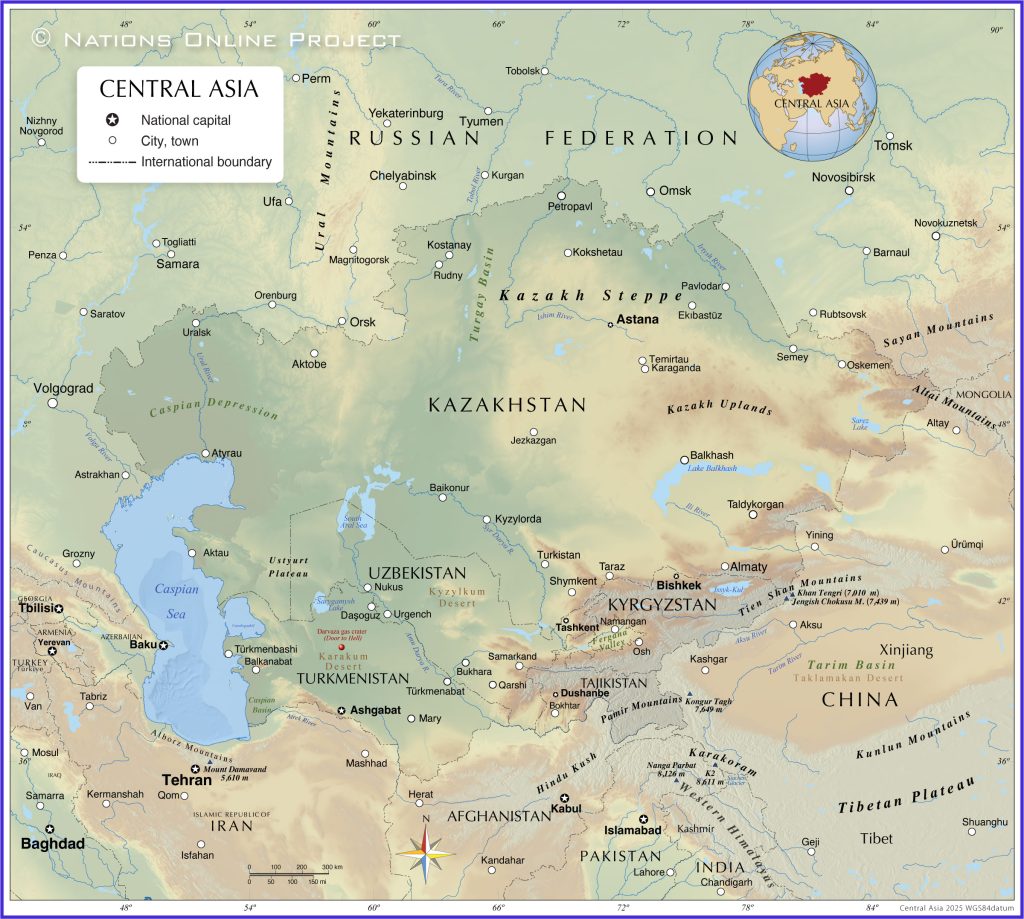
On Monday, we wrote about the challenges facing Moscow and Tehran in the Caucasus, particularly how to respond to Azerbaijan and Armenia, which no longer function in terms of rational national interests.
So far, they have not taken decisive action and are allowing the problem to worsen. June elections are looming in Armenia. U.S. Vice President J.D. Vance has just endorsed Armenia’s current Prime Minister Nikol Pashinyan, but unless the opposition wins and Trump’s path toward international peace and prosperity ends. [TRIPP] Moscow and Tehran will have to take action at some point as Turkey seeks to advance Western NATO influence into the Caucasus and Central Asia.
Russia could crush both Armenia and Azerbaijan economically if it wanted to, but it remains to be seen whether that would be enough to change the current trend. The current ruling elites in both Armenia and Azerbaijan have already done much work to cultivate antipathy toward Russia, and economic retaliation by Russia may only add to that narrative. While the wider population suffers, elites appear to be heavily paid by the West to steer their countries down this destructive path.
Meanwhile, Baku and Yerevan, as well as Ankara lurking in the shadows, are approaching several tipping points. Construction is expected to begin soon on a railway line, natural gas pipeline, and power transmission line connecting Azerbaijan and the Nakhchivan enclave across Armenian territory. Ali Akbar Velayati, a senior adviser to Supreme Leader Ayatollah Khamenei, is on record as saying that the Iranian government would turn the project into a “graveyard for Trump’s mercenaries.” Commanders of the Islamic Revolutionary Guard Corps also support the threat. Meanwhile, President Masoud Pezeshkian spoke upbeatly, pointing to Pashinyan’s promise that the corridor would remain under Armenian control. It’s a promise he can’t control. Armenian officials will be physically present at all border and customs checkpoints, but Washington and Yerevan already have a deal in place under which the United States will hold a 74% stake in the corridor infrastructure for 50 years. The United States plans to invest and establish a private company to implement the project, with Turkiye and Azerbaijan expected to have a large presence. So who is in real control? Is it Yerevan or the US-backed investors pumping billions into transportation and energy infrastructure?
Another key point will come as Azerbaijan seeks to expand the TRIPP energy and trade corridor beyond the Caspian Sea, as Vance and Azerbaijani President Ilham Aliyev discussed last week.
The strategic partnership agreement between the two countries frequently mentions the objective of connecting TRIPP to the Central Corridor across the Caspian Sea and siphoning vital mineral and energy resources from Central Asia. And Baku and Washington intend to strengthen security cooperation to make that happen.
Just look at the map and you will see that there are only several ways to proceed along such a route. Reviving the idea of a trans-Caspian pipeline or tanker fleet, crossing the sea from Azerbaijan to Kazakhstan and Turkmenistan, or with the involvement of Russia and Iran.
Aliyev, who attended Davos, touted his country as the only safe shipping route between Europe and Central Asia that would not be at risk of sanctions, and said there were plans to expand the Arat international maritime trade port for Caspian Sea cargo, saying the latter was simply not an option. (Oddly enough, China is a major investor in its expansion, as Washington and Beijing’s pursuit of intermediate corridors partially overlap.) [more on that below]).
Aliyev then appeared on “Davos with Guns” and further promised the same. All of this poses a clear threat to Russia and Iran, as governments unfriendly to NATO and Russia and Iran are expected to follow suit, suffering the economic blow of being excluded from logistics in Central Asia, the Caucasus and Europe. At that point, Iran will be almost completely surrounded, and Russia will have enemies ranging from Finland to China—save Belarus and, for now, Georgia.
Marat Khairlin, a Russian military correspondent, blogger and documentary filmmaker, argues that Azerbaijan’s actions will cause big problems in Central Asia.
In the past, the Caspian Sea countries agreed to keep outsiders out of the region and to work together solely with their own militaries to develop their territory. And now we see how Azerbaijan violates this joint promise – accepted both Turkiye and Israel. American and British agents. This paved the way for the direct destabilization of Central Asia as a whole.
But there is a reason why this vision of energy and resources flowing west from Central Asia through the US/NATO allies and across the Caspian Sea, thereby eliminating Iran and Russia, has not yet materialized. As we wrote in November:
Supporters of the trans-Caspian route envision a new pipeline through TRIPP or a connection to the existing Baku-Tbilisi-Ceyhan (BTC) pipeline from Azerbaijan through Georgia to Turkiye and then on to Europe. There are reasons why pipelines are not being built, and the main reason is that the 2018 Convention on the Legal Status of the Caspian Sea signed between Azerbaijan, Iran, Russia, Kazakhstan and Turkmenistan did not resolve disputes over submarine cables and pipelines.
These are governed by the 2003 Tehran Convention, which sets out environmental standards. Moscow and Tehran have repeatedly invoked the treaty to effectively block construction of pipelines between Azerbaijan, Kazakhstan and Turkmenistan.
Tanker fleets may be a different story (though they may face challenges posed by shrinking oceans due to climate change, such as one already 50 kilometers off the coast of Kazakhstan).
Granted, it doesn’t make economic sense, but it would reflect Europe’s energy strategy over the past four years.[1] It would then serve as a “Western link” to Central Asia, separating Russia and Iran.
It is noteworthy that last year the leaders of the C5+1 (five Central Asian countries and the United States) approved the development of a trans-Caspian trade route.
Military logistics will soon follow. Kazakhstan is currently building a shell factory to NATO standards and last year signed a military cooperation plan with Turkiye.
In Turkmenistan, opposition forces based in France are helping to maintain pressure on the Ashgabat government. There are rumors that the American presence in this country is growing.
🚨⚡️ Urgent and serious
According to some reports, the US has relocated Delta Force troops to Turkmenistan, near the northeastern border with Iran.
-: Delta Force is the elite force that carried out the kidnapping of Venezuelan President Nicolas Maduro! pic.twitter.com/jJXQKHx22B
— Turbo’🌍 (@AliNor383073191) February 7, 2026
Although it seems to be just a rumor, the two countries have secret military ties. And from the Caucasus to Central Asia, Washington is essentially working to get Moscow and Tehran to do something about it. Can they afford to put up with it?
The Central Corridor is still economically less competitive due to its mix of road, rail and sea transport. Current costs range from $3,500 to $4,500 per 40-foot equivalent unit, compared to $2,800 to $3,200 for the northern route through Russia and Belarus.
And the United States and the European Union continue to try to gain economic status in Central Asia. Last year, Brussels announced plans to invest €12 billion in infrastructure for the Intermediate Corridor. Business leaders and government officials from Central Asia and the United States recently gathered in the Kyrgyz capital for the second B5+1 Business Forum, as the U.S. government plans to expand into the region with a focus on critical minerals. Their road is long. From 1994 to 2024, the United States invested $44 billion to $51 billion in Central Asia, most of which consisted of ExxonMobil and Chevron’s operations in Kazakhstan and its position as the largest shareholder in the Caspian Sea Pipeline Consortium.
Meanwhile, China is only increasing its dominance in the region. Despite the influx of money from the Gulf, China dwarfs all other players. The company’s investments in Central Asia are expected to reach $25 billion in the first half of 2025 alone.
And Russia is the region’s second-largest investor, playing a key role in energy, mining, nuclear power and other infrastructure.
One might imagine that China and Russia’s economically dominant position in Central Asia would allow them to align with the C5 countries, but the US-led “West” has an uncanny ability to force governments to ignore such details and act in ways that harm the nation. Just look at Armenia and Azerbaijan.
Another growing player in Central Asia is the Gulf states. From 2020 to 2024, the UAE, Saudi Arabia and Qatar invested a total of $16.2 billion. In addition to infrastructure and energy projects, Turkey’s influence and the Gulf monarchies’ funding could also lead to other “projects” that Professor Seyyed Mohammad Marandi calls “CIA Islamic”. We are also witnessing a growing threat of terrorism targeting Chinese infrastructure projects across the region. Just say it!
memo
[1] Western giants such as Chevron, ExxonMobil and Shell already play a major role in Kazakhstan’s oil. The problem is clearly that more than 80% of it is moving through the Caspian Sea Pipeline Consortium. The consortium transports crude oil via pipelines through Russia to the Black Sea port of Novorossiysk. This pipeline remained operational during the three years of war, and was a huge win-win for all involved.
But that’s not safe, writes Nurul Rakhimbekov, founder and president of the Washington, D.C.-based think tank Center for Global Civic and Political Strategy. As evidence, he cited the fact that supplies were threatened by drone attacks on pipeline infrastructure in February and October 2025.
Who is behind the strike? Ukraine, backed by NATO, of course.
