


The latest US bombings in Somalia brings the total number of US airstrikes in the country this year to at least 109, which means Trump—elected to make America Great Again—has already shattered the previous annual record of 63 set back in 2019 by Trump.
US troops are also reportedly on the ground fighting alleged members of ISIS, and the commander of US Africa Command is calling for it all to be “intensified.” Why? To answer the question in the headline, the official response is the usual one: terrorism.
But seeing as the US only deems it necessary to respond to what it labels terrorism in certain areas that are usually strategically significant to Washington—and sometimes has a hand in arming and funding the very terror forces it is fighting—the answer likely has much more to do with China.
Battles across the wider Horn of Africa are intensifying as the US and allies turn to increasing violence in face of Chinese economic clout. Calling them battles for influence wouldn’t be entirely accurate as the US cannot compete with Beijing for economic influence.
It has tried—or at least made an appearance of trying—and failed. And as usual in the wake of that failure we see carnage from Washington and its allies.
As the US bombs Somalia, its friends in the UAE—with help from the UK—turn Sudan into a living hell that threatens to spill over into Djibouti, South Sudan, and new BRIC member and close China ally Ethiopia. Climate change is only making matters worse, and all the destabilization is calling into question Chinese regional infrastructure projects.
The US has been involved in Somalia for three decades and yet each year only brings fresh rounds of death and discord. On the surface it would seem that Washington’s policy has failed, but time and again across the world we see that US policy is not geared toward nation building and stability but the opposite. And that trend has only accelerated in recent years.
With the empire in a panic and Secretary of War Pete “Kill Everybodyl” Hegseth representative of the idea that spilling more blood will put the US back on top, we see Washington lashing out in multiple directions.The increased bombings in Somalia are representative of a worldwide trend—from Central Asia to West Asia and Venezuela to the South China Sea. Somalia is just another victim—and one that receives a fraction of the attention as other American targets.
During his first overseas trip in February, Hegseth signed a directive easing policy constraints and executive oversight in a meeting with senior U.S. military leaders from AFRICOM in Germany. That means the number of Trump administration strikes might also be an undercount, since the US military’s Africa Command no longer provides specific details of such operations after the White House greenlit a more liberal policy allowing American commanders to authorize airstrikes and special operation raids outside conventional battlefields, broadening the range of people who can be targeted for death.
Is there a method to the madness? Let’s look at what’s unfolding.
How Does Somalia Fit into Larger US Schemes?
Somalia sits on prime shipping real estate. All the way back in 1888 Britain established the Protectorate of Somaliland to help exert control over the routes from East Asia through the Red Sea to the Suez Canal. Washington is thinking along the same lines as a recent paper published by the U.S. Naval Institute highlights how the Red Sea will be one of many locations where a near-future global war between the US and China plays out.
That paper describes what’s long been obvious—that Taiwan will be the pretense to launch this war—and that the US would then try to starve China of energy resources:
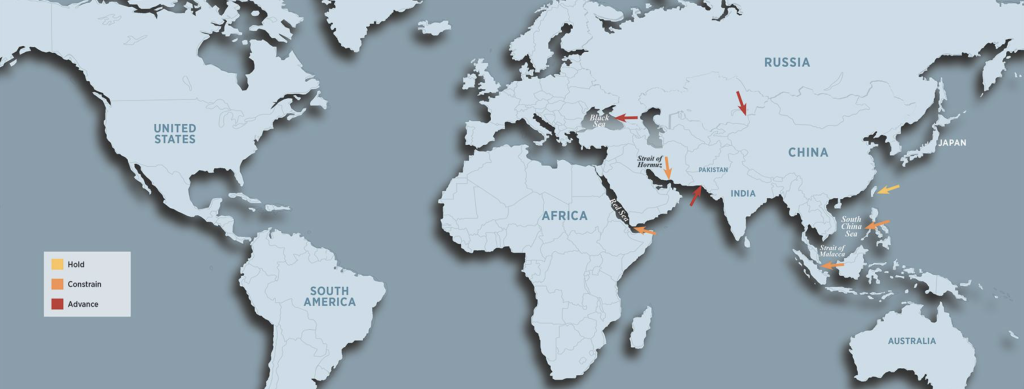
To win a war with China over Taiwan, the United States must adopt a three-tier strategy—it must hold, constrain, and advance. Initially, Taiwan must be empowered and supplied to hold off the Chinese attack, with none of the parsimonious hand-wringing that has characterized the response to Russian aggression in Ukraine. It is far easier to defend than to dislodge, and the price not initially paid in Taiwanese munitions will be paid later in American blood.
Next, the Navy must constrain China’s ability to prosecute the war, cutting vulnerable sea lines of communication (SLOCs) with an open blockade across the Indo-Pacific, while recognizing the threat China’s proxies will present to interdiction.
Finally, the United States must accept that blockade and sanctions alone will not suffice, especially when Beijing already will have accounted for those actions. China has spent decades establishing a strategic hinterland that spans Eurasia. For the United States to win the war decisively and avoid stalemate, the scope of its offensive operations must expand to new theaters, with allied regional actors and proxies empowered to target China far from the center of the maritime campaign.
As the following map shows, Somalia and Somaliland would be key in the plan to “constrain.”
One can think of dozens of reasons this hail mary by the US is destined to failure; nonetheless the US is attempting to move in this direction in multiple arenas by gaining stronger footholds—if not control—over key shipping lanes, strengthening ties with potential proxies, and ongoing escalation over Taiwan, which is currently being done by vassals in Europe and Japan if not the US itself.
China, too, appears to be preparing as it stockpiles oil at unprecedented rates and plans to continue to do so for the foreseeable future.
Instability is Washington’s Friend?
China’s supposed influence over the small Gulf of Aden nation Djibouti apparently poses an existential threat to American influence. The US, Germany, Japan, and Italy all had military presences in Djibouti, but it became a problem when China opened its first foreign military base there in 2017. Beijing’s stated interest — like the others — is to protect its shipping.
For the US, however, it is unacceptable, and Washington became more determined to do something about it when Djibouti denied the US request to use its territory for attacks against the Houthis in Yemen who subsequently embarrassed the American military. The US publicly blamed China for Djibouti’s decision and is now turning to Somaliland in a decision that will further destabilize the region. More from Responsible Statecraft:
Rather than accept Djibouti’s position, foreign policy experts have sought to escalate tensions, blaming Djibouti for being pro-Houthi and pro-China. Hoping to find a more reliable partner, many propose that the United States recognize and work with Somaliland instead. Somaliland is an unrecognized state that asserted its independence from Somalia in 1991. Close to Yemen and next Somalia, it seems Somaliland offers everything Djibouti has with no strings attached. Project 2025 recommends “the recognition of Somaliland statehood as a hedge against the U.S.’s deteriorating position in Djibouti.”
But recognizing Somaliland would not provide the security America hopes for. The Horn of Africa has a delicate balance of power, with tensions between Ethiopia and Somalia only recently resolved. American recognition of Somaliland would threaten this delicate peace. In addition, while Somaliland is far more stable than Somalia, clan warfare has been ongoing in its Eastern region for the last two years. Finally, relations in the region are often fluid. While China supports Somali unity, this might change if Somaliland was recognized by more countries. With China as the largest investor in Africa, Somaliland might want to work with China. In the end, all America could be left with is a more unstable Horn of Africa.
You say that like it’s a bad thing.
The neverending war against terrorism helps the US military maintain a presence in Somalia and Somaliland and keep the money flowing to politicians and warlords—and to the very terrorists the US is purportedly fighting.
It also helps line the money of K Street operatives in DC. Despite the fact that Somalia receives US aid to pay government salaries, it launched a mega lobbying campaign following Trump’s victory, hiring big time firms like BGR . According to Africa Report, the Somali president is also attempting to win over Elon Musk by giving him a Starlink license to operate in the country. Will it pay off?
Somaliland, aware of its strategic position, is attempting to leverage it to gain recognition of its independence the same way Panama did, according to Ibrahim Mohamed, an economist and the Chair of the Somaliland National Committee:
Panama’s path to recognition highlights the importance of transactional diplomacy in securing recognition. The isthmus of Panama was not only geographically strategic but also economically vital, offering the most direct passage between the Atlantic and Pacific Oceans. By aligning its independence movement with U.S. ambitions to build a canal, Panama was able to secure Washington’s decisive support for statehood. Recognition was not granted because Panama had the strongest legal claim, but because its recognition served the strategic and commercial interests of a major power. Somaliland finds itself in a similar position. Situated along one of the world’s most important maritime chokepoints, at the entrance to the Red Sea and the Gulf of Aden, Somaliland’s geography offers immense value in terms of global trade, energy security, and counterterrorism. Just as Panama leveraged its isthmus, Somaliland can use its coastline and ports as diplomatic assets, making a compelling case to international partners that its recognition is not only legally justified but strategically advantageous.
Just as Panama controlled the isthmus connecting the Atlantic and Pacific, a corridor essential for global trade and military mobility, Somaliland commands the Gulf of Aden, Bab el-Mandeb Strait, and Berbera port. These chokepoints are critical for maritime trade, regional security, counterterrorism, and rapid deployment for international partners…a truly effective foreign policy for Somaliland must be flexible and multi-directional. It should target engagement not only with Western powers and Gulf states but also with African states that historically sympathized with Somaliland’s cause, such as South Africa and Ghana.
There are a few notable countries missing from that list. Nonetheless, this is the path Somaliland is following. In July, it offered the US access to a strategic military base near the Red Sea and deals on critical minerals in exchange for official recognition. Washington has yet to jump at the offer, most likely because of how it would complicate the US presence in Somalia.
US partner in crime in the region, the UAE, already enjoys a sizeable presence in Somaliland where it operates a port and military airstrip in Berbera. Notably that hasn’t stopped Abu Dhabi from port and base presences in Somalia, however.
As Semafor first reported in December, members of the Trump administration have expressed interest in recognizing Somaliland: The move could enable US intelligence to set up long term operations to monitor the movement of weapons in a volatile region as well as keep an eye on Chinese activity. And in January an influential US-China subcommittee in the US House of Representatives called for the State Department to open a representative office in Somaliland.
The increase of US airstrikes in Somalia helps destabilize the situation further, leading to increased calls for Somaliland recognition. Again, the Trump administration is just ramping up existing US policy with a twist. Collective Biden formally upheld Somalia’s territorial integrity, but the Pentagon showed interest in a presence in Berbera, with several visits by Africom officials.
Last year, the US signed a deal with the government of Somalia to construct up to five military bases for the Somali National Army in the name of bolstering the army’s capabilities in the ongoing fight against militant groups. The bases are intended for the Danab (“Lightning”) Brigade, a U.S.-sponsored Special Ops Force that was established in 2014. The US at first funded Danab from the State Department, which contracted with private security firm Bancroft Global. More recently, funding comes from the Pentagon’s proxy war fund called the 127e program, which bypasses congressional oversight by allowing US special operations forces to use foreign military units as surrogates in counterterrorism missions.
War on BRICS
Ethiopia, which joined BRICS in 2024, has moved closer to Moscow in recent years, creating new dynamics in the region. As Horn Review describes:
Ethiopia, already home to one of Africa’s largest and most experienced militaries, stands to enhance its capabilities significantly. This shift is poised to alter strategic calculations among its neighbors, potentially triggering an arms race or exacerbating existing rivalries, particularly with Eritrea and Somalia—each intent on fortifying their own security architectures.
China’s position in Djibouti is also about Ethiopia. “Djibouti is also important for China’s Belt and Road Initiative as a key maritime stop and a new railway line to Ethiopia’s capital Addis Ababa that connects the countries. China is the largest investor in Djibouti, with a total of $14.4 billion in infrastructure being built, a huge sum for an economy that is only worth $4.67 billion.”
A noticeable aspect of the above map of military bases in the Horn of Africa is the heavy presence of the UAE (as well as a growing presence of NATO member Turkey but for this piece we’ll focus just on the UAE).
Like Turkey, however, there is an argument to be made that the UAE—which is buying itself quite a few favors from the Trump administration— largely functions as American Trojan Horse. The Gulf of Aden is dotted with newly built runways and ports by the UAE that demonstrate its deepening strategic ties with Israel and Washington. As Red Sea Round Table notes:
The UAE’s involvement in Africa reflects a complex relationship where its actions align closely with U.S. interests, suggesting that it may be used as a tool for advancing American geopolitical objectives on the continent. While the UAE has its own motives for engaging in Africa, its strategies often contribute to outcomes that benefit U.S. policies, such as countering the influence of rival powers, controlling resources, and perpetuating regional instability that justifies military presence.
The close cooperation with the UAE continues in Africa despite (or because of) Abu Dhabi bankrolling and arming—including with UK weapons—the Rapid Support Forces (RSF) in the Sudan conflict, which is accused of genocide in the conflict that has killed more than 150,000. The war also destabilizes the entire region:
As the so-called Quad—the US, UAE, Egypt and Saudi Arabia—continue to stage peace talks on the conflict in Sudan, they arm opposing sides in the war and loot Sudanese mineral wealth as it drags on.
At the same time the RSF takes control over much of southern Sudan’s oil producing region, it raises the risk that the instability spills into Ethiopia as part of a wider conflict over water resources. From Horn Review:
Potential Sudanese state collapse presents Ethiopia with a serious security and geopolitical threat, especially along its western frontier. The porous border areas adjoining Ethiopia’s Benishangul-Gumuz region could become corridors for insurgent infiltrations, arms trafficking, and communal violence, worsening Ethiopia’s internal vulnerabilities. Meanwhile, the SPLM-N’s push for autonomy in the Nuba Mountains and Blue Nile could inspire parallel secessionist demands, potentially weakening the long-standing Sudan–Egypt alignment that once counterbalanced Ethiopia’s ambitions for the GERD. Sudan’s fragmentation also invites intensified intervention by external powers, transforming Sudanese territory into a proxy battleground and risking Ethiopia’s entanglement in broader contests for Red Sea access and Nile control.
The spillover from Sudan is already tangible. Increased arms trafficking, refugee inflows, and cross-border hostilities have strained security in western Ethiopia. Clashes between Ethiopian forces and South Sudanese militias have intensified, while internal insurgencies persist. Sudan’s war spreads like wildfire across porous borders, threatening to inflame Ethiopia’s internal conflicts and undermine state control.
GERD refers to Ethiopia’s newly inaugurated $5 billion Grand Ethiopian Renaissance Dam, which opened in September and means Addis Ababa now controls the flow of the Nile River’s largest tributary which Egypt and Sudan depend on for fresh water.
A recent piece in the National Interest from two neocon authors demonstrates Washington’s stance/threat on the issue. The authors argue that Ethiopia, by building the dam, hurts regional cooperation, which in turn strengthens Al Shabab who they argue is keen to attack the US.
The only solution to avoid more terrorism and proxy wars spilling into Ethiopia is for Addis Ababa to join a region-wide agreement overseen by Washington:
The United States should not wait until tensions spill over into open conflict. Cultivating strong relationships within the Horn of Africa and ensuring regional stability directly aligns with US counterterrorism mandates. The issues are interconnected, reflecting rising regional tensions and shifting power dynamics, so the solutions must be as well.
The United States should push for a binding water-sharing agreement among Nile River nations that sets clear drought-management rules, guarantees minimum flows, and establishes dispute-resolution mechanisms. To incentivize adherence to the agreement, it should link Ethiopian port access to the water-sharing agreement and make US aid contingent on countries’ abiding by its terms.
Whether Ethiopia succumbs to regional violence or enters into a Washington-led agreement to avoid it, one can bet that either track doesn’t bode well for China’s Belt and Road Initiative (BRI) in the country, which has been described as Africa’s “model” BRI nation, due to China’s extensive infrastructure investment and its many manufacturing enterprises.
The widening conflict also threatens one of China’s more important projects in the larger region. From Ethiopanorama:
The Lamu Port-South Sudan-Ethiopia Transport (LAPSSET) Corridor is a flagship regional infrastructure project that could transform East Africa through increased connectivity and economic integration. The corridor spans Kenya, South Sudan, Ethiopia, and links with Uganda, and has been built with the intention of unlocking the trade and developmental potential of these countries and the broader region.
LAPSSET features several key components: a 32-berth port at Lamu in Kenya that will serve as a major maritime hub; a interregional railway linking Lamu with Isiolo, Nakodok, Juba (South Sudan), Moyale, Addis Ababa (Ethiopia), and Nairobi (Kenya); highways running parallel to these rail lines; and oil pipelines moving petroleum from South Sudan and Ethiopia to the Kenyan coast. Additionally, the project also includes the development of resorts, industrial parks, power infrastructure, and international airports along the corridor.
Back in 2022 the Biden-led G7 launched a Build Back Better World initiative that was supposed to challenge BRI projects like LAPSSET. Predictably it amounted to nothing due to a lack of funding and inability to build anything cost effectively. So the fallback option is, as usual, chaos.
