


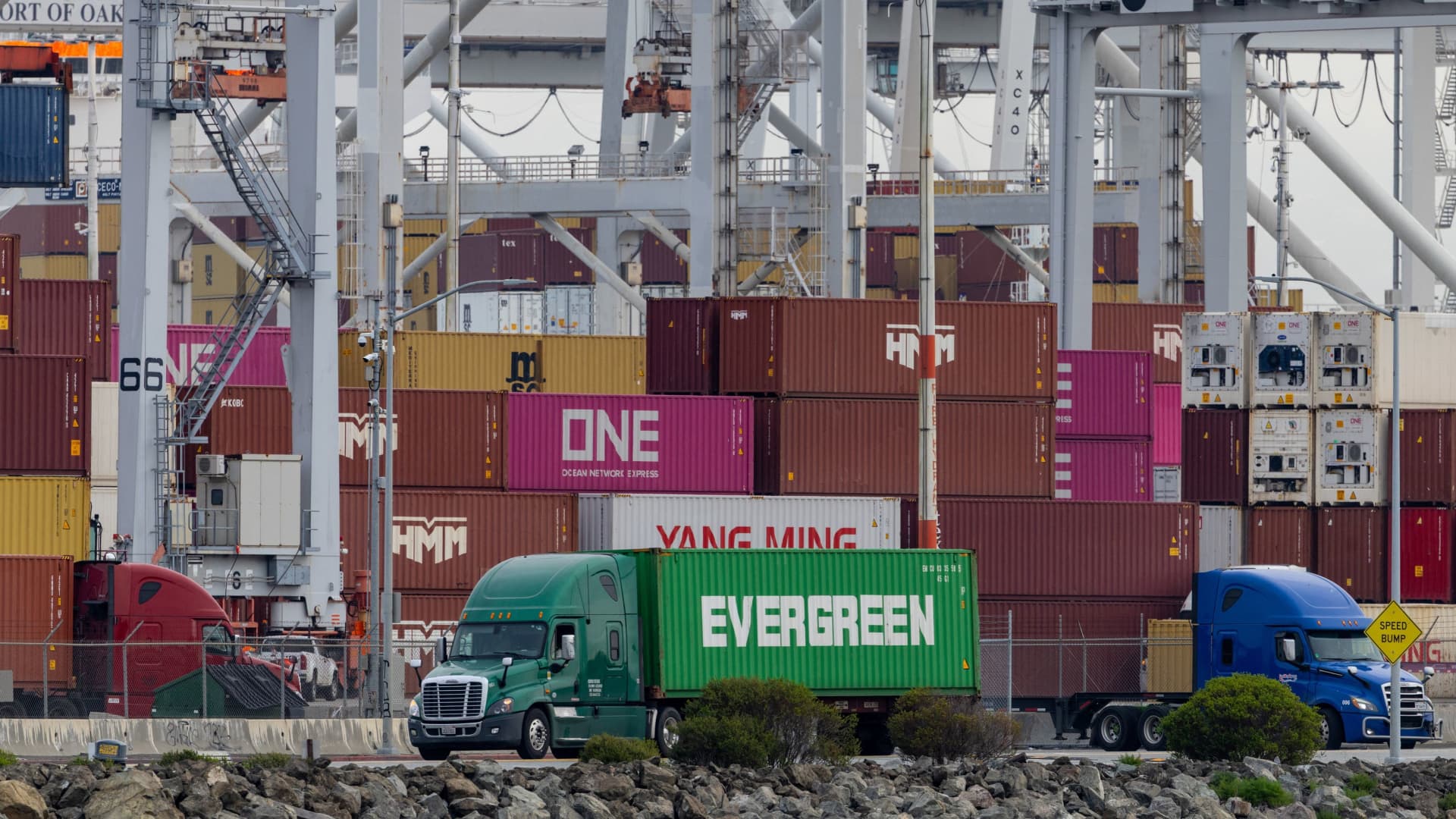
The Supreme Court struck down President Donald Trump’s tariffs on Friday, but the trade tax mess is far from over. Economists told CNBC that the backlash over the ruling threatens to further strain already global trade relations, and the U.S. economy is likely to suffer.
In a 6-3 decision, the high court ruled that President Trump lacked the legal authority to implement the steep tariffs he imposed last April under the International Emergency Economic Powers Act (IEEPA).
President Trump then imposed new tariffs of up to 15% on a range of U.S. trading partners, effective immediately, further escalating global trade tensions. European Union leaders expressed regret over the new tariffs and argued that the U.S. policy shift would upend trade deals already signed with the EU last year, as well as the UK. The EU on Monday again postponed a key vote on the deal with the United States.
The backlash against the latest U.S. tariff threats underscores deep dissatisfaction with the president’s erratic trade policies, potentially leading foreign governments to cut back on U.S. trade and companies to curb expansion, investment and hiring.
As a result, there is a possibility that it will be a drag on the US economy. “This changes the way we trade with the world’s largest economy, and it has economic implications,” Mike Reid, head of U.S. economics at Royal Canada Bank, told CNBC, referring to the Supreme Court ruling and new tariff push.
Downside
Mark Zandi, chief economist at Moody’s Analytics, said the trade war drama is likely to foster caution among businesses and foreign governments alike, which could be “nothing but negative” for the U.S. economy.
“Companies don’t know” what will happen next, Zandi told CNBC. “They’re going to invest less, hire fewer people, and be less aggressive about expanding their businesses,” which will limit U.S. growth.
The economist said foreign governments may react similarly and “continue to distance themselves from the United States” amid heightened uncertainty.
“I’m sure they’re pulling their hair out about this whole thing,” Zandi said. “There’s a growing sense that the economy is poorly managed in the U.S., and objectively speaking, that’s true. Things are a little chaotic, and it feels like it’s getting more and more chaotic.”
This realization could lead to efforts to divert trade from the United States to various other trading partners, including China.
According to Chinese customs data, China’s exports rose 6.6% in US dollar terms from a year earlier in December, beating analysts’ expectations and marking a record annual trade surplus. Imports rose at the fastest pace in three months, according to the same data.
President Trump’s trade tax
U.S. Trade Representative Jamieson Greer said the Trump administration continues to implement trade policy and now plans to use various provisions of the 1974 Tariff Act.
President Trump has cited Section 122 of the Tariff Act to justify the new tariffs passed this weekend, which are limited to a 150-day period through mid-July, after which they must be approved by Congress.
However, the administration will likely use Sections 232 and 301 of the Tariff Act to supplement the new Tariff Section 122, meaning the United States may continue to impose tariffs on foreign trading partners for at least the next few years.
Some say investors and economists shouldn’t sound the alarm just yet.
Citigroup economist Veronica Clark said in a note to clients that the introduction of the new trade tax “means little change to effective tariff rates or the outlook for inflation in the near term.”
“Eventually, tariffs under Section 301/232 may affect the prices of certain products in the future, but the details remain highly uncertain,” Clark wrote. “If the Section 122 tariff was 10%, the effective tariff rate would probably be 3 to 4 percentage points lower. [percentage points]for a 15% tariff, the effective tariff rate should remain virtually unchanged (if anything, it would be ~1pp lower).
Zandi said the overall impact of the new tariffs remains uncertain, but a few things are clear.
“The United States is moving away from the rest of the world, and the rest of the world is now moving away from the United States,” the economist said. “Deglobalization will weigh on the economy and ultimately weaken it.”
— With additional reporting by CNBC’s Alex Harring
