


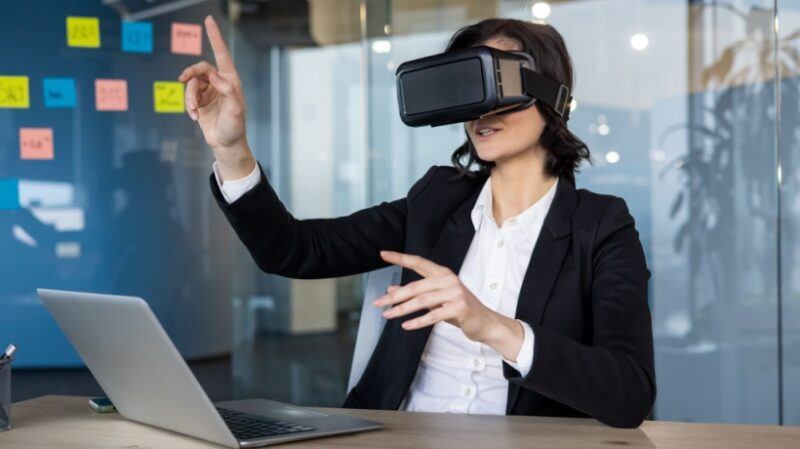
Benefits of VR in corporate training
Virtual reality (VR) is reshaping the way organizations train their employees, offering a blend of immersion, interactivity, and realism not possible with traditional methods. VR can transport learners into simulated environments, allowing employees to engage in real-life scenarios, practice skills, and make decisions in a risk-free environment. As companies strive to increase productivity and maintain a competitive edge, VR is emerging as an innovative tool in corporate training. In this article, we explore various use cases for VR in corporate training and how it addresses specific challenges while delivering tangible results.
Examples of using VR in corporate training
Enhance employee onboarding with VR
The onboarding process is critical to acclimating new employees to your company’s culture, values, and operations. However, traditional methods such as long presentations and static manuals often fail to effectively attract new employees. VR revolutionizes onboarding by providing an interactive and visually rich experience. for example:
virtual office tour
New employees can virtually explore the office layout and facilities even before they step foot in the workplace. Role-specific training
Employees can get a head start by immersing themselves in virtual scenarios customized to their job roles. immerse yourself in culture
VR can simulate interactions with virtual colleagues, helping employees understand workplace dynamics and expectations.
These immersive experiences not only reduce the time it takes to onboard employees, but also make them more confident and responsive.
Safely simulate real-world scenarios
Certain industries, such as construction, healthcare, and manufacturing, involve high-risk work where mistakes can have serious consequences. VR provides a safe, controlled environment for employees to practice and master these tasks without putting themselves or others at risk. Examples include:
safety training
Workers can experience virtual fire drills, machine breakdowns, and chemical spills and learn how to respond effectively. Emergency preparedness
Medical professionals can hone their skills by simulating life-saving procedures under virtual pressure. operational training
Employees can practice operating heavy equipment and complex systems in a risk-free virtual setting.
By simulating real-world scenarios, VR maximizes preparation and confidence while minimizing risk.
Improving soft skills through VR training
Soft skills such as communication, teamwork, and emotional intelligence are essential to the success of any organization. However, developing these skills through traditional training methods can be difficult. VR offers a dynamic solution by creating immersive role-playing scenarios that mimic real-world interactions. for example:
customer service training
Employees can engage with virtual customers and respond to complaints, questions, and feedback. Leadership development
Managers can practice decision making, conflict resolution, and team management in a simulated environment. Diversity & Inclusion Training
VR simulates diverse workplace scenarios and helps employees understand and address unconscious bias.
This interactive approach builds confidence, fosters empathy, and increases employees’ ability to effectively deal with real-world situations.
Enhance technical training with VR
Technical training often involves complex procedures, expensive equipment, and safety concerns. VR eliminates these barriers by allowing hands-on practice in a virtual environment. Main uses include:
software training
Employees can learn how to use complex software systems through guided virtual tutorials. machine operation
Workers can practice operating the machine without risking damage or downtime. product development
Engineers and designers can interact with 3D models of products to test functionality and identify areas for improvement.
VR allows employees to learn at their own pace, repeat sessions as needed, and gain confidence in their technical skills.
Attractive compliance training using VR
Compliance training is essential to ensure that employees comply with industry regulations and company policies. However, it is often perceived as monotonous and uninspiring. VR turns compliance training into an engaging and impactful experience. Examples include:
ethics training
Employees can navigate ethical dilemmas virtually and make decisions that align with company values. Regulatory compliance
Employees can simulate scenarios that require safety, data protection, and compliance with financial regulations. Harassment prevention training
VR can create realistic workplace scenarios that help employees identify and address inappropriate behavior.
VR enhances retention and application of critical knowledge by making compliance training interactive and immersive.
advantage
There are several benefits to using VR in corporate training, including:
Enhanced engagement
Immersive experiences engage learners and keep them focused. Improved holding power
Interactive simulations enhance learning and improve knowledge retention. cost reduction
VR reduces the need for physical resources, travel, and on-site trainers. Scalability
VR training programs can be deployed across multiple locations, ensuring consistency. Data-driven insights
VR systems track employee performance and provide valuable insights for improvement.
Challenges and future of VR in training
Although VR offers significant benefits, its implementation is not without its challenges, including:
Initial cost is high
Developing VR content and purchasing hardware can be expensive. technical limitations
VR requires a robust infrastructure and can face compatibility issues. learning curve
It may take some time for employees and trainers to get used to the VR system.
Despite these challenges, advances in VR technology and decreasing costs are making VR more accessible. The future of VR in corporate training is promising, with potential applications for AI integration, remote collaboration, personalized learning, and more.
conclusion
Virtual reality is transforming corporate training by providing innovative solutions for onboarding, skills development, compliance, and more. Its ability to create immersive and engaging learning experiences is unparalleled, making it a valuable investment for organizations looking to improve employee performance and productivity.
By embracing VR, companies can stay ahead of the curve and equip their employees with the skills and knowledge they need to succeed in a competitive environment. As technology continues to evolve, the possibilities for VR in corporate training are virtually endless.
Ozemio
We recognize the value of something very simple, yet fundamental: change doesn’t happen in silos. Our workforce transformation solutions are comprehensive, yet targeted. We offer bespoke plans tailored to your business requirements
