


Even as Iran defends itself by striking Israel and US targets in Iraq, Jordan and all six Gulf states it is not striking to its north against Türkiye or Azerbaijan—yet. That despite the presence of US troops in Türkiye and Israeli assets in Azerbaijan.
Among sites in Türkiye with a US presence is İncirlik, a key NATO air base that is believed to house upwards of twenty US B61 tactical nuclear gravity bombs. It is also used by the US to deliver weapons to Israel and monitor the region’s skies to help defend Israel and aid its aggression. Kürecik, a base in central Türkiye, also has a NATO early-warning radar system that can detect Iranian missile launches.
There’s a lot of noise that Iran isn’t hitting these sites because it fears triggering NATO article 5, but it’s unlikely Tehran loses much sleep over the paper tigers in Europe. Türkiye is a bit of a different animal. With 355,000 active troops and more than 1,000 aircraft, it actually has a serious military unlike the Gulf and European states. And it shares a border with Iran.
In Azerbaijan it is a well-known secret that Israel and others launch drones from the territory. Azerbaijan also counts Türkiye as its closest ally, and any Iranian strikes there would almost certainly draw a response from Türkiye and ignite the Caucasus and Caspian regions as well.
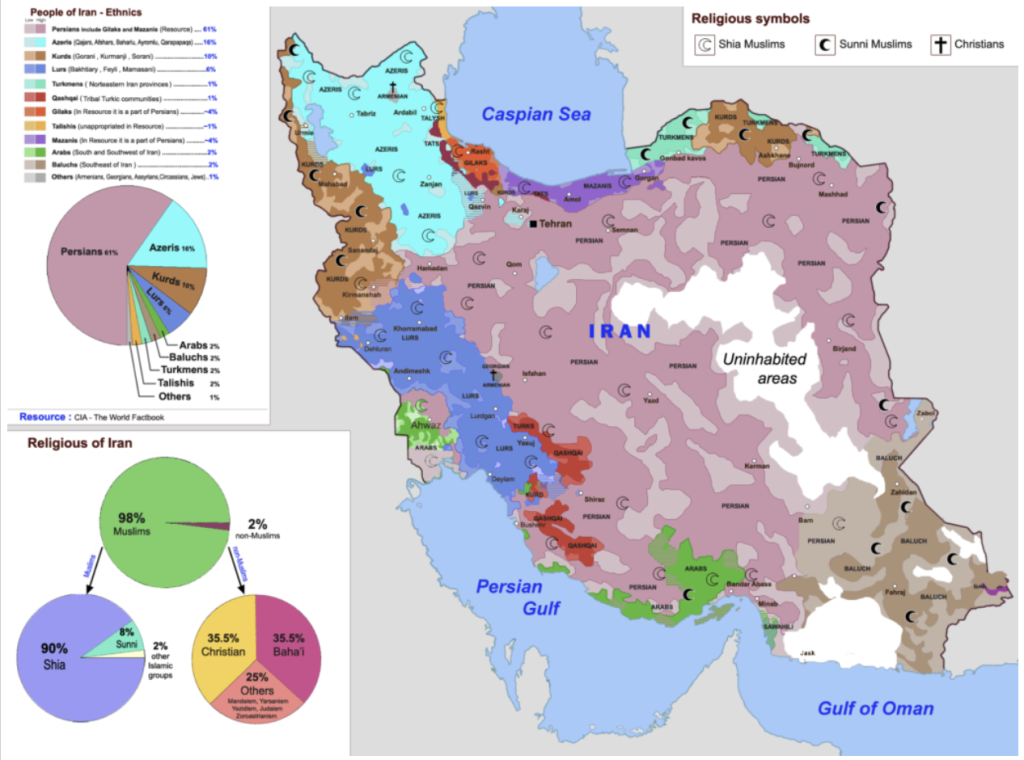
Due to the heavy presence of ethnic Azeris in northwestern Iran, any attack on Azerbaijan or Türkiye could complicate the situation for Iran there.
Neocons in Washington have long dreamed of using such ethnic divisions to help balkanize Iran, but have found little success. Ali Khamenei, after all, was of Azeri descent.
Most importantly, however, an attack on Incirlik (and the nukes there) could be an excuse the US and Israel use to try to justify the unjustifiable: using nuclear weapons against Iran.
It looks like Iran wants to save the Turkish issue for another day:
Iranian officials are warned early on that confronting Türkiye is a different game entirely. And if Iran, already standing at the edge, still wants to test that line, that’s its choice. 🤷♂️ https://t.co/M5oaXOrCvz
— Levent Kemal (@leventkemaI) March 2, 2026
The problem there is that there are actors eager to widen the war. The think tankers in Washington almost seem disappointed that Iran hasn’t attacked Türkiye and Azerbaijan.
It is quite revealing that the Islamic Republic of Iran has not attacked Türkiye with missiles or drones, where the huge Incirlik Air Base that hosts major US Air Force assets is based, nor did it strike Azerbaijan, which has close military ties with Israel and has a massive… pic.twitter.com/x6UVyF5aQj
— Ahmed Fouad Alkhatib (@afalkhatib) March 2, 2026
Perhaps they’re weary of having to go through the trouble of raising a false flag.
Turkish Minute also presents the viewpoint that bringing Türkiye openly into war would remove an avenue for negotiation:
“Iran continues to value Türkiye’s potential role in de-escalation and diplomatic mediation. Targeting Türkiye would undermine that channel at a moment when dialogue remains crucial,” [Serhan Afacan, director of the Ankara-based Centre for Iranian Studies] told Agence France-Presse.
Are you kidding? If that’s true, Iran is likely in trouble.
For one, how crazy would those in Tehran have to be to go back to the negotiating table?
🇺🇸🇮🇷 Iran fell for the same trick as Hezbollah’s Nasrallah.
1) The US made an offer that required the Iranian side to discuss details.
2) Iran held a meeting to discuss the offer and develop a negotiation strategy.
3) The US struck the meeting, killing many officials,… https://t.co/3bMeaClr57 pic.twitter.com/45qbA3Zctd
— Lord Bebo (@MyLordBebo) March 1, 2026
Türkiye has denied that its airspace and territory are being used by the US and Israel to attack Iran, and that might be true, but does anyone in Iran really believe that Türkiye isn’t involved in the efforts to destroy Iran?
Not if Professor Marandi is representative:
The Erdogan and Aliyev regimes continue to provide Netanyahu with cheap oil. They also allow the Epstein regime to use bases in their countries against the Islamic Republic of Iran and the Axis of Resistance.
— Seyed Mohammad Marandi (@s_m_marandi) March 2, 2026
Let us not forget that all the wheeling an dealing between Washington, Ankara, Israel and others up to this point has been designed to steer hostile actors against Iran.
Turkish deals with the Kurdistan Workers’ Party (PKK) fighters mean they are now in Iraq rather than Türkiye. The Syrian Kurds are joining them after the US withdrew support for the Kurdish Syrian Defense Forces in Syria.
There are roughly 200,000 Kurd fighters in Iraq, 50,000-plus making their way east from Syria, and 50,000+ Kurd fighters in Iran, yet there are differences in their effectiveness.
The strongest armed Iranian Kurdish group is PJAK and inconveniently now for Trump it is on the US Treasury’s list of terrorist organizations due to its links to another proscribed group, the PKK. The others have been largely ineffective for over three decades. Trump called one… https://t.co/wd3U8sKAHX
— Amberin Zaman (@amberinzaman) March 3, 2026
Will they fight and die for American financial class again only to be abandoned at the drop of a hat?
It looks likely:
Five Iranian Kurdish separatist groups formed an alliance today: PJAK, Komala, PAK, PDKI, and Khabat, called the “Alliance of Political Forces of Iranian Kurdistan.”
The coalition stated that its primary goal is to overthrow the Islamic Republic, achieve the right to… pic.twitter.com/CjG8zoNb3c
— Victor vicktop55 commentary (@vick55top) February 22, 2026
Kurdish language specialists with TSC/SCI clearance started going up last week across major defense contractors. pic.twitter.com/j0zNeJvf4m
— Daniel Boguslaw (@DRBoguslaw) March 3, 2026
Trump reportedly coordinated with Kurdish leaders on Sunday as the US and Israel began striking positions along Iran’s border with Iraqi Kurdistan.
NEW: Israeli jets have begun striking border guard positions along the Iraq-Iran frontier in what appears to be an effort to weaken Iranian control over the region and potentially clear a path for armed Iranian Kurdish opposition groups based in Iraq to move back into Iran. pic.twitter.com/srj7CWrGWr
— Levent Kemal (@leventkemaI) March 2, 2026
More from Frame The Globe News:
Watch the targeting pattern from March 1 and the sequencing becomes visible.
The combined US-Israeli force targeted the West Azerbaijan Provincial Border Guard. West Azerbaijan Province is located along Iran’s border with Türkiye and Iraqi Kurdistan. The combined force separately struck the Mehran Border Regiment in Ilam Province, killing 22 security personnel. Mehran is also located along the Iran-Iraq border.
These were not high-value strategic targets in the conventional sense. They were border posts. The people who died there were guards, not generals. The reason for striking them is stated explicitly in Russian and Eastern European military analysis being circulated in real time: these strikes are considered preparation for the penetration of Kurdish groups, as well as possibly more trained American and Israeli groups from Iraq into Iran in order to seize a foothold on its territory.
Iran has reportedly “neutralized” these threats so far, and look prepared to continue to do so:
The Islamic Revolutionary Guard Corps (IRGC) struck a facility that, according to reports, serves as a command post for American special forces, used to control the forces of the Kurdish National Union in Sulaymaniyah, Northern Iraq.
(thats normally a Green Berets mission)
— — GEROMAN — time will tell – 👀 — (@GeromanAT) March 3, 2026
But it does add to the pressure on all Iran’s borders by US-Israel aligned forces, which include the “Free Baloch Movement” in southern Iran and neighboring—and warring—countries Pakistan and Afghanistan.
Turkmenistan’s leader also visited Mar-A-Lago just before the US and Israel attacked Iran. The country’s news agency published a statement February 21, headlined Turkmenistan-USA: Reliable and Strong Partners. For now the word is he discussed golf courses. Okay then.
There have been consistent reports in recent weeks that Türkiye is planning a buffer zone in Iran—much like it did during its involvement in the Syria dirty war. This would essentially be a Turkish invasion of Iran since the buffer zone would be on Iranian territory.
The stated reason is that Türkiye fears a mass influx of refugees, which would strain a system already struggling with 3 million refugees from the destruction of Syria and put more pressure on the economy already dealing with high inflation and low growth. What’s unclear is why all of Türkiye’s recent investments in a concrete wall, razor wire, surveillance towers, and a multi-layered system of military, gendarmerie, and police patrols along the 560-kilometer-long border with Iran wouldn’t be enough if the goal is to prevent refugee arrivals.
But should the Kurds try gain a foothold in Iran under the cover of US and Israeli airstrikes, Türkiye will no doubt reason it needs one too to keep the Kurds at bay. This is the same logic used in Syria with the same dynamics at play. The US and Israel support the Kurds, Türkiye counters, violence ensues helping to weaken the state, and then in the case of Syria, the Kurds are discarded while the US, Israel, and Türkiye carve it up.
Perhaps the Kurds are wising up:
Everyone I know who’s actually based in Iraqi Kurdistan is extremely skeptical about this planned Kurdish uprising in Iran. What I suspect is going to happen — and this is *not* based on any sources — is an attempt to put a Kurdish veneer on a U.S. special operation into Iran.
— Matthew Petti (@matthew_petti) March 3, 2026
The Kurdish coalition is also reportedly demanding the US establish a no-fly zone over Kurdish areas. I’m not a military expert, but that sounds difficult for Washington to achieve (if it can) without taking some serious losses.
There are also ISIS militants, of which Türkiye has had a role in fostering. The end of US support for the SDF and their withdrawal to Iraq meant that ISIS prisoners were in some cases released en masse by the Al Qaeda government in Syria now so beloved by Washington and European governments and now look to be making their way to Iraq while their final destination might be western Iran.
Turkish President Tayyip Erdogan, similar to his condemnations of Israel genocide, “on Monday criticised the U.S. and Israeli attacks on Iran as a ‘clear violation’ of international law, adding that Türkiye shared the pain of the Iranian people amid the widening war.”
Right. As we’ve covered for some time here at NC, Türkiye and Azerbaijan have designs on strengthening their positions in the region by linking up and being the key node in a sanction-free Middle Corridor. Washington Risk aficionados view the two as key territory to destabilize Iran and weaken Russia.
Both are the biggest beneficiaries of the Trump Route for International Peace and Prosperity (TRIPP), the 43-kilometer (27 miles) corridor across southern Armenia that would connect Azerbaijan to its autonomous Nakhchivan exclave bordered by Armenia, Türkiye, and Iran with internationally-financed rail and energy infrastructure.
Tehran rightfully views this as a major threat and a creeping NATO presence on its northern doorstep. It is already alleged that Israel and the US use Azerbaijan as a launching pad for attacks inside Iran and possibly Russia too.
Prior to the US and Israel attacks on Iran, Türkiye was trying to play peacemaker with talk about a “restructured security architecture.” What did that entail?
Ankara was looking to throw Tehran some crumbs on regional connectivity, transport, and logistics in exchange for accepting what will essentially be a NATO corridor along its northern border. As one example, Ankara mentioned the resumption of a gas swap arrangement with Iran and Turkmenistan that saw 1.3 billion cubic meters of Turkmen gas go from Iran via an existing Iran-Türkiye gas pipeline while Turkmenistan delivered a slightly larger volume of gas via existing pipelines to northwestern Iran.
Iran remained uninterested in such games and remained opposed to TRIPP.
The Islamic Republic of Iran’s foreign minister has made it crystal clear today that Iran will not accept any changes to the Armenian southern border and that it will not tolerate any foreign forces there. pic.twitter.com/6HjlRYHiKB
— Seyed Mohammad Marandi (@s_m_marandi) November 6, 2025
Now here’s Turkish foreign minister Hakan Fidan sounding to my ear like a more sly gangster compared to the crude ones in Washington. From The Daily Sabah:
“A new leadership structure may reshape Iran’s decision-making and create an opportunity to stop the war,” [Fidan] told a live broadcast on TRT Haber news channel. “The new leadership in Iran may show greater flexibility at this stage…This could be a window of opportunity, if used wisely.”
Why it is on the Iranians to show “greater flexibility” in giving in to the demands of people who assassinate their leaders and bomb school children in their county is beyond me.
And what exactly does Türkiye hope to gain from such flexibility?
Energy Wars Pivot Point
Türkiye’s efforts in recent years to transform itself into an energy hub now means it is at the center of the conflicts raging from the Gulf to Ukraine. On that other front, the warnings are coming more frequently that its energy connections to Russia are under threat.
On Monday, Moscow for the umpteenth time warned that Ukraine (so the US, UK and friends) is trying to sabotage the TurkSteam and Blue Stream pipelines. Russia has also said in the past that it has thwarted attempts to do so.
TurkStream, which brings natural gas from Russia to Türkiye across the Black Sea and then into southeastern Europe, was controversial in certain quarters of the West ever since it was conceived.
Now the flow of natural gas to Europe from Russia via Türkiye has reached all-time highs since the methodical cutting of other Russia-EU pipelines. TurkStream has a capacity of 31.5 billion cubic meters of natural gas a year, roughly half of which stays in Türkiye, and the rest continues on to the Balkans and Central Europe. Serbia and Hungary are the primary European consumers. Blue Stream, launched in 2003, delivers up to 16 billion cubic meters of gas annually to Türkiye.
Does Ukraine still get the green light to keep trying to take out the pipelines even with European natural gas prices surging by 50 percent (and potentially headed much higher) due to the war against Iran and the shutdown of QatarEnergy LNG production?
One big NATO member might certainly see the benefit of doing so as US LNG exporters are rushing to cash in on the higher prices.
Meanwhile there are reports in Türkiye that Washington and Ankara plan to sign a mega energy investment deal at this summer’s NATO summit. Here’s Euractiv with a summary:
Washington and Ankara are said to be in talks over a $500 billion co-operation agreement under which US energy companies would directly invest in exploration, production and pipeline development activities in Türkiye’s territorial waters in the Mediterranean, as well as in Syria and Libya. The plan also allegedly envisages US investment in Türkiye’s financial system…According to the reports, the proposed energy deal would pave the way for Türkiye to proceed with the purchase of American Lockheed Martin F-35 Lightning II fighter jets.
Perhaps most crucially from Türkiye’s point of view is that all sanctions against Türkiye, especially the CAATSA variety which have hampered its defense sector, will be lifted under the deal.
Ankara and Baku have also been making a lot of noise about resurrecting trans Caspian energy trade that cuts out Iran (and Russia). In February Vice President JD Vance and Azerbaijan President Ilham Aliyev discussed extending TRIPP across the Caspian. Türkiye, aided by TRIPP and western sanctions, is strengthening its influence in the Central Asia Republics. Notably, the heads of state at last year’s C5+1 (the five Central Asian states plus the US) endorsed the development of the Trans-Caspian Trade Route. Military logistics will be soon to follow. Kazakhstan is now building NATO-standard shell factories and last year signed a military cooperation plan with Türkiye.
Yet there are reasons that this vision to see energy and resources flow westwards from Central Asia across the Caspian through US/NATO-aligned states, thereby cutting out Iran and Russia, hasn’t happened yet. As we wrote back in November:
Supporters of the Trans-Caspian route envision it linking up with a new pipeline through TRIPP or the existing Baku–Tbilisi–Ceyhan (BTC) pipeline that runs from Azerbaijan to Türkiye via Georgia and then onto Europe.There are reasons why the pipeline hasn’t been built, chief among them that the 2018 Convention on the Legal Status of the Caspian Sea signed between Azerbaijan, Iran, Russia, Kazakhstan, and Turkmenistan didn’t solve disputes over submarine cables and pipelines.
Those are governed by the 2003 Tehran Convention, which stipulates environmental standards. Moscow and Tehran repeatedly invoke the Convention to effectively block the construction of pipelines between Azerbaijan and Kazakhstan and Turkmenistan.
A tanker fleet could be a different story (although it could face challenges posed by climate change shrinking the sea, including already 50 kilometers off the coast of Kazakhstan).
Marat Khairullin, a Russian military correspondent, blogger and documentary filmmaker, claims Azerbaijan’s actions will lead to major problems in Central Asia and requires Russia (and Iran) to restore order in the Caucasus—preferably sooner rather than later when the problem has been allowed to fester:
At one time, the Caspian states agreed not to let outsiders into the region – to develop the territory only with their own forces, together. And now we see how Azerbaijan is violating this collective promise as well – it let in both Türkiye and Israel. American and British proxies. And opened the way to direct destabilization of all of Central Asia.
Yet so far it’s crickets in the Caucasus. Although it wouldn’t be a surprise if that changes any minute now.
