


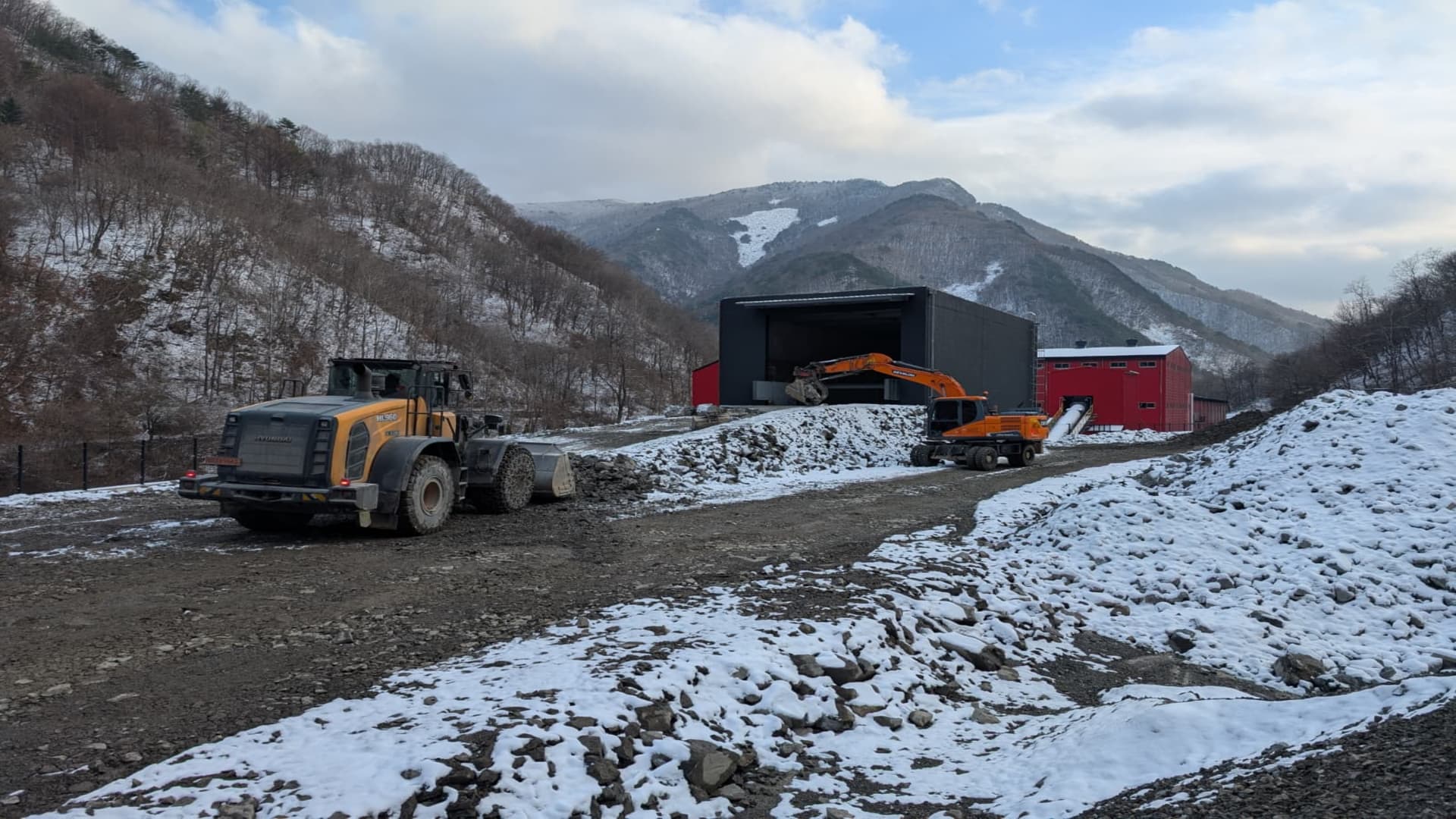
March 2026, Almonti tungsten mine in Sangdong, South Korea.
almonti
BEIJING — The Iran war is straining global commodity markets already squeezed by China’s export controls and stockpiling efforts.
Prices for three niche elements – tungsten, sulfur and helium – have risen sharply in recent weeks.
While no commodity is as widely traded as oil, the surge shows how the ripple effects of the Middle East conflict could limit production of the semiconductors that support advances in artificial intelligence.
Tungsten, a metal about as hard as diamond, forms electrical connections to the core of semiconductor chips. Sulfuric acid, a byproduct of sulfur, cleans chip wafers. Helium prevents undesirable chemical reactions during the manufacturing process, allowing for smooth manufacturing of semiconductors.
These are just some of the ways the three elements are becoming important in modern manufacturing, including defense.
Partly as tensions with the United States have escalated in recent years, the Chinese government began tightening control over critical supplies even before the Iran war began on February 28.
China began restricting exports of tungsten over a year ago, and in December called for tighter restrictions on exports of sulfuric acid. Helium is a difficult gas to store, and China’s imports increased by 15.7% in 2025 after surging nearly 65% in 2024, according to Wind Information.
The Iran war and subsequent constraints on the Strait of Hormuz, a key Middle East transport route for energy and chemicals, have turned some oversupply conditions into shortages while exacerbating existing shortages.
Prices of the three commodities have soared, in some cases even higher than that of crude oil. The widely used fossil fuel rose more than 50% in March, with Brent on track for a record month.
“While China’s supply chain is considered resilient compared to many of its peers, the risk of disruption to raw materials for manufacturers in some segments is higher than expected based on feedback,” Goldman Sachs analysts said in a report over the weekend, citing nearly 40 commodity-related meetings and site visits in China.
tungsten
Tungsten hit a record high of more than $3,000 late last week, marking a month-on-month jump of well over 50%, with prices more than tripling since late December. This is based on an industry benchmark called ammonium paratungstate (APT) in fast market metric ton units (MTU), cited by tungsten miner Almonti.
Earlier this month, Almonti officially restarted its large-scale tungsten mine in Sangdong, South Korea, and plans to start producing tungsten at a project in the U.S. state of Montana this year.
The company’s CEO, Lewis Black, told CNBC that demand for tungsten in the defense sector has been “very strong” since early last year, but there has been no noticeable change despite the Iran war.
“We don’t have any materials to stockpile anymore. That’s probably the biggest change,” he said.
sulfur
Analysts at Goldman Sachs, citing local Chinese miners in Africa, said sulfuric acid prices in Africa are now at least 30% higher than before the war and are still rising.
Other reviews note that price increases have been gradual.
Sulfur prices in China, including cost and freight, have risen about 13% since early March to $621 per ton as of March 26, according to S&P Global Platts.
“A de facto blockade of two to three months is likely to result in a severe supply shock, especially as cargo and insurance premiums remain high, making it difficult to fulfill cargoes originating in the Middle East,” Pan Yuya, principal analyst for sulfur and phosphate feedstocks at S&P Global Energy, and Isaac Chao, senior principal analyst for China fertilizers at S&P Global Energy, said in a March 20 note.
S&P analysts said that by 2025, about 56% of China’s sulfur imports will come from the Middle East.
“Even before the Middle East conflict, sulfur prices were rising rapidly as markets tightened. With sulfur prices now at new record highs, the ‘super squeeze’ in this somewhat obscure supply commodity merits further investigation,” HSBC analysts said in a March 16 note.
helium
Helium prices have nearly doubled since the Iran war began, according to Fitch Ratings.
Shelley Jiang, Fitch’s director of corporate ratings for Asia Pacific, said it was difficult to pinpoint industry-wide prices because most deals are done through long-term private contracts between industrial gas suppliers and manufacturers.
This month’s Iranian missile attack crippled a major industrial center in Qatar, which produces about a third of the world’s helium.
This means helium supplies will not recover quickly, said Christopher Eccleston, principal and mining strategist at Hallgarten & Company.
In a sign of further market tightening, helium prices in China’s Henan province reversed declines this year, rising to 600 yuan ($86.81) per bottle from a Feb. 28 low of 545 yuan ($78.85), according to Wind Information.
Weekly analysis and insights from Asia’s largest economy delivered to your inbox
Subscribe now
The shortage caused by the Iran war is the latest supply chain disruption to shake up global markets, which have faced similar shocks from Russia’s 2022 invasion of Ukraine and the coronavirus pandemic. This has prompted companies to diversify and countries like China to step up stockpiling programs.
“Access to the supply of certain physical materials whose production and processing is concentrated in China will likely feature more frequently in negotiations with the Chinese government,” Rhodium Group said in a March 24 report.
Limited price transparency also means that supply shortages could be even more severe than the numbers available.
Prices for tungsten and helium are rising, “but no one is buying them and saying, ‘Oh my gosh, we don’t have enough of the product,'” Ecclestone said. “Defense contractors are supposed to have tungsten warehouses, but they don’t.”
“The world has become lazy. It thinks of life as being like a supermarket, where the product is a pack of corn flakes or a few tons of sulfuric acid,” he said. “Part of the aisle in a supermarket that sells daily necessities has been cut out.”
Never miss the most trusted news moments in business news when you choose CNBC as your preferred source on Google.
Source link
