


Conner: The following passage has a lot of imperial propaganda embedded in it, as expected from RFE/RL, but it does mention how the US is seeking a “reset” with Georgia.
That makes sense. Despite claims that the Georgian Dream ruling party is anti-Western and anti-democratic, having passed foreign agent laws similar to those that exist in Western countries, it is actually a neoliberal party that tolerates Trump’s famous deals.
It is unclear what exactly Washington is offering, although continued unsuccessful pressure campaigns include sanctions, an attempted color revolution, and an alleged violent plot orchestrated by Ukrainian war veterans. Georgia’s trade with Russia, China and regional partners dwarfs its economic relations with the EU and the US. At the same time, wars in Ukraine and Iran have made Georgia a more attractive country as a transit destination.
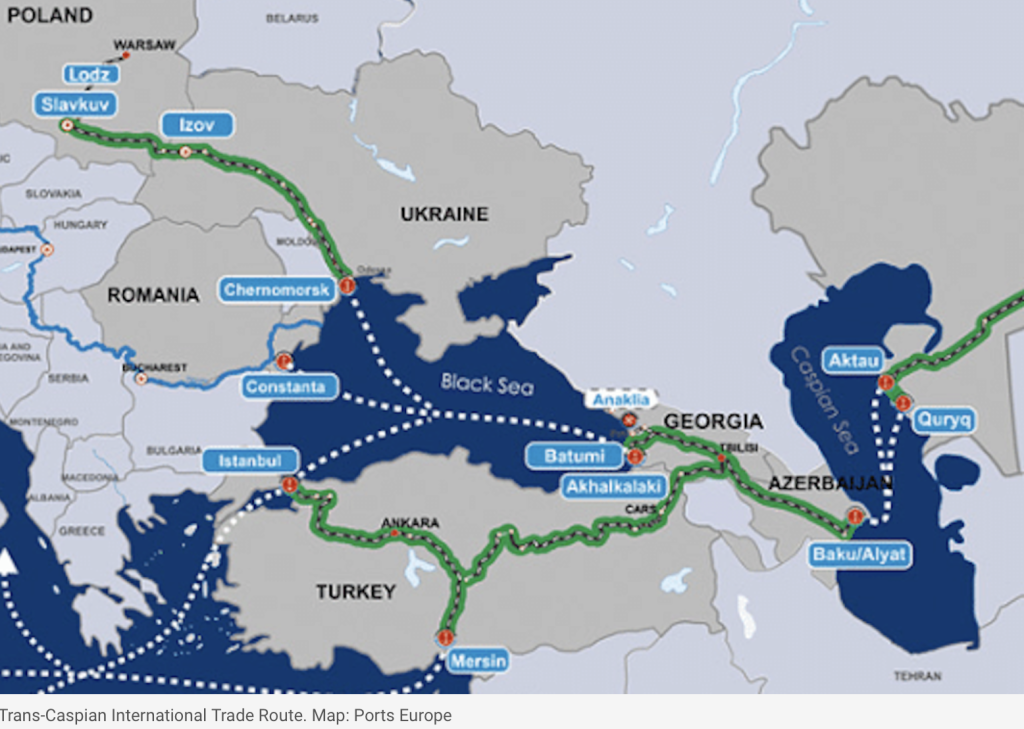
If the US were to successfully penetrate Tbilisi, as it did in Yerevan, it would be able to control access to the Central Corridor from the Black Sea.
It would also establish supply routes to Armenia and Azerbaijan, which have become increasingly problematic for the U.S. government and friendly nations. The following article’s claim that US military aircraft used Tbilisi as a staging area for the war with Iran is a case in point.
Georgia may want to avoid becoming too dependent on Moscow and China. This makes sense except for the fact that the US has repeatedly proven that it is not a trustworthy actor.
And while President Trump may have little interest in Georgia, as the article points out, the Blob is working on a multi-year Black Sea strategy aimed at containing Russia, destroying Iran and establishing a launch point into Central Asia across administrations. James O’Brien, then the U.S. assistant secretary of state for European and Eurasian affairs, said this several years ago.
“A future built around Russia and Iran’s access as key participants in the security of the South Caucasus region is unstable and undesirable…”
The author is Ulviyya Asadzade, a journalist in RFE/RL’s central newsroom. Prior to this role, he spent nearly 20 years in RFE/RL’s Azerbaijan bureau, where he reported extensively on corruption, human rights, and geopolitics in the South Caucasus, Russia, Turkey, and Iran. Originally published in RFE/RL.
The United States has resumed high-level contacts with Georgia after nearly two years of suspended engagement under a multi-year strategic partnership. On March 30, US Secretary of State Marco Rubio had a telephone conversation with Georgian Prime Minister Irakli Kobakhidze.
Tbilisi has framed the aid as a possible “reset”, but many analysts say it is too early to draw such a conclusion. Still, Washington appears to have reason to re-engage.
Under President Donald Trump, US foreign policy has become increasingly focused on strategic logistics corridors, and Georgia’s location remains important in that context, analysts say.
“This suggests that there may still be scope for Washington to influence the political and geopolitical direction of Anaklia Port before it becomes irreversibly entrenched in a Chinese-led direction,” Vakhtan Partsvania, a professor of economics at the Caucasus School of Business in Tbilisi, told RFE/RL.
Relations deteriorated sharply after Georgia’s ruling Georgian Dream party adopted policies widely seen as anti-democratic in Washington, including controversial policies such as a “foreign agent” law and the use of force against protesters.
In response, the United States suspended its multi-year strategic partnership with Georgia in November 2024.
The US government also imposed sanctions on Georgian Dream founder Bidzina Ivanishvili and other officials.
As Tbilisi deepened its ties with China and maintained its engagement with Russia, U.S. attention increasingly shifted to Azerbaijan and Armenia.
Anaklia Port: Strategic Core
“I don’t think Georgia is a huge strategic priority for the United States, but there may be a lot of things that the U.S. government wants to do in the region, and it could be more collaborative with the Georgian government,” Joshua Kucera, a senior analyst at the International Crisis Group, told RFE/RL. “It could be a transit and I think it’s reasonable to assume that’s the reason behind the visit to Anaklia and Poti, another major port.”
Located between Russia and Iran and bordering the Black Sea, Georgia remains an important transportation hub.
The U.S. government has long viewed the country as part of the so-called “middle corridor,” a trade route linking Europe and Asia that bypasses both Moscow and Tehran.
In the South Caucasus, the US supports the TRIPP project (Trump Route for International Peace and Prosperity), which connects Azerbaijan and its enclave of Nakhchivan via Armenia, allowing goods from Asia to reach Europe.
Georgia’s Black Sea ports are of vital importance in expanding that corridor and the entire Middle Corridor.
Once completed, Anaklia Port will become Georgia’s only deep-sea port capable of handling large cargo ships, strengthening the Trans-Caspian International Transport Route (TITR).
Initially, the Anaklia Development Consortium (ADC), a US-Georgia consortium, won the bid. The Georgian government canceled the contract in 2020, citing non-fulfillment of its obligations. The project stalled for years, and in May 2024 Tbilisi selected a China-Singapore consortium led by China Communications Construction Corporation (CCCC) as its new private partner, but details of the final deal remain unclear.
A few days before the Rubio-Kobakhidze telephone conversation, US State Department official Peter Andreoli visited the port of Anaklia. Few details were released, but Georgia’s opposition party, Lelo Strong Georgia, called for the port to be named after President Donald Trump and positioned as a hub for the proposed “Trump Route.”
“The Port of Anaklia is in an in-between state today. The project has not been canceled, construction activities are underway, and a Chinese consortium has been appointed as the preferred private investor. However, the lack of a publicly confirmed final contract means that the project is still underway. That is exactly why this visit to the US is important,” Partsvania told RFE/RL.
“We cannot rule out the possibility that Anaklia could become part of a broader strategic negotiation framework. This does not necessarily mean direct pressure, but rather a combination of incentives and expectations, where deeper political and economic involvement by the US could lead to a restriction of the role of Chinese actors in strategically sensitive infrastructure,” Partsvania added.
“Washington recognizes that without closer ties with Tbilisi, its policies regarding TRIPP and the South Caucasus in general could be compromised,” Paul Goble, an analyst at the Jamestown Foundation, told RFE/RL.
Iran factor: secondary factor?
The war in Iran has been cited as another possible reason why contacts were resumed.
Just a day after the Rubio-Kobakhidze telephone conversation, a Boeing C-17 Globemaster III US military aircraft landed in Tbilisi.
The aircraft, typically used to transport troops, equipment, and humanitarian supplies, arrived from Germany and then departed south.
Cornely Kakachia, director of the Georgia Institute of Politics, said the United States may be reevaluating Georgia’s role in the changing regional landscape.
“Jet refueling…may be something like the bare minimum level that the United States can expect from Georgia,” Kakachia told RFE/RL.
The US embassy in Tbilisi downplayed the move, saying such flights were routine and “unrelated to regional tensions.”
Is the role decreasing?
For many years, Georgia’s importance to Washington was tied not only to its role as a transit corridor but also to the unresolved conflict in the South Caucasus, particularly between Armenia and Azerbaijan.
But its influence could weaken as Baku and Yerevan grow closer together through a U.S.-backed peace process.
At the same time, new regional initiatives like TRIPP risk alienating Georgia from new trade routes.
US Vice President J.D. Vance skipped Tbilisi during his recent visit to the South Caucasus, underscoring the country’s declining diplomatic priority.
What happens next?
Despite the Georgian Dream framework, many in Washington remain skeptical that Mr. Rubio’s calls represent real change.
“It’s amazing that the State Department would answer the call now,” said a senior Senate Democratic aide, speaking on condition of anonymity. “There is no policy, there is no clear goal, and frankly many members of Congress are confused as to why such a call was made.”
Former U.S. Ambassador Ian Kelly said the administration’s approach reflects uncertainty rather than strategy.
“The Trump administration will be ambivalent at best about Georgia,” Kelly said.
Laura Thornton, former senior director of the McCain Institute, also questioned the significance of the outreach.
“The Trump administration is transactional. Without rare earth minerals, golden jets, or other treasures to offer, [Georgia Dream] “It is unlikely to attract President Trump’s attention.”
Georgia suggests more U.S. visits may follow. But for now, Washington remains steadfast.
“There are no visits to announce at this time,” the U.S. Embassy in Tbilisi said in a written response to RFE/RL’s Georgia bureau.
