


Interestingly, Democrats are cherry-picking ideas thrown around by Donald Trump to address the so-called affordability crisis. Sens. Elizabeth Warren and Jeff Merkley are introducing the American Home Ownership Act, which aims to limit the role of institutional investors in single-family homes. I have embedded their fact sheet and January Trump Executive Order at the end of this post.
However, as we will discuss, the practical impact of this bill appears to be limited. It is more important to set a precedent that seeks to limit the actions of large investors who seek to gain market power and use it to drive up prices to the detriment of consumers. Among other things, this summary is written as if it were future-proof, given that the giant companies that own U.S. residential real estate bought during a downturn in the market, especially after the foreclosure crisis, and are not in much acquisition mode right now.
We explained at some length how President Trump’s proposal to cap credit card interest rates at 10% would ultimately harm people who use credit cards as a source of funds. As law professor and consumer finance expert Adam Levitin has detailed, even though credit card interest rates are at nosebleed levels, card issuers are still incurring costs, partly from charge-offs and administration, but more from marketing. A 10% limit would force credit card companies to severely limit lending and focus on lower-risk customers. If that happens, many consumers will be tempted to take on even more expensive debt, such as payday loans, deferred payment schemes, or even high-interest loans.
In contrast, here the effects would be primarily beneficial, even if limited. The fact sheet embedded below provides an overview. I couldn’t find the draft on the Congress.gov site. Perhaps it will come soon.
The fact sheet states that depreciation and mortgage interest tax deductions for newly purchased single-family rental homes will be eliminated, and existing portfolios will not be affected. This would limit tax deductions for new homes held as rental properties by major institutional developers. From the fact sheet:
Companies that build new single-family homes will be allowed to continue receiving tax incentives for five years, at which point the incentives will end, encouraging both new construction and sales to real people.
Tax incentives for renovating and renting uninhabitable properties will be maintained. It does not mention corporate acquisitions of apartment complexes, where abuses by landlords have also been observed. One infamous case was BlackRock and Tishman Speyer’s purchase of Stuyvesant Town in Manhattan, which ended in bankruptcy. It’s not just that this trade took place at the top of the pre-crisis market. Its economy also depended on forcing out rent-regulated tenants and obtaining leases far above current market rates. The new owners found that very difficult due to New York City’s strict housing laws.
The fact sheet is not clear about what size investors or portfolios are covered by the law. Instead, he repeatedly refers to “Wall Street landlords.” This section suggests that legal structures, such as limited partnerships that acquire more than 50 homes, can be a catalyst for inclusion.
●Private equity, hedge funds, private real estate investment trusts, and large investment management companies—the Wall Street landlords most associated with fraud—do not receive tax breaks on any type of home purchase.
● Other corporations that purchase 50 or more single-family homes for rental also do not qualify for these tax breaks, increasing the likelihood that real people will be able to purchase those homes and achieve the American dream of homeownership.
Please note:
Remember a few days ago….
Did President Trump ban institutional investors from purchasing single-family homes?
Did you know…..
the next day…
The definition of “institutional investor” has been changed from one who owns assets of 25 million or more to one who owns assets of one billion or more??!…
— SickOfWar (@AZMaGHaMaMa) February 23, 2026
The bill also seeks to prohibit oligopolistic behavior, considering the control of more than 30% of a market by a company as a violation of antitrust laws. But how do we define the market? The entire metered area? To local government?
Before Warren and Merkley proposed the bill, Wolf Richter debated Trump’s idea and decided it was more gesture than substance. The big flaw is that private equity landlords are not a huge factor in the single-family housing market, even in cities like Atlanta where ownership is concentrated. Moreover, they sell far more than they buy because of the same generally high home prices that prompted this bill in the first place.
President Trump is asking Congress to pass a bill that would prevent landlords with more than 100 single-family rental homes from purchasing additional single-family homes. The aim is to prevent a surge of concentrated buying in a few markets that would further distort prices. These landlords can still build their own single-family rental homes or buy pre-built properties from builders, thereby increasing their housing stock. However, they could no longer buy an existing home.
Even if Congress passed a bill to that effect, it would not have a major impact on the market at this point for the following reasons:
SFR’s largest landlords have sold off their existing homes purchased since 2012 and are now either building their own homes or buying pre-built homes from builders. As a group, SFR’s largest landlords are, and always have been, single-parent household landlords and will not be affected by the ban.
According to John Barnes Research and Consulting, only about 6.3% of SFRs are owned by landlords with an SFR of 100 or more. If the ban becomes law, only those landlords will be affected.
Wolf’s article notes that the Warren/Merkley plan is broadly in line with Trump’s ideas, but is shown to be more restrictive in important ways, including ending tax breaks for new rentals after five years and adding reporting and antitrust regulations. And this is where the Senate proposal has more impact than Trump’s. From Wolf again:
But in 2022, after prices skyrocketed, SFR’s biggest landlords began selling off some of the scattered estate properties at huge profits. And they don’t buy existing scattered-lot homes anymore. At current prices, it’s too expensive and too expensive to manage.
They are adding to their SFR portfolio by constructing entire developments from build-to-rent or by purchasing purpose-built SFR developments from builders.
Build-to-rent has been the most popular trend in home construction for the past four years. Most of these developments have common amenities, often leasing and maintenance offices, and are cheaper to operate than the thousands of high-maintenance older homes scattered throughout.
Mr. Wolf also identified the largest single-family home landlords.
Housing progress: ‘nearly 100,000’ homes
Invitation Homes (now RETI, independent from Blackstone) 97,036 units
Blackstone: 62,000 units
American Homes 4 Rent (REIT): 60,337 units
Amherst Group: 59,400 units
FirstKey Homes: “Over 52,000” homes
Other sources also confirmed Mr. Wolf’s brief. For example, from the daily economy:
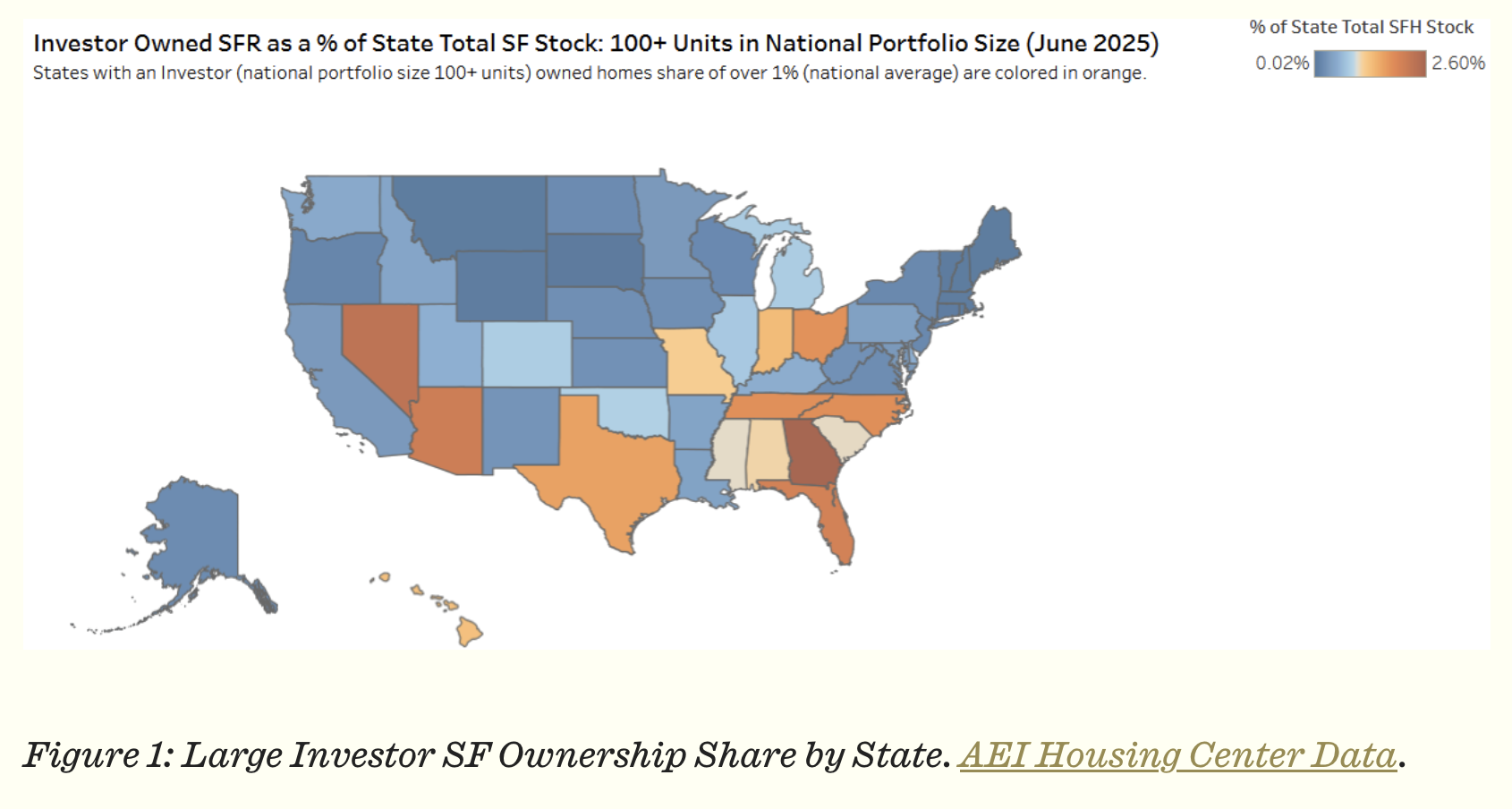
Institutional investors, defined as those with 100 or more homes in their portfolio, own less than 1 percent of the nation’s single-family housing stock, and only about 3 percent of single-family homes are for rent. Their buying activity has declined since 2022, but even at their peak, the largest investors (1,000+ units) accounted for less than 3% of single-family home purchases nationwide. While institutional investors are more important in some markets than others, there is no metropolitan area where more than 5% of single-family stocks are held by companies with portfolios of 100 or more homes. Figure 1 shows the percentage of large investor ownership by state. In all blue states (the majority of them), large investors have a share of single-family equity of less than 1 percent.
Zooming out to the state level is misleading. Because no one searches the entire state to decide where to rent. but:
And another analysis can be read as proving the opposite of their claims.
When zooming out to the largest 50 meter area, the same correlation holds, albeit a little weaker. Places with larger institutional ownership of single-family homes saw larger price declines over the trailing 12-month period.
Rather, one could argue that large landlords were so willing to “sell high” that they put some pressure on overall prices, leading to a gradual contraction in local supply and concentrated home buying that led to even larger price declines.
Critics argue that the bill would penalize the housing market during a crisis by preventing institutional investors from setting a downdraft floor. You really don’t have much confidence. First, there was no national housing bear market before the 2008 crisis. And even when Fannie and Freddie decided to unload the property, there was so much demand from institutional investors that they did not sell in large quantities as planned, but in “mini-bulks.” If something like that were to happen again, it’s easy to imagine that Congress would amend the Single-Family Housing Act to allow the two major mortgage insurance companies to repossess foreclosed homes on a large scale.
An even bigger risk is that even if Warren and Merkley pass enhanced reporting and antitrust legislation and sign it into law, enforcement will be weaker. Pam Bondi’s thumbing her nose at the Epstein File Transparency Act shows how little it means to the Trump administration to have the law on the books.
_____
1 When this trend started, we argued that managing a portfolio of homes primarily acquired through foreclosure would be difficult due to the diversity of the homes (think different bathrooms!) and physical dispersion. In contrast, small landlords typically manage several properties in close proximity to each other.
00 Fact Sheet_ American Homeownership Law
00 President Trump’s order creates new housing for families
Source link
