


The US’ suspension of tariffs on countries that provide Cuba with oil may provide a tiny window of opportunity to get oil to the island. But which country will take the risk?
In the last couple of weeks, the Trump administration has intensified its gunboat diplomacy in the Caribbean. A recent article in the New York Times, titled “A New US Blockade Is Strangling Cuba”, recounts a spate of interceptions of oil tankers heading towards Cuba as “the largest US military presence in the Caribbean in decades [polices] the waters around the island, fresh off its work blocking oil shipments to and from Venezuela”:
Cuba is confronting the United States’ first effective blockade since the Cuban Missile Crisis and running out of fuel fast, pushing the nation toward a humanitarian crisis and its government to the edge of collapse, according to a New York Times analysis of shipping data and satellite images.
Last week, a tanker linked to Cuba burned fuel for five days to get to the port in Curaçao but then left without cargo, according to ship-tracking data. Three days later, the U.S. Coast Guard intercepted a tanker full of Colombian fuel oil en route to Cuba that had gotten within 70 miles of the island, the data showed.
The ship in question was the Ocean Mariner, a Liberian-flagged vessel that has allegedly transported fuel to Cuba before. The vessel set sail on February 5 from the Sociedad Portuaria Sitio Nuevo, in Palermo (Magdalena), around 12 kilometres from the bustling Colombian seaport of Barranquilla.
The destination shown in the ship’s bill of lading was the port of Río Haina, in the Dominican Republic, reports El Comercio. However, subsequent satellite images showed an abrupt change in the ship’s course to Haiti, which culminated in its interception on Feb 11 by the US Coast Guard. It was then escorted by US naval vessels toward the Bahamas.
.@nytimes: US Coast Guard is now intercepting civilian fuel ships in international waters. Satellite proof of an undeclared, illegal naval blockade against #Cuba. This is not an “embargo”, it is a direct violation of international maritime law.
Read more: https://t.co/5qV50AMV69 pic.twitter.com/MVRY1Cdjo3
— Cuba in the UK (@EmbaCuba_UK) February 20, 2026
As the Times notes, the Trump administration has stopped short of calling its recent escalation of policy towards Cuba a naval blockade despite Trump’s frequent pledges to halt any oil headed to the island.
Meanwhile, Colombia’s President Gustavo Petro is facing accusations from political opponents at home that his government sought to break the US blockade, as if it was a crime to trade with Cuba during a humanitarian crisis provoked by the US’ illegal seizure of Venezuelan oil and unilateral blockade of Cuba. In his own defence, Petro underscored that it was a “private company”, not the Colombian government, that loaded the Ocean Mariner ship with oil.
“There is no Colombian irregularity, neither public nor private,” said the head of state. “The one who loads the ship is a private company”.
In a tweet on Saturday Petro also rejected the US’s economic blockade and emphasised Colombia’s long-standing relationship with Cuba, in particular its role in the recent peace talks with the Revolutionary Armed Forces of Colombia, or FARC. He also described Cuba as a country with a strong cultural and educational wealth that has a great deal to offer the world.
Petro not only criticised Washington’s foreign policy, but also urged the US to rethink its strategy towards Havana and proposed promoting joint energy projects with Cuba. The president even proposed that Latin America could supply the island with inputs to develop solar energy.
In a recent post on the US’ energy blockade of Cuba, we noted that it would take only one or two countries to break the blockade by sending . The two most obvious candidates were China and Russia:
For its part, China has less to worry about from Trump’s tariff threats than just about any other nation. As we saw in its recent showdown with Washington over rare earth minerals, Beijing can more than hold its own in any tit-for-tat tariff escalation with the US:
Also, Cuba, unlike Venezuela, is a BRICS associate partner. As the Cuban commentator El Necio argues, if Cuba is hung out to dry, the message to the Global South will be that BRICS membership counts for little, if anything, especially as the US becomes increasingly assertive on the global chessboard.
[As Conor reported yesterday, that already seems to be the case following India’s decision to trade in its BRICS ties for a “lead role in the US’ AI cage”]
Moscow could also send a tanker or two, though it would risk inflaming tensions with the US just as the two countries are locked in negotiations to end the Ukraine conflict. That said, those negotiations appear to be going nowhere as the US increasingly targets Russia’s shadow fleet. Russia certainly has oil to spare for Cuba as well as the capacity to provide naval protection. Plus, it’s already on the receiving end of just about every US and EU sanction imaginable.
So, it didn’t come as much of a surprise when Bloomberg reported a few days ago that a tanker carrying Russian fuels was heading to Cuba to test Trump’s blockade:
A ship believed to be carrying Russian fuels is on its way to Cuba, putting US President Donald Trump’s sanctions to the test amid the island’s deepening energy crisis.
The vessel Sea Horse, expected to arrive in early March, is carrying much-needed fuels to Cuba, according to data from maritime intelligence firm Kpler Ltd. The country is short on fuels critical for cooking, transportation and power generation, with it literally struggling to keep the lights on. Available electricity has plummeted since the start of the year and satellite imagery found the level of light at night is down as much as 50%…
The Sea Horse received supplies in a ship-to-ship transfer off the coast of Cyprus and is likely carrying nearly 200,000 barrels of Russian gasoil, Kpler’s lead oil analyst Matt Smith said. Gasoil broadly refers to diesel-type fuels used in transportation and power generation.
The Bloomberg article followed on the heels of reports in Cuba’s state-owned media that Moscow had been in contact with Havana to discuss possible avenues for resolving the island’s energy crisis.
A report in Granma indicated that the Kremlin “is holding talks with Cuba to finalise shipments of oil and petroleum products to the island.” Citing an article in Izvestia, the Granma report also noted that “the Russian Embassy in Cuba had announced that a shipment of oil and petroleum products is being prepared as humanitarian aid.”
For his part, Russian presidential spokesman Dmitry Peskov had previously told the Russian news agency TASS that Russia would not want an escalation of tensions with the United States over oil supplies to Cuba. However, he also acknowledged that trade ties with Washington are now virtually non-existent.
Last Wednesday, President Vladimir Putin and other top Kremlin officials met with Cuban Foreign Minister Bruno Rodríguez in Moscow. Putin told Rodríguez that Russia has “always stood by Cuba in its struggle for independence, for the right to develop along its own path and has always supported the Cuban people.”
Putin also pledged Moscow’s official participation in the upcoming centenary of Fidel Castro’s birth, on August 13 of this year.
#Internacional 🌎Putin manda mensaje al mundo
Rusia desconoce las nuevas sanciones contra Cuba y lo dice sin rodeos. Pero el gesto que más ruido hace es otro: en 2026 Moscú se sumará oficialmente al centenario de Fidel Castro.
👉Un guiño político con dedicatoria directa a… pic.twitter.com/1GffdEIDFn
— El Soberano (@ElSoberanoMX) February 19, 2026
The Bloomberg article was seized on by many alternative media sites as a sign that Cuba was not completely isolated, and that Russia and perhaps even China as well would soon come to the rescue. Rumours even began swirling on social media that the Russian Foreign Minister had published the following text (machine translation):
Within the framework of humanitarian and energy cooperation between the Russian Federation and the Republic of Cuba, the Russian merchant ship Sea Horse is currently transporting more than 200,000 barrels of oil bound for the port of Havana, with arrival scheduled for the first days of March.
Russia reiterates that this operation is being carried out in strict accordance with international law and in international waters, so any attempt to intercept, inspect or use force against this ship would constitute a flagrant violation of the rules governing freedom of navigation.
In order to ensure the integrity of the cargo and the safety of the crew, the Russian Navy destroyer Mad 2034 accompanies the Sea Horse as an escort throughout the voyage.
We warn clearly and responsibly: any hostile action by the US Navy against this tanker will be considered an act of aggression against the Russian Federation. The consequences of such an act will fall entirely on those who make that decision.
We call for prudence and mutual respect among sovereign nations.”
Apparently, however, it’s a complete fake. On Sunday, the Russian Embassy in Havana felt compelled to publish a tweet denying that the Foreign Ministry had published said statement:
‼️ ATENCIÓN ‼️
La información que circula en las redes sociales sobre el presunto comunicado de la Cancillería rusa es falsa. @mae_rusia no ha publicado ningún comunicado de este tipo.
☝️ Les recomendamos siempre utilizar fuentes oficiales. ¡No se dejen engañar! pic.twitter.com/i9kqAHAJxo
— Embajada de Rusia en Cuba (@EmbRusCuba) February 23, 2026
The text of the tweet reads as follows:
The information circulating on social media about a supposed statement by the Russian Foreign Ministry is false. The Russian Foreign Ministry has not published any such statement. We always recommend that you use official sources: the website of the Russian Foreign Ministry, as well as the official accounts of the Foreign Ministry and our Embassy. Don’t be fooled!
The Limits of Denial
As denials go, this one only goes so far. Russia’s embassy is essentially debunking the claims that the Russia Foreign Ministry had made the alleged statement. But that is as far as the denial seems to go. It does not, as far as I can tell, extend to a rejection of the main assertions in the Bloomberg report — namely that a vessel, named Sea Horse, is expected to arrive in Cuba in early March carrying around 200,000 barrels of Russian fuel.
There are no guarantees that this will happen, of course. So far, no country, not even China or Russia, has shown a willingness to break the US blockade by sending naval-escorted tankers to Cuba. If Russia were to break the blockade, it may represent the final straw for its foundering negotiations with the Trump administration over Ukraine. Also, if Russia did decide to help out Cuba in this way, it almost certainly would not be telegraphing that fact to US authorities.
That all being said, what is happening vís-a-vís Cuba needs to be set against the broader backdrop of the US’ increasing use of gunboat diplomacy against Russia and its Venezuelan, Cuban and Iranian allies.
A week ago, Nikolai Patrushev, a Kremlin aide who oversees Russian shipping and is a close ally of Putin, was quoted as saying that Russia’s navy could be deployed to stop Western powers from seizing further Russian vessels as part of sanctions against the country’s oil shipments and Moscow’s so-called “shadow” or “ghost” fleet — which, as Alexander Mercouris has repeatedly pointed out, merely signifies that they are not insured in the London market.
From Al Jazeera:
“We believe that, as at all times, the best guarantor of navigation safety is the navy,” Patrushev said in comments made to Moscow’s Argumenty i Fakty newspaper, where he referred to “piracy-like attacks” by Western countries on Russian shipping.
“If we do not resist decisively, the English, the French, and even the Balts will soon be so bold as to try to block access to the seas for our country, at least in the Atlantic Basin,” he warned.
Patrushev said Russia had to be able to ship oil, grain and fertiliser to keep its economy operating. He accused Moscow’s Western opponents of targeting one of the most important sectors of the Russian economy – shipping.
“In the main maritime areas, including regions far from Russia, substantial forces must be permanently deployed – forces capable of cooling the ardour of Western pirates,” he said.
A Brief Window of Opportunity?
Interestingly, the recent tariff Trump imposed on Cuba, which allowed for the imposition of an additional surcharge on any nation selling or supplying oil to Cuba, either directly or indirectly, was among the many tariffs nixed by the recent Supreme Court ruling. In other words, there may be a brief window of time to get oil to the island of Cuba.
The question is: which country, or countries, is/are willing to run the gauntlet of Trump’s ire?
While the tariff system enacted on January 29 may have been rescinded, the national emergency declared by Trump on the same day concerning the Cuban government remains very much active. That includes Washington’s designation of Cuba as an “unusual and extraordinary threat” to US national security and foreign policy as well as other actions.
This, lest we forget, is part of a broader hemispheric doctrine — the so-called Trump corollary, or Donroe Doctrine — that views the whole of the American continent, including Canada and Greenland, as the US’ exclusive sphere of interest.
Since the official launch of that doctrine late last year, the US has attacked Venezuela, kidnapped its leader and seized control of its oil supply. It has also intervened in Honduras’ general elections, expanded its military presence in Argentina, and escalated its security “cooperation” efforts with Mexico’s Claudia Sheinbaum government.
Right now, senior US figures such as Elon Musk are trying to paint Sheinbaum as a “narco-president” despite the fact that Mexican security forces just killed one of Mexico’s most prominent cartel bosses, Nemesio Oseguera, aka El Mencho. Others, like US Senator Bernie Moreno, are spreading fake news that Mexican “narco-terrorists” are hunting down US citizens in Mexico.
There are NO reports whatsoever, NONE, that ‘narco-terrorists’ are ‘hunting down American citizens’. This is a complete fabrication and Senator Moreno should be ashamed of himself. https://t.co/Beo3V5ATSz
— Jan-Albert Hootsen (@jahootsen) February 23, 2026
This a hell of lot of chaos for one country, even a rapidly declining hegemon, to cause in the space of just a few months. Ominously, the Trump administration has also convened a presidential summit in Miami of US pawns in the region — which we labelled the “Six Stooges” Summit.
The upcoming summit suggests what we might be seeing is the rebirth not just of the Monroe Doctrine but also Operation Condor (1975-82), the coordinated campaign of political repression by US-aligned right-wing dictatorships in South America that involved joint intelligence operations, coups, and assassinations of left-wing sympathizers.
The US invited reactionary leaders of Latin America—e.g.,Bukele, Milei, Kast—to discuss security, immigration & common strategy. They will meet at Trump National Doral Miami on 7 March.
Terrifying rebirth of the Monroe Doctrine & training of LA military to do the US bidding.
— Camila Vergara (@Camila_Vergara) February 23, 2026
Unbeknown to most US citizens, Trump’s de facto energy blockade of Cuba has already triggered a humanitarian crisis that is worsening by the day.
Food is growing scarce while what food there is, is increasingly unaffordable to the island’s residents. Cuba’s healthcare system, which has benefited dozens of countries around the world as well as the 9/11 emergency responders that featured on Michael Moore’s documentary on US healthcare, Sicko, is being pushed to the brink.
For decades, Cuba has been sending thousands of doctors to respond to health crises across the world.
But the U.S. is trying to put a stop to that – a move that could have far-reaching impacts across the Global South. pic.twitter.com/zzyA5F1vzk
— AJ+ (@ajplus) February 17, 2026
In an interview with The Associated Press, Cuba’s Health Minister José Ángel Portal Miranda said US sanctions are no longer just crippling the island’s economy, they’re threatening “basic human safety.”
“You cannot damage a state’s economy without affecting its inhabitants,” Portal said. “This situation could put lives at risk.”
As a 2024 study published in the Lancet study revealed, sanctions imposed by the US and its Western allies since 1970 are associated with an estimated 38 million deaths — several times more than those killed in direct conflict. That’s an estimated 564,000 deaths each year – most of them children under the age of five. In some years, the death toll was more than a million.
That study was systematically covered up by the Western media. Now, the US is trying to starve an island nation of 11 million people into submission — at the same as its indispensable ally in the Middle East, Israel, continues its genocide in Gaza, with US-made weapons.
The parallels being drawn between Gaza and Cuba are clear for all to see, the most important being the near-total inaction by the rest of the world. A tiny smattering of countries, including China, Mexico and Spain, have sent emergency supplies of food and medicines, but it’s energy that the country needs most.
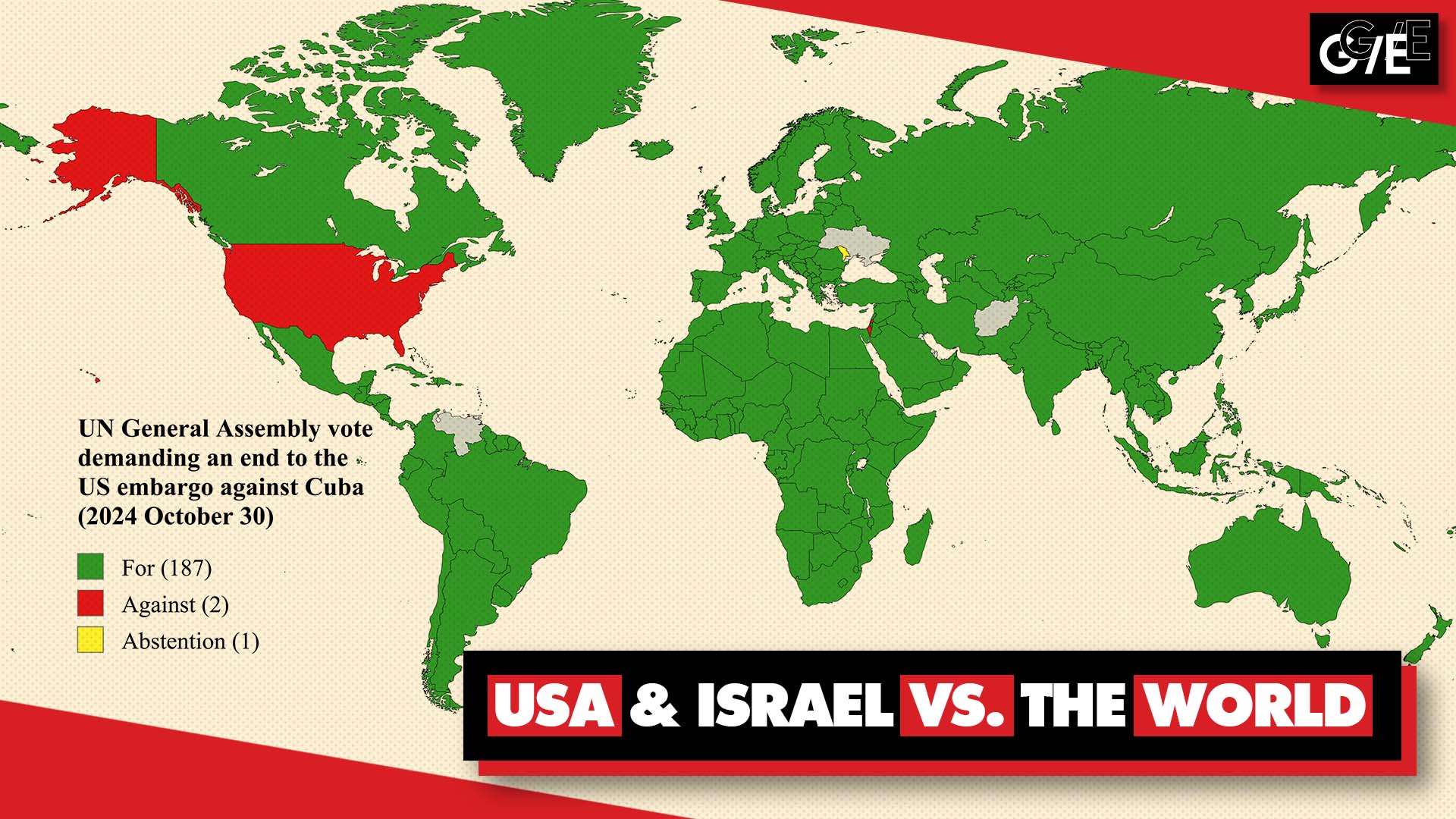
Every year since 1992, the overwhelming majority of the world’s countries, including many traditional US allies, have voted in the United Nations General Assembly to condemn the US’ embargo of Cuba, now in its 64th year. But as the embargo tightens, and another vast manmade humanitarian crisis looms, will any of them dare do anything to stop it?
