


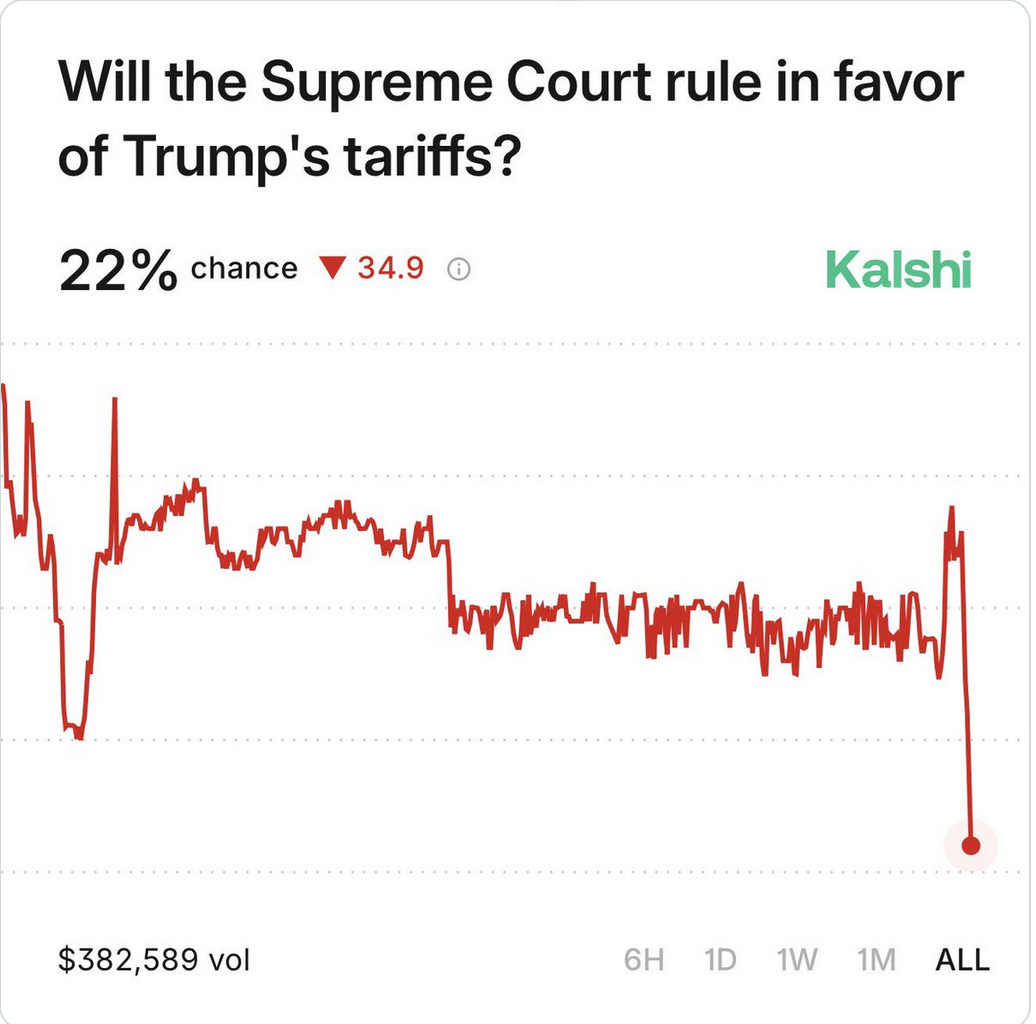
As many news outlets reported today, the case against President Trump’s sweeping use of emergency powers to justify imposing hefty and often capricious tariffs did not go well for Team Trump during oral arguments before the Supreme Court on Wednesday.
Expert commentary is likely to be released in the coming days, so I’ll limit myself to a few of the big issues if the administration loses. We think this will have very detrimental consequences for President Trump on a number of fronts. Proponents who point out that President Trump can rely on other tariff authorities to implement these tariffs, while technically correct, are often substantively misleading because they do not explain how these other tariff authorities are limited in scope and duration.
First, we would like to provide a brief update on the state of play. Next, we’ll look at some of the big reasons why a Supreme Court defeat ends President Trump’s sails. That would take away his big stick with which he bullied other countries. Domestically, the losses would throw the federal budget into disarray. Many also point out that contracting parties that have paid customs duties that are deemed unacceptable are entitled to a refund. Although it may seem obvious, the government is expected to require those seeking their money back to file a lawsuit. And that decision may not be as quick or orderly as the people in the peanut gallery assume. A top lawyer at Covington & Burling once told me, “Anyone who says litigation is nothing but frivolous is lying.” Let’s look at some of the factors that can be complicating.
overview
The May post summarized the plaintiffs’ arguments that they won in the International Trade Court.
The lawsuit was brought by U.S. importers of foreign goods and some U.S. states, challenging President Trump’s use of the International Emergency Economic Powers Act of 1977.
The lawsuit argued that the national emergencies cited in imposing the tariffs (the trade deficit and the fentanyl crisis) were not emergencies and would not be directly addressed by the tariff relief package. The court agreed, holding that President Trump overstepped his authority by imposing the tariffs.
The ruling stated that the executive order used was “declared contrary to law and null and void.”
The law says the president has the right to take economic action in the face of “unusual and extraordinary threats.” It has primarily been used to impose sanctions on terrorist groups and freeze assets from Russia. There is nothing in this law that mentions customs duties.
The decision means that all reciprocal tariffs, including the 10% tariffs on most countries, the 50% tariffs President Trump had talked about imposing on the EU, and some of the tariffs on China, have been ruled illegal by courts.
This judgment was based on two separate cases. One of the lawsuits was brought by a group of small and medium-sized businesses that say the tariffs will severely harm their businesses. The remaining bills were filed by 12 individual states, arguing that tariffs would significantly impact their ability to provide public goods.
Oddly, although the appeals court ruled that President Trump’s tariffs exceeded his authority under the IEEPA, it did not block or overturn them.
Reuters summarized the trial on the same day as follows:
During oral arguments Wednesday, the Supreme Court justices questioned President Trump’s authority to impose tariffs under the International Emergency Economic Powers Act of 1977 (IEEPA). The law does not mention tariffs, only language regarding import restrictions during a national emergency declared by the U.S. president.
“Based on the judges’ questions, it appears that IEEPA tariffs are in jeopardy,” said Damon Pike, chief of customs and trade affairs at BDO USA.
He added that all justices except Samuel Alito and Clarence Thomas “appear to be skeptical that the IEEPA gives President Trump the power to impose unlimited tariffs on any product imported from any country in the world.”
But Pike said the Trump administration would simply invoke other trade laws if it lost, a view widely shared by trade lawyers, Trump administration officials, importers and analysts.
Again, the dog-whistle-beyond-the-grave claim that President Trump has access to other trade powers ignores that they are far more limited. The two main setback provisions are the Trade Act of 1974 and Section 232 of the Trade Expansion Act of 1962. The former allows the president to unilaterally impose tariffs of up to 15% for up to 150 days to address significant trade imbalances. This is a chilling cheer given that President Trump’s average tariffs are currently 17.9%, imposing some of the tariffs on countries with deficits with the United States, such as Brazil. A big reason for Trump’s decision was his personal anger over Brazil’s refusal to grant commutation to imprisoned former President Bolsonaro.
Under Section 232, President Trump could pose national security risks, such as those to aluminum and steel. But the administration must first have the Commerce Department conduct an investigation to substantiate that claim.
Below are some highlights of the Supreme Court justices’ skepticism.
SCOTUS 9-0, President Trump appears likely to lose tariff case
(Well, Thomas is hard to read because he doesn’t ask the question, but when asked about it he uses some weird form of identity politics to say it’s because he grew up Gullah and that anyone asking him about it is racist.) pic.twitter.com/GoWIgaoDTJ
— Chris Dazzleox 🇵🇸 (@Dazzleox) November 5, 2025
🚨BREAKING: The U.S. Supreme Court appears poised to overturn President Trump’s emergency tariff powers.
Even Gorsuch called it a “one-way cog” of power to the presidency. Kavanaugh questioned why presidents before Trump did not take advantage of the system. Barrett scoffed at the idea of tariffs… pic.twitter.com/e66SCyBUkJ
— ⁿᵉʷˢ Barron Trump 🇺🇸 (@BarronTNews_) November 5, 2025
oh! Hearing Neil Katyal tear down Justice Alito, who kept cutting him down for making great points for eliminating Donald Trump’s tariff powers, is a listen to hear.
Neil Katyal is very smart and professional! 🔥🎯✊🏾
pic.twitter.com/Gvn2rHOQxz
— Lucas Saunders💙🗳️🌊💪🌈🚺🟧 (@LucasSa56947288) November 5, 2025
If you lose your money honey:
President Trump faces an uphill battle to prevail in Supreme Court tariff case, legal experts say | https://t.co/elSnNkYVzi @moon_maria @FoxBusiness @POTUS #supreme court #Tariff @realDonaldTrump
— Maria Bartiromo (@MariaBartiromo) November 6, 2025
And the normally reserved Greg Yip of the Wall Street Journal says:
Lawyers often stretch the facts to make their case, but U.S. Attorney General John Sauer’s rallying cry that “tariffs do not raise revenue” was nonetheless significant as he defended President Trump’s tariffs at the Supreme Court on Wednesday.
sorry? Of course it is. President Trump likes tariffs because they generate revenue. For years, he has dreamed of charging other countries the privilege of selling to the United States. He has bragged about the cash he received from the tariffs, saying it would replace income taxes, fund farmer relief, and maybe even fund tariff rebate checks. Treasury Secretary Scott Bessent, who attended Wednesday’s meeting, praised Tariff’s contribution to reducing the deficit.
So why did Sauer claim otherwise? This is because the Constitution gives Congress the power to raise revenue through tariffs and taxes. Sauer hoped to persuade the Supreme Court to keep the tariffs in place by arguing that Trump’s rationale was completely different from what he actually said.
Not only these specific tariffs are at stake, but also the fundamental principles of American governance. The framers gave lawmakers the power of the purse to prevent the president from gaining dictatorial powers like the king.
Next, we discuss the implications if Trump loses. This list is not exhaustive.
Watering down President Trump’s ultra-aggressive foreign policy
Tariff bullying and gaslighting are by far the biggest tools President Trump has used to threaten and make demands on other countries, including repeatedly punishing former close allies like Canada and Japan to show who is boss. Former ambassador Chas Freeman confirmed that such tariff threats were more about showing off superiority than achieving anything positive, recalling that when other countries participate in trade negotiations imposed by President Trump, the United States has no proposals and just demands what the other country can offer, like a mafia shaker. No written promises were made. That is, the US side can and has backtracked on verbal commitments (see the UK for one of several examples). And the US has also forced its interlocutors to make hundreds of billions of dollars in investment commitments that are clearly unrealizable (such as Saudi Arabia, perhaps), and which coercive countries typically “comply with fairly quickly.”
But the impact may go beyond just power loss. President Trump has enjoyed using tariffs to displease national leaders. From Politico shortly after the Liberation Day tariffs were announced:
Overnight, US President Donald Trump said world leaders were willing to do whatever it took to strike a trade deal with him as the US imposed tariffs.
“I’m telling you, these countries are calling us and kissing my ass,” Trump said in a speech at the National Republican Congressional Committee Dinner in Washington.
“They want to make a deal. ‘Please, please, make a deal. I’ll do anything, sir,'” he said, imitating a foreign leader begging.
Moreover, new tariff torture, like finding excuses to impose higher taxes, was one of Trump’s ways of making headlines to distract from domestic malaise, like the Jeffrey Epstein rumors. He may be running out of tools to do so, and President Trump’s violent swaying of President Putin has made negotiations with Ukraine no longer on the table. So will Trump double down on domestic displays of force, especially raids on ICE, to restore masculinity?
poke a hole in President Trump’s budget
President Trump already has a huge budget deficit.
President Trump’s budget deficit. pic.twitter.com/SYlRT75gTX
— Beach77650🇺🇸🇺🇦 (@dennisclot7) October 17, 2025
Here are details from the Committee on Responsible Budgets in late October:
Ministry of Finance confirms $1.8 trillion deficit in fiscal 2025
The United States borrowed $1.8 trillion in fiscal year 2025, according to the Treasury Department’s latest monthly financial report. This deficit is similar to last year, even though an additional $118 billion in tariff revenue and a record change in expected future costs on the student loan portfolio reduced the deficit by about $200 billion.
If the Supreme Court rules against the use of IEEPA, the government will not be able to recover all of the lost tariff revenue, even before allowing for a lag in the introduction of a type of replacement tariff. From ABC:
The Committee for a Responsible Federal Budget found that tariffs issued under the legal authority at issue in the Supreme Court accounted for about $90 billion in tariff revenue, raising the possibility that the funds would be returned if judges rule the tariffs illegal. The ruling could in turn affect the country’s federal debt, the group said.
