


Reporting Highlights
Powerful Friends: Well-placed allies, from U.S. senators to county officials, give ranchers leverage against regulators. They’ve sometimes pushed for fewer consequences for rule breakers.
Chilling Regulators: Multiple current or former BLM and Forest Service employees told us that ranchers’ influential allies make enforcement of grazing regulations politically fraught.
The Most Influential Ally: Trump is increasing support for ranching and appointing individuals sympathetic to the industry, including some who’ve sued over the enforcement of grazing regulations.
These highlights were written by the reporters and editors who worked on this story.
In late 2019, a pair of Montana ranchers got in trouble with the Forest Service, which oversees the federal lands where they had a permit to graze their cattle. Agency staff had found their cattle wandering in unauthorized locations four times during September of that year. The agency also found some of their fences in disrepair and their salt licks — which provide cattle with essential minerals — too close to creeks and springs, drawing the animals into those habitats.
After repeated calls, texts and letters, the Forest Service sent the ranchers a “notice of noncompliance,” according to documents obtained via public records requests. The agency asserted that the ranchers had engaged in “a willful and intentional violation” of their permit and warned that future violations could lead to its revocation.
The ranchers were hardly the largest or most politically influential among those who graze livestock on public lands. But they soon had help from well-placed people as they pushed back, hoping to get the warning rescinded based on their belief that they had been treated unfairly.
“The Forest Service needs to work with us and understand that grazing on the Forest is not black and white,” the ranchers wrote to the agency. The agency’s acting district ranger, for his part, said his staff had “gone above and beyond” to help the ranchers comply with the rules.
With assistance from a former Forest Service employee, the ranchers contacted their congressional representatives in early 2020. Staffers for then-Rep. Greg Gianforte and Sen. Steve Daines, both Republicans, leapt into action, kicking off more than a year of back-and-forth between the senator’s office and Forest Service officials.
“When they hear something they don’t like,” they run to the forest supervisor and the senator’s office “to get what they want,” a Forest Service official wrote in a 2021 email to colleagues.
Public lands ranching is one of the largest land uses in many Western states like Montana, where there are more cattle than people. Politicians have shown themselves remarkably responsive to requests for help from grazing permittees, even those of modest means.
Ranchers who have been cited for violations or who resist regulations have called on pro-grazing lawyers, trade group lobbyists and sympathetic politicians, from county commissioners to state legislators and U.S. senators like Daines. These allies — some of whom now hold positions in the Trump administration — have pushed for looser environmental rules and, in some cases, fewer consequences for rule breakers.
Multiple current or former Bureau of Land Management and Forest Service employees told ProPublica and High Country News that ranchers’ powerful allies can pose a serious obstacle to enforcement of grazing regulations. When pushback comes, regulators sometimes cave.
“If we do anything anti-grazing, there’s at least a decent chance of politicians being involved,” said one BLM employee who requested anonymity due to a fear of retaliation from the administration. “We want to avoid that, so we don’t do anything that would bring that about.”
In this 2021 email, a Forest Service official writes to colleagues about how ranchers were turning to a sympathetic senator to get around staffers’ attempts to enforce regulations. Obtained, redacted and highlighted by ProPublica and High Country News
Mary Jo Rugwell, a former director of the BLM’s Wyoming state office, said that a majority of ranchers in the public lands grazing system “do things the way they should be done.” But some are “truly problematic” — they break the rules and “go above and around you to try to get what they want or think they deserve.” Ranching interests “can be very closely tied to folks that are in power,” she added.
Since 2020, members of Congress on both sides of the aisle have written to the BLM and Forest Service about grazing issues more than 20 times, according to logs of agency communications obtained by ProPublica and High Country News via public records requests. In addition to Daines and Gianforte, these members include Rep. Paul Gosar, R-Ariz.; former Rep. Yvette Herrell, R-N.M.; former Sen. Dianne Feinstein, D-Calif.; Sen. Mike Lee, R-Utah, and others. Their communications addressed such issues as “Request for Flexibility with Grazing Permits” and “Public Lands Rule Impact on Ranchers and Rural Communities.”
Rick Danvir, who was a longtime wildlife manager on a large ranch in Utah, said pressure on the BLM comes not just from ranchers and their allies, but also from litigious environmental organizations opposed to public lands grazing. “Everyone is always kicking them,” he said of the agency. “I didn’t feel like the BLM was out to pick on people,” he added. But the agency, wary of being taken to court, often ends up in a defensive crouch.
In the Montana dispute, Daines’ office, from March 2020 through February 2021, sent a stream of emails to Forest Service officials about the issue, including demands for detailed information about the agency’s interactions with the ranchers. In April 2021, a Daines staffer showed up unannounced at a meeting between the ranchers and the Forest Service, only to be turned away because the Forest Service did not have the appropriate official present to deal with a legislative staffer. But interventions by Daines’ office apparently made an impact.
It’s not unusual for people regulated by the government to reach out to their elected representatives, and “constituent services” are a big part of every senator’s and House member’s official duties. But local Forest Service officials involved in the dispute noted that the pressure from outside political forces was leading them to give the ranchers special treatment.
“If this issue was solely between the [ranger district] and the permittee, we should administer the permit and end the discussion there,” wrote one Forest Service official in 2020. “Unfortunately, we have regional, state and national oversight from others that deters us from administering the permit like we would for others. It is very unfair to the top notch operators that call/coordinate/manage consistently. But, what the [ranchers] perceive as picking on them, for political reasons, has become a mandate that we make accommodations outside the terms of a mediated permit. So be it.”
Another agency official wrote, “It leaves a sour taste to think I am expected to hold all other permittees to the terms of their permits/forest plan/forest handbook … yet be told to continually let it go with another.”
In this 2020 email, a Forest Service employee complains that being forced to apply rules inconsistently after a politician intervened in a grazing dispute “leaves a sour taste.” Obtained, redacted and highlighted by ProPublica and High Country News
By June 2020, the acting district ranger expressed willingness to “cut [the ranchers] some slack” if it would improve relations. In December 2020, the agency found the ranchers were once again violating the terms of their permit, citing evidence of overgrazing that could lead to declining vegetation and soil health, but decided not to issue another formal notice of noncompliance. By late 2022, the agency noted the Montana ranchers had been in violation of their permit for four consecutive years and warranted yet another notice of noncompliance. Agency staff, however, were wary of the conflict that would likely ensue.
Although the Forest Service found that the ranchers’ grazing land showed widespread signs of overuse, the agency declined to officially recommend another citation in its year-end report for 2022, according to agency records.
As one agency official wrote during the yearslong squabble, “the drama continues.”
A spokesperson for Daines, in a statement, said that the senator “advocates tirelessly on behalf of his constituents to federal agencies” and “was glad to be able to advocate” for the ranchers in this case. The Forest Service, the ranchers and Gianforte’s office did not respond to requests for comment.
Friends in High Places
The second Trump administration is shaping up to be another powerful ally for ranchers who have argued against what they see as government overreach.
The administration appointed Karen Budd-Falen, a self-described “cowboy lawyer,” to a high-level post at the U.S. Department of the Interior. Budd-Falen comes from a prominent ranching family and owns a stake in a Wyoming cattle ranch, according to her most recent financial disclosure released by the Interior Department. She also has a long history of suing the federal government over the enforcement of grazing regulations. In one of her best-known cases, she used the anti-corruption RICO law — often used to target organized crime — to sue individual BLM staffers over their enforcement of grazing regulations. (The case made it to the Supreme Court, where Budd-Falen lost in 2007.) She also represented an organization of New Mexico farmers and stockmen in a legal filing supporting Utah’s failed 2024 lawsuit to take control of millions of acres of federal land within its borders.
President Donald Trump nominated Michael Boren, a tech entrepreneur and rancher, as undersecretary of agriculture for natural resources and environment at the U.S. Department of Agriculture, a post overseeing the Forest Service. Boren has a contentious history with the Forest Service, which manages a national recreation area that surrounds his 480-acre ranch in Idaho. Among other issues, a company he controlled received a cease-and-desist letter from the agency in 2024 for allegedly clearing national forest land and building a private cabin on it. He was confirmed to his USDA position in October.
The new administration has also wasted no time in dismantling Biden-era reforms designed to strengthen environmental protections for public rangelands.
In September, the Trump administration proposed rescinding the Public Lands Rule. The rule, finalized in May 2024, sought to place the protection and restoration of wildlife habitat and clean water on equal footing with uses such as oil drilling, mining and grazing on federal land. It would have allowed individuals, organizations, tribes and state agencies to lease BLM land for conservation purposes and sought to strengthen the BLM process for analyzing the impact of grazing and other economic activities on the environment.
Under the Biden administration, the BLM also issued a memo prioritizing environmental review for grazing lands that were environmentally degraded or in sensitive wildlife habitat. The Trump administration effectively nullified that memo this year.
The Interior Department and BLM said in a statement that “any policy decisions are made in accordance with federal law and are designed to balance economic opportunity with conservation responsibilities across the nation’s public lands.”
A BLM grazing allotment in Colorado shows both signs of a healthy environment marked by native Indian ricegrass, first image, and areas degraded by cattle, second image.
The administration is also undertaking a broad effort to reopen vacant federal grazing lands to ranchers as part of its drive to position “grazing as a central element of federal land management.” The administration says there are 24 million acres of vacant grazing land nationwide. Many of these vacant grazing allotments are temporarily without livestock because they needed time to recover from wildfire, did not have enough water or forage to support cattle, or were awaiting removal of invasive species.
Still, in May, Forest Service Chief Tom Schultz gave staff about two weeks to compile lists of unused grazing allotments that could be quickly refilled with livestock, according to internal communications obtained by ProPublica and High Country News via public records requests. Such policies cater to grazing permittee advocates like the Public Lands Council, which in a 2024 policy paper called on federal agencies to swiftly fill vacant allotments. The council did not respond to requests for comment.
“Vacant grazing allotments have always been open and available to permitted grazing,” a USDA spokesperson told ProPublica and High Country News.
The Trump administration has sometimes run afoul of ranchers. In October, ranching groups blasted the administration for increasing beef imports from Argentina amid rising prices for consumers.
Long before Trump first took office, presidential administrations that tried to raise grazing fees or strengthen regulations faced fierce pushback from ranching interests.
In the mid-1990s, the Clinton administration backed off a proposal to raise fees amid widespread rancor from public lands ranchers and their Republican allies in Congress. Many in the industry saw then-Interior Secretary Bruce Babbitt’s proposed reforms as an existential threat. “The government is trying to take our livelihood, our rights and our dignity,” said one rancher at a hearing on Babbitt’s failed push to raise fees. “We can’t live with it.”
Ranching industry groups do not spend anywhere near as much money lobbying Congress as do well-funded industries like pharmaceuticals, oil and gas, and defense contracting. But they get their perspective heard in the Capitol.
J.R. Simplot Co. — the largest holder of BLM grazing permits, according to a ProPublica and High Country News analysis — spent about $610,000 lobbying Congress from 2020 through 2025. Earlier this year, the company hired the Bernhardt Group to lobby on its behalf in Washington, D.C. David Bernhardt, who launched the firm this year, served as Secretary of the Interior during the first Trump administration and sits on the board of Trump’s media company.
Those with fewer resources may turn to trade groups such as the National Cattlemen’s Beef Association, which has affiliates in 40 states. In recent years, the association and its allies have sued the Environmental Protection Agency over Biden-era water regulations and the Interior Department over endangered species protections for the lesser prairie-chicken. A federal judge in August vacated protections for the imperiled species after a request from the Trump administration. The administration has also moved to roll back the water regulations at the center of the association’s EPA lawsuit.
The association, which represents public lands ranchers as well as the beef industry as a whole, spent nearly $2 million lobbying in Washington, D.C., over the past five years and contributed more than $2 million to federal candidates and political action committees in the last two election cycles. During the 2024 election cycle, more than 90% of its political contributions went to Republicans.
The association vociferously opposed the Public Lands Rule and, alongside other groups, filed a lawsuit to halt its implementation before the Trump administration moved to rescind it. Rancher Mark Eisele, then-president of the association, called the rule “a stepping stone to removing livestock grazing from our nation’s public lands.” The association did not respond to requests for comment.
Groups like the cattlemen’s association and Public Lands Council were influential in getting the Public Lands Rule rescinded, said Nada Culver, a deputy director of the BLM during the Biden administration.
The political influence of ranchers, she said, goes beyond their relatively modest lobbying and campaign donations. “It is tied to their cultural power,” she said. “They are icons of the American West.”
From Bunkerville to the Halls of Government
State and local officials, from legislators to county commissioners to sheriffs, also sometimes come to the aid of ranchers who run into trouble with the Forest Service or BLM.
In June 2019, in the midst of a long-running dispute between a group of ranchers and employees of Utah’s Fishlake National Forest, a forest supervisor told a rancher that he would receive a citation if he failed to sign his permit, place ear tags on his cattle to identify them and otherwise abide by the rules. The rancher “became really angry, said there were two ways this could go, and he wasn’t going to court because the courts are all stacked in our favor,” the Forest Service employee wrote in an email recounting the conversation.
“He then said if anyone in his family got hurt by this, remember I have a family and they can get hurt too,” the supervisor noted in his email. “I asked him if he was threatening my family, and he said his family has worked hard for what they have and weren’t going to have it taken away, or something to that effect.” The rancher declined to comment for this story.
The ranchers in the dispute, which lasted years, had support from a local sheriff. At one point, the sheriff expressed his willingness to jail Forest Service personnel, according to The Salt Lake Tribune. Minutes from a January 2016 meeting of the Piute County Commission note that the sheriff said that “he will not allow this to be a Bundy situation,” referring to the infamous 2014 standoff between rancher Cliven Bundy and the BLM in Bunkerville, Nevada. “If that entails jailing the forest service he will do it!!!” The sheriff told The Salt Lake Tribune that his comments were taken out of context.
In a few cases, ranchers who violate grazing regulations have even taken up arms — without losing support from elected officials.
Heavy grazing has left this BLM parcel near the Colorado-Utah border largely denuded of grass and with native greasewood shrubs stunted.
This was the case during the Bundy family’s Bunkerville standoff. After two decades of chronic trespassing, the Bundys owed about $1 million in grazing fines and unpaid fees. Bundy maintained, without evidence, that the U.S. government had no say over grazing on public lands in Nevada. When federal agents arrived with a court order to round up the family’s trespassing cattle, Bundy and a group of supporters engaged in an armed standoff. The agents eventually retreated. “I’ll be damned if I’m going to honor a federal court that has no jurisdiction or authority or arresting power over we the people,” Bundy told The New York Times in 2014.
Throughout the dispute, the family was supported by political figures from across the region. The commissioners of Nye County, Nevada, for instance, passed a resolution denouncing “armed federal bureaucrats … operating outside their lawful delegated authority,” and at least one commissioner traveled to Bunkerville to support the Bundys. Michele Fiore, a member of the Nevada Legislature at the time, voiced her support for the family, and several members of the Arizona Legislature traveled to Nevada after the standoff to support the Bundys.
The Bundys’ ties to powerful officials have only grown. Celeste Maloy, Bundy’s niece, was elected to represent Utah’s 2nd Congressional District in 2023. (Bundy married Maloy’s aunt.) During her short time in the House of Representatives, Maloy has pushed for the sale of some federal lands and sponsored legislation to make it easier for ranchers to access vacant grazing allotments during droughts and extreme weather. During the 2024 election cycle, Maloy received $20,000 in campaign contributions from the National Cattlemen’s Beef Association.
Maloy’s office did not respond to requests for comment.
“Everything Stacked Against You”
Wayne Werkmeister, a longtime BLM employee who spent most of his career overseeing federal grazing lands before retiring in 2022, said he knows how difficult it can be to enforce public lands protections.
“When you have everything stacked against you, when you’ve got political pressure on you, when you’ve got management who doesn’t want to hear it, when you’ve got a rancher who’s trying to prove himself, it’s nearly impossible,” he said in an interview with ProPublica and High Country News.
By 2017, after intensive on-the-ground research, Werkmeister and his colleagues had determined that two ranchers near Grand Junction, Colorado, were damaging habitat across the more than 90,000-acre allotment where they grazed roughly 500 cattle. Werkmeister began pushing to reduce the number of cattle on the land.
Wayne Werkmeister, a former BLM employee, spent years fighting to reduce the number of cattle grazing on the West Salt Common allotment.
In response, the ranchers hired former BLM employees to argue their case, accusing the agency of “agenda driven bullying.” They copied then-U.S. Sen. Cory Gardner, a Colorado Republican, on correspondence with the BLM. Werkmeister said he had to justify the agency’s actions to the senator’s aides.
In October 2018, Werkmeister’s office received a two-page letter from the Budd-Falen Law Offices — the firm co-founded by Budd-Falen, now a high-ranking official in the Interior Department — which represented the two Colorado ranchers. “The actions of the BLM in reducing livestock grazing on the West Salt Common Allotment could potentially and unnecessarily force them out of business,” the letter read. The firm also sent the letter to local county commissioners.
Werkmeister said his bosses quickly ordered him back into the field to gather more data, even though, as BLM records show, he and his colleagues had already spent years documenting the condition of the allotment, its precipitation patterns and its use by the ranchers. The ranchers continued to dispute the agency’s findings.
Ultimately, Werkmeister said he was never able to reduce grazing enough to give the allotment time to recover. As recently as 2024, agency records show, the BLM reapproved grazing there.
The ranchers, their attorney and Gardner did not respond to requests for comment.
Werkmeister counts his inability to turn around the parcel’s ecological fortunes as among his biggest failures. During a recent visit, he pointed out the denuded ground and nubs of native bunchgrasses amid a sea of invasive cheatgrass.
“Overgrazed to the point of gone,” he said.
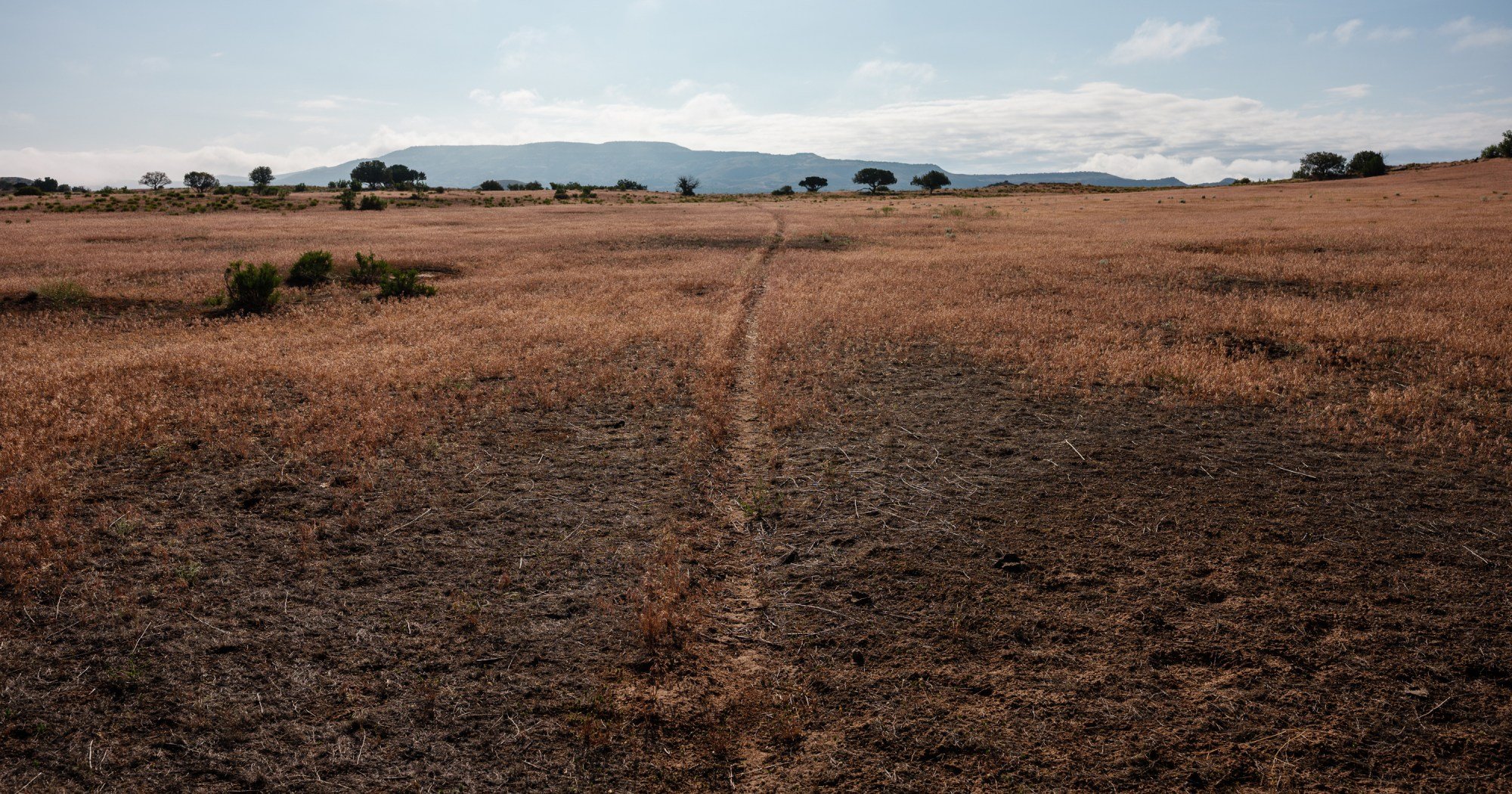
A cattle trail cuts through an overgrazed field in the West Salt Common allotment near Grand Junction, Colorado.
