


Connor: That’s great. More surveillance capitalist marketing strategies to maintain the AI bubble. But at least it pushes the flow a little further, as summarized by Edward Ongweso Jr.
Their goal is not to achieve AGI or fundamentally improve human life, but to redistribute capital so that it enriches itself, transforms wealth into further political power that imposes constraints on opposing political forces, liberates capitalism from recent flaws (such as democracy), and integrates profits into its architecture, regardless of the current social utility of the technologies they pursue.
On the topic of social utility, what is it, as the authors claim, that is “convenient” about being monitored by an “AI” and creating a narrow menu of choices at a high price?
OpenAI on Tuesday also released Atlas, a web browser that examines and directs browsing sessions while using all the data it captures from users for training purposes. Apparently, the convenience here is that it saves a lot of the time-consuming work of copying and pasting.
Authors: Yuanyuan (Gina) Cui, Assistant Professor, Department of Marketing, Coastal Carolina University, and Patrick van Esch, Associate Professor, Department of Marketing, Coastal Carolina University. Originally published on The Conversation.
Your cell phone rang at 6am. This is ChatGPT. “I hear you’re traveling to New York this week. Based on your preferences, we found three restaurants near your hotel. Can I make a reservation for you?”
You didn’t ask for this. The AI simply understands your plans by scanning your calendar and email and decides to help you. Then I told the chatbot that I needed flowers for my wife’s birthday. Within seconds, a beautiful arrangement will appear in your chat. Tap one of the “Buy Now” options. Donate. Flowers have been ordered.
This is not science fiction. On September 29, 2025, OpenAI and payment processing company Stripe launched the Agentic Commerce Protocol. This technology allows you to instantly purchase items from Etsy within a ChatGPT conversation. ChatGPT users will soon have access to over 1 million other Shopify sellers, from big household brand names to small shops.
As marketing researchers studying how AI influences consumer behavior, we believe we are on the cusp of the biggest change in the way people shop since the advent of smartphones. Most people don’t realize it’s happening.
From search to service provision
For 30 years, the Internet has functioned the same way. You want something, search on Google, compare options, decide, buy. You are in control.
Those days are coming to an end.
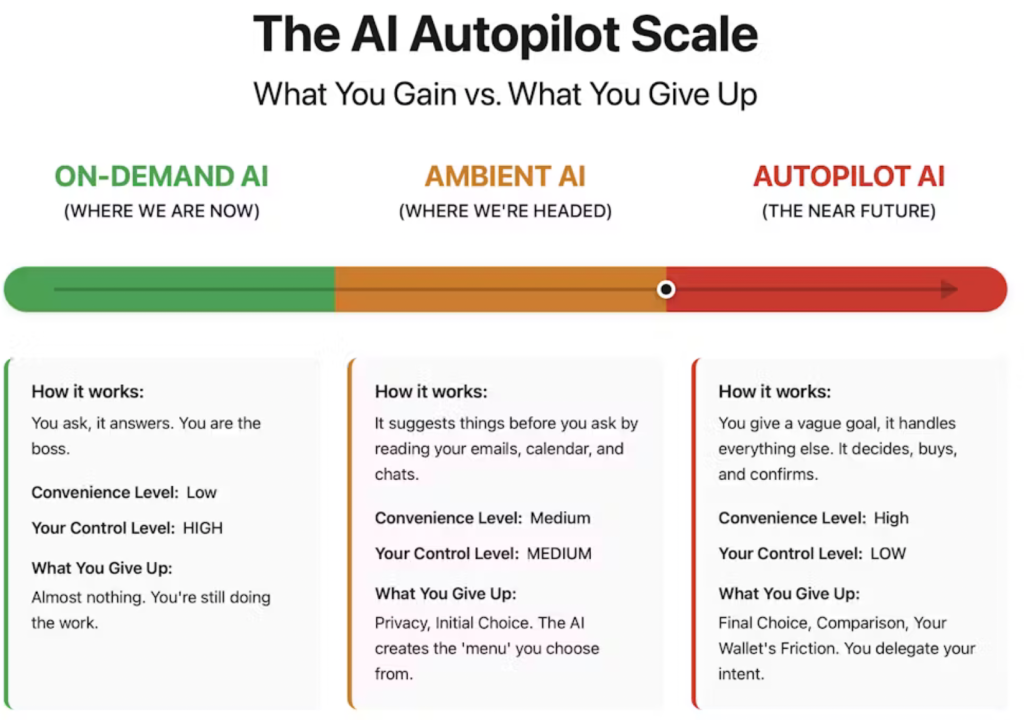
AI shopping assistants are evolving in three stages. The first thing that appeared was “on-demand AI.” Ask ChatGPT a question, ChatGPT will answer. That’s where most of us are today.
We are now entering “ambient AI,” where AI suggests things before you even ask. ChatGPT monitors your calendar, reads your emails, and provides recommendations, no questions asked.
We will soon see “autopilot AI” where AI will make purchases with minimal input from you. “Order flowers for your anniversary next week.” ChatGPT checks your calendar, remembers your settings, processes payments, and confirms deliveries.
Each phase increases convenience but decreases control.
Operation problems
The AI’s responses create what researchers call the “illusion of advice.” Even though ChatGPT suggests three hotels, they will not be displayed as ads. It feels like a recommendation from a knowledgeable friend. However, we don’t know if those hotels paid referral fees or if there are better options that ChatGPT didn’t display.
Traditional advertising is something that most people have learned to recognize and ignore. But AI recommendations feel objective even when they aren’t. The one-tap purchase makes the whole process very smooth, so you don’t have to stop to compare your options.
OpenAI is not alone in this race. That same month, Google announced a competing protocol, AP2. Microsoft, Amazon, and Meta are also building similar systems. Whoever wins will be in a position to control how billions of people buy things, potentially capturing a cut of trillions of dollars in annual transactions.
what we are giving up
This convenience comes with a cost that most people don’t even think about.
Privacy: AI needs to read your calendar and email to suggest restaurants. Purchase history is required to purchase flowers. People will seek complete surveillance for convenience.
Choices: Searches currently display multiple choices. If AI is the intermediary, you will see only three ChatGPT options selected. If AI chooses to ignore your business, it can make your entire business invisible.
The power of comparison: ChatGPT suggests products with one-tap checkout, eliminating the hassle of stopping and comparing.
The scale of AI autopilot shows how convenience trumps choice and control. Yuanyuan (Gina) Kui and Patrick Van Esch
It’s happening sooner than you think
ChatGPT reached 800 million weekly users by September 2025, growing four times faster than social media platforms. Major retailers began using OpenAI’s Agentic Commerce Protocol within days of its launch.
History has shown us that we consistently underestimate how quickly people will adapt to useful technology. Not so long ago, most people would not have considered getting into a stranger’s car. Uber currently has 150 million users.
Convenience always comes first. The question is not whether AI shopping will become mainstream. The question is whether people can actually control what they buy and why they buy it.
what you can do
The open Internet has given people a world of information and choices at their fingertips. The AI revolution could eliminate that. By letting algorithms make decisions so easily, rather than forcing people to do so, people forget what it’s like to truly make their own choices. Buying things is becoming as thoughtless as sending a text.
Additionally, a single company could become the gatekeeper for all digital shopping, with the potential for a monopoly that would exceed even Amazon’s current dominance in e-commerce. We believe it is important to have a lively debate, at least in public, about whether this is the future that people really want.
Here are some steps you can take to resist the temptation of convenience.
Ask questions to AI suggestions. Please note that when ChatGPT suggests products, we are showing you a selection of choices, not all of them. Before you make a one-tap purchase, stop and ask, “If I had to go to five websites and compare prices, would I buy this?”
Please review your privacy settings carefully. Understand what you are trading for convenience.
Discuss this with your friends and family. The transition to AI shopping is happening without public awareness. Now is the time to have a conversation about tolerance, before one-tap purchases become the norm and questioning becomes weird.
invisible price tag
AI will probably learn what you want before you even ask. Every time you tap “Buy Now,” you’re teaching it your patterns, your weaknesses, and the times when you make impulse purchases.
Our warning is not about rejecting technology. It’s about recognizing the trade-offs. Every convenience comes with a cost. Every tap is data. The companies building these systems are betting you won’t notice, and most of the time they’re probably right.
