


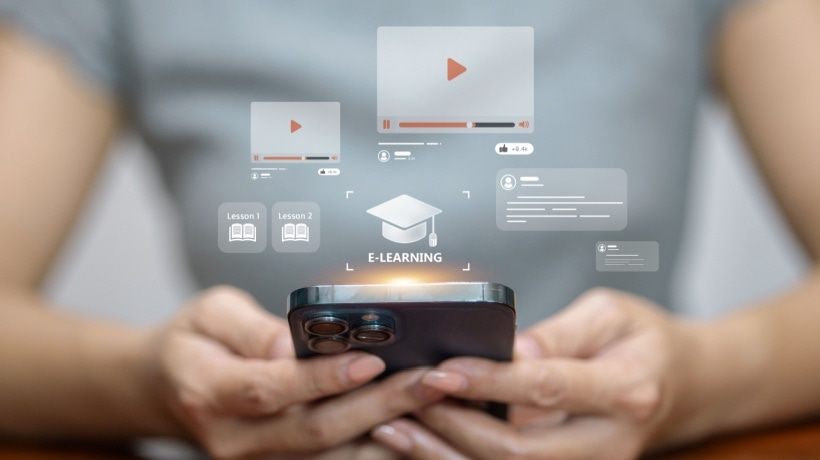
Mobile microlearning solution
If your employees are rushing from meeting to meeting, a 60-minute course can be more of a burden than a benefit. Two factors currently make it difficult to justify traditional long training sessions. First, we don’t have enough time. Half of U.S. learning leaders and 53% of employees say their workload leaves little room for training. [1]. Second, there is fragmentation of attention. According to a report by Gloria Mark, the average attention span of employees is reduced to just 47 seconds between tasks. For L&D leaders, this metric poses a significant barrier to organizational learning.
91% of U.S. adults now own a smartphone, and employees are constantly switching between digital tasks throughout the day. [2]. This fragmented attention makes long-form training impractical, but allows learners to respond accurately on the fly, making short, mobile-friendly microlearning an ideal format. That’s why mobile learning powered by microlearning solutions is becoming more prevalent in corporate L&D, as organizations move toward bite-sized, mobile-first experiences to protect productivity and adapt to changing roles.
Why mobile microlearning works
Microlearning solutions delivered through mobile learning work because they align with the way modern professionals think, work, and make decisions. Let’s break this down into practical terms.
1. Mobile microlearning fits into the natural flow of work
Most employees don’t have an hour to spare. You only have 5 minutes between meetings. 3 minutes before the customer calls. 10 minutes during my commute. That’s why mobile microlearning takes advantage of the moment.
Consider the following realistic scenario. Suppose a regional sales manager is trying to promote a newly launched product. But instead of delving into a 45-minute training recording, her sales rep opens a 4-minute mobile module that summarizes the value proposition, competitor comparisons, and two objection handling scripts. Training is frictionless because sales managers can access it from the same mobile devices they already use all the time. There are no login walls like on a laptop, and no need to wait for long courses to load. In other words, the more accessible learning is, the more likely it is to be used.
2. Mobile microlearning matches the way the brain retains information
This report shows that people retain information best when it is delivered in small, concentrated doses and reinforced over time. Long sessions with a large amount of information can overwhelm working memory. For example, consider implementing a new feedback framework for managers.
1 90-minute workshop Slide deck and downloadable PDF 1 post-session quiz Mobile microlearning approach Day 1: 5-minute animated explanation of the framework Day 3: Interactive scenarios – choose the best feedback response Day 7: Push notification reminders with simple microquizzes Day 14: Real-world application challenge
The second approach uses spacing and repetition, with each interaction strengthening neural connections. This is why structured microlearning with integrated reinforcement mechanisms performs better than single-event training. In other words, structured microlearning is designed to stick, not just complete.
3. Mobile microlearning supports just-in-time application
Learning is most effective when you put it into practice immediately. Imagine a front-line supervisor who has to deal with policy violations. She needs guidance on how to deal with violations when needed. Therefore, a well-designed mobile microlearning module might include:
Simple decision tree for quick selection. 3-stage conversion structure. Compliance checklist. A short scenario demonstrating best practices.
The module is also mobile-friendly, so you can discreetly access it right before the conversation about policy violations. This turns learning from academic exercises into real-time business tools. This is why consultants recommend incorporating microlearning into your daily workflow rather than isolating it within your LMS library.
4. Mobile microlearning reflects modern content consumption behavior
Employees already consume information in short, mobile-first formats, such as news alerts, short-form videos, and bite-sized updates. This is why microlearning doesn’t change behavior. Rather, it matches existing behavior. For example, a global financial institution developing a cybersecurity awareness initiative might design something like this:
3 minute risk scenario animation. Tap-based phishing identification challenge. A simple interactive quiz.
Delivered weekly via mobile, these learning sessions feel more like engaging digital experiences than mandatory training. Additionally, a strong custom content development strategy ensures that your learning design feels intuitive, with clean visuals, thumb-friendly navigation, short text blocks, and high interactivity. Therefore, when learning is approachable and easy to follow, resistance disappears.
5. Mobile microlearning increases engagement and completion rates
When learning is short, interactive, and accessible on mobile, completion rates naturally increase. But engagement is more than just completing a module. Employees also need to interact with microlearning modules from start to finish. Imagine leadership development happening like this:
Branching simulation of difficult conversations. Tap to see coaching tips. Micro-reflection prompts. Rapid peer-sharing voting.
Therefore, mobile microlearning transforms passive content into an interactive decision-making experience. Additionally, because these modules are short, learners are more likely to return for follow-up sessions. It is through that continuity that true behavioral improvement occurs.
6. Mobile microlearning can be efficiently scaled across the organization
Mobile-based microlearning solutions are easier to update and distribute than longer-form programs. For example, if compliance regulations change, microlearning allows you to update and instantly redeploy a four-minute module rather than redesigning a full-length course. Additionally, as product features evolve, you can push micro-updates directly to your sales team. This agility is critical in industries with fast cycles of change, such as automation, IoT, virtual reality, quantum computing, and climate change technologies. From an L&D leadership perspective, this means:
Faster rollout. Reduce production interruptions. More measurable impact. Increased revenue.
Mobile learning best practices for L&D leaders
So, if you’re looking to scale your microlearning solution, the following best practices can separate average efforts from high-impact efforts.
1. Start with the performance gap
Identify your business challenges before creating modules. Are your managers struggling with coaching conversations? Are safety incidents on the rise? Is product knowledge inconsistent across regions? In other words, microlearning works best when it’s closely aligned with measurable performance outcomes.
2. Designed for a thumb-friendly experience
Mobile learning is more than just shrinking desktop content. Rather, you also need to:
Vertical layout. minimal text. Tap-based navigation. short video segments. Interactive elements optimized for small screens.
Additionally, a robust custom content development strategy ensures that these learning assets are built mobile-first, rather than simply being retrofitted.
3. Use scenario-based design
Adults learn best through context. So instead of presenting new policies with slides, we present realistic decision-making situations. For example, imagine implementing a new workplace policy for your boss. However, instead of enumerating guidelines, it presents branching scenarios in which managers must respond to employee issues. Their choices will determine the outcome. This reflects real-world results and improves retention.
This is where partnering with a bespoke content development company can make a big difference. Customized scenario-based learning requires instructional strategies, so choosing a partner with deep microlearning experience is essential.
4. Integrating enrichment and analysis
Microlearning is most effective when done on an ongoing basis, so use push reminders, knowledge checks, and follow-up micro-modules every few weeks. Combine this with your analytics dashboard to track:
Completion rate. Engagement time. Performance evaluation. Indicators of behavioral change.
An experienced training consultant can help you align these learning analytics to your business KPIs and ensure your learning solutions demonstrate measurable ROI to your executive stakeholders.
5. Ensure cross-functional scalability
High-performing organizations don’t limit microlearning to compliance. Rather, it is also used for:
Leadership development. Sales enablement. Product updates. DEIB training. Deploying digital transformation.
Therefore, a strategic microlearning framework is not just a one-time initiative, but a long-term capability driver.
final thoughts
Employees don’t need more training time. Rather, they need more enlightened learning moments. Therefore, in environments where attention is scarce and time is limited, mobile learning solutions allow employees to learn where they are without compromising depth or impact. [3]. For L&D leaders ready to modernize their learning ecosystem, investing in high-quality, performance-driven microlearning solutions is the foundation for building sustainable capabilities in today’s fast-paced corporate environment.
References:
[1] TalentLMS 2026 Annual L&D Benchmark Report
[2] Mobile fact sheet
[3] Mobile learning solutions for hands-on employee training: Get results with learning on the go
Ozemio
We recognize the value of something very simple, yet fundamental: change doesn’t happen in silos. Our workforce transformation solutions are comprehensive, yet targeted. We offer bespoke plans tailored to your business requirements
