


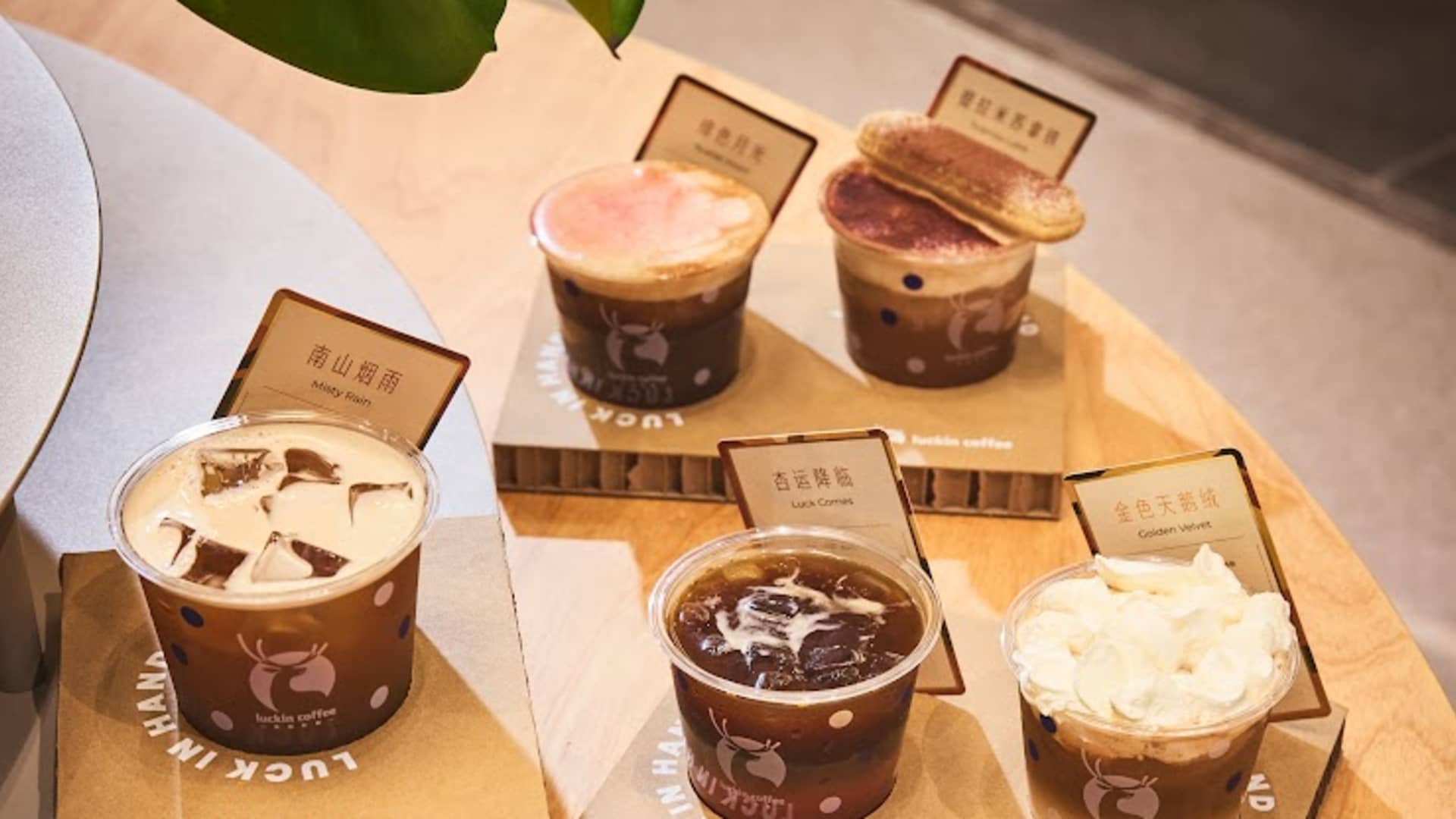
Chinese coffee giant Luckin has opened its first flagship store offering premium drinks to compete with Starbucks Reserve.
luckyn coffee
BEIJING – China’s Luckin Coffee is taking direct aim at Starbucks’ upscale roastery chain, opening a new flagship store selling premium drinks in the south of the country.
This is Luckin’s first major departure from its original strategy of operating affordable coffee kiosks, a strategy that helped the company overtake Starbucks in the number of stores in China.
Luckin has now sold most of its troubled China operations to a local investment firm, proving it has fully recovered from the 2020 fraud allegations that forced it to be delisted from the Nasdaq.
The Chinese company officially opened its two-story Luckin Coffee Origin flagship store on Sunday in Shenzhen, on the border with Hong Kong.
While a typical Luckin product costs about $1 or $2 for an Americano or latte, its flagship stores offer slightly higher prices for pour-overs and cold brew coffee drinks. Luckin is leveraging the geographic sourcing “origin” theme popular at Starbucks and other coffee companies, allowing customers to choose beans from Brazil, Ethiopia, or China’s Yunnan province.
The new store also sells several specialty drinks, including a tiramisu latte topped with pastry, according to a post on Chinese social media platform Xiaohongshu. Since the store’s soft launch on Jan. 20, users have started posting about waits of about one to three hours for their drinks.
The 420-square-meter (4,521-square-foot) store is a sign of how intense competition has become for Starbucks in China. Back in 2017, the US-based coffee giant chose Shanghai for its second-ever Reserve Roastery “Megastore” after launching a premium store concept in Seattle three years earlier.
But as coffee has become more popular in China, a traditionally tea-drinking market, Starbucks has come into conflict with numerous competitors, from boutique cafes to chains like Cotti Coffee and Manor. These chain stores often sell drinks for half the price of Starbucks.
Luckin reported sales of $1.55 billion for the three months ended September 30, 2025, an increase of nearly 48% year over year.
This is limited to the company’s own stores, which account for more than half of Luckin’s Chinese locations and most of its few overseas stores. The new store in Shenzhen is being touted as Luckin’s 30,000th store. The company reported a total of 29,214 stores worldwide as of September 30th.
This photo shows the second floor of Luckin’s new flagship store in Shenzhen, China, which officially opened on February 8, 2026.
Luckin
By contrast, Starbucks has more than 8,000 stores in China and about 16,900 in the United States, its largest market.
The Seattle-based coffee giant reported net revenue in China for the three months ended Sept. 28, up 6% year over year to $831.6 million. Comparable same-store sales, a standard industry metric, were just 2%, but improved to 7% in the quarter ended Dec. 28.
Starbucks did not release China net revenue for the latest quarter. The company plans to enter into a deal this spring to sell 60% of its China business to Boyu Capital, while retaining a 40% stake. When the partnership was announced in November, Starbucks said it valued its China operations at $13 billion, including future licensing fees.
Luckin’s shares are still traded over the counter in the U.S. and had a market value of about $10.46 billion as of Thursday.
Relisting and expansion plans
Late last year, Luckin CEO Jingyi Guo hinted at plans to relist the company in the U.S., but did not specify a date. The company was founded in late 2017, achieved a $2.9 billion valuation just 18 months later, and went public on the Nasdaq in May 2019. But about a year later, it was discovered that many of the company’s 2019 sales figures had been fabricated, leading to its delisting, Luckin said.
The Chinese coffee company continued to operate many stores and kept its name and logo.
Luckin also scrambled to captivate consumers through a number of timely collaborations, including premium spirits brand Maotai, the anime character Minions, and the video game Black Myth: Goku, which became a hit within days of its popularity surging.
Mingchao Xiao, founder of Zhimeng Trends Consulting, said Luckin’s unique feature is that it can build a solid pool of private user traffic through its smartphone ordering app. Luckin customers select and pay for drinks directly through the app, rather than ordering from a counter clerk.
Xiao said China’s coffee market is still in a period of rapid change. He added that today’s young consumers are more willing to try different experiences and seek emotional fulfillment, which can be met through cross-industry brand collaborations.
Weekly analysis and insights from Asia’s largest economy delivered to your inbox
Subscribe now
Like many Chinese companies, Luckin is ramping up its global footprint.
Last summer, Luckin opened its first U.S. store in New York City. It debuted on February 6th as the 10th store in the city.
Since Luckin entered the market about three years ago, it has 68 stores in Singapore and 45 co-operated stores in Malaysia.
