


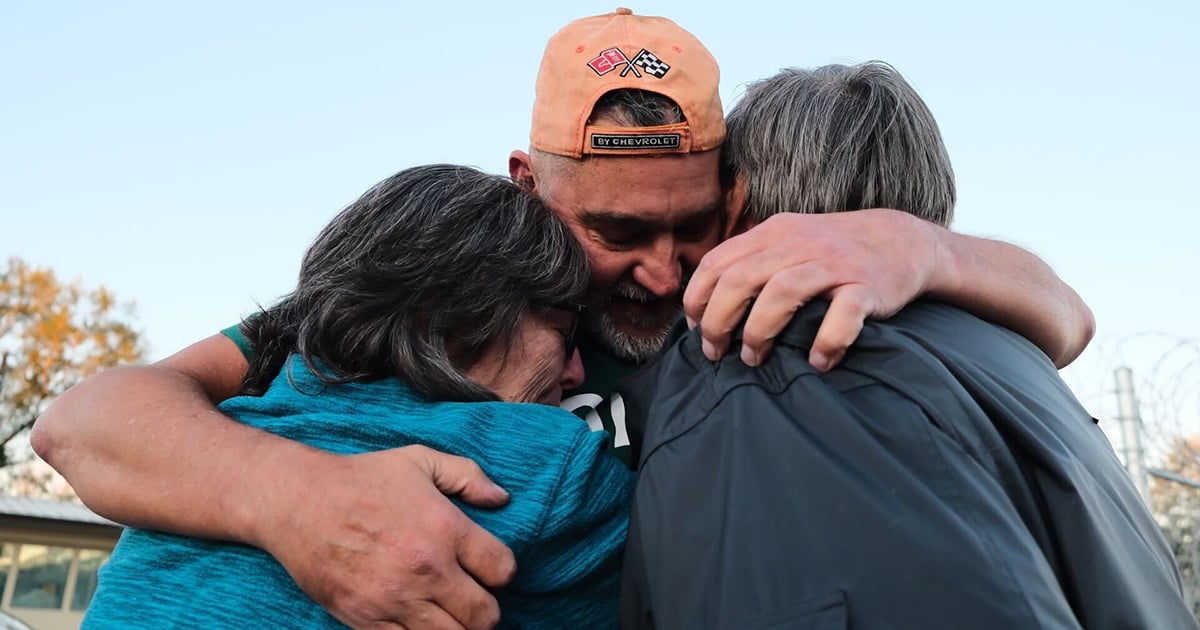
After spending 27 years on death row, Jimmy “Chris” Duncan left the Ouachita Parish Correctional Center and returned to the arms of his parents last week.
Seven months ago, a Louisiana district court judge vacated a man’s murder conviction for killing his ex-girlfriend’s infant child, citing doubts about the evidence used in the conviction. The judge granted bail after several legal delays, including unsuccessful requests by prosecutors to the Louisiana Supreme Court to suspend bail. Now a free man, Duncan spent Thanksgiving with his family and celebrated his 57th birthday the next day.
“We thank God that Jimmy is home,” Duncan’s stepmother, Sharon Duncan, said in an emailed statement on behalf of the family.
But Duncan’s journey to freedom isn’t over yet. Prosecutors asked the state Supreme Court to reinstate the death sentence. Duncan’s attorney declined to make him immediately available for an interview.
Judge Alvin Sharp’s April decision to vacate Mr. Duncan’s conviction and death sentence came after a Verite News and ProPublica investigation examined the reliability of key forensic evidence used to convict Mr. Duncan. At the time, Duncan faced the possibility of the death penalty after Gov. Jeff Landry, a staunch supporter of the death penalty, moved to expedite the execution after a 15-year moratorium.
Sharp, of the Ouachita Parish 4th Judicial District, found that Duncan’s conviction was based in part on bite mark evidence, which is now considered junk science by experts. The original analysis was by forensic dentist Michael West and pathologist Dr. Stephen Hayne, but concerns about the effectiveness of their technique have called into question the state’s long-standing partnership as experts. West did not respond to previous requests for comment, but admitted in a 2011 deposition in a separate case that he no longer believed bite mark analysis. Mr. Hayne passed away in 2020.
In the past 27 years, nine prisoners convicted in part because of inaccurate evidence by West and Hayne have been released. Three of them were on death row. Duncan was the last person awaiting the death penalty based on their research.
Robert S. Tew, the district attorney for Ouachita and Morehouse parishes, argued in his appeal that the evidence presented by prosecutors was sound and that Duncan raped and killed 23-month-old Haley Oliveau, and that he should be executed without delay. Tew’s office did not immediately respond to a request for comment on Duncan’s release.
Police arrested Duncan on December 18, 1993. Duncan was babysitting Haley that day at the West Monroe home he shared with the girl’s mother. Duncan told law enforcement that she gave the toddler a bath before going downstairs to wash the dishes. Hearing noises coming from the bathroom, he rushed upstairs to check on Haley and found her floating face down in the water. She was pronounced dead several hours later.
Mr Duncan was initially arrested on suspicion of manslaughter, but Mr Hayne and Mr West carried out a medical examination on Ms Haley and claimed they found evidence that she had been sexually assaulted and intentionally drowned. Hayne said she found bite marks on the girl’s body, which West examined and claimed matched Duncan’s teeth.
Based in part on these findings, prosecutors upgraded the charge against Duncan to first-degree murder. After about two weeks of testimony in 1998, a jury found Duncan guilty and sentenced him to death. He would spend the next quarter century on death row in an Angola prison.
But in the meantime, lawyers from the Innocence Project in New York, the firm of Brian Cave Leighton Paisner in Atlanta, and the Mwalimu Justice Center in New Orleans uncovered a wealth of evidence that ultimately led to the conviction being vacated in April.
The most damning of the new evidence casts doubt on whether the bite marks found on Haley’s body were made. A video of Mr. West’s 1993 examination of Haley, which was not shown to jurors in the trial, shows the dentist taking impressions of Ms. Duncan’s teeth and carving them into the girl’s body. (West has previously said he is simply using what he calls a “direct comparison,” in which a mold of a person’s teeth is pressed directly onto the suspected bite mark.)
In his decision to vacate Mr. Duncan’s conviction, Mr. Sharp said that the research done by Mr. Hayne and Mr. West in relation to Mr. Duncan’s case was “no longer valid” and “scientifically indefensible.”
Additional evidence that undermined Duncan’s conviction included the testimony of an expert witness who said the child’s death was the result of accidental drowning rather than murder. Investigators from Duncan’s defense team then spoke to a prison informant who recanted earlier trial testimony that Duncan had confessed to the crime.
Haley’s mother, Allison Leighton Statham, came out to support Duncan’s release, telling Mississippi Today in an interview in July that she believed Duncan was “wrongly accused of a crime he did not commit.”
Sharp, who had already ruled that Duncan was effectively innocent, granted bail on November 21 with bail set at $150,000 while the state’s appeal was considered by the high court. In his judgment, Mr Sharp said there was “not a great presumption” that Mr Duncan was guilty and the evidence against him was “not clear”. The state fought for his release but lost in court, setting the stage for Duncan’s release the day before Thanksgiving.
“When Chris came out and I went to hug him, it was very moving,” said attorney Ann Ferebee, who has been a member of Duncan’s defense team for the past 10 years and who greeted him shortly after his release. “I kind of choked up, and he asked me, ‘Are you OK?'”
“‘It’s so nice to meet you,’ I told him.”
After his release, Duncan went to live with family members in central Louisiana. Christian Bromley, another of Duncan’s attorneys, said he expects oral arguments in the state’s appeal to be heard in the state Supreme Court in early 2026. If prosecutors lose this round, they could take the matter to the U.S. Supreme Court and retry Duncan on the same charges or a new set of charges, Bromley said.
Or, the charges could be dropped entirely. But that seems unlikely, he said.
“We met Chris about 10 years ago and, like him, we believed in his innocence all those years,” Bromley said. “I think that’s something we always wanted, but we knew it was a potentially insurmountable feat to get there.”
Louisiana had not carried out an execution since 2010 until this year because it could not procure the necessary drugs. But after Mr. Landry’s election, the state approved the use of nitrogen gas, a controversial method only allowed in three other states.
That led to Jesse Hoffman Jr.’s execution on March 18th. Saving Duncan from a similar fate was “the most rewarding experience of my career,” Ferebee said, but acknowledged that prosecutors still seek the death penalty for Duncan. “While we celebrate this victory, we know there is more to come.”
