


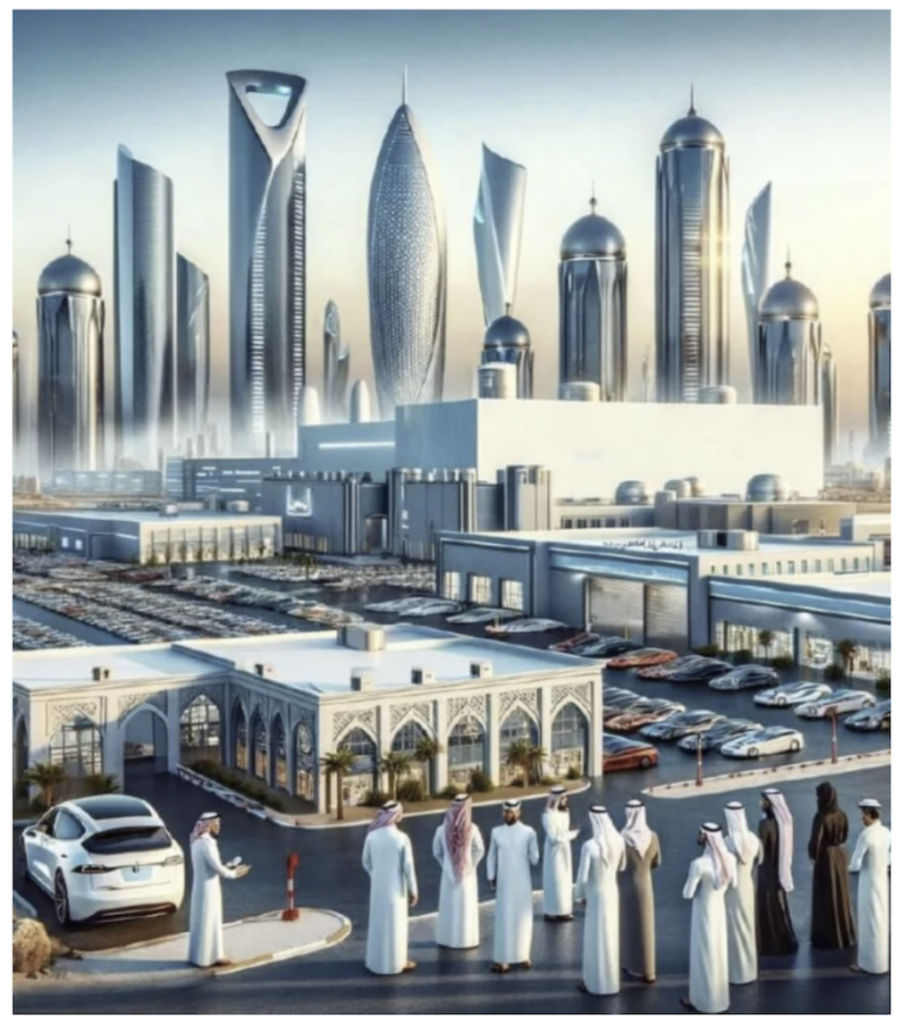
The AI “revolution” required capital, land, and great power. The rulers of Saudi Arabia, Qatar, and the United Arab Emirates were happy to provide all three.
In 2024, before the arrival of Trump 2.0, large US AI companies began deepening their relationships with Persian Gulf capitals, which began investing heavily in data centers and other AI infrastructure. But the relationship really took off under the current administration, which found a way to reward Silicon Valley and its Zionist supporters, provide untold personal wealth, and give the empire’s last legs a hurrah pass.
The United States is currently committed to a Persian Gulf partnership that envisions a new stablecoin dollar hegemony and the outrageous corruption and genocide that will come with it, but everyone in the game will become incredibly wealthy and believe that this partnership will lead to a never-ending winning streak.
Will it work, and what does it mean for the future of West Asia and America’s political economy? Let’s take a look.
Wedding of Silicon Valley and the Persian Gulf
In November, the United States and Saudi Arabia signed a Strategic Artificial Intelligence Partnership. This is the latest in an ever-deepening AI relationship with the Gulf states. A similar agreement was reached with the UAE in May. So the US has now agreed to export up to 70,000 advanced Nvidia chips to both countries.
The deal marked a sudden shift from previous efforts by the United States to restrict exports of such technology for fear that it would flow into China. Rather, the Trump administration claims the deal will “promote America’s continued AI dominance and global technological leadership.”
The deals with Saudi Arabia and the UAE probably involve investing trillions of dollars in the US, but I wouldn’t count on local infrastructure upgrades. Primarily, we’ve seen a list of partnerships with OpenAI, Anthropic, Adobe, Qualcomm, Microsoft, AMD, Cisco, GlobalAI, Groq, Luma, xAI, and more. Investments are also being made in US data centers and associated liquefied natural gas facilities, as well as specialty chemical plants for cooling. Wandering. In reality, therefore, these investments are destroying the environment, depleting scarce water resources, and strengthening the power of the American oligarchs, which shuts down any hint of social policy aimed at benefiting the working class or curbing the power of billionaires. But I digress.
Just look at the scale of the work being done on the Gulf Coast itself. Guy Laron writes in the American Affairs Journal:
Already, more than 3.3 gigawatts of AI-driven computing power is in the pipeline across the Gulf, a staggering number that signals the structural realignment of global digital infrastructure.42 Only the UAE is building a vast 5 GW AI campus under the Stargate UAE flag, with the first 200 MW of capacity coming online in 202643. Saudi Arabia has set aside a similar 500 megawatts. Through partnerships with Nvidia and AMD, more megawatts will be built through Humain, a sovereign AI company44. Additional projects, including Qualcomm’s co-development agreement and Amazon’s “AI Zone,” are expected to add another 300 to 500 megawatts. 45 The Gulf is thus emerging as a sovereign computing corridor, a region where energy systems, capital flows, chip diplomacy, and model training capabilities are boldly linked. Indeed, for all its technological innovations, the United States lacks the power and space to train models on a planetary scale without clogging up the power grid. Gulf provides the chassis. What started as a workaround for the limited flexibility of the national power grid has become a geopolitical pivot, redefining the geopolitics of artificial intelligence.
A detailed look at what the Middle East has to offer, courtesy of Edward Ongweso Jr.
Unsubsidized electricity prices in the Gulf region average $0.10 per kWh, compared to Europeans who pay $0.29 per kWh and Americans who pay an average of $0.17 per kWh. Through “intensive planning and execution,” the GCC could quickly build out its power infrastructure. Saudi Arabia plans to add 42 GW of gas capacity by 2030, 40% more than the US.
The second reason is due to geographical advantage. The Gulf is located at the crossroads of three continents and an extensive undersea cable network that can serve 4 billion internet users within 100 milliseconds of latency, the threshold for AI interactions to feel “instant.” If that wasn’t enough, the region also has the world’s largest desalination infrastructure (40% of the world’s desalinated water). Geographically, it is well suited to provide enough water to service inference workloads around the world and to cool increasingly overbuilt, power-hungry AI data centers.
There are also financial benefits. With a war chest of nearly $5 trillion in sovereign wealth funds, we have a little more patience than greedy Western financiers.
Given the US bombing of Venezuela and kidnapping of the president, it should be noted that there are similar plans in Latin America. Washington, led by Secretary of State Marco Rubio, is eyeing the region’s energy, mineral and water resources to strengthen its AI infrastructure and corral Beijing.
Dollar supremacy and the accelerationist vision of the future
It was widely believed that tipping limits were ineffective. They are still reaching China and the Chinese will catch up anyway. The U.S.’s calculations have therefore shifted to a strategy of locking in more countries, particularly the capital-rich countries of the Middle East, into U.S. technology. why is that?
According to Navin Greekkar, director of economic security and technology at the Center for Strategic and International Studies (CSIS), it has to do with the dollar and the vision for stablecoin hegemony.
This is above my pay grade, but Mr. Greciancar probably knows more because he has received funding from the Smith Richardson Foundation, Gordon and Betty Moore Foundation, Charles Koch Foundation, Bank of America Corporation, Northrop Grumman Corporation, BP, Citigroup, Meta, Johnson & Johnson, Microsoft, Raytheon Company, Amazon, Apple, IBM, Disney, and others. He writes:
Access to U.S. computing power will allow Gulf countries to export AI-enabled goods and services in areas such as logistics, precision agriculture, medical diagnostics, and finance.
Vice President J.D. Vance said the Trump administration aims to “ensure that American AI technology remains the world’s gold standard.” But these agreements lack a key element of U.S. power: guarantees that AI-enabled exports produced using American chips will be invoiced and settled in dollars.
…The US should condition access to cutting-edge chips on a binding commitment to settle AI-enabled exports in dollars…The US should use dollar-backed stablecoins as a payment mechanism.
And that vision for the dollar’s future comes with Silicon Valley’s enthusiasm for the political and economic philosophy that exists in the Gulf region.
As the UAE takes the crown of crypto capital, it is becoming the kind of model American oligarchs hope to reshape the United States: unregulated, virtually unlimited sovereign capital, low taxes, and rule by a techno-monarchy.
Consider countries that are further dismantled, their human and natural resources plundered, and then their profitable parts rebuilt under the supervision of financial, real estate, energy, and high-tech moguls. Consider what the vision of post-genocide Gaza looks like.
A CGI image of the post-genocide vision for the Gaza Strip, “Gaza 2035,” announced by Israeli Prime Minister Benjamin Netanyahu’s office in May 2024.
Grifting is good, but grifting
The great thing about the Middle East is that there are always large sums of money being spread around the military-industrial-tech complex and professional management classes, and there is ample opportunity for crypto corruption with monarchs seeking control of the AI pipeline.
So we see creepy fraudsters like Brett McGuirk, who once led the global “fight” against ISIS, now helping companies strike billion-dollar AI deals with Saudi Arabia and the UAE, and making a fortune doing so.
We can see that PMC has invested a lot of money in investments such as Mohammed Bin Zayed University of Artificial Intelligence. The university currently has a satellite laboratory in Sunnyvale, California.
And we’re seeing corruption on a whole new scale, represented by the commander-in-chief and his family. “Digital assets” are now reportedly “one of the largest single sources of funding” for the Trump family. Eric Trump’s World Liberty Financial has signed a $2 billion deal with UAE state-owned AI investment firm MGX, which holds rights to Trump’s USD1 stablecoin. MGX uses it for billions of dollars of trading on Binance. The Binance exchange has always been on the wrong side of the law, with its founder Zhao Changpeng pleading guilty to anti-money laundering failures in 2023 and receiving a pardon from President Trump in October.
It’s quite a racket, and like George Carlin, it’s quite a big club. To Mr. Greekkar’s suggestion above that this stablecoin corruption will become a new model of dollar hegemony, it seems like a lot of effort is needed to make it semi-legal, but what do I know? Here are more details about Guy Laron:
Trump and MGX’s stablecoin trading was not a side hustle. It was a business model. Ostensibly, USD1 was a digital token designed to maintain a 1:1 peg to the U.S. dollar and was “backed” by short-term government bonds and cash equivalents.31 But there was no federal oversight, no public mandate, and no guarantee that each token actually represented a redeemable dollar. It was legal because no one had made it illegal yet. Furthermore, Trump is the chief architect of crypto policy, making him the single biggest political beneficiary of the rise of cryptocurrencies. His executive orders, such as the January 23 directive establishing a supportive regulatory framework for stablecoins, directly benefited World Liberty’s reputation and business model. President Trump’s Securities and Exchange Commission (SEC) rolled back enforcement, while the Department of Justice (DOJ) quietly abandoned investigations into Trump allies like Binance.
This legal twilight zone allowed USD1 to function as a privatized financial instrument. It would be issued offshore, backed by U.S. public debt, and controlled not by the central bank but by the Trump family’s companies, the Gulf monarchies, and a cartel of crypto-based oligarchs. Like Tether and Circle before them, the Trump Organization had cracked the ultimate arbitrage. They minted private funds, raised real money from investors, parked the proceeds in U.S. Treasuries, and pocketed the yield. The people supported the debt. The oligarchy reaped its benefits. This was not just deregulation. It was financial sovereignty, sold and tokenized.
What could be better for America’s ruling class than a dollar-supremacist initiative that also galvanizes elected officials and the privately wealthy members of the imperial apparatus?
There are a number of problems with this plan, including an AI bubble, environmental restrictions, and the fact that all AI infrastructure would be located in a tinderbox in the Middle East (with the United Arab Emirates and Saudi Arabia at increasingly bitter odds). We will consider these issues on Wednesday, as well as what exactly Israel’s role is in this grand plan.
