


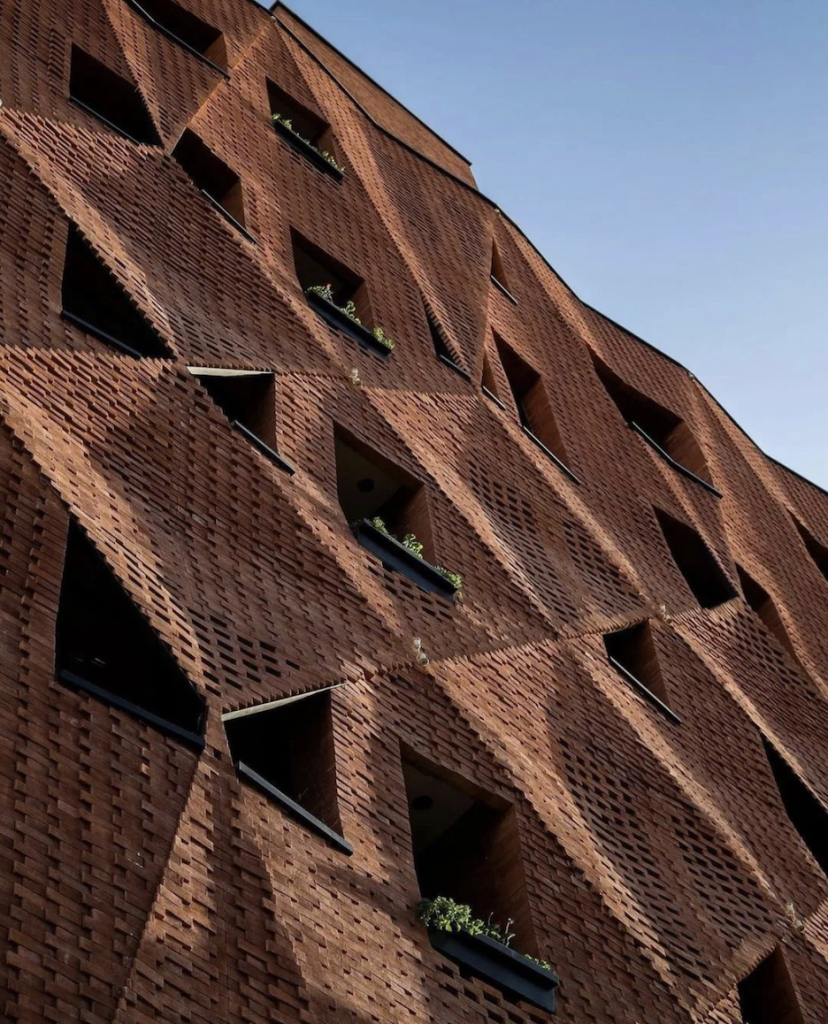
As is often the case when perusing the news on Twitter/X, it’s easy to end up falling down a rabbit hole when it comes to certain topics. The same thing happened recently with Iranian architecture. Philip Oldfield is Head of the School of Built Environment and Professor of Architecture at UNSW Sydney, and has a bit of an obsession with Iranian brickwork. His account uses it a lot, and when you see photos like this, it’s easy to see why.
Woof Shadow Building in Tehran by Tachra Design.
Like much of Iran’s recent history, brickmaking is tied to the country’s relationship with the West: stories of partial colonialism, questioning of modernity, and, of course, sanctions. While it is entirely possible that without the sustained economic war led by the United States, the buildings pictured above (and many of the buildings below) would not be built in Iran today, Western sanctions have prompted a rethinking of what Iranian architectural philosopher Razieh Ghorbani Khalazi calls “creative destruction.”
Sanctions force reconsideration
For a long time, Iranian architecture has largely imitated modern Western and classical styles, moving away from Persian inspiration.
However, Western sanctions over the past two decades have been a comprehensive event targeting aspects of everyday life. These include, in 2019, the United States sanctioned the sale, supply, and transfer of metal raw materials and semi-finished products, graphite, coal, and software for integrating industrial purposes to or from Iran, and is subject to sanctions if these materials are used in connection with Iran’s construction sector.
Perhaps it is no coincidence that Iranian architects began to incorporate local materials in a modern way. Mr Oldfield said:
We were struck by how Iranian architects are harnessing local materials such as bricks and tiles and reinterpreting their use through advanced software tools and technology, resulting in complex shapes and geometries of curved, folded and twisted brickwork. This is not only visually appealing, but also provides shade and privacy.
While there are other factors to consider, such as construction, design, development, and expression, as well as pedagogy, activism, and speculation, as Karadzi writes, economic warfare is always present, and it is arguably more troubling, as Karadzi writes.
On the other hand, sanctions are seen as an obstacle and a cause of Iran’s “global isolation.” This has created an ever-increasing socio-psychological market for cultivating the “modern,” “Western,” “worldly,” and “foreign.” On the other hand, sanctions are seen as a rather positive force, an opportunity to build an Islamic economy independent of Western imperial influence. These nationalist reactions are linked to spatial discourses of colonialism, globalization, and modernism, which also influence architectural practice in terms of design, material culture, and financial calculations.
On this basis, I argue that sanctions function simultaneously as a closing and opening mechanism. In other words, borders may be closed to certain flows of goods, capital, and materials, but they are open to certain ideologies and cultural economies. This is similar to the polarity inherent in the word “sanction” itself, an antonym that simultaneously means “permit” and “deterrent.” While the imposition of sanctions as a counterword has value as an analytical framework, as Iran has suffered from large-scale sanctions for the past several decades, what this study uncovers is the process by which the Iranian people and state “sanction” themselves. Sanctions here do not mean deterrence imposed on Iran, but rather that Iranians have given themselves permission to respond to ongoing political and economic instability through various cultural and economic strategies.
Such a strategy yields the following results:
A more stylish medium-rise brick house in Iran. It appears to be a mixture of two-story houses and one-story houses.
Design by Mahasa Moshtagi pic.twitter.com/yNuyx9Fyip
— Philip Oldfield (@SustainableTall) January 20, 2025
I skipped the best part! pic.twitter.com/QGyOxlDA4b
— Joe Cohen (@CohenSite) November 3, 2025
Kusar Residential Apartment in Shiraz, Iran by Asharia Architects
https://amazingarchitecture.com/residential-building/koohsar-residential-apartment-in-shiraz-iran-by-ashariarchitects
According to Qarazi’s discussions with Iranian architects, there is no dichotomy between tradition and modernity. It’s all part of a continuing history, and really great architectural history.
Iran is home to some of the oldest, most important and beautiful architecture in the world.
Here’s a quick introduction, from ziggurats and Zoroastrian fire temples to crystal mosques and the first ever churches. pic.twitter.com/BcYLNAuxQJ
— Culture Tutor (@culturetutor) June 26, 2023
And embedded in that history is an emphasis on what was urgently needed, even if it was temporarily ignored.
environmental design
In a rapidly heating world, architects and engineers are taking renewed interest in ways to stay cool without burning more fossil fuels. And that led to a focus on ancient Persia’s Badgir, or Tower of the Winds. (There is some debate about their origins, with some arguing that they were first developed in ancient Egypt).
Persian-style towers (بادگیر) and how 700-year-old air conditioners were able to cool the environment to 12°C without electricity.
[Credit: Never Enough Architecture] pic.twitter.com/bSSLJBv2Ap
— Chris (@ishiguzochris) November 12, 2023
Traditional air conditioning already accounts for one-fifth of the world’s total electricity consumption, and Wind Catcher is yet another reminder that there were many ways to tackle past climate crises if we were willing to look.
The windcatcher is making a comeback in Iran, and has sometimes been adopted in various forms elsewhere. From the BBC:
Around 7,000 types of wind catchers were installed in public buildings in the UK between 1979 and 1994. You can see these wind catchers from buildings such as London’s Royal Chelsea Hospital to supermarkets in Manchester.
These modernized wind catchers bear little resemblance to Iran’s towering structures. A small pink ventilation tower enables passive ventilation in a three-storey building on a busy road in north London. On the roof of a shopping center in Dartford, a conical ventilation tower rotates to catch the wind with the help of its rear wings, keeping the tower facing the prevailing winds.
In the United States, designs inspired by windcatchers are also being enthusiastically adopted. One example is the visitor center at Zion National Park in southern Utah. The park is located on a high desert plateau comparable to Yazd in climate and topography, and the use of passive cooling technologies, including wind catchers, has all but eliminated the need for mechanical air conditioning. Scientists recorded a temperature difference of 16 degrees Celsius (29 degrees Celsius) between outside and inside the visitor center, even though many bodies passed through it regularly.
Such technology also has the added bonus of helping reduce shared air in the new era of pandemics. It also helps reduce indoor pollutant buildup and create healthier living and working environments in urban areas where air pollution is a major concern.
And there are many ways to improve upon the ancient design and make it even more effective.
Wind towers are not the only way Iranian architects are now using bricks to increase shade.
Iran’s Hoaba Design does some of the best urban infill architecture I know of – Thread 🧵
Architecture that celebrates color, materials and craftsmanship
This is the Sharif office building in Tehran. pic.twitter.com/wd8Urz3fod
— Philip Oldfield (@SustainableTall) May 22, 2024
This is the Hitra office building in Tehran.
Although pet safety is unknown, the purpose is to allow natural light to penetrate deep into the building while preventing overheating. A brick-clad steel frame is used, and instead of the typical light well in the center of the building, it is placed at the sun-drenched southern end with a “scoop” overlooking the new public plaza.
interior pic.twitter.com/gWpIiMlvwT
— Philip Oldfield (@SustainableTall) May 22, 2024
There are also examples of shade, natural light, and ventilation.
A strong approach to the facade design of Iranian apartments, where privacy, shade and ventilation are prioritized
Brick apartment complex in Dezfur, Iran by Bio-Design Architects pic.twitter.com/1QP4BZIoAG
— Philip Oldfield (@SustainableTall) December 8, 2025
beautiful building
I’d be tempted to say that if someone wanted to get some of these photos in front of President Trump – who seems to appreciate buildings more than most people – maybe it would help deter him from leading even more rapacious violence on behalf of the Zionist oligarchy. After all, President Trump issued an executive order last year to make federal buildings beautiful again.
But beauty is in the eye of the beholder.
sauce.
President Trump’s executive order calls for more classical architecture. There are similar buildings in Iran.
Motifs and decorations of stone Roman facades in Tehran. Source: Razieh Ghorbani Kharaji.
While reading about Iranian architecture, I came across a building that looked like it was just down Trump’s alley.
Students Fereshteh Asadzadeh and Ivo Pekec have developed a satirical apartment complex project, “The House That Tehran Speaks,” which combines several historical Western buildings.
“The house that Tehran is talking about”
Asazadeh explains its origins:
Tehran’s typical upper-class mansions are postmodern in nature and have very similar stylistic trends. Their architectural language returns to historical elements, but with no regard for their traditional virtues (symmetry, unity, purity, etc.), and instead abuses them in the shallowest ways imaginable, considering only their aesthetic properties and connotations of power, wealth, and exclusivity. Elements such as epistyle, colonnades, cornices, architectural orders (Dorian, Ionic, Corinthian) and ornaments from every conceivable period, from antiquity to Art Nouveau, form a heretical ensemble indifferent to the context in which it is incorporated. Immersed in historical memories and tools, playing an absurd game of historical quotation, they result in an architectural dissonance with capital. As the only conductor, it radiates intensity and excess.
