


[This post launched before complete because too much is happening. But there is a lot of good material here, so don’t shy away from commenting. I will keep revising and updating through 8:00 AM EST so please refresh your browsers and scan again as of then if you checked in before that]
In addition to providing updates on the Iran war as best we can given the thick informational fog, we will also recalibrate a few of the sightings from earlier posts.
We had thought to invoke the saying from Dune, “The power to destroy a thing is the absolute control over it, before we saw the reports on Twitter of Iran strikes on Saudi oil assets.
Many commentators have made ritual incantations that the US and Israel are more powerful countries than Iran. But Iran is putting its dagger to the throat to enough of the world’s critical oil and LNG supplies so as to have the potential to impair delivery for long enough to create cascading economic effects. Two can play at economic warfare.
🚨🇮🇷🇸🇦 BREAKING: Iranian drones have struck Saudi Aramco’s Ras Tanura facility. INSANITY.
Ras Tanura is the single largest oil export terminal on the planet. It handles roughly 6.5 million barrels per day — nearly 7% of global oil supply flows through this one facility. pic.twitter.com/6cxBu7dKFf
— DD Geopolitics (@DD_Geopolitics) March 2, 2026
Confirmation and a hot take from Middle East Eye:
Two drones targeted Saudi Arabia’s Aramco refinery in Ras Tanura on Monday, the defence ministry said.
Turki al-Maliki, the ministry’s spokesperson, told Al Arabiya that both drones were intercepted.
He said a fire at the refinery was caused by debris from the interception and confirmed there were no civilian injuries.
Saudi Arabia’s energy ministry said the limited fire was under control and had no impact on oil supplies. The refinery was shut down as a precaution.
The Ras Tanura complex, located on the kingdom’s eastern coast, houses one of the Middle East’s largest refineries, with a capacity of 550,000 barrels per day, according to AFP.
Mind you, these were just drone strikes. This action seems intended as yet another indication of what could be on the Iran escalation menu, in keeping with observations made by Professor Sayed Marandi to Glenn Diesen that we highlighted yesterday.
We hate to differ with Alexander Mercouris, who contends that oil refineries are huge and sturdy complexes, often with redundancy, and therefore are pretty attack and damage resistant. He argues that the very limited effect that Ukraine attempts on Russian refineries prove his point.
I beg to differ. The Houthis back in 2019 were able to ent Saudi output for two months from a single attack. Iran’s best missiles are vastly more formidable now than anything the Houthis had then. From CSIS in September 2019 in Attack on Saudi Oil Infrastructure: We May Have Dodged a Bullet, at Least for Now:
This weekend’s attack on Saudi oil facilities in Khurais and Abqaiq represents the single largest daily oil supply disruption in history—larger than the maximum daily output loss resulting from the Iranian Revolution, the invasion of Iraq, the Venezuelan oil strike of 2002-2003, or any of the Gulf coast hurricanes and almost twice as large as the combined outages produced by U.S. sanctions on Venezuela and Iran. The attacks targeted two critical Saudi facilities: one of the nation’s largest producing fields, Khurais, and the crown jewel of the Saudi oil system, the massive stabilization and processing facility at Abqaiq. The total supply loss from taking these facilities offline amounted to some 5.7 million barrels per day (b/d) in oil output—more than half of Saudi Arabia’s recent output and about 6 percent of global supply—as well as 2 billion cubic feet per day of associated gas….
Late Tuesday afternoon, Saudi oil minister Prince Abdulaziz bin Salman and Aramco president Amin Nasser delivered a much-anticipated recovery update. Consistent with the details provided above, the officials announced that 50 percent (2.8 million b/d) of the weekend’s production loss was restored, presumably bringing current Saudi output to somewhere between 7 and 7.5 million b/d, and that Saudi Arabia’s production capacity would return to 11 million b/d by the end of September and 12 million b/d in November.
So as I interpret this, the Saudis suffered an expected two-week oil output loss of one-half the immediate reduction of 6% of global supply, or 3% and a 0.5% reduction for two months. Perhaps a reader can comment on how much of total oil shipments come from Saudi Arabia now.
In addition, Iran, if it decides to escalate attacks on oil assets in the region, would be well advised to crib from the Russia playbook with its Ukraine energy grid attacks. Ukraine has sought and failed to deliver a consequential blow to Russia with impressive-looking refinery hits. But showy blows are still helpful to Ukraine’s heavily PR oriented strategy, of showing its Western backers that it can still hurt Russia.
Iran may not want or need to wreck oil infrastructure in the region at scale. It could instead launch regular much smaller attacks that still interrupt production, force repairs, and keep traders and investors nervous with the result that they assign a risk premium to oil. Russia initially used its grid to deplete Ukraine’s air defenses; note the the Saudis had to marshal some sort of air defense assets to parry this attack.
Another potentially complicating factor for Riyadh is that Saudi oil workers are Shia. What if there is a fatwa and the Shia are told not to turn up at work? Or alternatively, they go passive aggressive and make the repairs slowly and badly?
There are more apocalyptic views of where Iran could go in its oilfield escalation, but a few notches up the ladder, say using more potent missiles when air defenses across the region are thinned, plus Mr. Market’s tizzy, could more than make the point:
We’re in Schelling’s world now. This is a competition in pain tolerance; we’re playing Mercy now. Iran has escalated to attacking Saudi oil infrastructure. So far this is just ‘a taste of what it is to come.’ But if there is no pullback of the US-Israeli unprovoked attack on the…
— Policy Tensor (@policytensor) March 2, 2026
Admittedly, the red flag of revenge is flying over the main mosque in Tehran:
Iranian state media has published footage showing that the red flag of revenge has been raised at Jamkaran Mosque following the assassination of Ayatollah Khamenei https://t.co/tddSqL5zz8 pic.twitter.com/lNKVlUOfSg
— Afshin Rattansi (@afshinrattansi) March 1, 2026
That flag also went up at the start of the 12 Day War. But Iranians are of the “revenge is a dish best served cold” mode of operation.
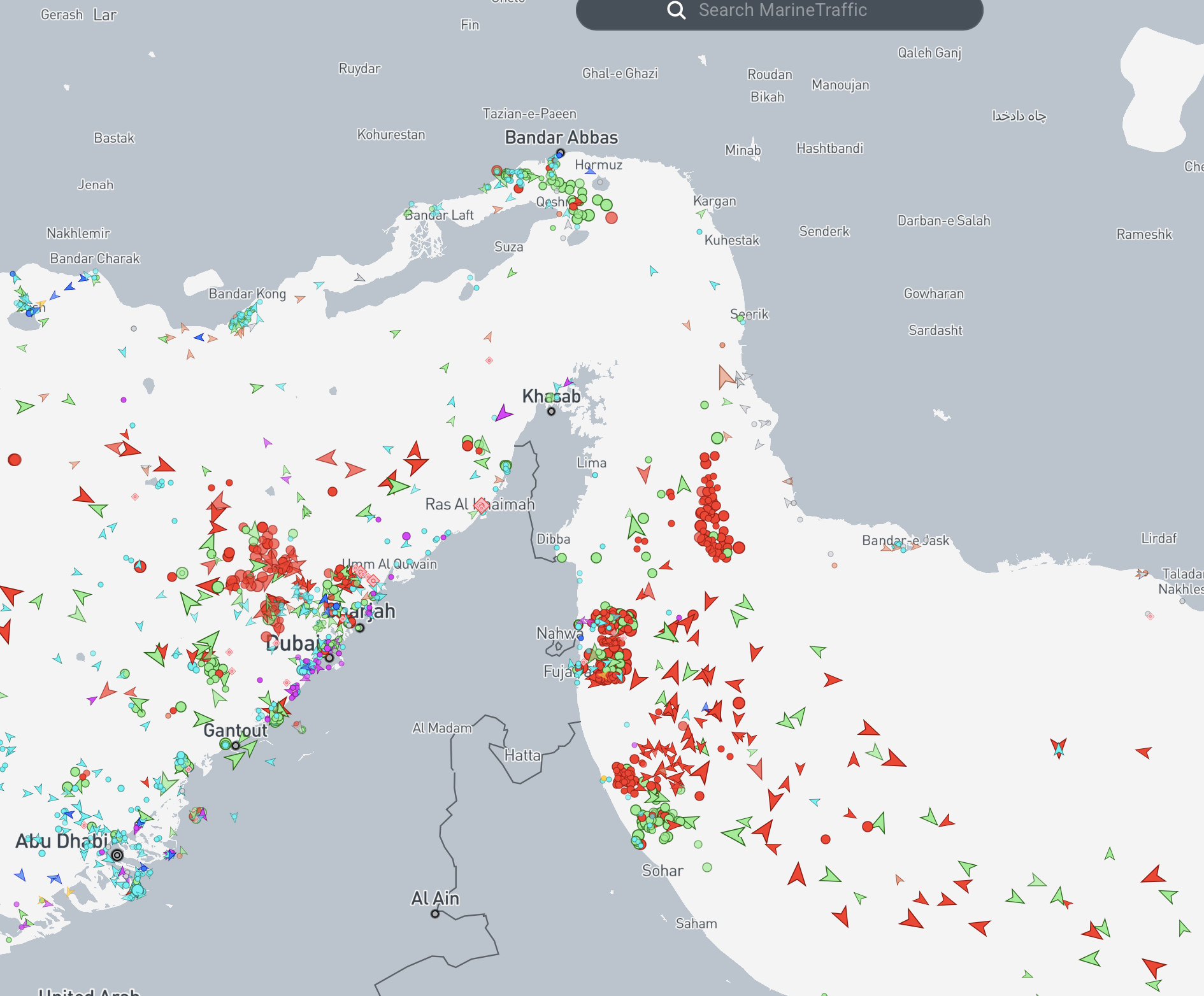
As for the closure of the Strait of Hormuz, Jeff W pointed to a presentation at What’s Going on With Shipping? His key point is that Iran has actually not formally closed the Strait but largely achieved that result from the action of tanker owners and insurers.
Key extracts from host Sal Mercogliano’s discussion:
What is happening right now is the ocean carriers, those who operate ships, largely tankers, but there’s also other commercial ships that go in and out of here, have decided to basically sit back and wait a minute and let’s see what happens between the US, Israel, and Iran. The other issue here, and the important one to understand, is war risk insurance. So, everything in shipping is geared to insurance. I can’t say this enough. Uh money is what makes this industry go around and without insurance ships are not going to take the risk.
Shipping is all about minimizing your risk and right now if a ship sails through the straits of Hormuz and gets hit by a missile, a drone or something like that, you need war risk. War risk does not cover basically if you get hit by a missile or drone. You are not covered if you just have your standard what’s called PNI protection and indemnity insurance which covers the cargo or your H&M hull and machinery which covers the ship..
Mercogliano argues that Iran is hurt most by closure of the Strait and adds:
Now UAE and Saudi Arabia have a little bit flexibility here and they have pipelines that come out of the area but Bahrain, Qatar and Kuwait do not. They have to get out of this area and the same with Iran.
Mercogliano later discusses in detail how much higher the war risk insurance premiums might go, how there were 450 tankers lost in 1980 to 1988 during the tanker wars with no closure of the Strait, and the implications of the general shortage of tanker capacity due to some operating as part of the Russian “shadow fleet”.
This image from Marine Traffic is as of 6:25 AM EST:
And with advanced economies, particularly the US, as well as China, mired in high levels of potentially-crisis-causing private debt, and China already in deflation, an additional shock of high energy price and even availability risks a severe economic downturn, which could ripple powerfully into frothy financial markets as fast-footed traders sell to preserve gains. Admittedly, of the big economies, Europe which is already suffering economically due to the self-inflicted harm of Russian energy sanctions, would presumably take the biggest hits. But the entire global economy would take damage under a scenario of markedly more expensive oil and LNG, and even shortages. That means China too, since it would see lower exports in a global recession.
On the kinetic war, commentators who ritually describe the US as having the world’s most powerful military, then effectively concede that the US through its overcommitments, particularly pouring offensive and defensive missiles into the Ukraine burn pit, its preference for private-sector-enriching, fussy kit, and having greatly skinnied down its military after the collapse of the USSR, is actually close to spent as it has taken on an Iran that it looks to have badly underestimated.
Alon Mizrahi describes how he sees Iran prosecuting the war. His assessment is similar to that of Trita Parsi of Responsible Statecraft, which we featured yesterday:
Iran firing at Israel nonstop (millions have spent the last 24 hours mostly in shelters, and the economy will be at a complete standstill for the foreseeable future), and is applying a clear tactic of saturating Israeli air defences and triggering an interceptor crises. If I’m…
— Alon Mizrahi (@alon_mizrahi) March 1, 2026
Please click through for his entire tweet, but the essential part:
Iran firing at Israel nonstop (millions have spent the last 24 hours mostly in shelters, and the economy will be at a complete standstill for the foreseeable future), and is applying a clear tactic of saturating Israeli air defences and triggering an interceptor crises. If I’m reading them right, their initial response is designed to remove the immediate threat from US assets in the region, which they have been doing brilliantly, and, simultaneously, exhausting Israeli and Western air defences, which will compel the US and Israel to ask for a ceasefire…
But this is only the opening phase, and, as always with Iran, great methodicity is carefully applied….
They are picking apart Israel’s infrastructure and economy. In 10 days, the country will begin to crack. Maybe even sooner.
The current headline at the BBC live blog (as of 7:00 AM EST) speaks volumes:
More quick updates. The EU is trying to get out of its underwear to enter the fray. The headline of Politico’s European morning newsletter: E3 warns Iran: We’re ready to hit back. From its text:
How will Brussels respond? European Commission President Ursula von der Leyen will convene an emergency meeting of European commissioners today, after a Sunday of frantic meetings. With ministers from the EU’s 27 members failing to see eye to eye on how to respond to the crisis, it’s now up to the Commission to pull together a coherent foreign policy response and ensure the bloc speaks with one voice….
Assertive defense: Europe’s largest military powers warned Iran late Sunday they were ready to take “defensive action” to destroy Iran’s ability to fire missiles and drones “at their source” unless Tehran stops its “indiscriminate attacks.” The warning from the E3 powers — France, Germany and the U.K. — doesn’t bring those countries directly into the U.S.-Israeli war, but it does suggest they’re willing to take action against a regime seriously weakened by the death of Supreme Leader Ayatollah Ali Khamenei on Saturday.
French build-up: The statement came as France moved to bolster its military presence in the Middle East after an Iranian strike hit a French base in the United Arab Emirates, POLITICO’s Laura Kayali reports.
And in London … U.K. Prime Minister Keir Starmer warned Iran to “stop these reckless attacks immediately.” Britain has told the U.S. it can use the Diego Garcia military base on the Chagos Islands to launch air strikes — something Starmer had previously been unwilling to do, much to Trump’s dismay (and outrage).
EU, too: A senior EU official told journalists Sunday that the bloc’s Operation Aspides — a naval operation to guard commercial ships in the Red Sea and Gulf of Yemen — will be reinforced by two naval vessels provided by France. That will bring the total number participating in the mission to five, including French, Italian and Greek vessels.
Hands tied: There’s also a discussion underway about updating Aspides’ restrictive rules of engagement, said the official, who was granted anonymity to discuss non-public exchanges between foreign ministers during an extraordinary meeting on Sunday. (An EU diplomat confirmed the deployment of additional ships to Operation Aspides but not their number. A French official didn’t immediately reply to a request for comment.
Israel attacked Lebanon shortly before this war started. Hezbollah has responded:
🇱🇧⚔🇮🇱 The Lebanese ‘Hezbollah’ enters the war, launching a massive strike against Israel
▪️A barrage of missiles towards Haifa from southern Lebanon was carried out by Lebanese fighters who joined the war on Iran’s side.
▪️According to another version: the missiles could have… pic.twitter.com/uQZSqPDUgo
— Zlatti71 (@Zlatti_71) March 2, 2026
Aljazeera reported that Israel attacked Beirut after the Hezbollah strike. More from the BBC:
The entry of Hezbollah in the conflict threatens to reopen a devastating year-long war between Israel and the Lebanese group which ended in a ceasefire 15 months ago.
Hezbollah – a Shia Islamist organisation – is one of the most powerful of the armed groups across the region which are loyal to Iran. The Islamic republic has spent billions of dollars funding, training and equipping it to oppose Israel for decades.
Hezbollah and Israel have repeatedly attacked one another since the group was formed in the 1980s. They fought a deadly war in 2006, and again in 2023-24, triggered by Hezbollah rocketing Israeli positions in support of Palestinians a day after Hamas’s deadly attack on Israel on 7 October and the start of Israel’s military campaign in Gaza.
During the last war with Hezbollah, Israeli attacks killed about 4,000 people in Lebanon and left more than 1.2 million displaced, Lebanon said. Israeli authorities said more than 80 of its soldiers and 47 of its civilians were killed.
Hezbollah was significantly weakened in the war and its firepower degraded. As part of the November 2024 ceasefire agreement, it agreed to withdraw extensively from southern Lebanon, although Israel has continued to attack Hezbollah targets which it says pose a threat.
The group’s rocket and drone attack on Monday and the Israeli response puts the ceasefire in jeopardy, leaving the populations of Lebanon and northern Israel anxiously wondering if the renewed hostilities will be limited or spiral once again into all-out war.
The US also lost fighter F-15 fighter jets in Kuwait:
Video shows the moment a military jet crashed in Kuwait, as the crew ejected from the flaming plane. Residents who rushed to the scene of the crash said the aircraft and crew were American, the country’s defence ministry confirmed they were US fighter jets. pic.twitter.com/GdHSZabvcx
— Al Jazeera English (@AJEnglish) March 2, 2026
From Aljazeera:
Three US fighter jets mistakenly shot down by Kuwaiti air defence: CENTCOM
The United States Central Command (CENTCOM) has said that three US F-15E Strike Eagles were “mistakenly been shot down” by Kuwaiti air defence on Sunday.
“All six aircrew ejected safely, have been safely recovered, and are in stable condition. Kuwait has acknowledged this incident, and we are grateful for the efforts of the Kuwaiti defense forces and their support in this ongoing operation,” the statement published on X said.
“The cause of the incident is under investigation. Additional information will be released as it becomes available,” it added.
More detail on the F-15s from Janta Ka reporter (he usefully has long clips of public statements):
We have not given any detail on financial market action. I intend to provide that in comments as germane after US markets open. Gold has moved to over $5,300 but the dollar is also up a smidge.
UPDATE 7:45 AM. Adding commentary that I was too time pressed to include earlier:
Getting confirmation from Bahrain that every building in the US Navy 5th fleet (near Manama) has been destroyed.
This is the single most significant defeat for the United States in its entire history.
— Korobochka (コロボ) 🇦🇺✝️ (@cirnosad) March 2, 2026
2) and indeed US is running low already on its interceptor anti air missile batteries. https://t.co/kinUVWsvPE
— Eric Feigl-Ding (@DrEricDing) March 2, 2026
Note that Ritter argued long-form on Danny Haiphong (with quotes from news) that Khameni intended to be martyred and was not about to hide in a bunker and worse, have family members successfully targeted by Israel (murdering relatives is one of their specialities), enabling him to be depicted as a coward. One has to include the rest of the leadership decided to follow his example of conducting their affairs on a normal basis. CNN reports that Ali Larijani, who ran Iran response in the 12 Day War, is one of the key officials now in charge. One has to think that some critical figures did not participate in meetings to preserve decision-making capability.
He was at home.
Participating in a regularly scheduled meeting with his 14-month old granddaughter.
Who was murdered by the Israelis.
This isn’t the “intelligence coup” you think it is.
It is, however, a clear indication of your lack of moral compass.
— Scott Ritter (@RealScottRitter) March 2, 2026
WaPo: the mood inside the Pentagon is “intense and paranoid”
Pentagon leaders worry the US will expend its air defense stockpiles, and the conflict will “spiral out of control”
This is precisely what Pentagon Joint Chiefs Chair Dan Caine warned of last week pic.twitter.com/bxWuW3RVCv
— Max Blumenthal (@MaxBlumenthal) March 2, 2026
The IRGC announces that it will deploy the Khorramshahr-4 missiles. If so, now the war truly begins.
From my Iran Prepares -piece: pic.twitter.com/8wdkWKMu84
— Tuomas Malinen (@mtmalinen) March 2, 2026
This is immensely telling of U.S. capabilities: they’re not capable of defending their allies – countries in which they have dozens of military bases for that very purpose – against a mid-level power, in the region in which they’ve concentrated a huge percentage of their military… https://t.co/ONec383unF
— Arnaud Bertrand (@RnaudBertrand) March 2, 2026
BREAKING: Iranian ballistic missile strikes Be’Sheba in southern Israel.
Injuries being reported.
— Douglas Macgregor (@DougAMacgregor) March 2, 2026
Mind you, not clear how long this halt will be. Readers may have an idea as to how robust LNG facilities are compared to oil refineries:
🚨🚨🚨 QATAR ENDS PRODUCTION OF LNG AFTER DRONE STRIKES ON ITS FACILITIES
QATAR IS THE BIGGEST LNG PRODUCER IN THE MIDDLE EAST
— Iran Observer (@IranObserver0) March 2, 2026
