


[Today’s Iran war update may be a bit thin due to media dialing down before long holiday weekend and as usual launched before complete. Please return at 8:00 AM EDT for a final version]
Far too many are exhibiting serious cases of normalcy bias and are only slowly and in many case partially waking up to the immense changes to the global economic and political order proceeding at a breathtaking pace. Admittedly, Asia is getting an early and harsh version of what is coming). But even so, it as if people are clustered at the edge of a beach, seeing the water retreat far far far further than normal, not recognizing that this means a tsunami is about to sweep in and they need to find higher ground as quickly as possible.
In addition to the investor under-reaction to the accelerating damage to economies all over the world is the widespread detachment about the already severe and dangerous escalatory dynamic underway. Had the genocide in Gaza normalized brutality, including the effort to destroy a culture, that the press and public have become desensitized? Did they miss that the US failed to defeat Ansar-Allah, who would be stereotyped as guys in sandals with AK-47s and shoulder-mounted rocket launchers? That Israel has inflicted an enormous punishment on Palestinians but have still not beaten Hamas, despite it being contained to a tiny territory? And that Iranians, unlike Palestinians living in an open air prison camp, are a very large, technologically advanced nation with terrain that is extremely hostile to invaders? And that the prospect, absent a monster climbdown of the aggressors, of them liberalizing control of the Strait of Hormuz, is vanishingly small?
First to the kinetic war:
It’s clear that like the repeated Ukraine attempts to take out the Kerch Bridge, this attack was intended to destroy a symbol of national accomplishment and not just important infrastructure:
Israel/US have bombed the B1 Bridge in Karaj, a monumental project that connected Tehran with northern regions of the country, including the Caspian Sea. A major transportation artery. We are witnessing war crimes in real time. Again and again and again. pic.twitter.com/m1O27e9B3Z
— kev joon (@never_oppressed) April 2, 2026
The intelligence-insulting justification was that this bridge was being used to transport drone….when it has not even been completed.
This is obviously a lie since it was not even operational yet. The U.S. president also said he bombed it because it was the “biggest bridge” in the country. https://t.co/rA55Xl0e8d
— Murtaza Hussain (@MazMHussain) April 2, 2026
Given that the Caracas raid managed to generate some striking images, it seems reasonable to think this bridge was made an early target due to how photogenic its destruction was expected to be.
Let me turn the mike over to Janta Ka, who registers the appropriate, as in high, level of disgust this latest war crime warrants:
And Iran is contemplating a brutal retaliation.
🚨🚨 IRAN JUST RELEASED A TARGET LIST OF 8 BRIDGES ACROSS 4 COUNTRIES. THIS CHANGES EVERYTHING.
🇰🇼 Sheikh Jaber Al Ahmad Al Sabah Bridge — TARGETED.
36 km over water. Kuwait’s northern lifeline. No alternative route.
🇸🇦 King Fahd Causeway — TARGETED.
ONLY road between Saudi… pic.twitter.com/DHcnxNlFnr
— 🇦🇪 Khalid Al-Mansouri خالد (@KhalidAlMans_) April 2, 2026
Larry Wilkerson warned, both on Judge Napolitano and longer form with Danny Haiphong and fellow guest Patrick Henningsen, that Iran has moved from its first-round targets, which it struck with impressive precision and fitting use of ordnance, to its second group. Wilkerson describes how that is not merely escalatory but threatens the economies of the Gulf States, and with them, the wider world:
I’ve seen the second set of targets, regional targets the Iranians are looking at. I know what they’re talking about. I know where they’re talking about hitting. I know what from the first set of targets they hit they can do. I know the devastation. I know the accuracy. And I know the exquisite selection of targets that were struck to make sure that we and the regional powers knew that Iran was making every effort to hit the United States of America and in some cases like Prince Sultan Air Base, the people who were supporting those facilities for the United States of America.
This second set has no such inhibitions and I have no question in my mind that they can hit them and hit them with the incredible accuracy they did the first set and the incredible devastation. What am I talking about?
I’m talking about Ras Tanura in Saudi Arabia with 550,000 barrels per day production throughput capacity. I’m talking about the other one up the up the stream from it which produces 7% of the entire world’s now light sweet and good crude that Libya is kind of out of the picture for many purposes. We’re talking about 7% of the global supply coming out of that one place.
All it would take is a strike like they put on Bahrain, maybe another missile or two. That’s out.
I’m talking about the pipeline that the Saudis have built to kind of obviate the need for the straight of Hormuz, although it doesn’t do much of that, especially not with the Houthis having been at war with them for so long that goes over vicinity to of Jedda to the Red Sea. They’re going to take that out.
I’m talking about every target in the region that applies to what I just said. Global recession, depression, they’re going to hit them. That’s their second tier. So, if we go on into this further, Donald Trump, you are going to set the world a flame economically and you’re going to make a pariah out of the United States like Israel is now. And that’s a position from which it is going to take maybe a generation if ever to recover.
That’s what you’re setting up, Mr. President.
University of Chicago professor Robert Pape gave on his Substack a more general warning of the escalation dynamic that Trump accelerated with his address to the nation. From Trump Accelerated the Crisis: No Plan for Hormuz, No Off-Ramp — a New Phase has Begun:
Last night, Trump did not stabilize the crisis—he accelerated it….
The result is not resolution.
It is deepening instability.
1. The world now sees there is no plan to fix the problem
Not because of rhetoric—but behavior.
No mechanism to reopen stable shipping
No timeline for restoring normal energy flows
No alignment between military operations and economic stability
In practical terms, this means that the actors who actually move the global economy—energy traders, insurers, shipping firms, and central banks—are repricing risk in real time and adjusting behavior accordingly….
So actors are not waiting.
They are adjusting.
2. Escalation is now clearly the US default tool
The signal from the speech is simple:
When pressure rises → increase threats and expand targets.
That tells:
Iran to prepare for continued confrontation
Markets to price ongoing risk
Allies to expect instability, not resolution
Historically, this pattern is not incidental—it is inherent to coercive campaigns. Limited strikes designed to compel adversaries expand when initial effects fall short of political expectations. The target set widens—from military assets to economic infrastructure—while timelines extend without formal acknowledgment. This is how short wars become coercive campaigns.
3. The war now has no defined endpoint
….You cannot end this war if the system it disrupted remains unstable.
Right now, there is:
a military timeline measured in weeks
an economic disruption with no clear end
no constraint on Israeli military action
That gap means the war is not actually contained.
It also means something more dangerous:
The United States and its allies are falling deeper into an escalation trap—where each attempt to impose control through force increases the instability it is trying to resolve.
An escalation trap is a structural condition in which each effort to impose control through force increases the instability that makes control necessary. That is now the trajectory at Hormuz.
Securing Hormuz against asymmetric threats—mines, drones, missile strikes, and harassment of commercial shipping—is not a discrete task. It requires continuous presence and near-perfect performance. Iran, by contrast, does not need to stop the flow of oil. It only needs to demonstrate that the flow cannot be guaranteed.
There is no path back to stable energy flows under the current strategy. Only different levels of instability…
This is the trajectory of the escalation trap: not a sudden collapse, but a steady movement toward a prolonged phase of global economic disruption with no clear point of reversal. It is a trap because the near-term incentives for doubling down intensify as the costs of failure mount….
And in this phase, the key variable is no longer who can strike.
It is whether the global energy system can function.
Right now, it cannot do so reliably.
And as long as that condition persists, power will continue to shift.
So it should come as no surprise that US invasion plans are still moving forward. Aljazeera in a new clip, US Army chief ousted mid‑war as Trump ramps up strikes on Iran. took note of one part of the military developments that Larry Johnson discussed in his latest post, that Trump is purging top officers who were believed to be opposed to a ground forces operation. But IMHO the continued movement of forces into the theater is yet more evidence that Trump intends to Do Something. Robert Pape similarly warned on Breaking Points was the only way to believe the US might be retreating is if it reduced its force levels in the theater.
From Larry Johnson:
I know some in the military — not just guys and gals from the Army — who strongly believe that General George was forced to resign because he did not support putting US troops on the ground. In addition to the movement of A-10 Warthogs and Apache helicopters that I reported in my last post, there is a build up of US ground forces in West Asia.
Consider this: Sixty three C-17 flights that have departed CONUS and headed to Israel or Jordan since March 12, according toTheIntelFrog, with an additional 11 enroute. Twelve of these C-17 flights have departed Pope Army Airfield since March 12, 2026. Given that a C-17 can carry 102 paratroopers with combat loads, then we’re talking a total of 1,224 soldiers… that is roughly the size of one 82nd Airborne battalion and four Delta Force squadrons. The odds that the US will launch an ground operation in Iran and employ Delta Force operators is high. Remains to be seen if General George will speak out against further escalation with Iran, or if he will keep his mouth shut and take a sinecure with one of the defense industry behemoths.
And more on how war priorities are being twisted to fit Trump’s preferences, which look to be unduly influence by Hollywood action movies:
NEW: The high-risk plan to seize Iran’s uranium in a commando raid that would require building a runway in Iran and dropping in excavation equipment amid incoming fire, came at Trump’s request, signaling his interest in the complex operation
— John Hudson (@John_Hudson) April 1, 2026
However, fixations like that do serve to divert attention from apparent moves to protect Red Sea transit:
ATTEMPTED AIRBORNE LANDING BY UNIDENTIFIED TRANSPORT AIRCRAFT ON MAYYUN ISLAND, BAB AL-MANDEB.
YEMEN GOV FORCES ON MAX ALERT
— Russian Market (@runews) April 2, 2026
The US is still taking hits:
Watch the moment a US base in Saudi Arabia was targeted. 🚀🔥 pic.twitter.com/4N8HoM8c0L
— IRAN EVENT (@Iranevent_tv) April 2, 2026
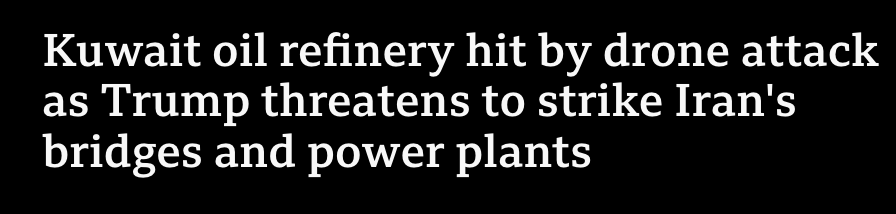
And Gulf States, per the current BBC live blog headline:
Detail from its live feed:
Kuwait’s Ministry of Electricity and Water says a power and water desalination plant has been attacked by Iran, resulting in “material damage” to some components.
Technical and emergency teams began work “immediately” to “maintain operational efficiency”, it says in a statement on X.
“The safety and stability of the electricity and water system is a top priority,” the statement adds.
And an older entry:
Kuwait: Emergency services have been responding to fires at an oil refinery in Kuwait after it was hit by Iranian drones. Separately, a power and water desalination plant has been attacked.
As is Israel:
The Times of Israel reported that the settler colony is moving the goalposts for its latest Lebanon ethnic-cleansing exercise. From IDF official says disarming Hezbollah unrealistic, not a goal of Lebanon operation:
Another admission against interest:
🚨🇺🇸🇮🇷 BREAKING: After Trump repeatedly claimed Iran’s Navy was destroyed in the opening days of the war, the U.S. State Department now says “Iranian Navy could be destroyed within weeks”
— Jackson Hinkle 🇺🇸 (@jacksonhinklle) April 2, 2026
A senior military official said Friday that while the Israel Defense Forces aims to significantly weaken Hezbollah and remove the threat the terror group poses to residents of northern Israel, the prospect of fully disarming the group was unrealistic and not a “required goal” of the army’s ongoing ground offensive.
The remarks came as the military said it was set to present to the political leadership its plan to establish a “security zone” in southern Lebanon, which would involve demolishing Lebanese villages near the border and setting up army posts several kilometers inside the country.
“Disarming the organization is not a required goal at the end of this campaign,” the military official said, despite previous statements by IDF Chief of Staff Lt. Gen. Eyal Zamir and Defense Minister Katz saying that Israel would not give up on disarming Hezbollah.
Moving towards the economic front, UN members are crafting a resolution to authorize the use of military force. However, it is set to be sufficiently watered down so as to avoid a veto as to not to amount to much.1 However, it does have the effect of rejecting the Iran (and Omani?) position that the Strait of Hormuz is not international waters but internal to Iran and Oman.
BBC’s live feed also reveals some to-ing and fro-ing:
A vote by the United Nations Security Council (UNSC) on a resolution on the Strait of Hormuz, which had been put forward by Bahrain, appears to have been removed from the UNSC’s daily schedule.
A schedule published on Thursday 2 April showed a vote on a Middle East resolution scheduled for 11:00 local time (15:00 GMT). That vote is no longer showing on the UN website, external under Friday 3 April.
No reason has been given for the removal of the meeting, and the UN has not announced a new date for the vote as of the time of this post. When we find out more about when it will take place, we will update you right here.
Now turning to Bloomberg’s landing page for a view of what traders and investors are being told is important:
And a cheery update from NO1:
Trump escalates, markets crater — Prime-time April 1 speech declared Iran “essentially decimated” then immediately promised to hit them “extremely hard over next 2-3 weeks” and “bring them back to the stone ages where they belong.” Within minutes of the speech ending: S&P 500 futures erased roughly $550B in market cap, Brent crude surged per shanaka86, American gasoline crossed $4/gallon for the first time since 2022, gold and silver sold off. Record ~$1B in leveraged crude short positions immediately facing a 5% rally per OilPrice.com.
The Bloomberg landing page story about the three ships exiting the Persian Gulf via the Oman coast (and not the new inspection route close to Iran) is less consequential than it seems. The three vessels were Omani, but were very large crude carriers. Possibly more noteworthy is that a Maltese flagged, French-owned bulk carrier was also allowed to depart, making it the first European vessel to transit. However, the ship is owned by the French shipping giant CMA CGM. It was founded by the Sadde family, which was born in Lebanon, and has remained involved in Lebanon, for instance, in providing humanitarian aid. So this looks to be a special situation.
Bloomberg had an important if also odd article yesterday, Key Real-World Oil Price Soars to Highest Level Since 2008. This isn’t the first time that Bloomberg had pointed out that crude is trading hands at higher prices than for Brent on the futures market. I am a little bothered at to the lack of curiosity as to why. I did some poking but could not get to the bottom of it. The CME loudly points out that contracts that require physical delivery (cash settlement is an option even if most often exercised) are the gold standard for futures. Brent is not that. If you read the weasel-wording, it makes clear that physical delivery can be done but is hard and so the contract seems to be effectively cash-settled, as opposed to cash settlement being the super popular option. That may be due to Brent being a blend of crudes and it being non-trivial to deliver the mix in the proper ratio.
From the Bloomberg story (as you can see, the details are less than satisfactory but you get the gist, prices are going up!):
The world’s most important price for real-world oil barrels surged above $140 on Thursday, the highest since 2008.
Dated Brent, the price of shipments bought and sold in the North Sea, reached $141.37, surpassing levels seen when Russia invaded Ukraine, according to S&P Global, which publishes the data.
The surge is a sign of the growing disconnect between futures contracts and various pockets of physical markets that are pricing increasingly scarce supplies.
Dated Brent underpins a significant number of transactions where actual cargoes are bought and sold, and a large volume of supply has been lost to the Iran war. The futures market, on the other hand, is weighted largely to financial trading in so-called paper barrels.
And more private equity cockroaches now visible on the counter:
When the US Treasury starts calling in regulators, it means something has gone wrong enough to worry Washington.
Yesterday, the Treasury convened meetings with domestic AND international insurance regulators to discuss private credit risks.
The specific concern: billions in…
— Nic (@nicrypto) April 2, 2026
Done for now. See you tomorrow!
____
1 As many have noted, Putin has been more friendly to Israel during its genocide than seems warranted merely by the presence of many Russians in Israel. John Helmer describes how a fresh poll from Lavada shows much more support in Russia for Iran than for Israel, plus a bargain-basement low view of Israel generally, but most Russians are still fence-sitting on the conflict. From his post:
Sympathy for Iran is expressed by 40% of the nationwide sample; this percentage is accelerating with time and with state television news broadcasts reporting Iran’s fightback, its successful attacks on US bases in the Gulf states, and unprecedented strikes against Israeli targets. During the June War against Iran last year, by contrast, 29% of Russians supported Iran. This shift in public opinion has occurred among those who said they were uncertain or undecided last June…
No European public, no American opinion poll, and no BRICS member state shows such a low level of support for Israel as this.
The Levada poll also reveals that, notwithstanding their growing sympathy for the Iranian side and against the Americans and Israelis, the majority of Russians wants to stay out of the conflict.
