


[This Iran War update is yet again launching before finished. It will be done by 8:00 AM EDT. If you arrive before then, please do remember to refresh this page as of then and re-skim]
With respect to the Iran war, said there was no idea so foolish that this Administration would not attempt it. As many military experts, as well as savvy members of the commentariat have pointed out, a shambolic exercise is moving forward; hastily assembling a small number of US special forces and throwing them into an Iranian buzz saw. We won’t belabor that this is a catastrophically bad idea, with comparisons already being made to the charge of the Light Brigade and Galipolli. Some of the videos we feature below provide ample detail. But all you need to consider is that even if the US manages to land forces more or less safely, sustainment is impossible.
Admittedly, seasoned analysts like John Mearsheimer and Richard Pape clearly stated that they expected the US to continue to move up the escalation ladder. And we have argued that the force that would check Trump sooner rather than later has astonishingly not yet come into play, that of a market rout. Financial time moves faster than political or military time. Amazingly, investors have bought the Administration’s happy talk, which has been proven false in Project Ukraine, that the opponent was weak, incompetent, running out of weapons, about to revolt, and all the US had to do was keep pushing just a bit longer and they would fall like a house of cards. We explained long-form on our last post how long-standing trends, that of an elite almost entirely removed from real-economy operations, plus bad conditioning of investment professional, has created a remarkable degree of complacency in the face of catastrophic downsides that are starting to emerge.
Now aside from harboring the Iran version of “Russia is running out of missiles” fantasy, a very dimly plausible theory is that if the US occupies either Kharg Island or small islands in the Strait of Hormuz proper, that will get the Europeans and other countries that have held back from committing naval assets to opening the Strait of Hormuz to enter the fray.
Another view is that this probable escalation is because Bibi (see Breaking Points in Transcript of Bibi DEMANDS Ground Troops As Marines Rushed to Iran)
If Trump were less convinced of his own vainglory, a possible motivator is the logic that kept us in Vietnam for so long. Recall that Daniel Ellsberg was convinced like other Vietnam experts who had recognized that war was unwinnable, that if he could only get access to the President to explain why, that he could convince him to start pulling out. But as a top decision scientist at Rand, he had access to what became known as the Pentagon Papers. They showed that the US had long known it could not prevail, but no Administration was willing take the massive loss of prestige of conceding that the US could not win against a small country run by yellow Communists.
Finally, Trump may have come to believe like the evangelicals around him that Jesus is on his side.
This Daniel Davis report is a must watch. Davis provides the evidence, such as deployment of medical units, as well as chatter from his contacts, that convinces him that the US is about to attempt a special forces/ground operation, and that the timing seems urgent. He notes, for instance, that it would be more normal to take the two or so weeks more to get more naval assets in place, but he senses an eagerness to move even sooner:
Larry Johnson is more equivocal about what Trump might do (see Boots on the Ground in Iran… A Deception or a Suicide Mission?) but Davis’ detail on the number and type of assets being moved to the theater seems dispositive
This fresh update from Hindustan Times identifies targets besides Kharg Island, the aforementioned small islands in mouth of Hormuz. It is entirely plausible that all of the US media braying about Kharg Island is a misdirection. Notice in this segment how Defenes Secretary Pete Hegseth throws Ukraine under the bus:
Keep in mind that Davis above, like others, highlighted the importance of careful preparation in ground operations. This is not that:
We’re now dealing with multiple expedited CO applications by those in the Navy, Army and Marines who were just told they deploy as early as tomorrow. https://t.co/CknavtOhlx
— Mike Prysner (@MikePrysner) March 20, 2026
Janta Ka believes that Trump is messaging that he wants a way out. He includes a long clip from a Trump presser, where Trump makes the astonishing claim that the US does not need the Strait of Hormuz (will Mr Market take that well?), that opening it would be easy if you get enough ships, and that anyway the problem will solve itself because the US has hit Iran so hard:
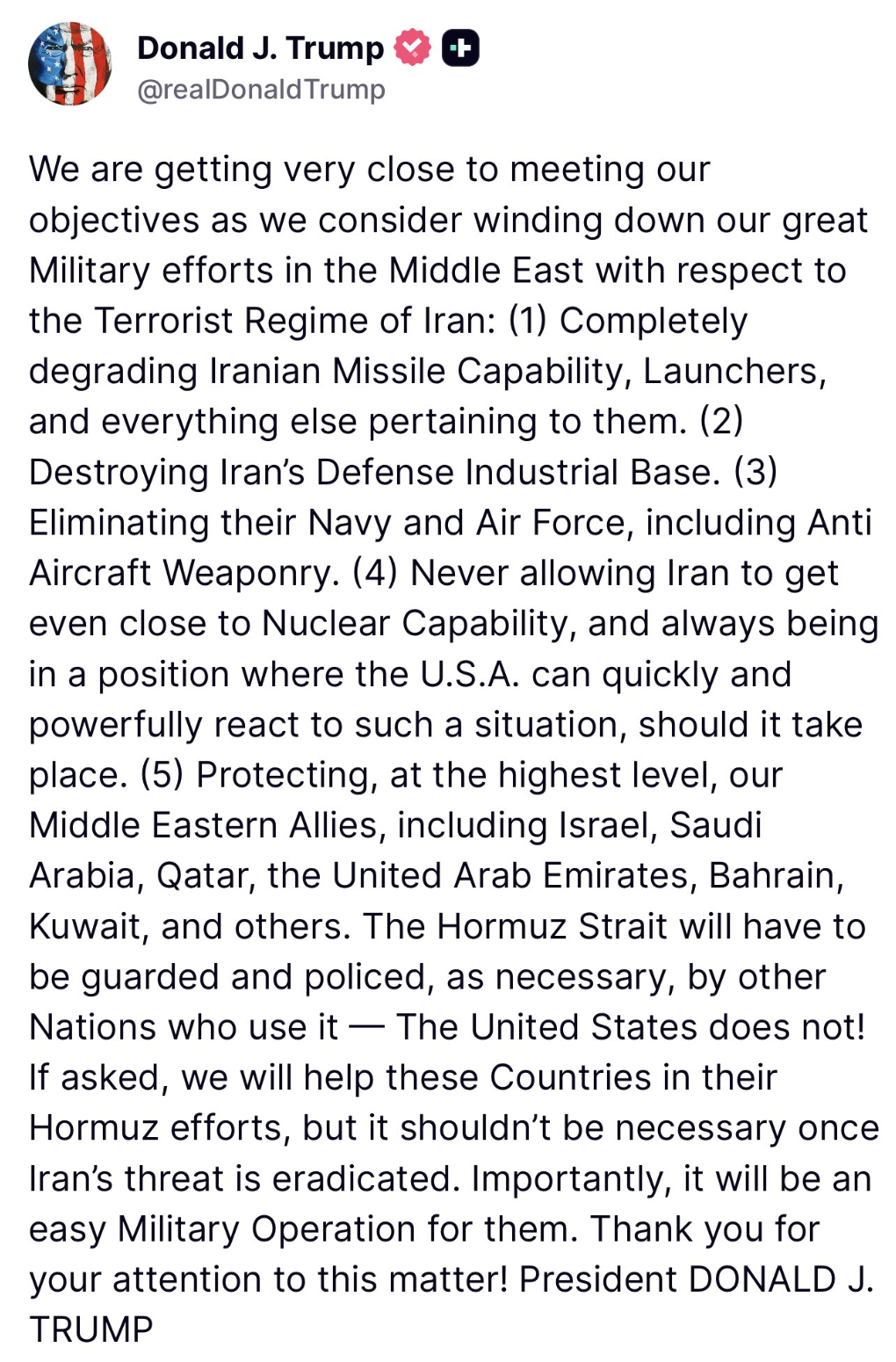
Simplicius and others have argued that this fresh tweet points to Trump trying to declare victory and go home. But anyone with an operating brain cell knows he can’t with the Strait of Hormuz effectively closed (more on how Iran is implementing a more formal process for selective opening later in this post)
This was not written by Trump. It lacks his eccentric capitalization and ALL CAPS.
If the Diego Garcia strike report is accurate, then one of the central assumptions about Iran’s missile program has just collapsed. For years, the accepted ceiling was around 2,000 kilometers. A ballistic missile reaching Diego Garcia suggests something in the neighborhood of… pic.twitter.com/MxD16567NM
— Nawaf Al-Thani نواف بن مبارك آل ثاني (@NawafAlThani) March 21, 2026
This attempted show of manhood is coming as the US continues to lose ground in a fundamental manner all across the Middle East:
The US admits that Iran hit and damaged an F-35, its supposedly super stealthy fighter jet. I recall (but not why) the F-35 was not as stealthy as billed. And no, it was not due to having to sidle up to refuelers en route.
More on “The war situation has developed not necessarily to the advantage of the US and Israel”:
🚨🇮🇷 BREAKING: Iran fires two intermediate range ballistic missiles at Diego Garcia (4,000 km away),
Proving its missiles can reach far beyond the Middle East — potentially hitting London, Paris, and most of Europe.
Neither missile hit the target, but the message is clear.… pic.twitter.com/nJ0h33tM4p
— Globe Observer (@_GlobeObserver) March 21, 2026
US RETREATS/ABANDONMENT OF KEY STRATEGIC ZONES AND ASSETS:
– The largest airbase in the Middle East
– The most strategically important and busiest naval base in the Middle East, HQ of the US Fifth Fleet
– Baghdad Green Zone, US embassy, possibly all of Iraq
– The waters of the…
— Amerikanets 📉 (@ripplebrain) March 21, 2026
Hindustan Times points out that Israel is admitting publicly that is it having to let some Iranian strikes through so as to preserve its depleting air defense inventory:
Hindustan Times describes yet more proof of Iranian prowess:
Israel is now on its own
The US has ordered the evacuation of the Kuwait airbase and the withdrawal of all naval ships. https://t.co/0UwMQWDtCy
— Ignis Rex (@Ignis_Rex) March 20, 2026
Iran continues to boomb other Gulf states. Note that the Aljazeera presenter, to his credit, points out that that the US and Israel attacks on Iran are what triggered retaliatory strikes:
But as Chas Freeman points out in a new talk with Nima, the Gulf states not thinking clearly. They are going into arms of US when Iran can destroy them in whole or in part and US can’t stop Iran. He also talks briefly about a boots-on-the-ground mission, and can’t fathom how that could possibly work, save the US retaking some small islands seized by Iran back in the day of the Shah from the UAE. That would be a win for the UAE, which is taking an awful lot of punishment, and would be achievable at reasonable risk.
Mind you, US and Israel are still landing some hard punches:
Turning to the economic front, please click though to read this tweet in full. Shanaka Anslem Perera identifies seven clocks and why the sand runs out of the hourglass for each of them between March 31 and mid-May. The first three are agriculture-related: planting (for corn and soybeans), the USDA prospective plantings, and the next publication of the FAO food index. The others on his list are pharmaceuticals (when inventories of Indian active pharmaceutical ingredients for its generics start to run out), China crude (when its inventories run low and what it might do then), helium (as in what happens if Russia can’t ramp up replacement supply fast enough to prevent semiconductor production rationing) and maritime insurance. This forecast may be seen as dire but tails are fat:
Seven clocks are running. None of them negotiable. All of them counting down to the same weeks.
The planting clock. Mid-April is the biological deadline for corn and soybean planting across the US Midwest. Every day that passes without nitrogen becoming affordable and available… pic.twitter.com/eCjCAHcH0m
— Shanaka Anslem Perera ⚡ (@shanaka86) March 19, 2026
Keep in mind that the helium problem will not be solved by opening the Strait of Hormuz, even if that were to happen, but is a long way from being solved, due to the loss of Qatar LNG. We’ve pointed out that it may take as long as five years to rebuild the critical Ras Laffan facility. From India Today in Why the world is running out of helium, and how it could disrupt modern life
… helium production is entirely dependent on LNG production. If LNG operations stop, helium extraction also halts automatically.
Despite its simplicity, helium underpins critical sectors of modern life:
Semiconductors: It cools silicon wafers, enables chip fabrication, and supports extreme ultraviolet lithography used in advanced processors powering AI and data centres,
Healthcare: Liquid helium cools superconducting magnets in MRI machines worldwide.
Space and defence: It pressurises rocket fuel tanks and purges propulsion systems ahead of launch.
Scientific research: Major facilities like particle accelerators depend on helium-based cryogenics for the smooth operation of heavy machines.
There is currently no viable large-scale substitute for helium in these applications.
Finite helium reserves, primarily in the US and Qatar, which together account for roughly 30-38% of global output, are steadily depleting. The shutdown of the US Federal Helium Reserve in 2021 alone removed about 10% of global production capacity.
At the same time, demand is surging. MRI machines consume around 25-30% of global helium supply, semiconductors account for 20-25%, and usage in space technology continues to grow.
Continuing on the economic front, let us first look at jet fuel before going bigger picture. High and uncertain jet fuel prices are a killer for tourism. It isn’t yet clear how high ticket prices will go, but if they rise high enough in a generally bad stagflationary period (charitably assuming no Jackpot lite outcomes), passenger volumes will fall enough to result in big schedule cuts. If you had the misfortune to travel during the worst of Covid, flight scheduling, particularly in the US with its hub-and-spoke system, becomes difficult due to long layovers in intermediate airports.
A short update, Bad News For Air New Zealand from DJ’s Aviation, explains how jet fuel prices have risen as high as twice the old normal. And it mentions in passing an idea that had not occurred to me: jet fuel is priced at a spread over Brent. The big increase in that spread accounts for most of the price increase That also suggests that even airlines that hedged fuel are still exposed, since odds greatly favor that they simply (at most) somewhat overhedged using the very liquid Brent futures, as opposed to ponying up for a more costly, less liquid (perhaps custom?) hedge of jet fuel specifically.1 Anyone who knows either way, please pipe up.
To broader oil market issues, per the Telegraph in The oil market is in uncharted waters and signalling alarm for Europe:
In recent days, oil prices have splintered sharply – leading markets into uncharted waters and posing risks to Europe.
The $160-a-barrel price on offer for Middle Eastern crude oil is a sign of a market out of kilter and gives a frightening glimpse of what’s coming to Britain, say experts.
The price of Dubai crude oil is one of the three most important global oil price benchmarks, alongside Brent and West Texas Intermediate (WTI) – and normally they all sit fairly close together.
Before the conflict all three were hovering around $70 a barrel but each one is trading at a different price, with US prices much cheaper than European and Middle Eastern barrel.
It’s an imbalance that has rarely been seen in global energy markets, with many seasoned energy watchers surprised by the different trajectories.
“Global energy markets are in uncharted waters,” says Tom Kloza, a veteran oil analyst.
“I don’t think anybody was prepared for this. It is absolutely extraordinary. There is no real playbook for how to deal with it and everybody is making things up as they go along.”
Brent crude, typically seen as the benchmark for UK and European prices, has risen sharply to around $111 a barrel.
But WTI – the benchmark for US oil prices – is currently trading sharply lower at $98. Normally, the gap is only around $3.
Both are alarming in their own way. But is it the price of Dubai oil, shipments that can be rapidly delivered, that is setting off the most alarm bells. This has soared to $160 a barrel and is rising fast.
Again, this divergence raises further issues like the ones we pointed out with jet fuel. How many players, like big multinationals, who through they had hedge fuel risks, did so with Brent futures when their exposure is to Dubai crude or narrow grades like shipping fuel? This matters because some players (think cruise lines) do a ton of hedging (such as of currencies) because they book customer commitments considerably in advance and also make as many expense commitment forward as possible to reduce their net risks. So even more so than airlines, they may be whipsawed by having made commitments that may result in big losses if they try to honor them.
The temporary waiver on Iranian oil is yet another sign of underlying Trump Administration desperation, despite its bold talk. Lindsey Graham’s head must be exploding. Admittedly, this order applies only to Iranian oil now on tankers at sea, but is an admission of US desperation and take any measure possible to try to contain oil price increases:
🚨🚨 TRUMP JUST GAVE IRAN PERMISSION TO SELL OIL. THIS CHANGES EVERYTHING. THE WAR IS OVER. IRAN WON.
Read that again. The Trump administration has granted a TEMPORARY SANCTIONS WAIVER allowing the Islamic Republic of Iran to sell its oil. Shipments already loaded on tankers… pic.twitter.com/6ULGfzEL7y
— Dr. JiHoon Park | IQ 312 (@Jihooncrypto) March 21, 2026
But a bigger risk may be bearing down on oil prices.
(The Yemeni card and its cataclysmic implications)
I have to tell you why the assessments regarding projected energy prices and the economic consequences of the war on Iran, made by every expert and financial institution in the world are way, way off and don’t even begin to… pic.twitter.com/Gius6bXj49
— Alon Mizrahi (@alon_mizrahi) March 20, 2026
The guts of his tweet (emphasis his):
I have to tell you why the assessments regarding projected energy prices and the economic consequences of the war on Iran, made by every expert and financial institution in the world are
____
1 The term of art is basis risk, when the hedging instrument does not move perfectly with the value of the underlying.
