


This Iran War update may be a bit thin. It is hard for me to keep up daily postings at the level readers expect and deserve, particularly since my schedule is not set up for daily original posts. And given that I am in Asia, I am doing a good deal of defensive preparation which impinges on my working hours. I very much appreciate the information provided by readers to inform the community such as by Ann, Ben Panga, Acacia, AG, and others like Kevin W, Micael T, guurst and Chuck L via e-mail, and sightings from those like raspberry jam who have direct intel. Please do not feel offended if you have provided links and tweets and I neglected to mention your name. It would take time I do not have to be systematic in creating a proper thank you list.
I must go out and I may not return before its scheduled launch time, so the version you see may be rough. I hope to have this post completed by 8:00 AM EDT.
New information keeps pointing to a protracted conflict and real economy crisis. as in not merely a two month further close to complete closure of the Strait of Hormuz, which would be a catastrophe, but easily four months plus, which will push many countries and economies into a depression and political upheaval.
One indicator of the ever-lengthening duration forecasts comes from the Washington Post (hat tip Larry Johnson). Mind you, this Administration has a very bad case of optimism bias:
The Pentagon is preparing for weeks of ground operations in Iran, U.S. officials said, as thousands of American soldiers and Marines arrive in the Middle East for what could become a dangerous new phase of the war should President Donald Trump choose to escalate.
If President Donald Trump approves the plans, such an effort would mark a new phase of the war that could be significantly more dangerous to U.S. troops than the first four weeks. . . .
Discussions within the administration over the past month have touched upon the possible seizure of Kharg Island, a key Iranian oil export hub in the Persian Gulf, and raids into other coastal areas near the Strait of Hormuz to find and destroy weapons that can target commercial and military shipping, officials said. One person said that the objectives under consideration would probably take “weeks, not months” to complete. Another put the potential timeline at “a couple of months.”
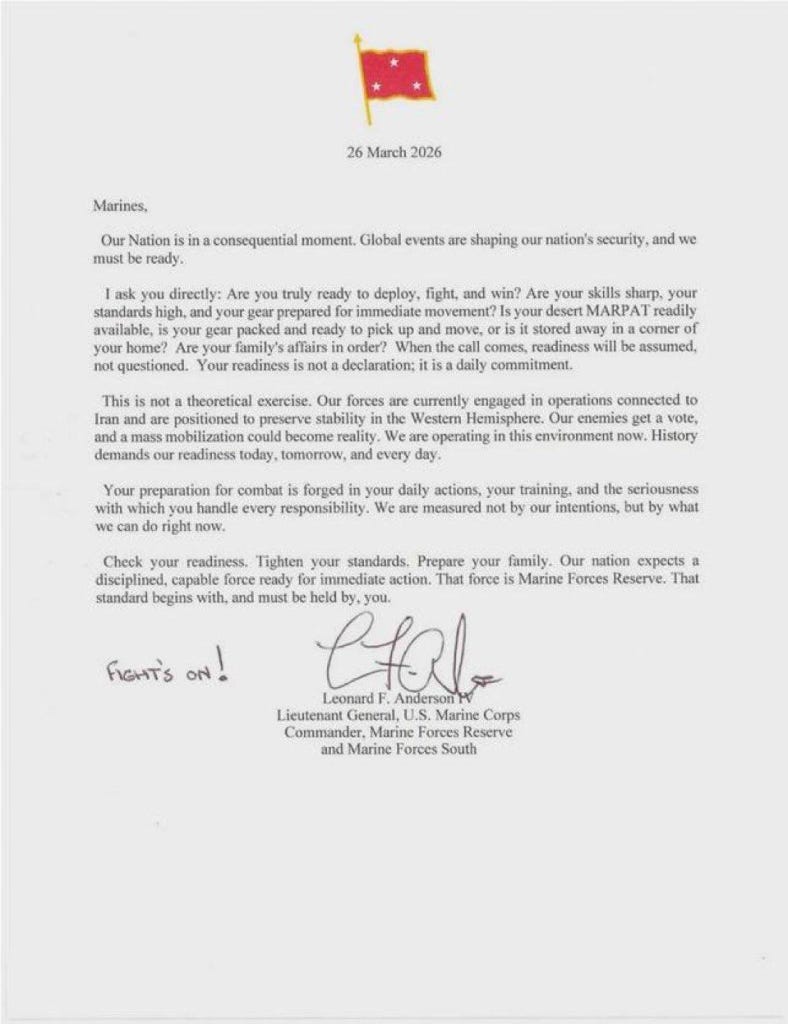
In his Marine Reserve Commander Asks His Marines… Are Your Family’s Affairs in Order? Johnson also provides an indicator that some expect a ground operation to produce a a lot of body bags:
We’ll return to the kinetic war, but now to real economy matters.
Some, one has to admit even yours truly, took cheer from non-hostile countries like India, Pakistan, Spain, and Thailand reaching agreement with Iran that their vessels could pass the Strait of Hormuz.
If you listen carefully to this new talk by Sal Mercogliano, if he has his facts right, that is not even remotely going to produce even a small amount of non-Iranian oil flow.
Mercogliano says that two Chinese super-tankers were not allowed to transit the Strait of Hormuz despite China having reached an understanding with Iran. Mercogliano says that Iran is tightening up its inspection of vessels and is not allowing cargoes that originated in hostile nations through. As we described yesterday and earlier, Gulf states (ex Oman, which is not a meaningful petrostate) are doubling down on their support for the US/Israel side. That means their energy will not transit the Strait of Hormuz. That translates into Iran’s largesse not producing any relief on the energy front. It is possible they will allow bulk products like urea as a gesture to alleviate a food crisis.
Second, Meracogliano identifies a tiny number of vessels allowed into the Persian Gulf, which is an important step in the right direction. But that is way way way short of normality.
Third, Mercogliano identifies another impediment: carriers that service US trade (and perhaps more) adhere to US sanctions against Iran. That means no sanctions-evading payments of tolls in yuan
Fourth, Mercogliano seems to put undue faith in the idea that the US will ever get a maritime reinsurance scheme up and running.
Nevertheless, there is some progress even if as of now the Gulf States’ oil (ex what Saudi Arabia sends via pipeline to the Red Sea) is under Iran’s lock and key. I am having trouble fathoming this Trump tweet:
Just IN:— Trump reposts Pakistan’s foreign minister Ishaq Dar tweet about Iran allowing 20 more Pakistani ships through the Strait of Hormuz. pic.twitter.com/QQMrtJxP8u
— South Asia Index (@SouthAsiaIndex) March 29, 2026
I have not been able to ascertain much about these 20 vessels as of this hour.
Another fresh talk is openly alarmist, which does not make it wrong. Keep in mind that this discussion has a strong libertarian skew, as in it depicts Covid responses as unwarranted, as opposed to poorly conceived and executed. It also invokes the bogus petrodollar thesis.1 However, it makes important observation about how much food production depends on energy and thus certainty of big price increases separate and apart from the effect of reduced fertilizer supplies translating into lower crop yields. They also anticipate “energy lockdowns” and reduced personal mobility. Even though the language is heightened, they aren’t wrong.
Local playback is blocked but you can click below to view Energy Lockdowns are Here, Putin Says “Worse than Covid” on the Redacted channel.
With Glenn Diesen, David Gibbs looks at the consequences of the sure-to-be-less bad-by-comparison 1970s oil shock. He also has the amazing finding from recently released official archives that the Saudis offered the US price relief but the Nixon Administration turned it down. 1 Gibbs is very clear, by contrast, that this Administration did not want a huge energy cost spike (Trump’s earlier obsession with getting oil prices down confirms that).
Gibbs points to use of austerity and squeezes of worker wages as part of the response to the 1970s oil shock, and the greater fragility of the US now due to its economy being heavily financialized and loaded with lots of household debt.
Now to the kinetic discussion. The biggest news is being in “wait and see” mode, per the current BBC live blog headline:
It is astonishing to see Aljazeera experts concede that the US cannot prevail in this war even as Gulf state join the US in doubling down. It also features the cope trope, that Iran is not prevailing militarily but will succeed Vietnam-style, by losing on the battlefield but winning in the end by inflicting more punishment than the US could take.
Iran is winning on the ground. The US is still stuck in World War/Cold War tactics and weaponry, and even worse, heavy relianca on high-priced, fussy, and low volume weapons. They have not even remotely adapted to the tactics and weaponry priorities of a world of ISR, cheap drones, and powerful missiles. Iran in a mere month into the war has made US bases unusable and driven the US out of Iraq. How is that not winning?
More confirmation from Doggo in comments: Key E-3 AWACS Damaged in Iranian Attack on Saudi Air Base from Air and Space Forces. This is a severe loss. As former Royal Navy Commodore Stephen Jermy explained (IIRC, to Daniel Davis), when radars like the US THAADs are destroyed, AWACS are the backup. But they need to fly 24/7.
I came across this talk between Stanislav Krapivnik and Mark Sleboda after the initial launch of the post. Given the caliber of these two experts, I am adding this based on my prejudice in favor of both. I am listening as I clean up and decorate the initial draft. So far, it is an interesting discussion of how shambolically bad the US planning and operations have been.
[Comments on Diesen and Wilkerson to come. Wilkerson confirms a Hezbollah claim, doubted by some readers, that they have succeeded in killing >7 Merkava tanks]
Hindustan Times updates the apparent US ground operation plans, and perhaps more important, starting at 5:20, covers IRCG claims to have hit US six LCU (landing craft utility vessels), killing a large number of US servicemembers.
Another re-report of that claim:
🇮🇷|The IRGC Navy hit six US Landing Craft Combat Aircraft (LCU) in the port of Al-Shuyukh. According to field reports, three of these vessels sank after the hit, and the rest are burning. pic.twitter.com/RMWGu6JSGU
— Aprajita Nafs Nefes 🦋 Ancient Believer (@aprajitanefes) March 28, 2026
Readers in comments discussed yesterday that Iran is threatening to target US university facilities in the Middle East after the belligerents bombed Tehran’s University of Science and Technology. Iran has now set a date of March 30 for a US apology and a promise that they will keep Israel from a repeat action. As most readers likely recall all too well, the Gaza genocide has included wiping out Palestinian culture by destroying their educational institutions.
Daniel Davis warns a false flag may be coming:
Federal authorities need to b paying close attention to this woman and her claims of “just having a sense” that something bigger than 9/11 is coming – and she’s already readying blame on the supporting culprits: podcasters who warn against the foolishness of choosing war in the… https://t.co/NtZxuH0JZY
— Daniel Davis Deep Dive (@DanielLDavis1) March 28, 2026
_____
1 The oil trade was denominated in dollars before the oil shock and the then lower capital surpluses of the Saudis were heavily invested in dollar financial assets. The 1970s negotiations between the US and the oil sheiks were about “dollar recycling” as in how to make sure that the new huge weight of petrostate money that would be heavily invested in the US would not result in them getting additional political influence. The US use of dollar dominance has obviously evolved substantially, but the oil shock and the resulting understandings are widely misrepresented.
2 Amazing detail on how the Nixon Administration rejected Saudi overtures to lower oil prices during the 1970s oil shock (this is from a machine generated transcript; I do plan to clean it up but not by initial launch time):
The first phase was led by Saudi Arabia which on religious grounds objected to the whole idea of a Jewish state in the Middle East and the idea of Zionism and it was ideological in character and um then there was a second phase though after a few months uh until they quote unquote moderate Arab controversies I should say so not Arab led by Iran close US ally uh realized that they could uh make a lot of money from oil price increases. Iran did not have any real interest in the Arab religious group and had business-like relations with Israel….
The Shiawan had ambitious plans of building up a vast military apparatus which he was rapidly doing and to pay for it through oil revenues. And so this was a very attractive idea to him. And so in his second phase, you had continued oil uh in price increases. I believe was about 400%. Oil prices increased 400% to the United States. Um, United States was had much oil production internally. Europe and Japan were hit even harder around the southern hemisphere or still. So, it was a global event. What I do want to emphasize is that what has come out more recently out of the archive is not known before is the United States government led by Richard Nixon and Kissinger encouraged this price increase. They did not oppose it. They encouraged it. They privately told the Sha Iran, you can raise oil prices as much as you like.
United States will not object to it. And we um I I I’ll get into the reasons why in a moment. But again, this is really very surprising because the um oil shock devastated the US economy. As I said, there was extreme damage of the US economy and the US was deeply complicit in it. You might say it was apt to self-destruction by the Nixon administration. The question of course is why. But before I I I go into why, let me just note that um after a few months there was a factional dispute within the Saudi elite. And there was, shall we say, a uh another faction of the Saudi elite sort of seemed to come to the four and wanted to repair the damage they did with the United States and offered privately to work with the United States to lower oil prices.
Amazingly, the United States refused to do this. He did not want prices and he buffed the sovere to the astonishment of the sellers. Um and u you know we have letters from Ahmed Zakaya who was the Saudi minister of petroleum who expressed astonishment that the United States was not interested in his offering and um it underscores the fact the United States was committed to raising oil prices and damaging their own country which is what they did. And um now the question is why uh now I I I don’t want to keep going on and on. And you would you want to interject anything at this point or ask any questions?
>> No, the the why is quite interesting.
>> Want to get into unless >> well there are a number of reasons. The I think one was that the United States had been building up the shran was the guardian of American and western interests in the Gulf. the British had pulled out of the Gulf uh after 1967 and they uh 68 I believe and they um the United States was not able to basically assert military forces into the Gulf because of the Vietnam debacle and so we relied upon the shock to do it for us and so building up his military was functional from that standpoint.
condition. Nixon was very eager to increase American military sales for the benefit of the American military exports exporters. We’ve been hurt very severely by the Vietnam which have tainted American weapon sales. We just lost for so nobody wanted to buy our weapons but the Shaw wanted to buy our weapons and that was a good thing. Furthermore, the Shaw had been carefully building up support to the US political and mil and and economic elite for decades.
in addition to that, American companies benefited considerably. The major oil companies, five of which were American-owned, the seven sisters they were called, five of the seven sisters were American oil companies. They benefited from the greasive oil prices and increased their coffers. uh the very powerful Rockefeller family was historically very friendly socially with the Palavi dynasty and um you know there was a whole series of business interests that uh benefited considerably from the economic boom going on in Iran thanks to high oil prices and so I think these considerations both the strategic considerations as well as the you might say more grubby economic considerations uh was what swayed Nixon and Kissinger.
Kissinger by the way himself was very close to the shop person but he was also a a bit of an acolyte of a Rockefeller historically. So I think all of these kinds of connections was what drove US policy even though by any reasonable standard this was a self-destructive policy was following but whatever the cause of the policy um what we now know is the United States encouraged this oil price increase and the results were quite devastating.
But if we draw a parallel to today, there there’s no real why anymore.
There’s no interest for the United States to drive this price up.
