


[This Iran War update yet again is launching before finished. I will be done by 8:30 AM EDT, perhaps sooner. If you arrive before then, please do remember to refresh this page as of then and re-skim]
Even after Trump came as close to contrition as he ever does, in trying to throw Israel under the bus for attacks on Iranian energy facilities that led to swift, brutal retaliation, including most importantly, destruction at Qatar’s vital Ras Laffan LNG operations that will take years to repair and promising really, truly, Israel will never do anything like that again. Even though Netanyahu said the Israel “acted alone,” Reuters joined Axios in reporting that the settler colony coordinated its attacks with the US.
The fact that Trump and Netanyahu seem momentarily chastened does not change the underlying dynamic. This war is a test to destruction. Reader ISL pointed to ISL March, 16-19: diplomatic impunity by NO1. This section summed up the state of play:
Iran’s declared terms are: reparations, closure of all US bases in the GCC, guarantees against future aggression.
The US’s declared goal is: regime change, denuclearisation, dismantlement of the “Iranian terror regime”.
Neither side has moved an inch. The only people who might have found a middle lane are either dead or sidelined.
The US cannot voluntarily swallow the epic level of defeat that accepting Iran’s terms would amount to. We have repeatedly said that even if Trump and Netanyahu were to have Damascene conversions and show genuine, credible movement to an exit ramp, there are too many powerfully placed factions and individuals who are deeply invested in the Iran hatred project for that to happen. The one measure that could impress Iran of US sincerity would be to turn over the $100+ billion of Iran’s frozen assets, which Iran could treat as meeting its reparations demands. Please tell me in what alternative universe you think that might happen.
Netanyahu has made clear that Israel intends to press on. From YNet News in Netanyahu: ‘You can’t make a revolution from the air, there are ground options’, courtesy reader Ann:
In a statement with foreign media present, Prime Minister Benjamin Netanyahu said in response to a journalist’s question that “you can’t make revolutions from the air. We are doing many things from the air but there must be a ground component – I won’t share with you all the options.”
And Iran has no reason to back down. It has stood alone for decades, with no friends save perhaps North Korea. Readers recounted long form how Russia has a history of broken promises1 and can at best be regarded as opportunistic in backing Iran now (not that that is unhelpful).
Iran has been demonized, sanctioned, and subjected to repeated attempts to break it as a nation and even a culture. Yet the Persians have a long and storied history of defeating seemingly far more powerful military opponents by careful study of their weaknesses and extensive planning and preparation.2 At best, they were never going to go down without an extremely bloody fight, the opposite of what the high-on-their-misplaced-sense-of-power-and-superiority belligerents assumed.
The Gulf States, they are starting to grapple with how dire their situation is becoming. Notice the quiet emotional exhaustion of the presenter and his use of the expression “breaking point”:
However, the Iran strikes, triggered by the Israeli bombings of energy assets, seem to be hardening the tendency of Gulf States to stand with the US even though they recognize intellectually that it was the US and Israel, without their consent, unleashed this volley of destruction against them. The Qatar Prime Minister states: “Iran has destroyed the nation’s [Qatar’s] trust with its aggression.”
The reason that posture matters is that it represents a failure to deal with the new reality, and if it holds, closes one dimly conceivable de-escalation path: that individual Gulf States capitulate to Iran, by committing to neutrality, expelling US forces,3 and providing reparations by agreeing to accept payment for their energy, circumventing dollar payment systems, and adding a 10% toll as reparations. That could still be the way this ends, via an oil state revolt against the US, but events seem to be moving away from rather than toward that path. A sighting from reader Ann at Aljazeera:, US approves $16.5bn arms deal to Gulf states amid rising Iran tensions: “The proposed deal includes the sale of drones, missiles and radars for Gulf allies, including UAE, Kuwait and Jordan.”
One of the big reasons it will be close to impossible for influential actors in the Iran-attacking states to reverse course isn’t simply personal complicity and ego investment. It is that powerful players in adjacent spheres of power, even those who have not drunk the Kool-Aid, are having extreme difficulty in processing what is happening before their eyes. This means that self-preservation behavior that would lead them to take urgent action to try to prevent worst outcomes is not kicking in.4
For instance, traders and investors should see the potential for making big bucks by being ahead-of-the-curve on the trajectory of events and placing wagers accordingly. So this report from reader kriptid before the market opening yesterday, which illustrates the depth of learned passivity, or what is more formally called normalcy bias:
A sense of goings on inside Wall Street…
For the most part, everyone is MSM-captured at mid- and senior-level management. There is some noticeable confusion from those types about why we haven’t just ended this already. Last week, a senior guy was recounting a golf course meeting with a highly placed general, recently retired, who assured him that US tech was “at least 30 years ahead of what they’ve got.” That gives you a sense of it.
Inside my shop, we have been getting daily missives from our energy trading desk about the war. The tone has shifted markedly from “this should be over soon” and “don’t see how Iran can sustain against the combined might of US/Israel” towards the realm of “the sustained closure of the Strait of Hormuz could wreak havoc” and “we think Trump will soon seek an off ramp.”
Myself, I’ve been telling everyone in my little corner of the office that the LNG situation is precarious given (1) the number of tankers bottled up in the gulf is a large proportion of the global fleet (2) LNG has lower stockpiles and less marine infrastructure to support it than oil and (3) the gas field shared between Iran and Qatar is the most easily accessed escalatory lever, and as this drags on, someone will be tempted to use it.
I did not expect it to happen this quickly. I expect this will sharpen the focus a lot of minds in the energy markets today.
After the initial spike in gas and oil prices, both retreated a bit. I wish I had screenshot it, but during the say, I saw a Bloomberg banner headline which said something very close to “Markets Chipper Up After Soothing Words from Trump and Netanyahu.”
Mind you, that recovery occurred despite evidence of reality starting to break through, as shown in the Financial Times in ‘Armageddon scenario’ for gas markets as Qatar hit by missiles (hat tip reader Acadia):
Before the attack, traders assumed that the flow of LNG from Ras Laffan would resume once the Middle East conflict eased and the Strait of Hormuz was safe for tankers to pass through. Gas prices, having risen last week, had stabilised far below the levels seen during Russia’s 2022 invasion of Ukraine.
But that assumption has now been shattered.
One trader said that gas prices in Europe would be pushed higher “through 2027” and that Europe would find it harder to refill its gas storage tanks this summer as Asian buyers snapped up LNG from the US to make up for the lost supply.
Asia was already facing shortages and rationing due to the loss of supply from the Gulf.
Europe, which has become more reliant on LNG since Russia slashed pipeline exports during its war with Ukraine, is now expected to be pitched into direct competition against countries such as Japan and South Korea for limited cargoes.
Laurent Segalen, a clean energy investment banker, said: “It is apocalypse now. The coming months for gas importers are going to be a bloodbath.”
Now how can that be? Decades of momentum trading being far more lucrative than fundamental analysis, exacerbated by faith in the Greenspan-Bernanke-Yellen-Powell put, plus indoctrination that if you hold financial assets long enough, they will work out in the end, seems to have produced cognitive stupor, an inability to recognize the black swan that just landed on your desk.
But it goes even deeper. In the early 1980s, in a short print article I have never been able to locate again, management guru Peter Drucker noticed that the symbol economy, as in profiting from finance and other non-material products, was assuming primacy over the real economy. He could sense this would produce bad outcomes in the long run but could not articulate why.
Now the world is run almost entirely by professional-managerial class symbol manipulators, who like Ursula von der Leyen, think if they can make things work on paper or in a PowerPoint and get approving nods at meetings, their schemes are viable. Admittedly, current divisions over what to do about Iran shows that at least some EU leaders have sobered up, per a new Politico story, EU leaders find themselves incapable of action despite wars so close to home.
For an extreme but not entirely surprising heated rejection of the harsh new realities of Iran’s power, be sure to watch the closing part of this Janta Ka segment. The Newsmax reporter’s conduct is astonishing. He cannot process what Professor Marandi is saying:
But it’s not just Trump loyalists who are having trouble staring the awfulness of where we are headed in the face. I hate to make an object lesson of the normally terrific Larry Johnson, but today he slips into hopium in Are Bibi and Trump Looking for an Exit Ramp From the War in Iran?:
I think Trump’s best option to end the war with Iran is to resurrect the JCPOA, only call it something else. If Trump agrees to lift sanctions on Iran and withdraws US forces from the Persian Gulf by proclaiming they are no longer needed because Iran has been totally defeated, and Iran agrees to full IAEA inspections of its nuclear facilities, he could declare victory. I think this is farfetched but I’m trying to come up with something that is in the realm, albeit a distant one, of possibility.
Now in fairness, Johnson does concede that this is “farfetched” “but my reading is that he depicts is as farfetched because it is almost vanishingly impossible to see Trump retreating that much. But Iran won’t accept that even if he did.
Or consider a key section from an interview of John Mearsheimer at Daniel Davis’ channel. Many of you have seen this already:
From near the end:
Davis: I’m not going to put you back on the hot spot again to ask you uh you know, how’s this going to end? Because you’ve already told me you don’t have it and nobody has a good answer for it. The one question I will leave you ask you at the end here is uh how long do you think that this can go on before something has to give? How long can we muddle along with where we’re in now at on day 18 or 19?
Mearsheimer: It’s hard for me to imagine it going on much beyond two or three months just because of the damage that is likely to be done to the international economy.
It it would just seem to me that President Trump at some point uh you know maybe two or three months out is going to have no choice but uh to end the war. But who knows for sure.
You know it’s just what’s so difficult Danny is to tell is to determine how fast we’ll go up the escalation ladder. If we go up the escalation ladder at a rather rapid pace, it could end pretty quickly uh because the damage that would be done to the international economy uh would be great. But if things pretty much stabilize in terms of going up the escalation ladder and neither side does uh anything uh terribly provocative, you know, the war could go on probably beyond three months, maybe for a really long period of time. But my guess would be, you know, after three months, this one will probably come to an end.
Again, Iran demands that the US exit the Middle East and pay reparations. It will need to see concrete action that that is happening before it will let up much on its Strait of Hormuz chokehold. That is operationally, let alone politically, impossible in three months.
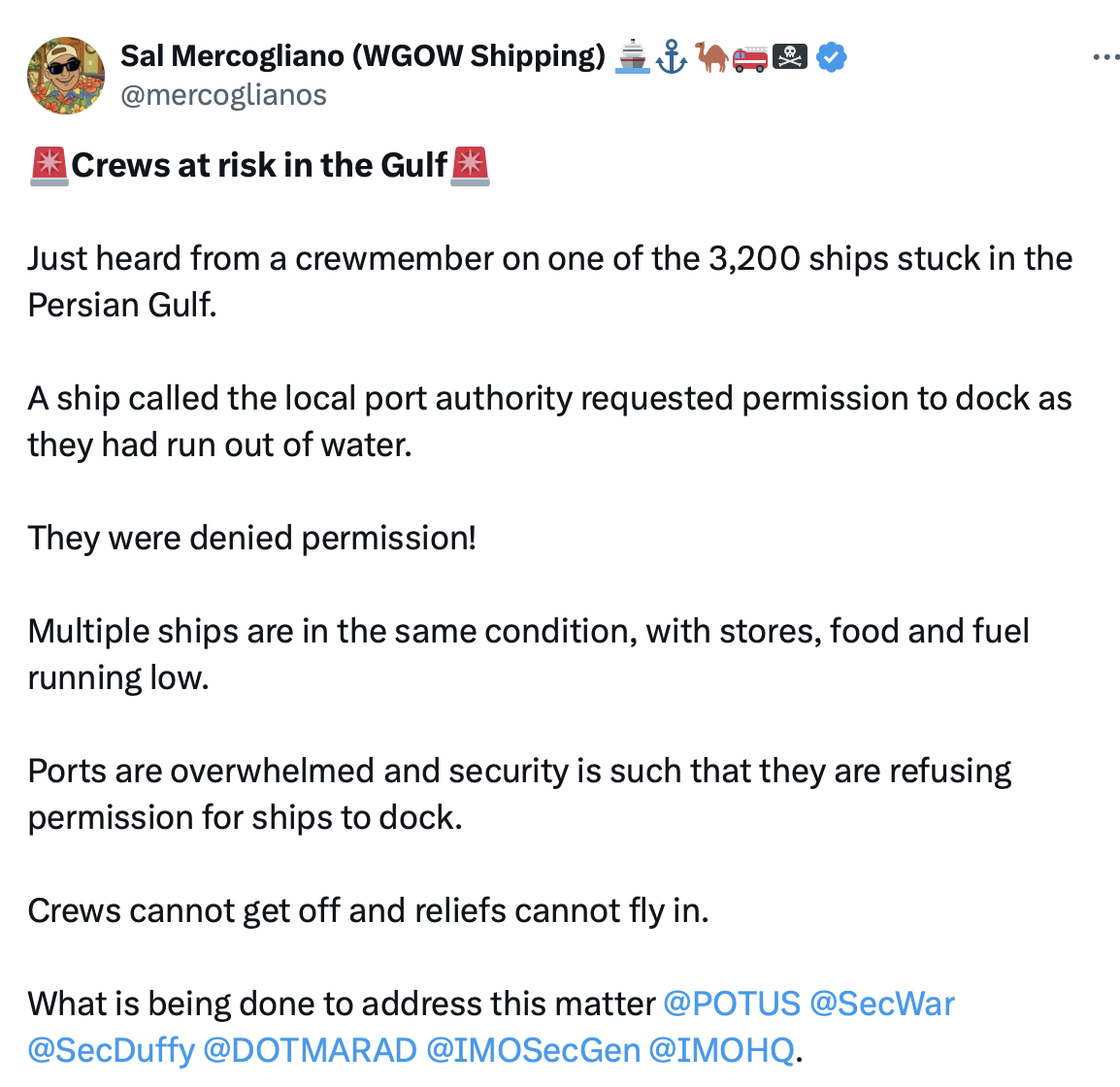
Mercoglino is not in the same universe as Mearsheimer in terms of understanding the bigger forces in play. But look at his sense of disbelief at US impotence (note also that Twitter is now blocking a lot of embeds):
Some short kinetic war updates. Janta Ka also covers another development we are late to profile due to wanting to take a step back and look at the bigger picture. Here he discusses Iran presenting evidence that it did indeed down an F-35:
From the BBC live feed:
Israeli oil refinery operator says most facilities operational after Iranian attack
The operator of an Israeli oil refinery in Haifa says it is has been damaged in an Iranian missile strike on Wednesday, but that most of its production facilities remain operating, reports news agency Reuters.
Oil Refineries Ltd says that essential infrastructure was damaged in “localised hits” in Thursday’s attack, but reports that there were no injuries or casualties.
It adds that the production facilities that have stopped operating are currently being restarted.
The refinery, located in northern Israel’s Haifa Bay, is the largest oil processing facility in Israel.
One of only two refineries in the country, Haifa is a critical facility as it supplies around 60% of Israel’s diesel and 50% of its gasoline, according to a report from S&P Global.
And earlier (also noted in the Aljazeera video above):
Kuwaiti oil refinery hit in drone attacks
Despite calls on Iran to halt its attacks, Kuwait’s state oil firm KPC has said its oil refinery has been hit by multiple drone strikes. So far, there are no reports of casualties.
Emergency crews battled a fire at the Mina Al-Ahmadi refinery, and some units have been forced to shut down, according to the state news agency.
This is the nightmare scenario that Gulf countries had hoped to avoid – their energy infrastructure becoming a repeated target in the war.
After Israel’s strikes on Iran’s South Pars facility, Iran has retaliated, with Gulf countries’ on the frontline of its fury.
The war shows no sign of abating, even as countries across the Gulf mark Eid al-Fitr, the end of the holy month of Ramadan.
Hindustan Times provides its daily dose of evidence of Iranian missile prowess at Israel’s expense:
ISL cited this tidbit from NO1 in March, 16-19: diplomatic impunity :
Iran’s launch rate hasn’t declined. It’s stable, and in the past week, increasing.
The coalition has lost 10% of its entire MQ-9 Reaper drone fleet.
The US has zero combat vessels actively present in the Persian Gulf – the Littoral Combat Ships based in Bahrain, whose entire purpose is to engage IRGC speedboats and sweep mines, were spotted in Malaysia three days ago. I have been told the beaches are lovely this time of year.
And some sobriety on the economic front. Fresh landing page at Bloomberg, the first from about four hours ago, the second one fresh:
Huge caveat: This channel is very uneven. The publisher, Jeff Snider, is a permaear and also does not understand banks and financial markets as well as he thinks he does. But this is an extremely solid presentation of the poor state of the American consumer, particularly lower income cohorts, before the energy price shock started. Notice he also uses the breaking image, such as “breaking the back” of the consumer.
Done for today. See you tomorrow!
_____
s1 From protectourfreedumbs:
i don’t say this with any pleasure, but from an iranian point of view, russia has proven to be a very unreliable and untrustworthy partner over many years. russia supported genocidal us sanctions against iran. iranian children died as a result. simple statement of fact. iran contracted with russia to purchase s300 missiles. russia refused to deliver these – for many years. iran developed the bavar system as a substitute. russia refused to complete work at bushehr it was contracted to carry out. russia did all these things in return for worthless us promises (never kept) not to put missile bases on russia’s borders. russia has a very bad record of doing sordid and very ill advised deals with its enemies which involve selling out its friends. putin often talks in gushing terms of israel and its right to “defend itself.” sometimes it sounds like lindsey graham talking. putin seems to have an unhealthy relationship with jewish oligarchs. going further back in time, russia was the main arms supplier to saddam hussein in the iran-iraq war (half a million iranian dead?) or how russia invaded iran in 1941. for all these reasons, i take reports of concrete russian assistance to iran with a very healthy dose of salt. or maybe the annual output of a siberian salt mine. sorry, but sticking your head in the sand ostrich-like is just self delusion. on numerous occasions, russia has shown itself to be a bit of a snake that cannot be trusted.
And Pearl Rangefinder:
The Iranians have every reason to be suspect of Russia, that’s for sure, especially over the Putin years.
To expand your point on the S300 system, the Iranian’s paid for them in 2007 and only started getting delivery of the systems they had paid for in 2015(!), with a lawsuit or two thrown in for good measure.
Armscontrol.org: (December 2016) Russia Completes S-300 Delivery to Iran
Russia completed delivery of the S-300 air defense missile system to Iran last month, concluding an $800 million deal signed between the two states in 2007, state-run Russian press agency RIA Novosti reported. The S-300 mobile surface-to-air missile system can counter multiple aircraft at a range of 195 kilometers and ballistic missiles at a range of up to 50 kilometers.
In September 2010, following pressure from the United States and Israel, Russian President Dmitry Medvedev suspended the agreement in compliance with a stricter UN arms embargo passed in June of that year.
Iran protested the decision, filing a $4 billion lawsuit against Russia’s defense export agency and embarking on the manufacture of its own long-range, mobile air defense system, the Bavar-373, which President Hassan Rouhani unveiled in August.
After Iran and the six-country group known as the P5+1 agreed on the Joint Comprehensive Plan of Action to constrain and roll back Iran’s nuclear program in July 2015, Russian President Vladimir Putin lifted the ban on weapons sales to Iran and signed a new agreement with Tehran, sending the first shipment of parts in April.
2 The closing section of Kevin Kirk’s Armageddon Now! Israel’s Nuclear Weapons Program
Back in 63 BC, a very wealthy property mogul, politician and a member of the ruling Triumvirate in Rome, Marcus Licinius Crassus, decided to attack Parthia (Iran) because the presumed easy military victory and the immense wealth it would bring, would help with his re-election chances. At his command was the might of the world’s biggest military super power; namely, the power of the combined Roman empire. He marched with 7 of the best legions of Roman infantry, equipped with the very best weapons paid for by Crassus himself, expecting an easy victory.
Roman military doctrine at that time was geared towards putting down insurgencies and was resistant to change. It consisted of massed ranks of infantry, supported by cavalry on the wings, smashing through any opposition arrayed against them. The relatively small size of the Parthian army of around 10,000 men, against 40,000 or so Romans, also augured well for a stunning Roman victory because they’d be overwhelmed in a direct clash.
Except…
When the two sides did clash, in the battle of Carrhea, the Parthians, under General Surena, had no infantry and so he adopted a mosaic strategy, where small groups of archers acting under their own volition and mounted on fast horses, swooped in for lightning attacks on the ponderous squares of Roman infantry, shooting blizzards of arrows before racing off when the Roman cavalry closed in on them. These archers were trained extensively in shooting both forwards while attacking and backwards while fleeing and this caused the Roman cavalry to back off, at which point the Parthians swooped back in to attack the main body again. These Parthian arrows were heavy enough to pierce both Roman shields and body armor thus pinning the shields irretrievably to the soldiers. As this battle of attrition unfolded, the Roman strategy was to hunker down and wait until their adversaries had run out of missiles before they proceeded on their planned ground assault on Parthia. Unfortunately for Crassus, Surena had arranged for huge convoys of weapons to be brought in from the East (by caravans of camels in those days – the equivalent of a direct railway line, say between China and Iran, today).
The end result was a crushing defeat for Rome who lost over 30,000 soldiers (20,000 killed and 10,000 captured) and Crassus, himself, was killed. The Parthians on the other hand lost, according to some estimates, less than 100 men.
Lesson to be learned: never underestimate Iran.
3 They can cut off water and power.
.4 I do not mean to sound like a Pollyana, but Asian countries ex captured Japan, South Korea and Taiwan know they are in a lot of trouble and are scrambling to find ways to mitigate damage. They will probably take much deeper initial dives than the US and Europe, but have the potential to start pulling out sooner.
