


Today’s update on the Iran war will be more telegraphed than usual. I typically don’t prepare original posts on Saturdays, and had competing obligations to compile links. We will try to have a finished version by 8am EST. Please add or correct in the comments. If you arrive early, refresh your browser and skim again at 8am.
At the risk of appearing to be perversely optimistic yet again, if financial time operates as usual and faster than political and real-world (here, kinetic war) time, the prospect is that market turmoil will throw an impossibly large spanner in Trump’s Iran war effort. Even though Brent oil prices have risen and remain above $90 a barrel (I heard President Trump’s favorite news source, FOX News, make a fuss about that and Friday’s drop in stock prices), his team still seems pretty in denial about rising economic costs and the real risk of an investor revolt. The employment statistics were weak, with a decline of 92,000 people and a slight increase in the unemployment rate, indicating that latent weaknesses already exist in the United States.
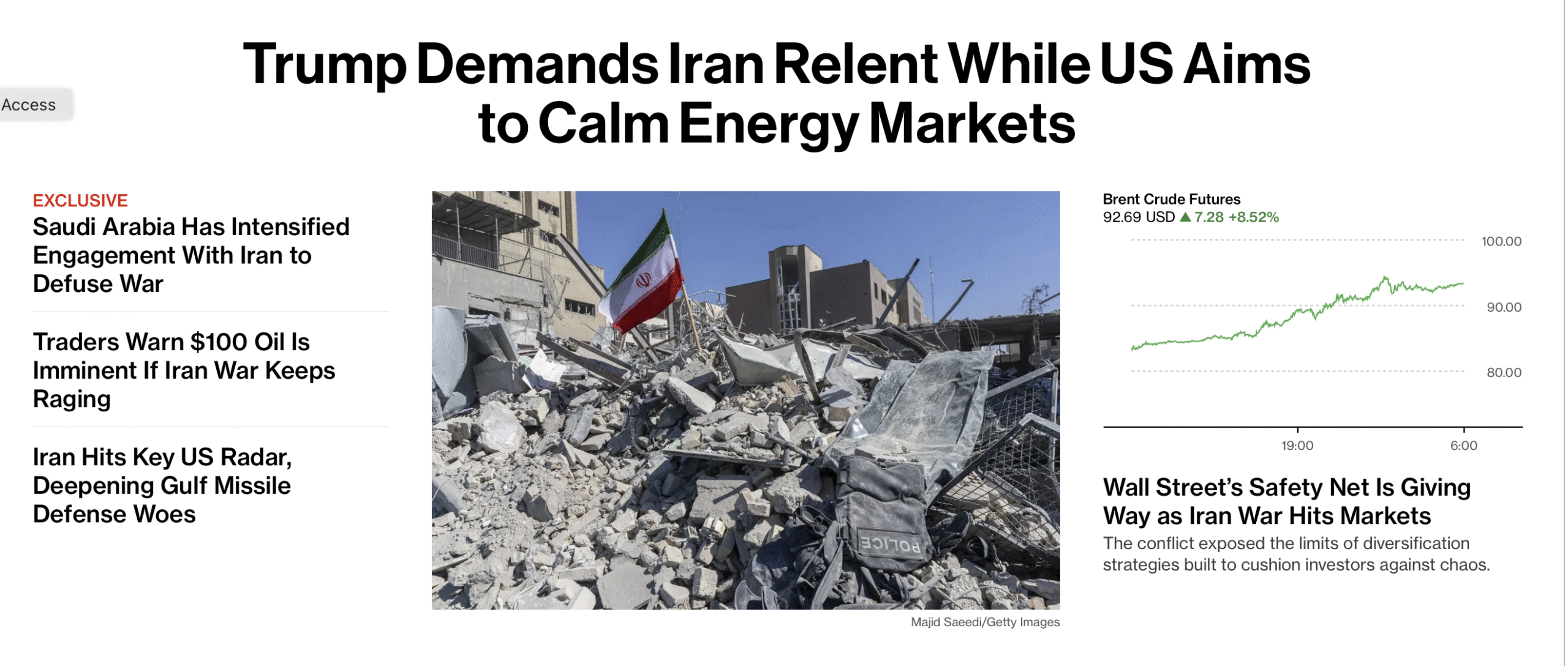
Bloomberg provides a one-stop, relevant overview of investor information as well as concerns. A snapshot of the landing page late Friday night:
Indeed, the financial world may still be reluctant to accept that Trump’s continued rhetoric is an admission of powerlessness. There are reports that Gulf states, particularly Saudi Arabia, are attempting to engage Iran. As a reminder, this comes after the Financial Times reported that at least some prominent officials were deeply upset by the high costs that the United States was casually imposing.
Prominent UAE businessman Khalaf al-Habtoor, in a social media post addressed to Trump, reflected the Gulf states’ frustration at being drawn into a war started by the United States and Israel.
“A direct question: Who gave you the authority to draw our region into a war with #Iran? And on what basis did you make this dangerous decision?” he said on X. “Did you calculate the collateral damage before you pulled the trigger?”
He noted that Gulf states are major financiers of Trump’s Gaza reconstruction plan and are expected to be supporters of Trump’s wide-ranging “peace commission.”
He said Arab Gulf states were “giving billions of dollars in support for stability and development,” adding: “These countries have the right to ask today where this money is going. Are we funding peace efforts or are we funding wars that endanger us?”
Learn more about the division of the Gulf region as the US has made it highly arid and prioritized the defense of Israel:
At the same time (I think it was Alastair Crook in a fresh interview with Chris Hedges), he suggested that the leaders of some countries may still be playing a double game in favor of the US campaign because they have decided that Iran has won, at least in the sense of confirming that the US failure to guarantee security in the region will inflict significant damage on Iran. The UAE and its fellow travelers have benefited enormously from positioning itself as a sunny, luxury-filled enclave for the world’s wealthy. If that brand proposition turns out to be empty, tourism and travel will certainly suffer.
However, Iran has made certain concessions over the whining of its neighbors. From Arab News: Iranian president apologizes to neighboring countries for attack:
President Massoud Pezeshkian has apologized for Iran’s attacks on countries in the region, asserted that Tehran would stop them and suggested that the attacks were caused by miscommunication between top officials.
Pezeshkian made the statement in a prerecorded speech aired on state television Saturday morning, following repeated attacks on Bahrain, Saudi Arabia and the United Arab Emirates.
“I apologize to the neighboring countries attacked by Iran,” Pezeshkian said in a speech broadcast on state television.
Pezeshkian said the Extraordinary Leadership Council approved a suspension of attacks against neighboring countries, unless attacks against Iran come from neighboring countries.
but:
The Iranian president said the Security Council has decided to halt all bombing of neighboring countries unless there is an attack from them.
Please note the IF.
— Elijah J. Magnia🇪🇺 (@ejmalrai) March 7, 2026
If you think the United States will stop using bases in the region to attack Iran, I have a bridge for you to build.
But President Trump will take any pre-emptive strike to shatter the idea that America is winning. Currently leading articles in the Financial Times:
But Pezeshkian’s comments are consistent with one of our beliefs: If the United States and Israel stop shooting at Iran, Iran will stop shooting. However, it seems logical for Iran to continue to block the Strait of Hormuz until it breaks America’s resolve.
Iran is slowing down with the closure of the Strait of Hormuz…with some exceptions. From Holmes Tracker’s Bloomberg: Iran-linked vessels are refraining from sailing as other vessels:
• Navigation in the Strait of Hormuz has been nearly halted for six days, with tankers linked to Iran being the only large vessels to have passed through the Strait in the past 24 hours.
• Following several attacks on commercial vessels, traffic in the Strait of Hormuz has virtually flattened, and missile and drone activity poses a significant risk to all vessels.
• The inability of oil tankers to enter or leave the Gulf means storage tanks are filling up and some refineries are cutting capacity as countries such as Iraq and Kuwait scale back production.
So far, apart from the dim-witted idea of a war risk insurance backstop (probably unfeasible in the relevant time period, except for US airlines, which are minnows in marine insurance), the latest bright idea has been for the Secretary of the Treasury to provide a 30-day sanctions waiver. According to Anadolu agency:
Treasury Secretary Scott Bessent told Fox News on Friday that the United States may consider lifting sanctions on additional shipments of Russian oil to ease a temporary global supply gap.
The remarks followed the US decision to issue a 30-day temporary exemption allowing Indian refiners to buy Russian crude oil to maintain global supplies…
Bessent said the Treasury Department is considering whether to release additional sanctioned Russian crude onto the market.
“There is also the possibility of lifting sanctions on other Russian oil products,” he said. “There are hundreds of millions of barrels of licensed oil at sea… By delicensing them, the Treasury can create supply.”
As for India, Mr. Bessent’s argument seems to be that the barn doors are closed after the horse reaches the next county. India was nearing the top of the list of countries affected by supply losses due to the closure of the Strait of Hormuz. Whether or not the United States continued with its arbitrary sanctions, India was almost certain to buy Russian oil to fill the gap.
As for other countries, Putin said he could immediately support a European suicide pact not to buy Russian energy before relinquishing Bessent’s hand.
President Putin warned that Russia could cut off gas supplies to Europe “right now” amid soaring energy prices sparked by the Iran crisis, linking the possible decision to the European Union’s desire to ban purchases of Russian gas and liquefied natural gas https://t.co/lRKY1A6XYg pic.twitter.com/PLkqFHPdhv
— Reuters (@Reuters) March 5, 2026
Now for the latest on Kinetic Warfare:
Tel Aviv, last night.
IRGC channel.
@SepahPasdaran pic.twitter.com/VcB0VRMcoD
— Tim Anderson (@timand2037) March 7, 2026
Note that there are growing doubts about the extent of the punishment Iran is receiving, and there are increasing signs that Iran is inflicting significant damage on Israel. While there appears to be no doubt that civilian lives and infrastructure have been damaged, CNN reports that life for most Iranians appears to be continuing as normal as during the war, especially with food supplies and other economic fundamentals operating properly. Military experts are also raising red flags about the US’ claims that it has destroyed Iran’s missile launchers. In a conversation with Daniel Davis, Chas Freeman cited Douglas McGregor’s account that during the 1997 Serbian Air Campaign, Serbia had 17 launchers, while NATO forces reported shooting down 64. Scott Ritter gave a similar account of the Iraq War, noting that pilots immediately reported having destroyed a significant number of integer multiples of the Iraqi missile launchers that existed as destroyed.
US missiles: pic.twitter.com/Mo0p9co3bp
—. (@distant dead star) March 4, 2026
There were many great talks on Friday, but this one stood out because Wilkerson presented both relevant operational details, such as active duty selection and combat readiness processes, as well as information he has from his contacts.
Key items for this discussion are:
The US has so far not provided photos confirming the damage in Iran, as expected
The US fires Iran almost exclusively from long range, so even JDAM is not accurate and almost always misses its target.
Stamler knows the Cyprus attack was a false flag
Larry Johnson has written an important article about how the Trump administration is lying about the number of American casualties in the Persian Gulf region.
After seven days of war in the Persian Gulf, clues are emerging online that the United States is suffering higher combat losses than reported, despite the Trump administration’s attempts to downplay the number of American casualties. The first clue is the Star-Spangled Banner’s Xhitter (pronounced sitter).
K-Town refers to Kaiserslautern, a U.S. military base in Germany located 21 miles east of Landstuhl Regional Medical Center. so what? Now, on March 4, 2026, Germany’s Landstuhl Regional Medical Center (LRMC), the largest Department of Defense hospital outside the United States and a major overseas trauma/evacuation hub for wounded soldiers from Europe, the Middle East, and Africa, sent out a memo advising that it would temporarily suspend labor and delivery services “until further notice.” Although the memo does not clearly define the “primary purpose,” LRMC’s core role is to treat combat- and training-related injuries. It is also the primary medical evacuation site for soldiers injured in ongoing operations.
A knowledgeable friend who oversaw the Pentagon’s Wounded Warrior Program and worked with LRMC personnel during the Iraq and Afghanistan wars learned today that hospitals are receiving a large number of wounded warriors. The numbers are so high that hospitals can no longer continue to dedicate resources to delivering babies.
And a while ago this photo appeared on Telegram.
Also consider:
Further evidence that the US government may be hiding US military casualties in the war with Iran:
A hospital in Landstuhl, Germany, has closed its entire delivery ward in anticipation of welcoming U.S. troops.
Watch the video below and drop your sauce… https://t.co/256CALmTOK
— Godfroy (@g0dfr0y) March 6, 2026
Keep in mind that Mr. Johnson is talking about casualties, some of which could be fatal. But recently, Army Ranger Greg Stoker pointed out that the military has a process for reporting family members killed in combat. Losses will not be recorded in official accounts until notification is given. Stoker believes this step will make it harder for the military to lie about deaths as much. However, injuries are in a completely different category.
In his article, Johnson also brought up the subject of Larry’s talk at Dialogue Works, where the Trump administration appears to be rushing to send troops into theater. We pointed out yesterday that Max Blumenthal had claimed that the Kurdish operation the US is allegedly trying to carry out is likely a means to bring in special forces.
More rumors:
As the United States prepares to send troops to Iran, the aircraft carrier George H.W. Bush Carrier Strike Group will be deployed off the coast of Israel in the Eastern Mediterranean.
to follow: @AFpost pic.twitter.com/taFrxwSbOp
— AF Post (@AFpost) March 7, 2026
The phone keeps ringing. Far more units have been activated for deployment than generally known… https://t.co/qax3F23lwM
—Mike Prysner (@MikePrysner) March 6, 2026
Former ambassadors Chas Freeman and Daniel Davis also had a more comprehensive and informative conversation. Mr. Freeman emphasized that he expects Iran to acquire nuclear weapons, and said that Iran’s strategy is a rope-a-dope strategy of continuing to suffer punishment from the West even as it wears out, and then delivering a decisive blow.
I hope this is enough information for today. I’ll be back tomorrow.
