


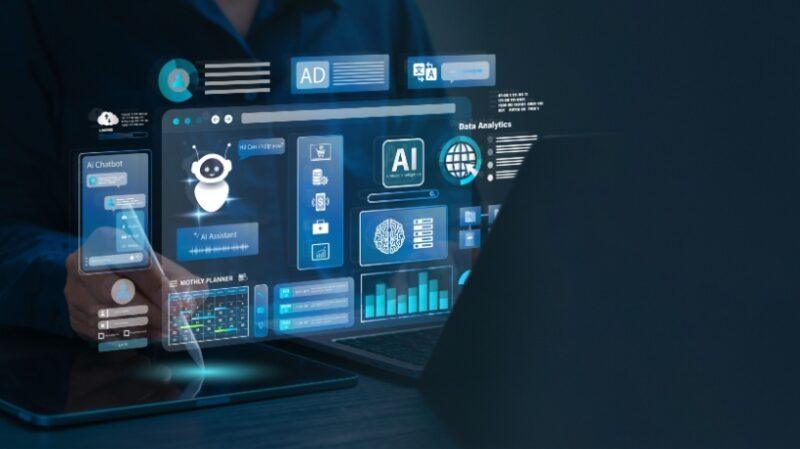
How AI chatbots are transforming employee learning
AI-powered tools are now an essential component of corporate training solutions across all industries. From intelligent content delivery to real-time performance tracking, AI helps businesses create smarter, faster, and more effective learning and development solutions.
Why AI is transforming employee learning
Employee learning is no longer a one-size-fits-all process. In today’s diverse and distributed workforce, employees expect learning experiences tailored to their roles, goals, and learning preferences. AI enables this at scale by providing intelligent personalization, predictive analytics, and conversational interfaces that engage learners in new ways. By integrating AI into custom e-learning solutions, organizations can move beyond static training modules to create adaptive and engaging experiences that meet individual learner needs while aligning with broader business goals.
Key benefits of integrating AI tools into your employee learning program
1. A personalized learning journey
AI analyzes employee data such as role, experience level, performance metrics, and past training activities to provide personalized content. This ensures each employee receives timely, relevant training that helps them grow in their role.
2. Automatic content creation
AI tools assist instructional designers by generating course summaries, learning materials, and even assessments. This streamlines the development of custom eLearning solutions, reduces production time, and frees up L&D teams to focus on strategy and innovation.
3. Real-time feedback and support
AI-powered chatbots and virtual assistants instantly answer employee questions and make learning more accessible and continuous. These tools provide 24/7 support and are especially useful for onboarding, compliance, and technical training scenarios.
4. Data-driven decision making
AI allows you to track learner engagement, knowledge retention, and performance improvement in real time. These insights help organizations refine their corporate training solutions, identify skills gaps early, and continually optimize training outcomes.
Real-world applications of AI in learning and development
Forward-thinking organizations are using AI in a variety of ways within their employee learning programs, including:
Onboarding and orientation
AI chatbots can guide you through the onboarding process, answer FAQs, and introduce you to company culture, alleviating the burden on your HR team. Compliance training
AI tools adapt compliance content to different job roles and simplify complex legal terminology to improve understanding and retention. leadership development
Personalized learning paths and scenario-based learning help managers develop soft skills, decision-making, and team management abilities. performance support
AI-based systems provide just-in-time learning by providing the right information in real-time when your business needs it.
Integrating AI with custom e-learning solutions
To maximize the potential of AI in workforce development, integration must be seamless and strategic. Here are some ways companies can incorporate AI into custom e-learning solutions.
Embed AI into your LMS platform to personalize the learning experience based on learner behavior and preferences. Rapidly build and update learning content to meet evolving business needs using AI-powered authoring tools. Combine AI and gamification to increase learner engagement and motivation. Leverage AI for learning analytics to turn raw training data into actionable insights for both learners and business leaders.
When combined with human-centered design and subject matter expertise, AI-powered e-learning becomes a powerful tool for workforce transformation.
Challenges and considerations
Integrating AI into learning and development solutions offers significant benefits, but also comes with challenges that organizations must carefully manage.
Data privacy and security
AI tools rely heavily on employee data. Organizations must ensure compliance with data protection regulations and internal policies. bias and fairness
AI systems can inherit biases from the data used to train them. L&D teams should regularly audit their AI tools to ensure fairness and inclusivity. User adoption
Employees can be hesitant to adopt AI-driven tools. Clear communication, training, and change management strategies are essential for successful implementation.
The future of AI in corporate training solutions
AI exists to augment human trainers, not replace them. This allows L&D professionals to focus on strategic initiatives while automating mundane tasks and improving the learner experience. The integration of AI into employee learning programs represents a shift towards smarter, more agile, and more human-centric corporate training solutions.
As AI continues to evolve, we can expect even better features, such as virtual tutor emotional intelligence, deeper personalization, and seamless integration with performance management systems. Organizations that embrace these innovations today will be well-positioned to build a future-ready workforce tomorrow.
conclusion
Integrating AI tools into employee learning programs is no longer optional. It’s a competitive advantage. By leveraging AI within custom e-learning solutions and broader learning and development solutions, companies can deliver more personalized, efficient, and effective training experiences. In a world where skills are becoming obsolete faster than ever, investing in an AI-powered corporate training solution will do more than just keep up. It’s about staying ahead of the curve.
monk
mon’k is an intuitive AI-driven platform that hosts a comprehensive knowledge suite including adaptive learning, e-books, audio-video players, Reader as a Service (RaaS), and journals.
