


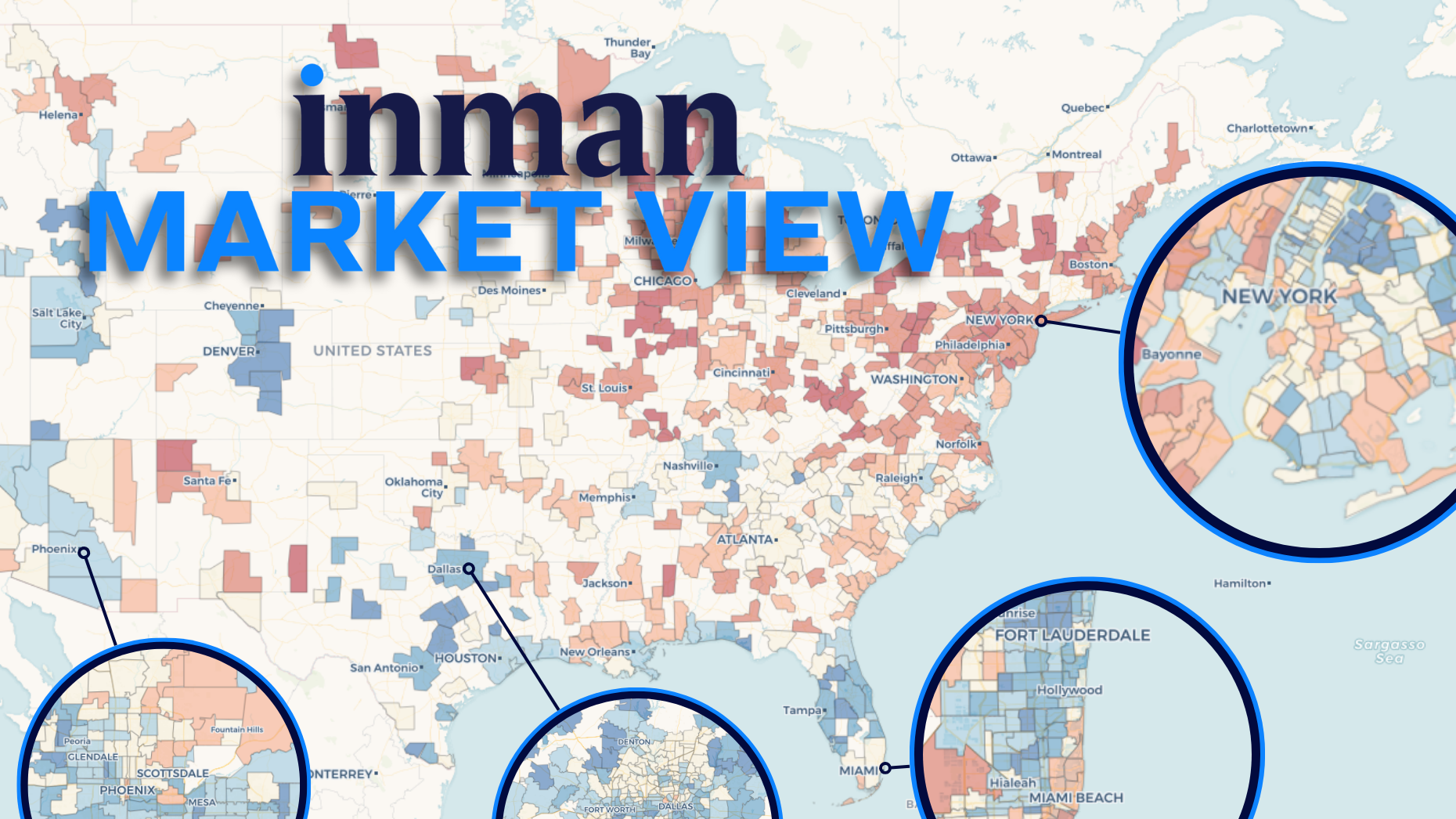
Home sellers continued to sell in March despite rising gas prices and mortgage rates. Dive into your market and compare it to hundreds of other markets using Inman’s interactive maps and charts.
In the first month of the U.S. war on Iran, consumers faced higher prices and higher mortgage payments.
However, home sellers are not letting up.
Inman Market View’s review of new data from Realtor.com shows new listings gaining momentum in some of the country’s most prominent tech hubs, and hundreds of other markets posting solid numbers to begin spring.
But what’s happening in the tech-heavy metropolitan area may be a cause for alarm for other parts of the country. There is no guarantee that this new supply flow will result in increased sales.
Use these interactive maps and charts to explore how early spring is unfolding in the U.S. housing market, which remains fragmented by price range, inventory, and geography.
Click on one of the 500 local markets in the tool above or explore the options in the drop-down menu to explore the data in even more detail. For a more complete picture, choose to compare different metrics and time periods.
technology and housing
The new numbers may reassure fears that sellers will immediately lose interest due to last month’s rise in mortgage rates.
In the first quarter of 2026, the number of new listings nationwide was 14% below pre-pandemic levels during the same period, an improvement of 1 percentage point from the previous quarter. The number of newly listed properties also increased by 1% compared to the previous year.
Compare your market trajectory to that of your country by selecting from the drop-down menu above. You can also select other metropolises and switch between different metrics and comparison views.
Although early, these numbers suggest that the number of listings is not immediately decreasing in response to the U.S. military action in Iran. And the growth we’re seeing in many places is even exceeding what was considered normal in the pre-pandemic spring.
This was especially true in metropolitan areas with high concentrations of technology workers, such as Silicon Valley, Seattle, Austin, and Denver.
The greater San Jose area, home to many of the world’s biggest technology companies, has seen some of the most dramatic changes in recent months.
The number of homes on the market in Silicon Valley neighborhoods over the past three months was 10% higher than during the same period before the pandemic. This is a significant increase from the last three months of 2025, when the number of new listings in the metro area was 22% below average for the same period from 2017 to 2019.
To the extent that this surge in new listings is driven by these locations’ connections to the high-tech industry, it may be more a sign of home sellers losing their jobs and being forced to list than a sign of buying intent.
This is a graph of the long-term growth of high-tech employment in the United States. The only thing comparable to the scale and duration of current job losses is the dot-com bust.
[image or embed]
— Joey Politano🏳️🌈 (@josephpolitano.bsky.social) March 6, 2026 7:47am
And Silicon Valley isn’t the only technology hub where the housing market has been transformed in recent years.
Evolving downtown
The fate of the downtown housing market has been the subject of much debate in recent years, but Seattle stands out for its bleak situation.
Six years after the pandemic first disrupted these markets, new listings are now coming online faster than ever before in the neighborhoods closest to Seattle’s downtown employment hubs.
But miles away from the downtown core, new listings are still declining across much of the country.
In Seattle, this may be due to a combination of large employers’ return-to-office efforts, but it may also be helped by the fact that home prices in central Seattle have not risen as much in recent years compared to neighboring cities and suburbs.
Each market’s journey during this period was unique. Connect your tool to the tools above to see how the situation near you has changed.
Email Daniel Huston
