


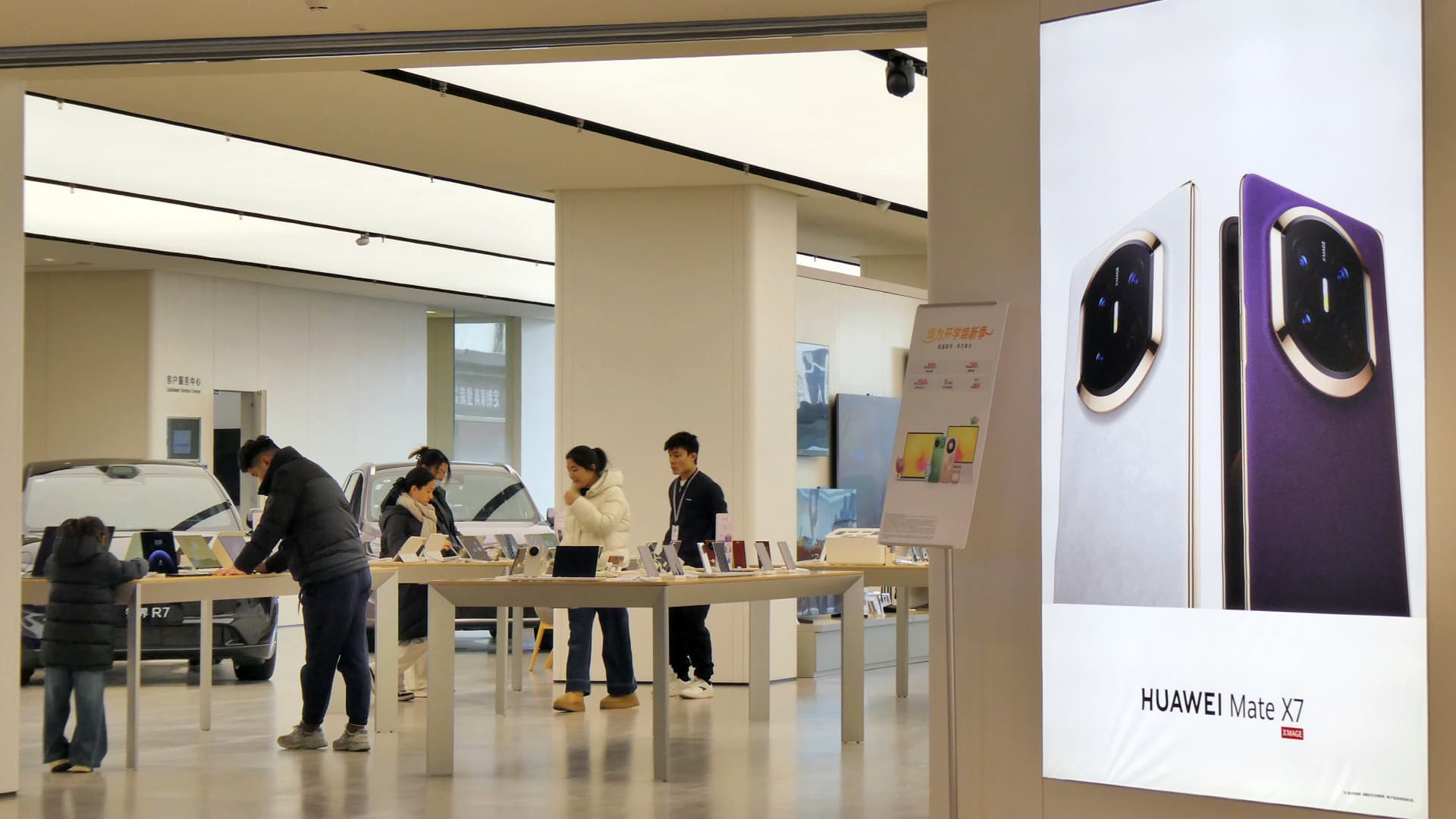
A consumer browses a Huawei mobile phone at a shopping mall in Yantai, Shandong Province, China, March 8, 2026.
Photo | Future Publishing | Getty Images
As Chinese companies seek to close the gap with the U.S. in AI, Huawei is pushing ahead with development of its own artificial intelligence chips, but it has yet to match the double-digit revenue growth of its peers.
Huawei said cloud computing revenue from external customers fell 3.5% to 32.16 billion yuan ($4.6 billion) in 2025. The company is the second largest cloud provider in mainland China.
Overall cloud revenue, including internal customers, increased by 4.8% to 72.8 billion yuan, but revenue growth in the key ICT infrastructure sector was reported to have slowed to 2.6% from 4.9% in 2024.
This is a segment that includes Huawei’s self-developed Ascend AI chip solution and is intended to rival Nvidia. Huawei’s total ICT revenue in 2025 was 375.01 billion yuan.
The United States has restricted Chinese companies’ access to cutting-edge Nvidia chips, while the Chinese government has encouraged domestic technology self-sufficiency.
The decline in Huawei’s cloud revenue to external customers comes as ByteDance has rapidly grown its AI cloud business in China in recent months, albeit from a smaller base.
TikTok’s owner is reportedly increasing its access to high-end Nvidia chips with a planned partnership deal with a data center in Malaysia. ByteDance and Alibaba are also planning to order Huawei’s new AI chips, Reuters reported last week, citing sources. ByteDance declined to comment. Two other Chinese companies did not respond to CNBC’s requests for comment.
While U.S.-developed AI tools are generally considered the most capable in the world, some Chinese models have shown advantages in video generation. Not all US AI models are officially accessible in mainland China.
Huawei’s cloud growth rate is modest, but comes amid rapid global industry expansion and slowing economic growth in China.
Globally, spending on cloud infrastructure services rose 29% in the fourth quarter, with the market expanding by more than 20% for the sixth consecutive quarter, Omdia said. The company predicts cloud will grow 27% in 2026.
Earlier this month, Alibaba, the cloud computing company with the largest market share in mainland China, reported a 36% increase in segment revenue in 2025 to 43.28 billion yuan. Tencent said the growth in domestic and international cloud services revenue will drive a 22% year-on-year increase in business services revenue in 2025.
Local promotions of the AI tool OpenClaw in China this month also encouraged many local residents to download the agent and pay for related cloud and AI model services. Personal consumption in China has remained sluggish since the pandemic.
Consumer earnings slow down
Weekly analysis and insights from Asia’s largest economy delivered to your inbox
Subscribe now
According to Counterpoint, Huawei’s smartphones ranked first in China in terms of shipments last year, with an increase of 1.7%. However, after the launch of iPhone 17, the Chinese company lost its position to Apple towards the end of 2025.
For all of 2025, the telecom giant reported a 2% increase in revenue to 880.9 billion yuan and a net profit of 68 billion yuan, an increase of about 8% year-on-year.
The company spent a record 192.3 billion yuan (21.8% of sales) on research and development.
“Huawei’s overall performance was stable in 2025,” Sabrina Meng, Huawei’s rotating chairman, said in a short statement, expressing gratitude to customers, partners and employees.
The Intelligent Automotive Solutions segment’s revenue was 45.02 billion yuan, with the growth rate slowing to 72% year-on-year, from 474.4% in 2024, as the automotive business captured the initial surge in electric vehicles. Huawei has partnered with multiple automakers on in-vehicle software and driver assistance technology.
Never miss the most trusted news moments in business news when you choose CNBC as your preferred source on Google.
Source link
