


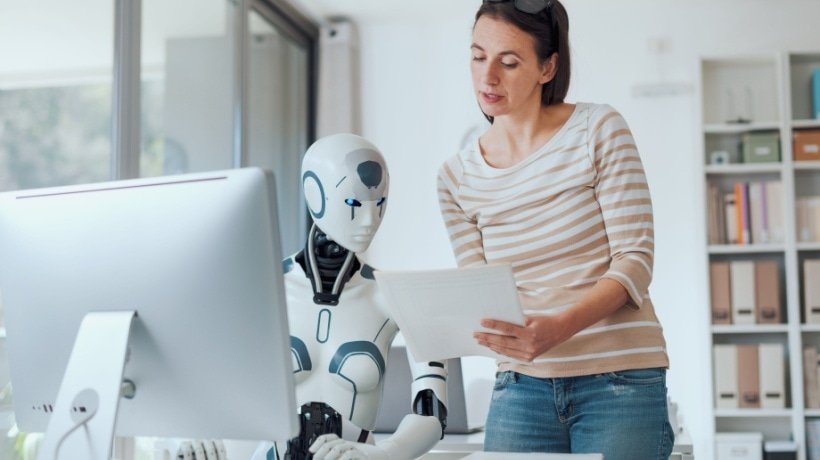

Are your employees ready to accept AI?
With the appearance of AI, the workplace is changing rapidly. It is not just a simplification of the task by automation. It is also useful for companies around the world to make wiser decisions. Therefore, if it is late to incorporate AI into business, it is time to reconsider it and start preparing employees for the AI world. What actually happens? It is to provide employees to learn new skills, increase adaptability, and learn how to link with AI systems.
Changes are terrible, so it may be difficult at first. One of the biggest concerns of employees is that AI replaces their work. AI certainly automates some tasks, but the truth is to create new opportunities. Therefore, the best thing to do with employees is to encourage this technology as a useful tool, not a threat. After all, one report predicted that the productivity of the industry that introduced AI by 2035 could increase up to 40%. Therefore, it is wise to prepare employees for future potential and changes brought by AI. Let’s take a look at how to do it effectively.
Seven ways to prepare an employee to adapt to AI -led changes
1. Training program
AI may be excellent in data analysis and task automation, but there are also skills that cannot be replaced. Soft skills such as critical thinking, mental intelligence, creativity, and problem solving are important in the AI era. Therefore, the first thing to do is investing in an employee’s training program. We will focus on improving soft skills and then teach the basics of AI. This includes the use of the AI tools, the data analysis, and the ethical use of technology. There are many online courses specialized in these topics, and you can build custom modules with the help of L & D experts and educational institutions.
2. Accept changes
If the team members take the change as an opportunity to grow, you will notice that there is nothing that you can not overcome. This is called a growth mindset, and believes that skills and abilities can only be strengthened by effort. This means that it is necessary for an employee to grow even if an employee experiment with peace of mind and fails. One way for that is to celebrate not only the results but also the progress. For example, if someone learns how to use a new AI tool, shout out loud at a team meeting. Lifelong learning is also useful for ensuring the future of employees and preparing for AI. By providing learning opportunities for online courses, workshops, webiners, etc., you can show that you are concerned about their growth, which further motivated them, and confident that they will deal with future changes. Will give.
3. Integrate AI step by step
The key to integrating AI to a workflow is not to replace AI, but to gradually execute it while showing the team how AI can easily work and increase productivity. Let’s start with the introduction of AI tools that directly solve your own issues. For example, if the team is spending hours on the task manually, indicate how AI can process tasks more quickly. If you realize the benefits of increasing the time you can concentrate on more important tasks, you will think that AI will help. To make the transition more smooth, involve the employees. Test new AI tools, provide feedback, and have AI propose a useful field. The more you feel that they are accepted, the more they will be scared. In addition, gradually accepting AI will allow you to use more time for AI, get used to the use of AI, and be confident.
4. Call the leader
Leaders exist to lead employees and encourage changes. As a result, the direction was determined on how smoothly the transition to AI proceeded. Therefore, if the employee is worried about AI, the leader needs to intervene to communicate things. After all, employees need to understand their goals behind the introduction of AI. Do you use it to increase efficiency? Do you automate tasks? Or enhance customer service? Whatever the goal, leaders need to clarify what AI will bring to the company and employees. And most importantly, they need to accept AI themselves. Even if they have a hard time learning AI at first, they should acknowledge it. Sharing employee learning processes with employees is an excellent strategy to increase employee motivation and learn together.
5. Cope with employee anxiety
It’s no wonder that some employees feel uncomfortable about how AI is integrated into their work. They may be worried that employment stabilizes, left behind, or being overwhelmed by learning new technology. But if you have transparency and communication, you can relieve their hearts. As mentioned above, it is necessary to clarify the reasons for introducing AI first. Please be honest with the issues. The more you understand how AI is useful for the company, the less the fear of change. In addition, you need to provide feedback and discussion opportunities. People need to feel that they are listening, especially when they are scared. Therefore, we hold groups or individual meetings, answer questions, and have the staff expressed concern.
6. Mentorship program for employees who are not very familiar with technology
AI may be especially overwhelming for employees who are not familiar with technology. The good news is that this can be solved by receiving guidance. Pairing employees who are familiar with technology and employees who need additional guidance are a perfect solution. To be honest, training and presentations do not always work when you feel stressed. Friendly colleagues who answer the questions and teach the procedure are safer. The mentorship program is more effective and effective, so start as soon as possible. Find employees who are used to using AI tools and match with team members who need support. Also, young staff are usually more familiar with technology, so they may work like a two -way mentor by connecting them with experienced colleagues.
7. Collaboration between humans and AI
The goal of applying AI to workflow is to achieve the ultimate collaboration between the system and employees. However, in order to realize this, it is necessary to redefine the role so that each role can be maximized. Specifically, AI is excellent in numerical analysis, pattern discovery, and task automation. This will release the time for employees, and will be able to focus on demonstrating creativity, strategic, and empathy not found in AI. For example, in marketing, AI analyzes data to predict the market trend, and the team devise a campaign based on those insights. The first method is to investigate the task in detail with the team and check which of them can be processed with AI. If something is full of data, it’s AI’s job. If you need critical thinking, it is for employees.
Conclusion
Adopting AI is not simply following the technical trend. It is to accept new tools for growth and innovation. AI can improve business efficiency and ensure time for employees to focus on more important tasks. Employees need to think that they are allies to achieve their goals and improve their satisfaction, rather than fear AI. In all of these, AI needs to be implemented ethically and in mind. But you should act now. Labor force corresponding to AI is a well -trained, adapted, and cooperative labor. Therefore, make sure your employee’s career is guaranteed in the future and make a profit to the company.
