


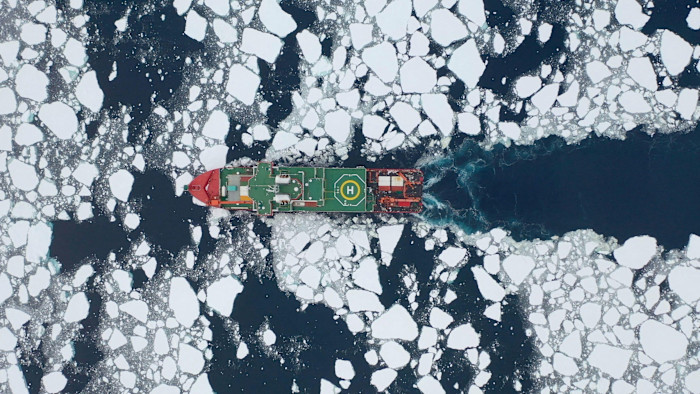
China’s newest Arctic icebreaker, which can break through ice floes up to 2.5 meters thick, is a powerful symbol of Beijing’s ambitions in the far north, where tensions are rising over US President Donald Trump’s attempts to assert control of Greenland.
The proposed Bull nuclear-powered ship, unveiled as a conceptual design in December, is intended to provide a prototype for Beijing’s emerging polar fleet.
China’s state-run 708 Institute, which designed the ship, says it will be a “multi-purpose” cargo ship and polar tourism vessel.
Although China describes its interests in the region in terms of trade and research, few analysts doubt the dual civilian-military intentions of Beijing’s Arctic plans, from the establishment of research bases to oil and gas cooperation to joint military patrols with Russia near Alaska.
China’s plan to build icebreakers has raised concerns in the West about China and Russia’s expansion into the Arctic, which President Trump is using to justify the U.S. takeover of Greenland.
“China views the Arctic as a new frontier that is critical to its geopolitical and geostrategic competition with the United States and the broader Western world,” said Helena Legarda, program director on Merix’s foreign affairs team. “Beijing wants to expand its influence, footprint, and access to the Arctic.”
These ambitions are a growing concern among experts and policymakers in the United States and other Western capitals, who anticipate a scramble for faster, cheaper shipping routes and abundant natural resources as polar ice sheets melt.
The Arctic offers myriad possibilities for military operations, from space and satellite warfare to the strategic deployment of nuclear submarines, raising the risk that tensions could spill over into conflict in the contest for control of the emerging region.
The shipyard used to build the first domestically produced icebreaker also delivered China’s third aircraft carrier, Fujian, which was commissioned late last year and equipped with some of China’s most advanced military technology. The shipyard is operated by the state-owned giant China State Shipbuilding Corporation.
China has had ambitions in the Arctic for decades. However, its activities have rapidly accelerated in recent years due to its growing economic and geopolitical influence.
The Chinese government purchased its first icebreaker, the Snow Dragon, from Ukraine in 1993, before starting to develop its own domestic fleet. In 2004, it opened its first permanent Arctic research station in Svalbard, Norway, followed by another in Iceland in 2018.
In the same year, the Chinese government announced an Arctic policy that envisaged a “Polar Silk Road” through the development of the Northern Sea Route. The policy touts China’s research and “hydrographical research” in the region, saying its purpose is to improve “Arctic security and logistics capabilities.”
Icebreakers are essential for projecting power in polar regions, allowing countries to enter and maintain a presence in frequently frozen areas. The Pentagon announced in December that the Trump administration had earmarked $9 billion for icebreakers and infrastructure in the Arctic and Antarctic to “ensure America’s polar access, security, and leadership.”
China described itself as a “near-Arctic nation” in a 2018 policy document, drawing a sharp rebuke from then-Secretary of State Mike Pompeo. “There are only Arctic states and non-Arctic states,” Pompeo said. “There is no third category, and claiming otherwise gives China absolutely no rights.”
Merix’s Legarda newspaper said that until a few years ago, China’s preferred partner in the Arctic was Europe. But since Europe began “de-risking” China and Russia in the wake of the Covid-19 pandemic and Russia’s full-scale invasion of Ukraine in 2022, Beijing has moved even closer to its northern neighbor.
The main shipping route from Europe to China is through NATO-controlled territories such as Canada and Greenland.
In recent years, China has shown particular interest in the Northern Sea Route, which passes through Russian waters.
The Arctic route “can reduce the voyage distance by 30 to 40 percent compared to the traditional Suez Canal route,” Yu Yun, a researcher at the 708 Institute, told state-run China Daily.
In September, a container ship called the Istanbul Bridge sailed from Ningbo in eastern Zhejiang province to the British port of Felixstowe via the Northern Sea Route, according to Chinese reports. The ministry announced that the voyage marks the “official opening of the world’s first Arctic container express transport route between China and Europe,” which has been named the “China-Europe Arctic Express.”
Container ship Istanbul Bridge became the first ship to sail from China to Europe via the new Arctic fast route ©Xinhua News Agency/Alamy
The Chinese government is also investing in mining, energy and infrastructure projects in Russia’s north, from coal near Murmansk to the deep-water port of Arkhangelsk on the White Sea, which China’s major shipping company Cosco reportedly plans to use as its main base in the Arctic.
But experts believe that while Russia wants to explore economic opportunities with China, there are limits to its willingness to cooperate.
“Russia is working closely with China, but there is some ambiguity about bringing Russia into the Arctic.” [Russia] wants to be a hegemon,” said Norwegian Defense Minister Tore Sandvik.
A senior Nordic official said eight Arctic states, including Russia, do not want China to play a formal role in the region. “China calls itself a near-Arctic state, and I think that’s close enough for all of us. We don’t want a form of governance that gives China a say.”
But James Cha, a China expert at the S. Rajaratnam School of International Studies in Singapore, said Beijing’s strategy was not to “brazenly project power” but to work on long-term “presence building” in the region.
Most of China’s military activity, including joint naval and air force patrols with Russia, took place near Alaska, about 4,000 kilometers from Greenland, said Jo Inge Beckevold, a senior researcher at the Norwegian Institute for Defense Studies. “To date, not a single Chinese military vessel has been observed to have sailed through the Arctic Ocean,” Beckebold said.
The military usefulness of the Northern Sea Route has also often been exaggerated, Beckevold said.
He added that the narrow shipping lanes and short seasons could make ships vulnerable in times of conflict, and that it would be difficult for China to penetrate the Arctic through the Bering Strait with nuclear submarines without being detected.
Recommended
While it may be faster to travel from northern China to Europe through the North Pole, Beckebold said it is still faster for exporters in China’s southern manufacturing hub to ship goods through the Suez Canal to Greece.
China, on the other hand, has sought to express its interests in the Arctic from a civilian rather than a strategic perspective.
The 708 Maritime Research Institute’s new icebreaker can transport hundreds of passengers and cargo containers and will create a “luxury, immersive and safe” polar travel experience for passengers, Cui Meng, the institute’s polar ship engineer, told China Daily.
Cha said he believed China was asserting its rights in some of these Arctic regions, describing its activities as “for research, trade and tourism.”
Cartography by Stephen Barnard
