


Introduction: Training to stay safe ahead of real-world risks
Manufacturing environments are becoming more sophisticated, automated, and electrified, but they are also becoming more dangerous. High voltage (HV) systems, robotics, advanced machinery, and tightly coupled production lines pose risks that traditional training methods can no longer effectively address. Instructor-led classroom training, PDFs, videos, and even supervised shadowing have long been the cornerstone of manufacturing training. However, when errors result in serious injury, death, equipment damage, or production downtime, it is no longer acceptable to “learn by observing” or “learning by doing” without adequate preparation.
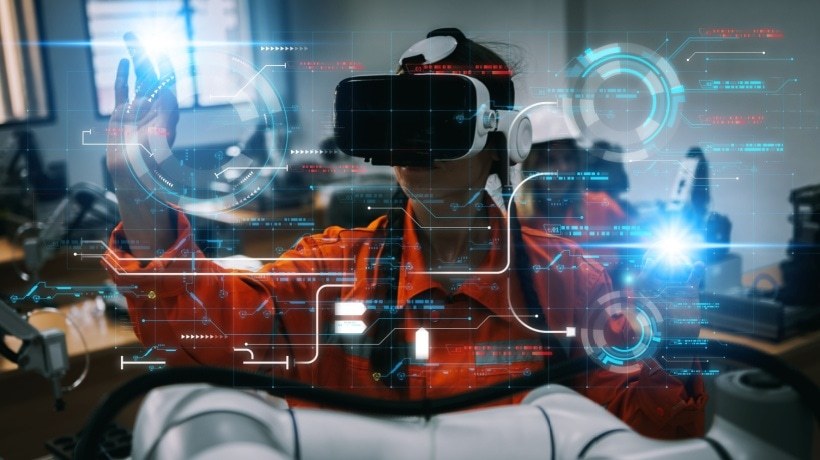
This is where virtual reality (VR) and augmented reality (AR) come in, not as experimental technologies, but as essential tools for modern manufacturing training. VR and AR are redefining how manufacturing organizations prepare technicians before they even touch real equipment by enabling safe, reproducible, and immersive simulations of high-risk scenarios. In this article we will cover:
Central issues in high-risk manufacturing training. Why simulation is essential before practical practice. How VR and AR uniquely address these challenges. Examples of Tesla and Fisker. Practical guidance on implementing VR and AR training. The future of immersive learning in manufacturing.
Central issue: High-risk manufacturing training leaves little margin for error.
Manufacturing training faces several systemic challenges, especially in high-risk environments.
1. Safety constraints limit practical practice.
Many dangerous procedures cannot be performed safely and repeatedly in real life, such as high voltage diagnostics, failed lockout/tagout, arc flash exposure, and battery thermal runaway. As a result, learners are often trained theoretically and expected to “get it” when real-life situations arise.
2. Inconsistent work exposure
Not all technicians encounter the same failure scenarios. Critical but rare incidents such as HV insulation failures, battery module damage, and emergency outages can occur infrequently, leaving large skills gaps among the workforce.
3. High cost of mistakes
Errors in a manufacturing environment can have the following consequences:
Serious injury or death. Damage to expensive equipment. Production downtime. Violation of regulations.
Although the margin for error is minimal, traditional training methods often do not adequately prepare learners for these risks.
4. Decay of knowledge between training and application
Even if technicians complete initial training, the time gap between learning and real-world application can impair procedural memory, especially for complex, multi-step safety processes.
Why simulation is important before practical practice
To address these challenges, manufacturing training must move from knowledge transfer to experience preparation. Simulation-based learning allows engineers to:
Practice dangerous procedures without putting yourself in physical danger. Make mistakes and safely learn from the consequences. Builds muscle memory and situational awareness. Rehearse rare but significant incidents.
This mirrors how pilots, surgeons and paramedics are trained. First the simulation, then the real world execution. VR and AR enable this change by placing learners in realistic, interactive environments that are guaranteed to be safe, repeatable, and consistent.
VR and AR: complementary technologies for high-risk training
VR and AR are often grouped together, but they solve different training problems and are most powerful when used together.
Virtual Reality: Fully Immersive for Hazard Simulation
VR puts learners in a fully simulated environment, making it ideal for:
High risk procedure. Emergency response training. Developing situational awareness. End-to-end process rehearsal.
VR allows learners to safely experience:
Risk of electric shock Arc flash phenomenon Consequences of improper use of tools If safety protocols are not followed
The immersive nature of VR induces emotional and cognitive engagement, significantly improving memory retention and behavioral transfer.
Augmented Reality: Contextual guidance in the real world
AR overlays digital information onto the physical environment, making it ideal for:
Equipment familiarization. Component level understanding. Just-in-time procedural support. Reduce cognitive load during complex tasks.
AR is great at answering the question, “What am I looking at now, and what should I do next?”
Real-world applications: VR and AR in HV manufacturing training
In electric vehicle manufacturing and service environments, high voltage systems pose one of the most significant safety risks. Technicians must follow strict procedures when working with HV components, but opportunities for hands-on practice are limited due to safety concerns.
EV companies can now use VR and AR to simulate:
HV system identification and danger zones. Appropriate PPE selection and testing. Step-by-step HV power-down procedure. Consequences of procedural errors.
Learners can:
Enter a virtual vehicle or manufacturing environment. Interact with HV components using tracking controllers. Practice correct order without feeling time pressure. Safely experience simulated failure results.
Observed effects:
Improved accuracy of pre-field work procedures Increased confidence levels of new technicians Reduced safety incidents during early field work
VR and AR have transformed HV training from abstract instruction to concrete experience.
How to bring VR and AR to manufacturing training: A practical guide
1. Start with risk and task analysis
Not every task requires immersive technology. Start by identifying:
High risk procedure. A rare but significant failure scenario. Tasks with high error rates or long ramp-up times.
These areas offer the highest ROI for VR and AR.
2. Define clear learning objectives
Avoid using VR and AR as a novelty. Each experience must be mapped as follows:
Specific safety behaviors. Accuracy of procedure. Decision making under pressure.
Ask what the learner should be able to do differently after this experience.
3. Choose the right modality
Use VR to: Dangerous procedure. emergency scenario. Complete workflow simulation. Use AR to: Equipment walkthrough. Step-by-step guidance. Reinforcement on site.
A mixed approach often yields the best results.
4. Design for instruction, not just realism
High fidelity is valuable, but clarity of instruction is even more important. Effective VR/AR training includes:
Guided onboarding. Progressive difficulty. Embedded feedback. Clear indicators of success and failure.
Learners need to know not only that a problem happened, but also why it happened.
5. Integration with existing training systems
VR and AR should complement, not replace, existing programs. Integrate them with:
LMS or LXP platform. Certification workflow. Safety compliance tracking.
This makes immersive training measurable and scalable.
6. Measure impact beyond completion rates
Success metrics should include:
Reducing safety accidents. Faster time to competency. Improving evaluation performance. Changes in behavior at work.
Data-driven evaluation strengthens executive buy-in and long-term adoption.
Looking forward: The future of immersive manufacturing training
As manufacturing continues to evolve, immersive technologies will move from optional enhancements to operational necessities. The main trends going forward are:
AI-driven adaptive VR scenarios. Digital twin integrated with real-time data. AR-enabled remote expert support. Scalable enterprise deployment with standalone headsets.
Most importantly, VR and AR move training from reactive instruction to proactive risk prevention, enabling employees to not only perform tasks, but also safely and confidently handle unexpected situations.
conclusion
High-risk manufacturing environments require a training approach that prioritizes safety, realism, and preparedness. Traditional methods are no longer sufficient. By leveraging VR for immersive, risk-free simulations and AR for contextual, real-world guidance, organizations can:
Reduce accidents. Accelerate skill development. Improve reliability and compliance. Build a safer and more resilient workforce.
Real-world applications at companies like Tesla and Fisker show that immersive learning is not just a concept of the future, but is already transforming manufacturing training today. For learning and development professionals, the question is no longer whether to adopt VR and AR, but how to implement them strategically and effectively.
