


What is driving the Trump administration’s obsession with taking control of Greenland? It can be a fool’s errand trying to make sense of the actions of an empire in decline.
We’ve been bombarded with nearly a dozen reasons the US must have the island. Yet they quickly fall apart under closer scrutiny.
Now, we are dealing with irrational actors with whom facts are optional, and they seem to believe consequences are as well. But let’s quickly gather some of the stated reasons and pair them with the facts. Then turn to what appears to be the driving force(s) behind the Greenland crusade.
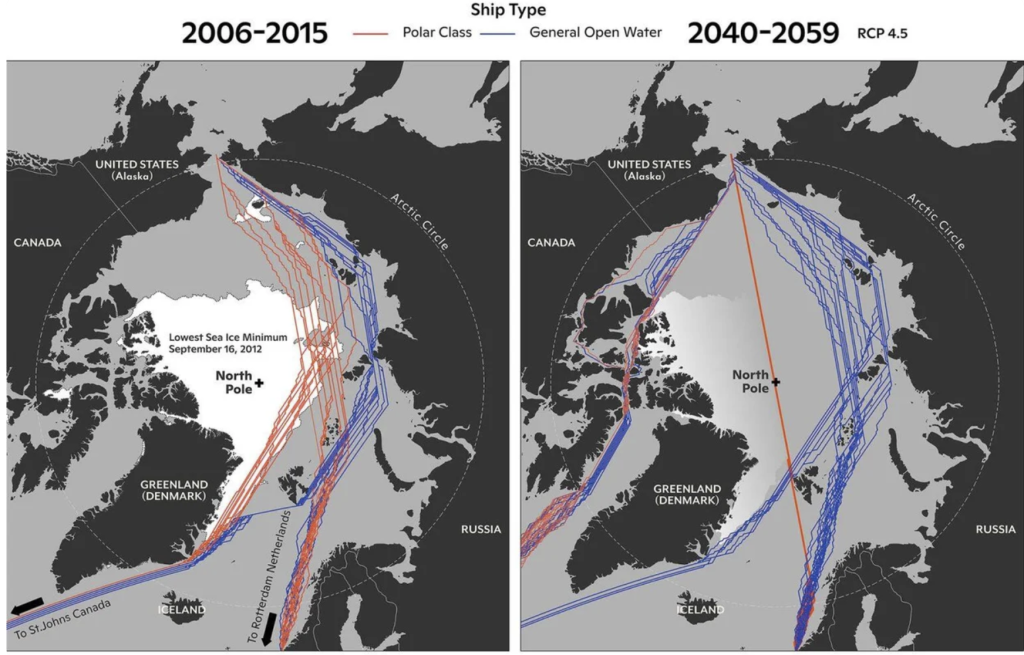
Shipping Lanes. As Arctic shipping lanes unfortunately becoming more viable due to climate change, Trump says the US must take Greenland to prevent China and Russia from dominating Arctic. Okay, but outside Greenland’s capital Nuuk, there is barely any road infrastructure in Greenland and only a few large enough to accommodate tankers and container ships. So is it to have a military presence near these thawing lanes?
The US already has a defence agreement with Denmark that allows for American military bases in Greenland. Peter Harmsen, author of Greenland at War: The United States, Germany and the Struggle for the Arctic, 1939-45, told Newsweek that the U.S. has “broad authority” to build and operate military facilities on the island, due to the 1951 treaty, noting, “For Trump, it offers a legal route to expand America’s footprint without attempting to buy the island or seize it outright.”
Yet the administration line is that they prefer to “own” it:
UN Ambassador Mike Waltz on Greenland: “Denmark just doesn’t have the resources or capacity to do what needs to be done in the northern region. And to the Democrats who say ‘they’re giving you full access,’ everybody knows if you’re renting a place you treat it differently than… pic.twitter.com/xVOPMOpykb
— Aaron Rupar (@atrupar) January 17, 2026
Resources. Greenland possesses at least 25 of the 34 raw materials considered critical by the EU. Some have noted how KoBold Metals, which is funded by the likes of Bill Gates, Jeff Bezos, and Marc Andreessen and uses AI to locate minerals, has interest in Greenland. But it has interest in everywhere, and KoBold, as well as all US companies, already have the opportunity to exploit most of these resources in Greenland. From Lukas Slothuus is a Postdoctoral Research Fellow in the School of Global Studies at the University of Sussex:
Foreign companies have tried to set up viable mining industries in Greenland for decades, with little to show for it. Indeed, contrary to US President Donald Trump’s assertions, American corporations have long had the opportunity to enter Greenland’s mining sector. The capital intensity twinned with extremely harsh climactic conditions mean that, so far, no firm has begun commercial mining activities.
On the oil front, back in 2021 Greenland’s government banned fossil fuel exploration and extraction, but even if that were rescinded it’s unlikely it would change much. More from Slothuus:
With volatile oil and gas prices and the same climactic and infrastructural challenges as for other natural resources, fossil fuel production in Greenland is implausible even in the event of a full US takeover.
Golden Dome. On Wednesday, Trump said US possession of Greenland is necessary for his trillion-dollar missile defense shield boondoggle. But it’s not.
The interceptors are supposed to be based in space, not on land. Even if they do end up on the ground they could be stationed in the US or Canada rather than Greenland. If the administration is determined to put them there, it could simply ask. The US does already have a space base at Pituffik, its northernmost installation.
Domestic politics. Picking a fight with the Europeans might fire up a part of the base, but for what it’s worth a CNN poll released Thursday found just 25 percent of Americans in favor of the attempts to take control Greenland with 50 percent of Republicans and Republican-leaning independents in support of it and 50 percent opposed.
Other. Perhaps it is what some argue is part of a vast intelligence psyop intended to make NATO appear at odds on the surface while the alliance’s nations continue to pursue the goal of ‘Western’ hegemony. That’s probably not as crazy as it sounds considering the way intelligence agencies are taking such a prominent role in everything from international diplomacy to domestic politics and the US and its allies are increasingly fond of deception.
There are other arguments floating around like this is solely down to Trump’s ego and increasing detachment from reality, but personally I prefer to stay away from the personal and lean towards the systemic. The likelihood this scheme would be progressing without backing from some powerful quarters is small. The question really is which group(s) of oligarchs are driving the quest for Greenland?
It does not appear to be the fossil fuel industry nor the military-industrial complex, which can already get what it wants there.
If we look at the people spearheading the push, it is filled with apparatchiks from Silicon Valley that has long been interested in Greenland and is now driving administration policy. On the surface it has to do with the tech elite’s obsession with so-called “freedom cities”—areas they can be free from any government control or societal obligations.
New Scientist reported last week that Praxis—a freedom city company— has raised hundreds of millions in seed funding and that its co‑founder, Dryden Brown, went to Greenland in 2023 in an attempt to negotiate a purchase of the territory.
Plans for these freedom cities within the continental US but free of government control have accelerated in recent years, and there’s a hope among the tech crowd that Trump will announce the creation of some come this July 4. Others are being tried outside the US in places like Honduras and in Africa, although they’ve unsurprisingly mostly fallen apart. But it will work in Greenland, they promise! They’re modeled somewhat after the United Arab Emirates, and the idea is that a tech billionaire will get to be a tech-bro king of any number of these freedom fiefdoms.
Techno monarchists like Peter Thiel, Sam Altman, and others have voiced support in the past for freedom cities on Greenland. And Thiel, Altman, and and even the Winklevoss twins are financial backers of Praxis.
Praxis
Vice President (and Thiel protege), JD Vance, is the administration’s point man on Greenland. Ken Howery, the US ambassador to Denmark, hails from PayPal Mafia. He was the CFO who helped bring it together and sell it to eBay. Following that windfall he co-founded the VC firm Founders Fund with Thiel and others, and he’s close to Elon Musk.
But still, why Greenland?
Did all these tech bros get together for a movie night and watch a 2020 apocalyptic survival disaster thriller that happens to be titled “Greenland”? (We do know they’re big fans of apocalypse bunkers.)
If we go back to an April piece from Reuters that noted that the push for Greenland freedom cities had begun, it helps shed a little light on the why. Anonymous sources told Reuters the following:
The vision for Greenland, one of the people said, could include a hub for artificial intelligence, autonomous vehicles, space launches, micro nuclear reactors and high-speed rail.
High speed rail, eh? If you just spit out your coffee, you’re not alone. The data centers angle, however, is one that makes some sense. From Expert Minds:
According to the U.S. Department of Energy, data centers could consume up to 12% of the country’s electricity by 2028. This trend has prompted IT giants to seek locations that combine abundant renewable energy with cooler climates to minimize cooling costs—Greenland ticks all the boxes.
Currently, 70% of Greenland’s energy comes from hydropower, a clean and sustainable source that aligns perfectly with the energy needs of large-scale data centers. Its Arctic climate further reduces the energy required to cool servers, making Greenland an ideal location for housing energy-intensive IT operations.
“Greenland has drawn significant interest from global companies, especially for its hydropower potential. Our cold climate and renewable energy resources make us a perfect candidate for hosting data centers,” said Greenland’s Minister of Energy, Kalistat Lund.
Well, almost. The recommended temperature range for data centers is 18 C to 27 C, according to the American Society of Heating, Refrigerating and Air-Conditioning Engineers, so Greenland might be a little on the cold side—for now.
A report published in December by the Lawrence Berkeley National Laboratory, which is funded by the Department of Energy, provides more detail on the need for American AI companies to secure more energy to power their growing ambitions. From MIT Technology Review:
The Lawrence Berkeley researchers offered a blunt critique of where things stand, saying that the information disclosed by tech companies, data center operators, utility companies, and hardware manufacturers is simply not enough to make reasonable projections about the unprecedented energy demands of this future or estimate the emissions it will create.
By 2028, the researchers estimate, the power going to AI-specific purposes will rise to between 165 and 326 terawatt-hours per year. That’s more than all electricity currently used by US data centers for all purposes; it’s enough to power 22% of US households each year.
“It’s not clear to us that the benefits of these data centers outweigh these costs,” says Eliza Martin, a legal fellow at the Environmental and Energy Law Program at Harvard and a coauthor of the research.
You think?
The report also mentions how AI companies are seeking more energy via any source they can find with a “scattershot approach” —which sounds a lot like the Trump administration’s kneejerk belligerence.
We mentioned Vance and Howery above and their connections to the techno monarchists, but also representative of the underlying goals at play is Louisiana Governor Jeff Landry, Trump’s envoy to Greenland. He also heads the Governors Coalition for Energy Security, which recently announced a set of policy recommendations to “address America’s energy challenges” and “remove obstacles” to building energy infrastructure.
“With electricity demand projected to grow 25% by 2030, driven largely by AI data centers and advanced manufacturing, we need decisive action to ensure reliable, affordable energy for our states and provinces, our people and our businesses,” Landry says.
Still, it’s unclear why exactly the US would need to annex Greenland in order to establish data centers there or potentially unveil a freedom city or two. It’s entirely possible that the current pressure campaign is intended to obtain these goals on favorable terms to the techno monarchists without “taking” the island.
According to a report by the US House of Representatives’ foreign affairs committee, Chinese investment in Greenland’s hydrocarbon and minerals sectors makes up nearly 12% of the territory’s GDP. That is likely in Trump’s sights.
It should be noted that after the last Greenland hullabaloo in the Spring Denmark overwhelmingly passed an agreement to let the US military enter the country whenever it wants. Added in the eleventh hour to that agreement was the planned construction of a new $500 million subsea cable to boost capacity alongside the two current cables.
Perhaps similar concessions are coming this time around. And if they aid Silicon Valley’s quest for energy and markets for its AI buildout, it would fit the common thread running through the Trump administration’s foreign policy. As Reuters noted back in April in its Greenland freedom city piece:
The administration’s consideration of such a quixotic quest underscores the growing clout of tech magnates and Trump’s increasingly expansionist foreign policy.
We recently wrote about the vision stretching from the Middle East to India and Europe:
According to Navin Girishankar, president of the Economic Security and Technology Department at the Center for Strategic and International Studies (CSIS), it has to do with a vision for dollar/stablecoin supremacy….
Access to American compute power will enable both Gulf countries to export AI-enabled goods and services in sectors such as autonomous logistics, precision agriculture, medical diagnostics, and finance.
The Trump administration aims to ensure that “American AI technology continues to be the gold standard worldwide,” according to Vice President JD Vance. But these agreements miss an essential ingredient of American power: a guarantee that AI-enabled exports generated using American chips will be invoiced and settled in dollars.
…the United States should condition access to leading-edge chips on binding commitments to settle AI-enabled exports in dollars…the United States should use dollar-backed stablecoins as the settlement mechanism.
And the vision for a future dollar is accompanied by Silicon Valley enthusiasm for the philosophy of political economy present in the Gulf.
As the UAE takes the crown of crypto capital, it’s become something of a model for how American oligarchs would like to see the US rearranged: regulation-free, virtually unlimited sovereign capital, low tax, and governed by a techno monarchy.
Think more dismantled nations, plundered for human and natural resources, and then reconstructing profitable segments of them under the oversight of financial, real estate, energy, and tech barons. Think about what the post-genocide vision of Gaza looks like:
Praxis’ sister city? A CGI image from ‘Gaza 2035’—a post-genocide vision for the Strip unveiled by Israel PM Netanyahu’s office in May 2024.
South of the border, a similar strategy is being spearheaded by Secretary of State Marco Rubio as Washington is eyeing Latin America’s energy, mineral, and water resources to power AI infrastructure and create tech fiefdoms.
At its heart, these schemes reflect the breakdown of the post-Cold War era fusion of militarism and financial governance. The American citizen has largely been bled dry, economic inequality is off the charts, there are legitimacy crises, and geopolitical backlash. Unable to break up or exercise financial control over peers like Russia and China, the US is trying to pillage as much of other parts of the world as it can.
Despite some wanting to believe the talk of conquering Greenland is just the rantings of a mad wannabe king, it is in reality a natural outgrowth of American late stage capitalism and the dozens of mad wannabe kings who organized a political economy around a massive AI bubble that needs to be continually inflated:
What could possibly go wrong?
👉AI related investment drove all of US GDP growth in the first half of 2025: 📊👇🎩 @FT
👉 consumption of 10% richest Americans drove most of the consumption growth in 2025.
👉The same Americans own most of the high tech stock.
🧐And if the AI boom… pic.twitter.com/xpnUQqgRar
— Richard Baldwin (@BaldwinRE) January 5, 2026
And so what we potentially have in Greenland—and elsewhere—is tech capital trying to control the levers of US state power in order to create their own little emirates. The great irony is that they are using the state to enrich and empower themselves while simultaneously weakening and destroying the US and enraging the rest of the world.
So maybe their desire for Greenland does make perfect sense. At the rate they’re going, they’re going to need those Greenland bunkers sooner rather than later.
