


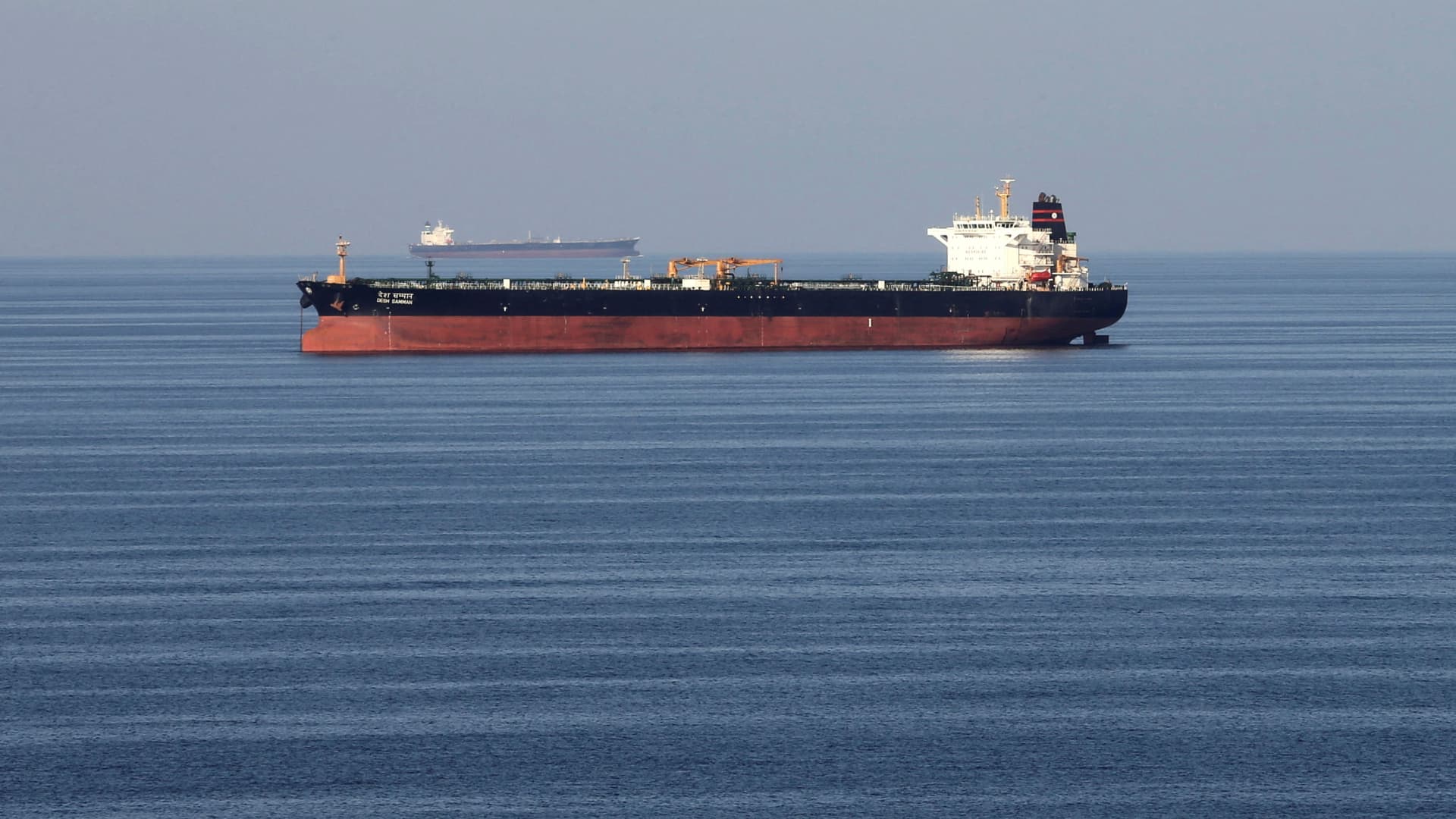
With tensions rising in the Middle East, Goldman Sachs analysts said a sustained rise in oil prices is likely to benefit China’s two oil giants. Due to the Iran war, shipping through the Strait of Hormuz has been virtually halted for the past week. Typically, about 20% of the world’s liquid oil flows through the strait, primarily crude oil, to Asian countries. Constraints and supply uncertainty caused Brent crude oil futures to surge 28% last week, the biggest weekly gain since April 2020. U.S. crude oil posted its biggest weekly gain in futures contracts since 1983. Brent crude oil, which settled at $92.69 a barrel on Friday, could rise to $100 a barrel if the volume of oil passing through the Strait of Hormuz falls 50% in a month and continues to fall by 10%. Energy analysts at Goldman Sachs Asia-Pacific said in a March 2 report that it could take another 11 months. But analysts said that even with Brent crude at $80 to $90 a barrel, full-year free cash flow for two Hong Kong-listed companies, China National Offshore Oil Corporation (CNOOC) and PetroChina, could rise by more than 10%. Goldman rates both stocks as “buys.” As of noon on March 2, the company estimated the average price for Brent at $70 per barrel. Both CNOOC and PetroChina shares hit 52-week highs on March 3, but gave up some gains heading into the weekend. While CNOOC has its roots in offshore oil exploration and production with foreign companies, PetroChina has had domestic operations that also include refining and distribution. Both companies are two of China’s three major state-owned oil companies. Analysts at Goldman Sachs said they had a less favorable view of Sinopec, the third state-owned oil company. The company is the world’s largest refiner and last year also became the largest chemical producer. The stock also hit a 52-week high on March 3. “For Chinese refiners like Sinopec, given that the domestic product cap calculation mechanism does not take into account international freight rates or increases in international freight rates; [official selling prices]”We see the net impact as skewed to the negative,” Goldman analysts said. China is the world’s largest oil importer, but while the country seeks to diversify into renewable energy, it relies heavily on domestic coal production for all its energy needs.In the wake of the Iran war, China has reportedly ordered its largest state-run oil refiner to stop exporting diesel and gasoline, amid concerns that the ongoing conflict could hinder easy access to energy. The Strait of Hormuz accounts for 0.6% of China’s overall energy demand, and although the Treasury has restricted purchases of CNOOC shares starting in 2021, the overall valuation of Asia’s upstream stocks is not the same, said Ting Lu, Nomura’s chief China economist. CNOOC, India’s ONGC and Thailand’s PTTEP “remain relatively cheap” [developed market] “Peers are performing well even after the recent rally,” Goldman analysts said, referring to the performance of rivals such as ConocoPhillips, BP, Chevron and ExxonMobil.
